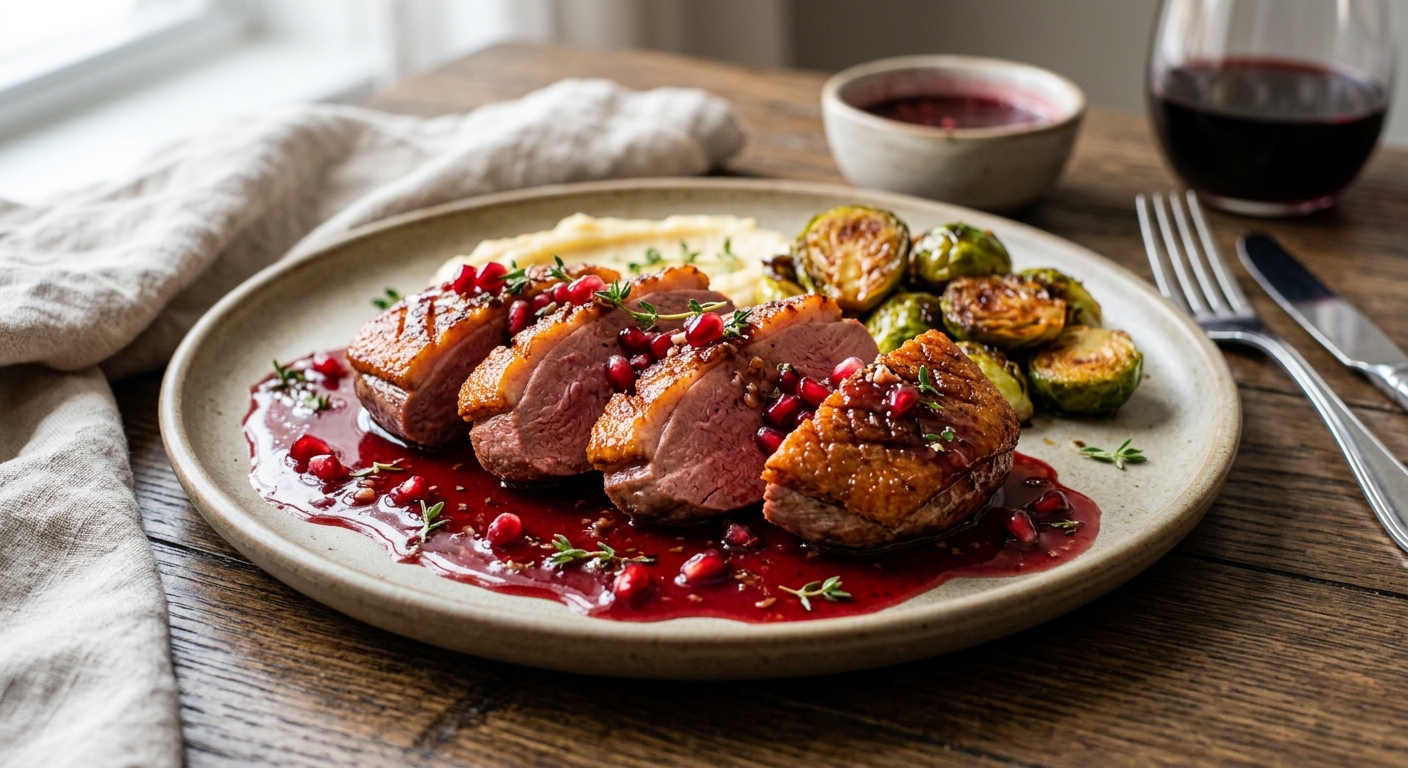
Duck breast occupies a rare and underappreciated position in the world of healthy cooking: it delivers the deep, mineral-rich flavour profile of red meat while remaining firmly in the poultry category. The secret lies in its myoglobin content, the same oxygen-carrying protein that gives beef its characteristic colour and iron density. A single 200g duck breast provides more bioavailable heme iron than a comparable portion of chicken thigh, making it a genuine nutritional powerhouse for anyone monitoring their iron intake.
The pomegranate glaze here is more than a flavour decision. Pomegranate juice is exceptionally high in vitamin C, which dramatically enhances non-heme iron absorption in the lentils and wilted greens you might pair alongside it, and its polyphenol content, particularly punicalagins and anthocyanins, has been linked in peer-reviewed research to reduced LDL oxidation and improved arterial flexibility. The tartness also cuts through the rendered duck fat beautifully, bringing acid balance to what could otherwise be a very rich plate.
Technique matters enormously with duck breast. The fat cap must be scored and rendered slowly before any high heat is applied, otherwise the fat remains chewy and the skin never achieves that lacquered, crackle-crisp finish that defines the dish. Whichever cooking method you choose below, that foundational principle shapes every step, and each method has been engineered to honour it while working within the constraints of your available equipment.
4
servings
Ingredients
- 800 gduck breasts (4 x 200g), skin on
- 240 mlpure pomegranate juice, unsweetened
- 80 mlchicken stock, low sodium
- 2 tbsppomegranate molasses
- 1 tbspraw honey
- 2 tspbalsamic vinegar
- 3 clovesgarlic, minced
- 1 tspfresh thyme leaves
- 0.5 tspground cinnamon
- 0.25 tspground allspice
- 80 gfresh pomegranate arils, for serving
- 1 tbspextra-virgin olive oil
- —Colima Sea SaltMicroplastic Free Salt and cracked black pepper to taste
- —Fresh flat-leaf parsley or microgreens, to garnish
Instructions
Click on an item below to shop for the recommended items for this recipe on Amazon.
As an Amazon Associate, we earn from qualifying purchases.
- Remove duck breasts from the refrigerator 30 minutes before cooking to bring them to room temperature, which ensures even cooking through the thickest part. Pat the skin completely dry with paper towels. Using a sharp knife, score the fat cap in a crosshatch pattern at 1cm intervals, cutting through the fat but stopping just short of the flesh. Season generously on both sides with fine sea salt and cracked black pepper.
- Place the duck breasts skin-side down in a cold, dry cast-iron skillet. Do not preheat the pan. Turn the heat to medium-low and allow the fat to render slowly for 12 to 14 minutes. You will see a significant volume of fat pool in the pan. Periodically tilt the pan and spoon off excess rendered fat into a heatproof bowl, which helps maintain steady browning. The skin should turn deep golden and feel rigid when pressed. Do not move the duck during this phase.
- Once the skin is deeply golden and crisp, increase the heat to medium-high. Flip the duck breasts and sear the flesh side for 3 to 4 minutes for medium (internal temperature of 57 to 60 degrees C). Transfer to a cutting board and tent loosely with foil. Rest for 8 minutes. Do not skip the rest; the juices need time to redistribute.
- Pour off all but 1 teaspoon of the rendered duck fat from the pan (reserve the rest for roasting vegetables). Over medium heat, add the minced garlic and thyme and cook for 45 seconds until fragrant. Deglaze with the pomegranate juice, scraping up all the browned bits from the pan base. Add the chicken stock, pomegranate molasses, honey, balsamic vinegar, cinnamon, and allspice. Bring to a vigorous simmer and reduce for 6 to 8 minutes, stirring occasionally, until the glaze coats the back of a spoon and has reduced by roughly half. Taste and adjust seasoning.
- Slice each rested duck breast on the diagonal into 5 or 6 medallions. Arrange on warm plates, spoon the pomegranate glaze generously over the top, and finish with a scatter of fresh pomegranate arils and flat-leaf parsley. Serve immediately.
- Preheat your oven to 200 degrees C (fan 180 degrees C / 400 degrees F). Remove duck breasts from the refrigerator 30 minutes ahead. Pat skin completely dry, score the fat cap in a crosshatch pattern at 1cm intervals without cutting into the flesh, and season all surfaces with salt and pepper.
- Place the duck breasts skin-side down in an oven-safe cast-iron skillet or heavy ovenproof frying pan over medium-low heat. Render the fat cap for 10 to 12 minutes without moving the duck, spooning off excess fat as it accumulates. The goal here is a deeply golden, rigid skin. Increase the heat to medium-high briefly and sear the flesh side for just 90 seconds to build a crust.
- Flip the breasts back skin-side up and transfer the entire skillet into the preheated oven. Roast for 8 to 10 minutes until the internal temperature reads 57 to 60 degrees C for medium. The circulating oven heat will continue crisping the skin while cooking the flesh gently and evenly from all sides. Remove the skillet from the oven, transfer the duck to a cutting board, and rest loosely tented under foil for 8 minutes.
- While the duck rests, return the skillet to the stovetop over medium heat. Carefully drain off all but 1 teaspoon of the fat. Add garlic and thyme, cook for 45 seconds, then pour in the pomegranate juice and chicken stock, scraping up any caramelised bits. Add the pomegranate molasses, honey, balsamic vinegar, cinnamon, and allspice. Simmer briskly for 6 to 8 minutes until the glaze is syrupy and reduced by half. Season to taste.
- Slice the rested duck breasts diagonally into medallions. Arrange on warmed plates, nap generously with the pomegranate glaze, scatter fresh pomegranate arils over the top, and garnish with parsley or microgreens. The combination of the oven-finished skin and the pan glaze produces an especially polished result.
- Score and season the duck breasts as described, then pat the skin completely dry. Heat the olive oil in a skillet over medium-high heat and sear the skin-side of each breast for 3 to 4 minutes until golden brown. You are not rendering fully here, only building colour and flavour. Sear the flesh side for 1 minute. This step is essential because slow cooking alone will not develop the Maillard reaction flavours that define this dish.
- In the slow cooker insert, whisk together the pomegranate juice, chicken stock, pomegranate molasses, honey, balsamic vinegar, minced garlic, thyme, cinnamon, and allspice. Place the seared duck breasts skin-side up in a single layer in the braising liquid. The liquid should come about halfway up the sides of the breasts; do not submerge the skin.
- Cover and cook on Low for 3 to 4 hours. Duck breast is lean compared to duck legs, so resist the urge to cook it on High or push beyond 4 hours, which risks a dry, stringy texture. The meat is done when it reads 75 to 80 degrees C internally and offers very little resistance to a skewer. This lower temperature target (versus stovetop medium) reflects the braised, fully-cooked style of this method.
- Remove the duck breasts carefully and place them skin-side up on a foil-lined baking sheet. Transfer the braising liquid from the slow cooker insert into a small saucepan and bring to a vigorous boil over high heat. Reduce for 10 to 12 minutes, stirring frequently, until syrupy and glaze-like. This stovetop reduction step is essential because the slow cooker cannot achieve the evaporation needed.
- Set your oven broiler to high and broil the duck breasts 10cm from the element for 2 to 3 minutes until the skin blisters and crisps. Watch closely. Slice or pull the duck, spoon over the reduced pomegranate glaze, scatter pomegranate arils on top, and garnish with parsley. Serve immediately.
- Score the duck breast fat caps and season all sides with salt and pepper. Select the Saute function on your Instant Pot (or use the stovetop insert of a conventional pressure cooker over medium-high heat). Once hot, place the duck breasts skin-side down and sear for 4 to 5 minutes without moving them until the skin is golden and has released significant fat. Flip and sear the flesh side for 1 minute. Remove the duck and set aside. Drain all but 1 teaspoon of rendered fat.
- With the Saute function still active, add the minced garlic and thyme to the pot and cook for 30 seconds. Pour in the pomegranate juice and chicken stock to deglaze, scraping the bottom of the insert thoroughly with a wooden spoon to lift any browned bits. Any residue left on the bottom risks triggering a burn warning. Stir in the pomegranate molasses, honey, balsamic vinegar, cinnamon, and allspice.
- Return the duck breasts to the pot, skin-side up, in a single layer. Cancel the Saute function. Secure the lid and set the steam release valve to Sealing. Pressure cook on High for 8 minutes. The duck will cook quickly under pressure; this timing targets a fully cooked, juicy interior rather than the medium doneness achievable on the stovetop.
- When the cook cycle ends, perform a quick pressure release immediately by carefully switching the valve to Venting. Do not use a natural release, which would overcook the breast meat. Remove the duck breasts to a foil-lined baking sheet. Select Saute again and bring the cooking liquid to a boil. Reduce for 6 to 8 minutes, stirring frequently, until the glaze thickens enough to coat a spoon.
- Place the duck skin-side up under a preheated high broiler for 2 to 3 minutes to restore crispness to the skin. Slice the duck into thick medallions or serve whole, spoon the glaze over generously, scatter pomegranate arils on top, and finish with fresh parsley. The pressure-cooker version delivers the most succulent interior texture of all four methods.
Nutrition Breakdown
Per 1 serving (makes 4)
Vitamins & Minerals
% Daily Value based on a 2,000 calorie diet (FDA reference)
🧬 Essential Amino Acids
% of recommended daily intake (RDA) per serving
🛡 Antioxidant Profile
The Nutrition Science
Duck breast derives its iron richness from myoglobin, the heme protein responsible for storing and transporting oxygen within muscle tissue. Because waterfowl like ducks use their breast muscles continuously during sustained flight, these muscles contain significantly higher myoglobin concentrations than the breast meat of domesticated chickens or turkeys. This translates directly into higher heme iron content, which the human body absorbs at rates of 15 to 35 percent, compared to just 2 to 20 percent for non-heme iron from plant sources. The practical upshot is that a 200g duck breast contributes iron to your stores far more efficiently than an equivalent weight of spinach or fortified cereal.
Pomegranate juice provides a synergistic nutritional benefit beyond its antioxidant profile. Its vitamin C content, predominantly ascorbic acid, actively reduces ferric iron (Fe3+) to the more absorbable ferrous form (Fe2+) in the gut, which can increase non-heme iron uptake from any plant-based foods served alongside by 2 to 4 fold. Simultaneously, pomegranate’s punicalagins, which are hydrolysed in the gut into ellagic acid and urolithins, have demonstrated in clinical trials the ability to lower LDL oxidation by up to 40 percent, making this glaze one of the more scientifically substantiated sauce choices you could apply to a high-protein main course.
The fat composition of rendered duck fat also deserves rehabilitation from its historic reputation. Approximately 36 percent of duck fat is monounsaturated oleic acid, the same fatty acid that underpins the cardiovascular benefits attributed to olive oil and the Mediterranean diet. A further 14 percent is linoleic acid, an essential omega-6 fatty acid. While duck breast fat should still be consumed in moderate portions, its fatty acid profile is notably more favourable than butter or beef tallow, and the act of rendering it away from the skin during cooking reduces the total fat per serving considerably compared to eating the skin unrendered.
Pro Tips
- Always start duck breast in a cold, dry pan for stovetop and oven methods. Adding it to a preheated pan traps fat under the skin and steams it rather than rendering it, producing a soft, rubbery texture instead of a crisp crackle.
- Reserve every tablespoon of rendered duck fat in a sealed jar in the refrigerator. It keeps for up to three months and transforms roasted potatoes, sauteed greens, or scrambled eggs with minimal effort and maximum flavour.
- For the most vibrant pomegranate glaze colour and the highest polyphenol concentration, use cold-pressed, 100 percent pure pomegranate juice with no added sugar or apple juice filler, which is commonly used to dilute commercial blends.


This sounds absolutely delicious and such a smart postpartum recovery meal, honestly. Duck is one of those proteins I always recommend because of that iron density plus the selenium and choline content, which are huge for brain development if you’re nursing. The pomegranate glaze is genius too, since the vitamin C would help with iron absorption. I’ve been experimenting with duck for my own recovery and paired it with sauteed dark leafy greens to really maximize that iron uptake, and it made such a difference in my energy levels around week 6-8 postpartum.
Oh, this is calling to me! I’ve been using pomegranate molasses in my kitchen for years, but I love seeing it highlighted for the iron bioavailability angle. The only thing I’m wondering about now: did you consider adding a pinch of black pepper to the glaze, or perhaps toasting some peppercorns as a garnish? The vitamin C from the pomegranate is already brilliant for iron absorption, but black pepper’s piperine can really amplify that nonheme iron uptake even further, and it brings out the pomegranate’s tartness beautifully in an Ayurvedic sense too. I’m definitely making this soon.
That’s a really sharp observation about the piperine enhancing iron absorption, I hadn’t thought about stacking it that way with the pomegranate’s vitamin C. Duck’s heme iron is already well-absorbed, but I’m realizing the real win here might be the total protein per serving hitting that leucine threshold for muscle protein synthesis, especially if someone’s eating this as part of intentional strength building like I am at my age. The pomegranate glaze plus peppercorn idea sounds like it would pair beautifully without overshadowing the duck itself.