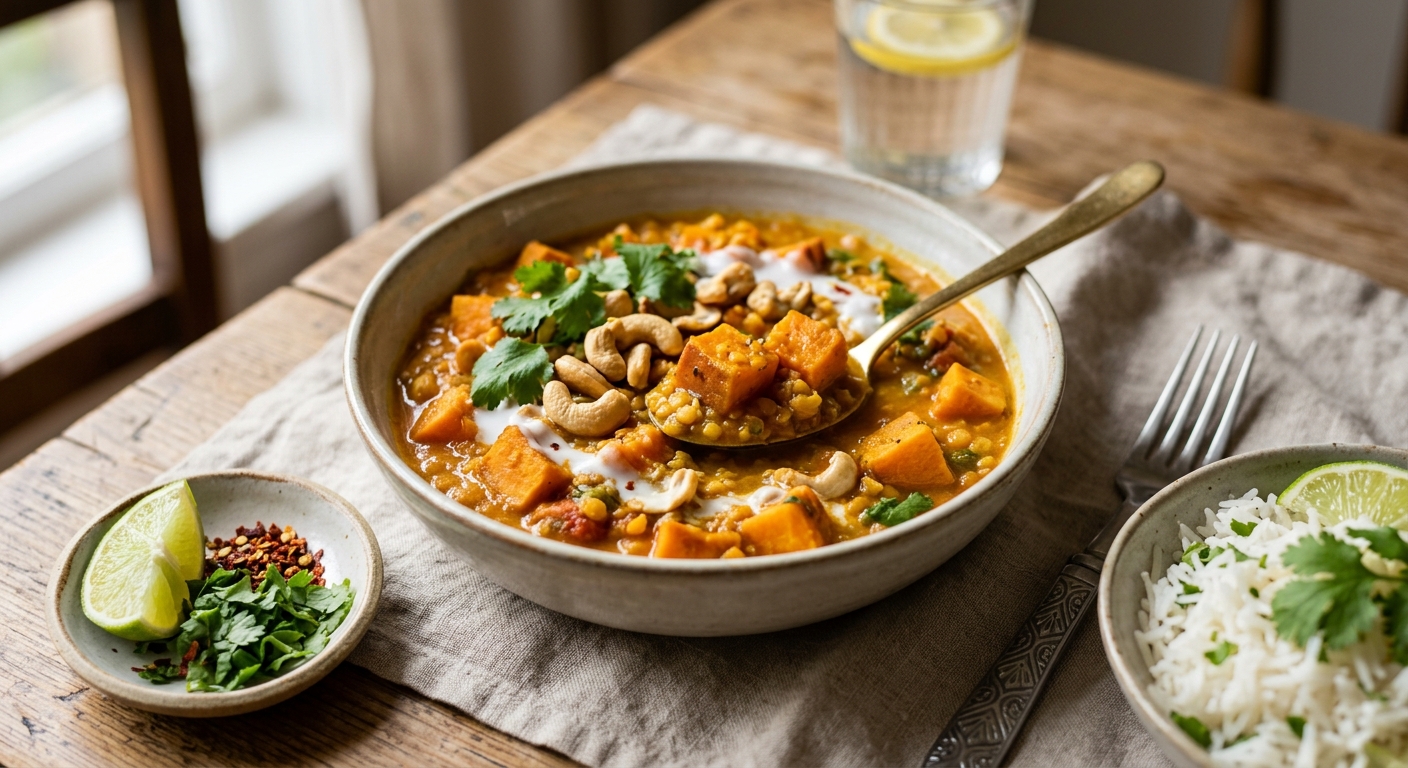
Some dishes earn their place on a weekly rotation through taste alone. This cashew and sweet potato curry earns its place twice over: once for the deeply aromatic, gently spiced broth that perfumes the whole kitchen, and again for a mineral profile so complete it reads like a supplement label. Copper from the cashews, magnesium from both the nuts and the sweet potato, zinc from the lentil base, and a supporting cast of manganese, potassium, and iron make this one of the most nutritionally purposeful curries we have ever developed at Calibrated Cuisine.
The genius of the combination is structural. Sweet potatoes bring natural sweetness and body, breaking down slightly at the edges to thicken the sauce without any added starch. Cashews contribute a buttery richness that mimics dairy in a fully plant-based context, and they happen to be among the most copper-dense whole foods available, with a single 30g serving delivering roughly 70% of your daily copper needs. The red lentils, which dissolve almost invisibly into the base, provide the zinc foundation and a complete amino acid partnership when eaten alongside the nuts. Coconut milk rounds everything into a silky, restaurant-quality sauce that holds the spices in suspension and carries fat-soluble carotenoids from the sweet potato directly to your cells.
We have calibrated this recipe across four cooking methods because the texture story changes meaningfully with each approach. The stovetop gives you the most control and the brightest spice character. The slow cooker produces an almost melting, deeply savory result as the potato fully surrenders to the broth. The pressure cooker delivers weeknight speed without sacrificing depth. And the oven method, our personal favorite for entertaining, creates gorgeous caramelized sweet potato edges before everything is brought together in one braising pan, adding a roasted dimension that no liquid cooking method can replicate.
4
servings
Ingredients
- 400 gsweet potato (about 2 medium), peeled and cut into 2cm cubes
- 150 graw cashews, soaked in cold water 2 hours then drained
- 100 gred lentils, rinsed and drained
- 400 mlfull-fat coconut milk (one 400ml can)
- 400 gcanned crushed tomatoes
- 240 mlvegetable broth, low-sodium
- 1 mediumyellow onion, finely diced
- 4 clovesgarlic, minced
- 1 tbspfresh ginger, finely grated
- 2 tbsptomato paste
- 2 tbspcoconut oil or Avocado Oil100% Pure Avocado Oil
- 2 tspground cumin
- 2 tspground coriander
- 1.5 tspground turmeric
- 1 tspgaram masala
- 0.5 tspsmoked paprika
- 0.25 tspcayenne pepper (or to taste)
- 1 tspColima Sea SaltMicroplastic Free Salt, plus more to taste
- 30 gfresh baby spinach, loosely packed
- 1 tbspfresh lime juice
- 15 gfresh cilantro, roughly chopped, for serving
- 30 gtoasted cashew halves, for garnish
- —Cooked basmati rice or naan, for serving
Instructions
Click on an item below to shop for the recommended items for this recipe on Amazon.
As an Amazon Associate, we earn from qualifying purchases.
- Set a large, heavy-bottomed pot or Dutch oven over medium heat. Add the coconut oil and let it melt until it shimmers. Add the diced onion with a pinch of salt and cook, stirring occasionally, for 7 to 8 minutes until the onion is soft, translucent, and just beginning to turn golden at the edges.
- Push the onion to one side of the pot and add the garlic, ginger, tomato paste, cumin, coriander, turmeric, smoked paprika, and cayenne directly to the cleared space. Stir constantly for 90 seconds until the paste is deeply fragrant and has darkened slightly. This step, called blooming, activates the fat-soluble compounds in the spices and is the foundation of the curry’s depth. Now stir everything together to coat the onion in the spice paste.
- Add the sweet potato cubes and toss to coat in the spice mixture for 1 to 2 minutes. Pour in the crushed tomatoes and vegetable broth, scraping up any browned bits from the bottom of the pot. Stir in the rinsed red lentils and 1 teaspoon of salt. Bring to a boil over medium-high heat, then reduce to a steady simmer.
- Cover the pot and simmer for 15 minutes, stirring every 5 minutes. The lentils will dissolve and begin to thicken the broth. Remove the lid and check the sweet potato by piercing a cube with a paring knife; it should be just barely tender with a slight resistance still in the center.
- Pour in the coconut milk and add the soaked, drained cashews. Stir well and return to a gentle simmer (do not boil vigorously after adding coconut milk, as this can cause it to split). Cook uncovered for 10 to 12 more minutes, stirring occasionally, until the sweet potato is fully tender and the sauce has thickened to a creamy, coating consistency.
- Remove from heat and stir in the baby spinach and lime juice. The spinach will wilt from residual heat in about 1 minute. Taste and adjust salt and cayenne. Serve over basmati rice, garnished with fresh cilantro and toasted cashew halves.
- If you have 10 minutes in the morning, heat a skillet over medium-high heat with the coconut oil and briefly sauté the onion for 4 to 5 minutes until softened, then add garlic, ginger, tomato paste, and all the dried spices. Cook for 60 seconds until fragrant and scrape directly into the slow cooker insert. If you are skipping the sauté, simply add the raw onion, garlic, ginger, tomato paste, all spices, and oil directly to the insert and stir well to combine; the curry will be slightly milder but still very good.
- Add the sweet potato cubes, rinsed red lentils, crushed tomatoes, vegetable broth, and salt to the slow cooker. Stir everything together until the spice mixture is evenly distributed. The liquid should just barely cover the sweet potato and lentils; do not add extra liquid, as the slow cooker generates significant condensation and the lentils will release starch as they cook.
- Place the lid on the slow cooker. Cook on Low for 6.5 to 7 hours or on High for 3 to 3.5 hours. The lentils will completely dissolve into the sauce, the sweet potato will be very tender and some pieces may begin to fall apart at the edges, which is desirable as this contributes to a rich, stew-like body.
- With 30 minutes remaining (switch to High if you were on Low), stir in the coconut milk and the soaked, drained cashews. Replace the lid and continue cooking for the final 30 minutes. This allows the cashews to heat through and soften slightly in the sauce without becoming mushy, while giving the coconut milk enough time to fully incorporate without the risk of curdling from prolonged high heat.
- When the cooking time is complete, remove the lid and stir. If the curry appears too thin, switch to High, leave the lid slightly ajar, and cook for an additional 15 to 20 minutes. Stir in the baby spinach and lime juice, letting the residual heat wilt the spinach over 2 minutes. Taste and adjust seasoning with salt and cayenne. Serve over rice topped with cilantro and toasted cashew halves.
- Set your Instant Pot or electric pressure cooker to Sauté mode on Normal (medium) heat. Add the coconut oil. Once it shimmers, add the diced onion and cook for 5 minutes, stirring occasionally, until softened and translucent. Add the garlic, ginger, tomato paste, cumin, coriander, turmeric, smoked paprika, cayenne, and salt. Stir constantly for 60 to 90 seconds until the spice paste is fragrant and sticking slightly to the bottom of the insert.
- Pour in the vegetable broth immediately and use a wooden spoon or silicone spatula to deglaze the insert, scraping up all the browned spice paste from the bottom. This step is essential with the Instant Pot: any residue left on the bottom can trigger the burn sensor during pressurization. Add the crushed tomatoes, rinsed red lentils, and sweet potato cubes. Stir to combine. Do not add the coconut milk or cashews yet.
- Secure the lid and set the steam release valve to Sealing. Cancel Sauté mode and select Manual (or Pressure Cook) on High Pressure for 10 minutes. The pot will take approximately 8 to 10 minutes to come up to pressure before the countdown begins.
- Once the 10 minutes are complete, allow a natural pressure release for 5 minutes, then carefully switch the valve to Venting to release any remaining steam. Open the lid away from you. Stir the curry; the lentils will have dissolved and the sweet potato should be completely tender. If any pieces are still firm, select Sauté mode and simmer for an additional 3 to 5 minutes.
- Select Sauté mode on Low heat. Stir in the coconut milk and soaked, drained cashews. Simmer gently for 3 to 4 minutes, stirring often, until the coconut milk is fully incorporated and the sauce returns to a gentle heat throughout. Do not bring to a rolling boil. Remove from heat, stir in the baby spinach and lime juice, and let stand 1 minute for the spinach to wilt. Adjust seasoning and serve over rice with cilantro and toasted cashews.
- Preheat your oven to 220C (425F) with a rack in the upper third. Toss the sweet potato cubes on a large rimmed baking sheet with 1 tablespoon of the coconut oil and a pinch of salt. Spread in a single layer, ensuring the cubes have space between them so they roast rather than steam. Roast for 20 to 25 minutes, flipping once halfway through, until the cubes are golden and caramelized on the cut sides with slightly crisped edges. Remove and set aside. Reduce oven temperature to 180C (350F).
- While the sweet potato roasts, place a large oven-safe Dutch oven over medium heat on the stovetop with the remaining tablespoon of coconut oil. Add the diced onion and cook for 6 to 7 minutes until soft and golden. Add the garlic, ginger, tomato paste, cumin, coriander, turmeric, smoked paprika, cayenne, and salt. Stir constantly for 90 seconds to bloom the spices in the oil until deeply fragrant.
- Pour the crushed tomatoes and vegetable broth into the Dutch oven, scraping up any browned bits. Stir in the rinsed red lentils. Bring to a simmer and cook on the stovetop for 5 minutes, stirring occasionally, until the lentils begin to soften and the sauce starts to thicken. This partial pre-cooking ensures the lentils fully dissolve during the oven braise.
- Stir the coconut milk into the Dutch oven along with the soaked, drained cashews. Gently fold in the roasted sweet potato cubes, taking care not to break up the beautifully caramelized pieces. The liquid should come about two-thirds up the solid ingredients. If it looks too thick, add a splash (up to 60ml) of additional broth.
- Cover the Dutch oven with its lid and transfer to the 180C (350F) oven. Braise for 18 to 22 minutes, until the lentils have fully dissolved into the sauce, the cashews are tender, and the roasted sweet potato pieces have absorbed the curry flavors while retaining their caramelized character. Remove from the oven and let stand, covered, for 5 minutes.
- Remove the lid and stir in the baby spinach and lime juice. The spinach will wilt in the residual heat in about 2 minutes. Taste and adjust seasoning with salt and cayenne. Serve directly from the Dutch oven for a dramatic presentation, topped with fresh cilantro and toasted cashew halves.
Nutrition Breakdown
Per 1 serving (makes 4)
Vitamins & Minerals
% Daily Value based on a 2,000 calorie diet (FDA reference)
🧬 Essential Amino Acids
% of recommended daily intake (RDA) per serving
🛡 Antioxidant Profile
The Nutrition Science
The copper story in this curry begins with the cashew. Cashews are, gram for gram, one of the richest dietary sources of copper available in a whole food, with 150g of raw cashews providing well over the 0.9mg adult RDA on their own. Copper is an often-overlooked mineral that functions as a cofactor in at least a dozen critical enzymes, including superoxide dismutase (the body’s primary antioxidant enzyme system), lysyl oxidase (essential for collagen and elastin crosslinking), and ceruloplasmin (the copper-carrying protein that governs iron metabolism). A mild copper deficiency, which is more common than most people realize in populations relying heavily on processed foods, can manifest as fatigue, poor connective tissue integrity, and impaired immune function, all signs easily misattributed to other causes.
Magnesium and zinc work synergistically in this dish and in the body. Sweet potatoes supply approximately 27mg of magnesium per 100g, while cashews deliver around 73mg per 30g serving. Together with the lentil contribution, this recipe approaches 30% of the adult magnesium RDA per serving, important because magnesium is a cofactor for over 300 enzymatic reactions including ATP production, protein synthesis, and muscle and nerve function. Zinc, provided primarily by the cashews and red lentils, is critical for immune signaling, wound healing, and the activity of taste and smell receptors. The mild phytic acid in cashews and lentils can reduce mineral bioavailability, but soaking the cashews and combining them with vitamin C-rich tomatoes and lime juice meaningfully offsets this through both phytate reduction and competitive absorption enhancement.
The fat matrix in this curry is nutritionally intentional, not incidental. Coconut milk and cashews both deliver fats that serve as carriers for the fat-soluble compounds in the dish: the beta-carotene and other carotenoids in sweet potato have near-zero bioavailability without dietary fat present in the same meal. Studies consistently show that pairing carotenoid-rich vegetables with fat increases absorption by three to eight times compared to fat-free preparations. Similarly, curcumin from turmeric is famously poorly absorbed in water-based media but becomes significantly more bioavailable when dissolved in fat. Every tablespoon of coconut milk in this curry is doing double nutritional duty, delivering its own medium-chain fatty acids while unlocking the fat-soluble nutrients from the vegetables and spices around it.
Pro Tips
- Soak your cashews for at least 2 hours (or overnight in the refrigerator). Beyond softening them for better texture, soaking reduces phytic acid content by approximately 20 to 30%, which meaningfully improves the absorption of cashews’ copper, zinc, and magnesium.
- Add a full teaspoon of black pepper when blooming your spices. Piperine, the active compound in black pepper, has been shown in clinical studies to increase curcumin bioavailability from turmeric by up to 2000% by inhibiting its metabolic breakdown in the liver and intestinal wall.
- For the richest sauce, choose full-fat coconut milk and resist shaking the can before opening it. Scoop the thick cream from the top and add it to the pot first, letting it fry briefly with the spices before adding the thinner liquid from below; this technique, borrowed from Thai curry technique, concentrates the coconut flavor and adds a subtle nuttiness.



omg YES the copper thing is so real, fred was just telling me about how cashews hit different for absorption compared to like, random seeds and i got so excited because my oldest refuses most proteins but will actually EAT cashews so this curry might be my secret weapon to sneak in what hes missing!! also sue you’re so right about bioavailability, my nutritionist was basically like “you can eat all the spinach you want but if your gut cant process it whats the point” and it totally changed how i approach meal planning for the fam
This looks right up my alley, especially the copper angle – my last panel showed I was still running low despite two years on my protocol, and my practitioner mentioned cashews as one of the more bioavailable plant sources. Quick question though: are you soaking the cashews before blending them into the base, or cooking them whole in the broth? I’ve found that soaking seems to reduce phytic acid and improve mineral absorption, but I’m curious if you’re seeing different results with the final mineral density when you skip that step. Also wondering about the sourcing of your coconut milk – I’ve noticed some brands have way more inflammatory seed oils mixed in than others, which kind of defeats the purpose of an anti
Oh Fred, I’m so glad you mentioned the bioavailability piece, because that’s exactly what I’ve been teaching my class lately – it’s not just about having minerals in the food, it’s about your body actually being able to use them! I made a version of this curry last week with an extra squeeze of lemon juice at the end, and I’ve read that the vitamin C really helps with copper absorption from plant sources. I’m definitely pulling this recipe for my next class session since so many of my students are exploring plant-forward eating, and I love that the toasted spices here will make it memorable rather than feel like “healthy food” – that’s always been my philosophy from my teaching days.