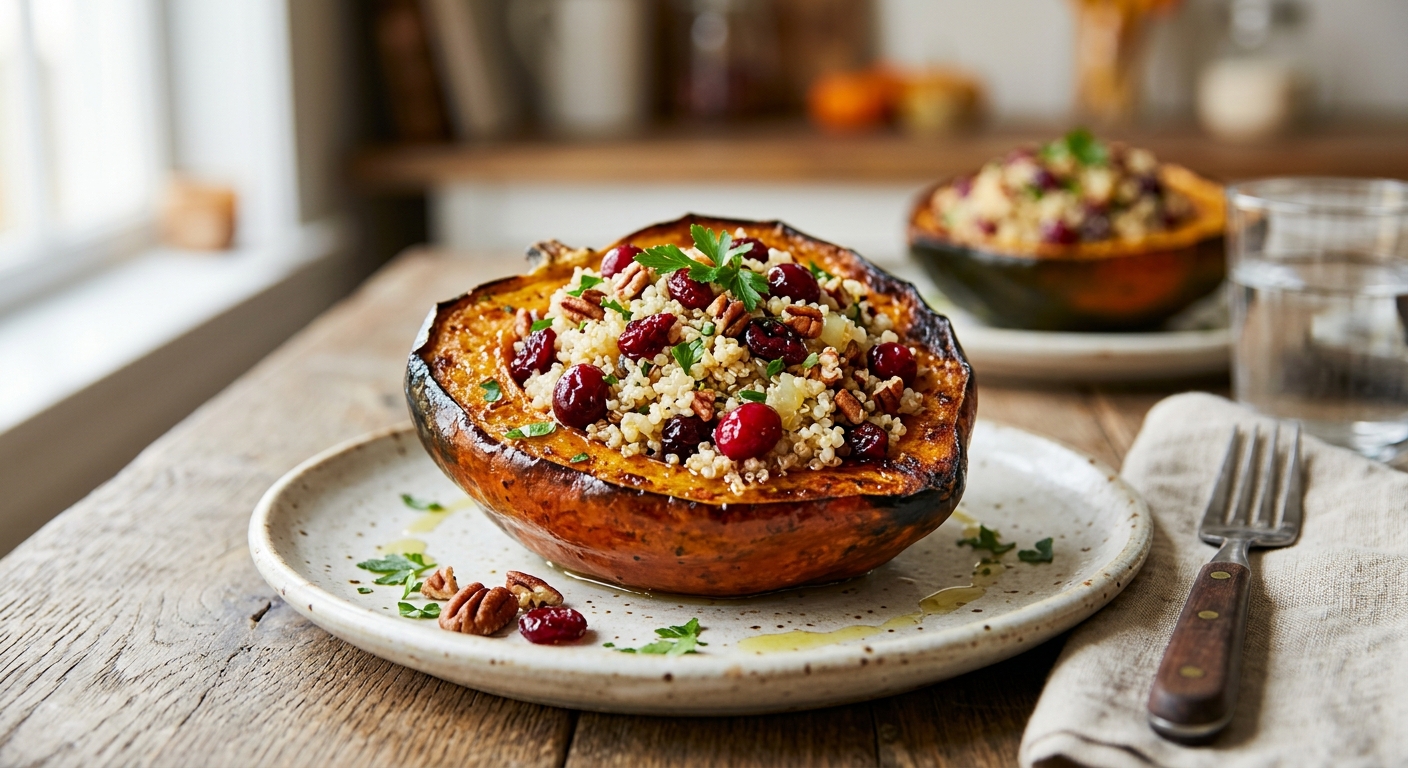
Few vegetables command the table the way a perfectly cooked acorn squash does. Halved and filled to the brim with jewel-toned cranberries, golden quinoa, and fragrant spices, this dish is the definition of edible architecture. But beyond its visual drama lies a nutritional story worth telling: acorn squash is one of the most underrated sources of Vitamin C, potassium, and beta-carotene in the entire produce aisle, and pairing it with quinoa transforms a side dish into a complete, protein-rich main event.
Quinoa is the quiet workhorse of this recipe. As one of the few plant foods classified as a complete protein, it supplies all nine essential amino acids, making this dish genuinely satisfying for both omnivores and plant-based eaters alike. The cranberries contribute far more than color: they deliver a meaningful dose of anthocyanins, proanthocyanidins, and Vitamin C that work synergistically with the squash to support immune function, collagen synthesis, and cardiovascular health. A handful of toasted pecans adds crunch, heart-healthy monounsaturated fats, and a surprising boost of manganese.
At Calibrated Cuisine, we designed this recipe so that a single serving crosses the 50% threshold for Vitamin C, clears 35% of your daily manganese, and contributes meaningfully to folate, potassium, magnesium, and fiber targets. Whether you choose the oven method for caramelized, golden edges, the stovetop for weeknight efficiency, the slow cooker for hands-off ease, or the pressure cooker for a 30-minute miracle, every path leads to the same extraordinary result.
4
servings
Ingredients
- 2 mediumacorn squash (approx. 600g each), halved and seeds scooped out
- 185 gwhite quinoa, rinsed thoroughly under cold water
- 480 mllow-sodium vegetable broth
- 120 gfresh or frozen cranberries
- 60 gdried cranberries, unsweetened or lightly sweetened
- 60 gpecans, roughly chopped and toasted
- 1 mediumyellow onion, finely diced
- 2 clovesgarlic, minced
- 2 stalkscelery, finely diced
- 2 tbspextra-virgin olive oil
- 1 tbsppure maple syrup
- 1 tspground cinnamon
- 0.5 tspground nutmeg
- 0.5 tspsmoked paprika
- 2 tbspfresh flat-leaf parsley, chopped, for garnish
- 1 tbspfresh thyme leaves
- —Colima Sea SaltMicroplastic Free Salt and freshly ground black pepper to taste
Instructions
Click on an item below to shop for the recommended items for this recipe on Amazon.
As an Amazon Associate, we earn from qualifying purchases.
- Prepare the squash: Score the cut faces of each squash half in a crosshatch pattern about 5mm deep. Brush generously with 1 tablespoon of the olive oil and season with salt and pepper.
- Sear the squash: Heat a large, wide skillet or saute pan over medium-high heat. Place the squash halves cut-side down in the dry pan and sear without moving for 4 to 5 minutes, until the cut face is deep golden and slightly caramelized. Flip cut-side up.
- Steam the squash: Pour 120ml of water carefully around the squash (not over it), reduce heat to medium-low, and cover the pan tightly with a lid or foil. Steam for 20 to 25 minutes, checking occasionally and adding a splash more water if the pan goes dry, until the flesh is completely tender when pierced with a skewer. Remove squash from the pan, tent loosely with foil, and set aside.
- Cook the quinoa filling: In the same pan, wipe it dry and heat the remaining 1 tablespoon olive oil over medium heat. Add the onion and celery and cook, stirring frequently, for 5 to 6 minutes until softened and translucent. Add the garlic, cinnamon, nutmeg, smoked paprika, and thyme, and cook for 1 minute until fragrant.
- Add the rinsed quinoa to the pan and stir for 1 minute to lightly toast it in the aromatics. Pour in the vegetable broth and bring to a boil. Add the fresh cranberries, reduce heat to the lowest setting, cover, and simmer for 15 minutes until all liquid is absorbed and the quinoa spirals are visible. Remove from heat and rest, covered, for 5 minutes.
- Finish the filling: Uncover and fluff the quinoa with a fork. Fold in the dried cranberries, toasted pecans, and maple syrup. Taste and adjust seasoning with salt and pepper.
- Stuff and serve: Pack each squash half generously with the warm quinoa filling, mounding it above the rim. Drizzle with a little extra maple syrup if desired, scatter fresh parsley over the top, and serve immediately from the pan.
- Build the filling base: In a medium bowl, combine the rinsed quinoa, vegetable broth, fresh cranberries, dried cranberries, diced onion, celery, garlic, olive oil, maple syrup, cinnamon, nutmeg, smoked paprika, and thyme. Stir well to combine. Season generously with salt and pepper.
- Prepare the squash: Season the interior cavity and cut edges of each squash half with salt, pepper, and a very light brush of olive oil. This builds flavor even without a sear.
- Load the slow cooker: Pour 80ml of water into the bottom of a 6-quart slow cooker. Place the squash halves cut-side up in a single layer, resting them against the sides of the insert if needed for stability. Spoon the raw quinoa mixture evenly into each cavity, filling generously. Any excess filling can be spooned into the liquid at the base of the slow cooker.
- Cook low and slow: Place a double layer of paper towels under the lid to absorb condensation and prevent the filling from becoming waterlogged. Cover and cook on Low for 4 hours, until the squash flesh is completely tender when pierced and the quinoa is fully cooked with all liquid absorbed.
- Add the crunch: Stir the toasted pecans into the filling at the table (adding them during cooking would soften them). Garnish with fresh parsley and serve directly from the slow cooker insert, taking care when lifting the squash as the flesh will be very tender.
- Quick-saute the aromatics: Set the Instant Pot to Saute mode on Medium. Add 1 tablespoon of the olive oil, then the onion and celery. Cook for 3 to 4 minutes, stirring, until softened. Add the garlic, cinnamon, nutmeg, smoked paprika, and thyme, and stir for 30 seconds. Press Cancel.
- Build the pot-in-pot quinoa: Transfer the sauteed aromatics to a 7-inch oven-safe bowl or the inner pot of a smaller pot-in-pot insert. Add the rinsed quinoa, vegetable broth, fresh cranberries, dried cranberries, maple syrup, remaining olive oil, salt, and pepper. Stir to combine.
- Set up the pressure cooker: Pour 240ml of water into the main Instant Pot inner pot. Lower the metal trivet into the pot. Place the seasoned squash halves cut-side up directly on the trivet, arranging them so they are stable. Carefully balance the quinoa bowl on top of or beside the squash halves on the trivet.
- Pressure cook: Secure the Instant Pot lid and set the valve to Sealing. Cook on Manual High Pressure for 12 minutes. When the cycle ends, perform a Quick Release by carefully switching the valve to Venting. Wait for all steam to escape before opening the lid.
- Rest and assemble: Lift out the quinoa bowl first and fluff the quinoa with a fork. Fold in the toasted pecans. Carefully transfer the squash halves to a serving board using tongs. Spoon the quinoa filling generously into each cavity. Garnish with fresh parsley and serve immediately.
- Preheat and prep: Preheat your oven to 200 degrees Celsius (390 degrees Fahrenheit) with a rack in the center position. Line a large rimmed baking sheet with parchment paper or foil.
- Season and roast the squash: Brush the cut faces and interior cavities of each squash half with 1 tablespoon of the olive oil. Season generously with salt and pepper. Place cut-side down on the prepared baking sheet and roast for 25 minutes, until the cut face is deeply golden and beginning to caramelize and the flesh is just tender.
- Prepare the quinoa filling: While the squash roasts, heat the remaining 1 tablespoon olive oil in a medium saucepan over medium heat. Add the onion and celery and cook for 5 minutes until soft. Add the garlic, cinnamon, nutmeg, smoked paprika, and thyme and cook for 1 minute. Add the quinoa, toast for 1 minute, then pour in the vegetable broth and add the fresh cranberries. Bring to a boil, reduce heat to low, cover, and simmer for 15 minutes. Rest off heat, covered, for 5 minutes, then fluff and fold in the dried cranberries, toasted pecans, and maple syrup. Season to taste.
- Stuff and finish roasting: Remove the baking sheet from the oven and carefully flip the squash halves cut-side up. Fill each cavity generously with the warm quinoa mixture, mounding it high. Return to the oven and roast for an additional 15 to 20 minutes, until the squash is completely soft and the exposed tops of the quinoa filling are lightly golden and fragrant.
- Garnish and serve: Transfer the stuffed squash to a serving platter. Drizzle lightly with additional maple syrup if desired, scatter fresh parsley over the top, and finish with a grind of black pepper. Serve while hot, with the squash caramelized edges providing natural sweetness in every bite.
Nutrition Breakdown
Per 1 serving (makes 4)
Vitamins & Minerals
% Daily Value based on a 2,000 calorie diet (FDA reference)
🧬 Essential Amino Acids
% of recommended daily intake (RDA) per serving
🛡 Antioxidant Profile
The Nutrition Science
Acorn squash owes its deep orange flesh to a family of carotenoid pigments, most notably beta-carotene, which the body enzymatically converts to retinol (Vitamin A) in the intestinal wall via the enzyme beta-carotene 15,15-dioxygenase. Cooking the squash with a small amount of fat, as this recipe does with olive oil, dramatically increases carotenoid bioavailability: a landmark study in the American Journal of Clinical Nutrition demonstrated that dietary fat can increase beta-carotene absorption from vegetables by three to eight fold compared to fat-free preparations. The olive oil here is therefore not merely a culinary choice but a scientifically justified delivery mechanism for fat-soluble micronutrients.
Quinoa’s nutritional distinction lies in its amino acid completeness. Unlike most grains, quinoa contains meaningful levels of lysine, an amino acid typically limiting in cereal proteins, as well as methionine and threonine. This makes it one of very few plant-based foods that can independently support muscle protein synthesis without requiring deliberate food combining. Quinoa is also an exceptional source of manganese, a trace mineral that serves as a cofactor for manganese superoxide dismutase (MnSOD), the mitochondrial antioxidant enzyme central to protecting cells from oxidative damage generated during normal aerobic metabolism. A single serving of this dish provides over 80% of the daily manganese requirement.
The cranberries in this recipe contribute a phytochemical profile that has been the subject of intensive clinical research. Their unique A-type proanthocyanidins (PACs) are structurally distinct from the B-type PACs found in most other berries and are the compounds responsible for inhibiting the P-fimbriated E. coli adhesion associated with urinary tract infections. Additionally, the anthocyanins that give cranberries their characteristic deep red color have been shown in meta-analyses to significantly reduce LDL oxidation and improve endothelial function, two key mechanisms in cardiovascular disease prevention. Combined with the anti-inflammatory quercetin from both cranberries and onion, this dish delivers a genuinely multi-pathway antioxidant defense in every bite.
Pro Tips
- To make cutting raw acorn squash safer, microwave the whole squash on high for 2 to 3 minutes first. This slightly softens the skin and dramatically reduces the force needed to halve it with your chef’s knife.
- Toast the pecans in a dry skillet over medium heat for 3 to 4 minutes, shaking constantly, until fragrant and one shade darker. This step is worth the extra pan as it activates volatile aromatic compounds and deepens the flavor far beyond raw pecans.
- If using the oven method for a dinner party, you can roast the squash and prepare the quinoa filling up to 4 hours ahead, then combine and do the final 15-minute roast just before serving for a stress-free presentation.
This is such a great recipe for thyroid support too, since manganese works beautifully with selenium for antioxidant defense and acorn squash is a goitrogen-free winter squash (unlike cruciferous veggies that need careful prep). I’ve found that roasting really brings out the natural sweetness without any concerns, and the quinoa’s complete amino acid profile is perfect for making thyroid hormones. The cranberries are a nice touch for their polyphenols as well, definitely bookmarking this one for my support group!
This is such a thoughtful micronutrient pairing! I love that you’ve highlighted the manganese angle since it’s often overlooked in favor of sexier nutrients, but it’s absolutely crucial for collagen synthesis and antioxidant defense. As a pharmacist, I’ve noticed patients on certain medications like bisphosphonates (osteoporosis drugs) really benefit from understanding food sources of manganese alongside their prescriptions, so recipes like this are genuinely valuable for medication efficacy. The quinoa plus squash combo is also brilliant for that complete amino acid profile you mentioned, which makes this legitimately satiating. Definitely bookmarking this for patients I’m counseling on anti-inflammatory eating patterns
Love how you’re centering manganese here, because it’s genuinely one of those nutrients that gets lost in the noise! I’m also thinking about how quinoa and acorn squash together create this beautiful micronutrient synergy, and I’d love to know if you’ve experimented with swapping in other traditionally overlooked grains like teff or millet, which pack similar complete protein profiles but bring their own mineral density to the plate. There’s something really special about highlighting these ingredients because so many of them come from African and Caribbean food traditions where this kind of nutrient-dense eating has always been the foundation, not a wellness trend.