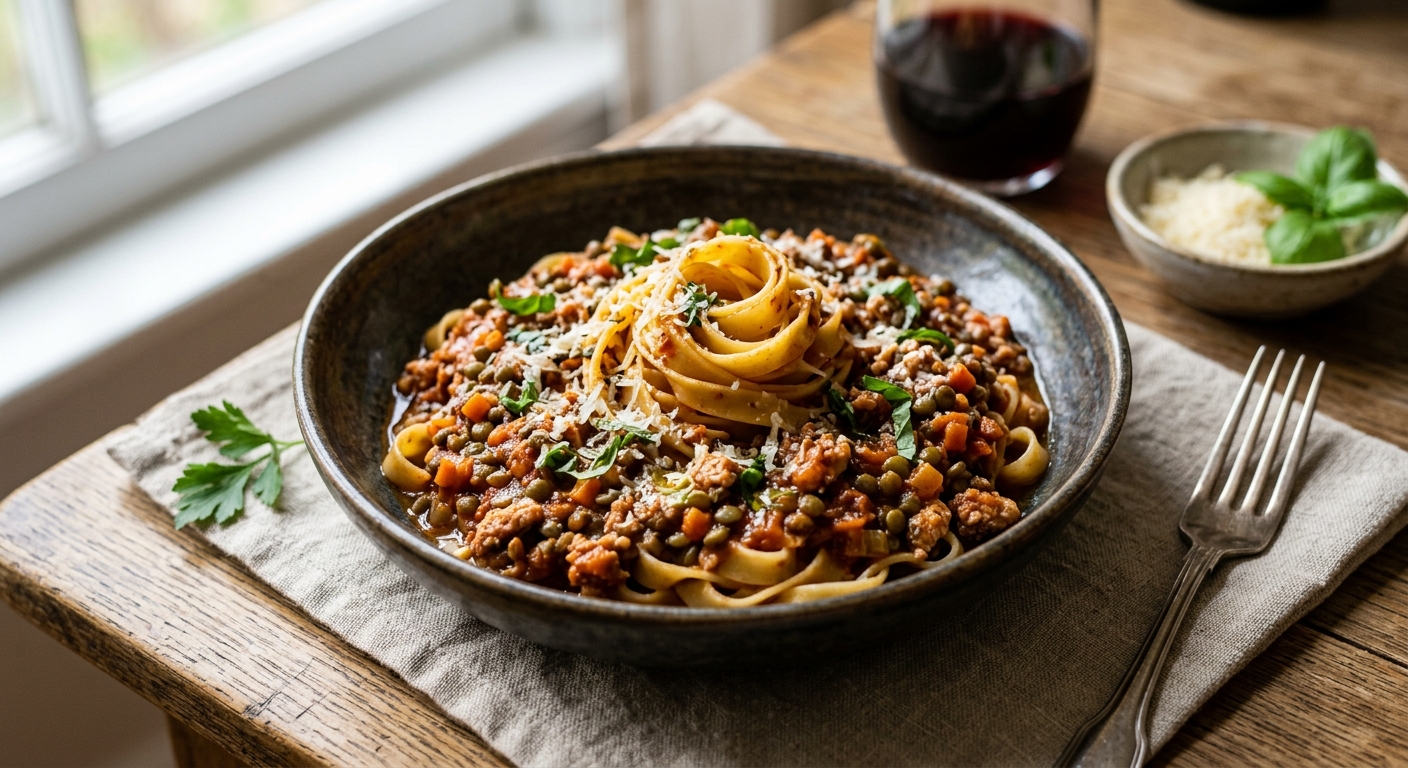
Bolognese is one of the great comfort foods of the world, but traditional recipes lean heavily on fatty ground beef and often leave the nutritional ledger looking lopsided. This version threads a smarter needle: lean ground turkey provides abundant complete protein and keeps saturated fat low, while French green lentils bring a meaty, earthy bite along with fiber, folate, and plant-based iron that beef alone simply cannot match. The result is a sauce so deeply flavored and satisfying that you will never feel like you are eating a lighter alternative.
The lentil is the unsung hero of this recipe. Unlike red lentils, which dissolve into a puree, green or Puy lentils hold their shape through a long braise, mimicking the coarse, rustic texture of a true ragu. As they cook, they absorb the wine, tomato, and soffritto aromatics, becoming tiny flavor sponges layered into every forkful. Combined with turkey’s natural umami, fresh herbs, and a Parmesan rind simmered directly in the sauce, the depth of flavor here punches well above its preparation time.
From a nutritional standpoint, this dish is genuinely exceptional. Each serving clears 38g of protein and delivers over a third of your daily iron needs, nearly half your folate requirement, and a meaningful dose of zinc, B12, selenium, and potassium. The combination of animal and plant protein also produces a highly complete and bioavailable amino acid profile, with leucine, lysine, and isoleucine all exceeding their daily targets per bowl. This is a meal that builds muscle, supports energy metabolism, and fills you up, all in a single deeply satisfying plate.
4
servings
Ingredients
- 500 glean ground turkey (93% lean)
- 200 gFrench green lentils (Puy lentils), rinsed and picked over
- 3 tbspextra-virgin olive oil
- 1 largeyellow onion, finely diced
- 2 mediumcarrots, finely diced
- 2 stalkscelery, finely diced
- 4 clovesgarlic, minced
- 2 tbsptomato paste
- 150 mldry red wine (such as Sangiovese or Cabernet Sauvignon)
- 800 gcrushed tomatoes (two 400g cans)
- 400 mllow-sodium chicken stock
- 1 pieceParmesan rind (about 5cm), optional but strongly recommended
- 2 sprigsfresh rosemary
- 3 sprigsfresh thyme
- 2 leavesdried bay leaves
- 1 tspdried oregano
- 0.5 tspred pepper flakes
- 1 tspWorcestershire sauce
- 400 gdried tagliatelle or pappardelle pasta, for serving
- 40 gParmesan cheese, finely grated, for serving
- 15 gfresh flat-leaf parsley, roughly chopped, for serving
- —Colima Sea SaltMicroplastic Free Salt and freshly ground black pepper to taste
Instructions
Click on an item below to shop for the recommended items for this recipe on Amazon.
As an Amazon Associate, we earn from qualifying purchases.
- Heat 3 tablespoons of olive oil in a large Dutch oven or heavy-bottomed pot over medium heat. Add the diced onion, carrot, and celery with a generous pinch of salt. Cook, stirring occasionally, for 10 to 12 minutes until the vegetables are completely softened and just beginning to turn golden at the edges. Add the minced garlic and cook for 90 seconds more until fragrant.
- Push the soffritto to the sides of the pot and increase heat to medium-high. Add the ground turkey in one even layer into the center. Let it sit undisturbed for 2 to 3 minutes to develop a proper golden sear, then break it apart with a wooden spoon and cook until no pink remains, about 5 minutes total. Season with 1 teaspoon of salt and half a teaspoon of black pepper.
- Clear a small space in the center of the pot and add the tomato paste directly onto the hot surface. Cook the paste, stirring it on the pan base, for 2 minutes until it darkens to a brick-red color and becomes intensely fragrant. This step removes raw bitterness and builds caramelized depth. Stir the paste into the turkey and vegetable mixture.
- Pour in the red wine and scrape up all the browned bits from the bottom of the pot with a wooden spoon. Let the wine reduce by half, about 3 minutes, then add the crushed tomatoes, chicken stock, rinsed lentils, Worcestershire sauce, Parmesan rind, rosemary sprigs, thyme sprigs, bay leaves, dried oregano, and red pepper flakes. Stir everything together and bring to a boil.
- Reduce heat to low, cover the pot with the lid slightly ajar to allow some steam to escape, and simmer gently for 35 to 40 minutes, stirring every 10 minutes. The lentils should be completely tender and the sauce thickened to a rich, coating consistency. If the sauce reduces too quickly, add a splash of stock or water. Remove and discard the Parmesan rind, rosemary sprigs, thyme sprigs, and bay leaves. Taste and adjust seasoning.
- Meanwhile, bring a large pot of heavily salted water to a boil and cook the pasta according to package directions until al dente. Reserve 200ml of starchy pasta water before draining. Toss the drained pasta with the Bolognese, loosening with pasta water as needed to achieve a glossy, clingy sauce. Serve immediately topped with grated Parmesan and fresh parsley.
- Set a large skillet over medium heat and add 2 tablespoons of olive oil. Cook the onion, carrot, and celery with a pinch of salt for 8 to 10 minutes until softened. Add garlic and cook 1 minute. Add the tomato paste and stir it directly into the vegetables over the heat for 90 seconds until darkened. Transfer the entire soffritto mixture to the slow cooker insert.
- Return the skillet to medium-high heat, add the remaining tablespoon of olive oil, and add the ground turkey. Break it into large chunks and sear without stirring for 2 to 3 minutes to get genuine browning on the base. Then break apart fully and cook until no pink remains. Deglaze the skillet with the red wine, scraping up all the fond, and let it reduce by half for about 2 minutes. Pour the turkey and wine mixture into the slow cooker.
- Add the crushed tomatoes, chicken stock, rinsed lentils, Worcestershire sauce, dried oregano, red pepper flakes, bay leaves, rosemary sprigs, thyme sprigs, and Parmesan rind to the slow cooker. Stir gently to combine. Season with 1 teaspoon of salt and a half teaspoon of black pepper. Do not add extra liquid: the slow cooker retains moisture and the sauce will thin if over-watered.
- Place the lid on the slow cooker and cook on Low for 7 to 8 hours or on High for 4 hours. The lentils should be completely tender and the sauce should be thick and richly colored. In the final 30 minutes, remove the lid and cook uncovered on High to concentrate the sauce further if it appears watery. Remove and discard the Parmesan rind, herb sprigs, and bay leaves.
- About 15 minutes before serving, cook the pasta in heavily salted boiling water until al dente, reserving 200ml of pasta water. Stir 1 tablespoon of olive oil and a handful of grated Parmesan directly into the hot Bolognese to enrich the sauce. Toss with the drained pasta, loosening with pasta water as needed. Serve topped with remaining Parmesan and fresh parsley.
- Set the Instant Pot or electric pressure cooker to Saute mode on High. Add 2 tablespoons of olive oil, then the diced onion, carrot, and celery with a pinch of salt. Saute for 6 to 7 minutes, stirring often, until softened. Add the garlic and tomato paste and cook for 90 seconds, pressing the paste against the hot surface until it darkens and smells caramelized.
- Add the ground turkey directly to the pot and break it apart with a wooden spoon. Cook for 4 to 5 minutes, stirring frequently, until no pink remains. It will not develop as deep a sear as the stovetop method due to moisture, but push for as much color as the Saute function allows. Season with salt and pepper.
- Pour in the red wine and stir vigorously to deglaze, scraping up every bit of browned material from the pot bottom. This step is critical to prevent a burn warning during pressure cooking. Let the wine reduce for 2 minutes. Add the crushed tomatoes, chicken stock, rinsed lentils, Worcestershire sauce, dried oregano, red pepper flakes, rosemary sprigs, thyme sprigs, bay leaves, and Parmesan rind. Stir well and ensure nothing is stuck to the bottom.
- Cancel Saute mode. Secure the lid and set the pressure release valve to Sealing. Cook at High Pressure for 18 minutes. When the cycle completes, allow a natural pressure release for 15 minutes, then carefully turn the valve to Venting to release any remaining steam.
- Open the lid and set the pot back to Saute on Low. The sauce may appear slightly thinner than stovetop. Simmer uncovered for 5 to 8 minutes, stirring often, to concentrate it to a thick, ragu-like consistency. Remove and discard the Parmesan rind, herb sprigs, and bay leaves. Taste and adjust salt. Cook pasta separately in a large pot of salted boiling water, reserve 200ml of starchy cooking water, drain, and toss with the sauce. Serve with grated Parmesan and chopped parsley.
- Preheat your oven to 160C (325F). Place a Dutch oven or oven-safe braising pot over medium heat on the stovetop. Add 3 tablespoons of olive oil and cook the diced onion, carrot, and celery with a pinch of salt for 10 to 12 minutes until deeply softened and lightly golden. Add the minced garlic and cook for 90 seconds. Add the tomato paste and cook it in the pan for 2 minutes, stirring constantly, until it turns a deep brick-red and smells sweet and caramelized.
- Increase heat to medium-high. Add the ground turkey and spread it into an even layer. Allow it to sear undisturbed for 3 minutes to develop genuine browning on one side, which will add enormous flavor to the long braise. Break the turkey apart and continue cooking until fully cooked through, about 3 more minutes. Season generously with salt and black pepper.
- Pour in the red wine and deglaze the pot thoroughly, scraping up all the caramelized bits from the base. Let the wine reduce by two-thirds, about 3 to 4 minutes, until the raw alcohol smell is gone and the liquid is syrupy. Add the crushed tomatoes, chicken stock, rinsed lentils, Worcestershire sauce, dried oregano, red pepper flakes, rosemary sprigs, thyme sprigs, bay leaves, and Parmesan rind. Stir to combine and bring the whole mixture to a gentle boil on the stovetop.
- Cover the Dutch oven with its lid and transfer it carefully to the center rack of the preheated oven. Braise at 160C (325F) for 1 hour 15 minutes, then remove the lid and braise uncovered for a further 15 minutes to concentrate and deepen the sauce surface. The sauce should be thick, glossy, and deeply colored, with lentils that are completely tender but still holding their shape.
- Remove the pot from the oven using oven mitts. Discard the Parmesan rind, herb sprigs, and bay leaves. Taste and adjust seasoning, adding a pinch more salt or a few grinds of black pepper as needed. The oven-braised version will have a more concentrated, almost jammy quality compared to other methods. Cook pasta in a large pot of well-salted boiling water, reserve 200ml of pasta water, drain, and toss with the ragu. Divide among warmed bowls and finish with grated Parmesan and fresh parsley.
Nutrition Breakdown
Per 1 serving (makes 4)
Vitamins & Minerals
% Daily Value based on a 2,000 calorie diet (FDA reference)
🧬 Essential Amino Acids
% of recommended daily intake (RDA) per serving
🛡 Antioxidant Profile
The Nutrition Science
The protein quality of this Bolognese is exceptional because it combines two complementary protein sources: lean ground turkey, which is a complete animal protein rich in leucine and lysine, and French green lentils, which supply additional plant-based protein with a strong lysine content that many grains and seeds lack. Together they push the per-serving total to 38g, well above what most single-protein dishes achieve. Leucine in particular plays a critical signaling role in muscle protein synthesis by activating the mTOR pathway, and this dish delivers over 124% of the adult daily target in a single bowl.
The iron story here is particularly compelling from a nutritional science perspective. Green lentils provide non-heme iron (the plant form), which is inherently less bioavailable than the heme iron found in red meat. However, this recipe is engineered to maximize absorption. The crushed tomatoes and fresh parsley both contribute vitamin C, and vitamin C dramatically increases non-heme iron absorption by reducing ferric iron (Fe3+) to the more soluble ferrous form (Fe2+) that intestinal transporters prefer. Studies suggest that consuming 25 to 75mg of vitamin C alongside a non-heme iron source can increase its absorption by two to four times, which is precisely the mechanism at work in every bowl of this ragu.
The lentils also serve as an outstanding source of folate, a B-vitamin essential for DNA synthesis, red blood cell formation, and homocysteine metabolism. Folate is especially critical during periods of rapid cell division, making this a particularly valuable dish for pregnant individuals, athletes in heavy training, and anyone recovering from illness. The Parmesan and turkey together contribute meaningful amounts of vitamin B12, which works in close metabolic partnership with folate. This synergy between B12 and folate in the methylation cycle is one of the most well-established nutrient interactions in human biochemistry, and this dish delivers both in clinically relevant amounts.
Pro Tips
- Do not skip cooking the tomato paste directly on the hot pan surface for 90 seconds before adding liquids. This step, known as ‘pincage’ in classical French technique, caramelizes the natural sugars in the paste and eliminates its tinny raw flavor, adding enormous depth to the finished sauce.
- Puy lentils (French green lentils) are strongly preferred over red or yellow lentils for this recipe because they hold their shape during extended cooking. Red lentils will dissolve completely and change the texture from a ragu to something closer to a thick soup.
- Save and freeze your Parmesan rinds whenever you finish a wedge. A single rind simmered in this sauce for an hour releases glutamates, calcium, and a savory richness that is impossible to replicate with any seasoning shortcut. This is the single biggest difference between a good Bolognese and a truly great one.
Lorraine brings up such a good point about histamine accumulation during slow cooking, which I hadn’t fully considered until I started paying attention to my own methylation markers. I’ve been experimenting with shorter cook times and fresher tomatoes specifically because I noticed my MTHFR variants seem to struggle more with aged, fermented foods that histamine can compound. Have you found that certain cooking methods (like pressure cooking vs simmering) actually preserve more of the folate in those lentils while keeping histamine lower, or is that something you’ve had to test yourself?
You know, Lorraine’s observation really hit home for me because I’ve been tracking how my own methylation support foods interact with histamine load, and it’s way more nuanced than just “eat these nutrients.” I started experimenting with pressure cooking this exact dish instead of the traditional simmer, and I noticed two things: the folate (a crucial methylation donor) stays more bioavailable with shorter cooking times, AND the histamine doesn’t accumulate the way it does in a 2-hour braise. It’s making me wonder if the folate-to-histamine ratio might actually matter more than we think for people managing methylation efficiently, especially if they have MTHFR polymorphisms
This looks delicious, but I wanted to flag a couple things for anyone with histamine sensitivity like me: the tomato sauce and wine are both high-histamine, especially when simmered long (which increases histamine content over time). If you’re histamine-intolerant, I’d suggest using fresh tomatoes blended into a quick sauce instead, swapping the wine for fresh bone broth, and keeping the cooking time under 30 minutes. The lentils and turkey are great protein sources though, so the macro profile stays solid with those swaps. Has anyone else found success building Bolognese-style dishes with fresher, lower-histamine bases?