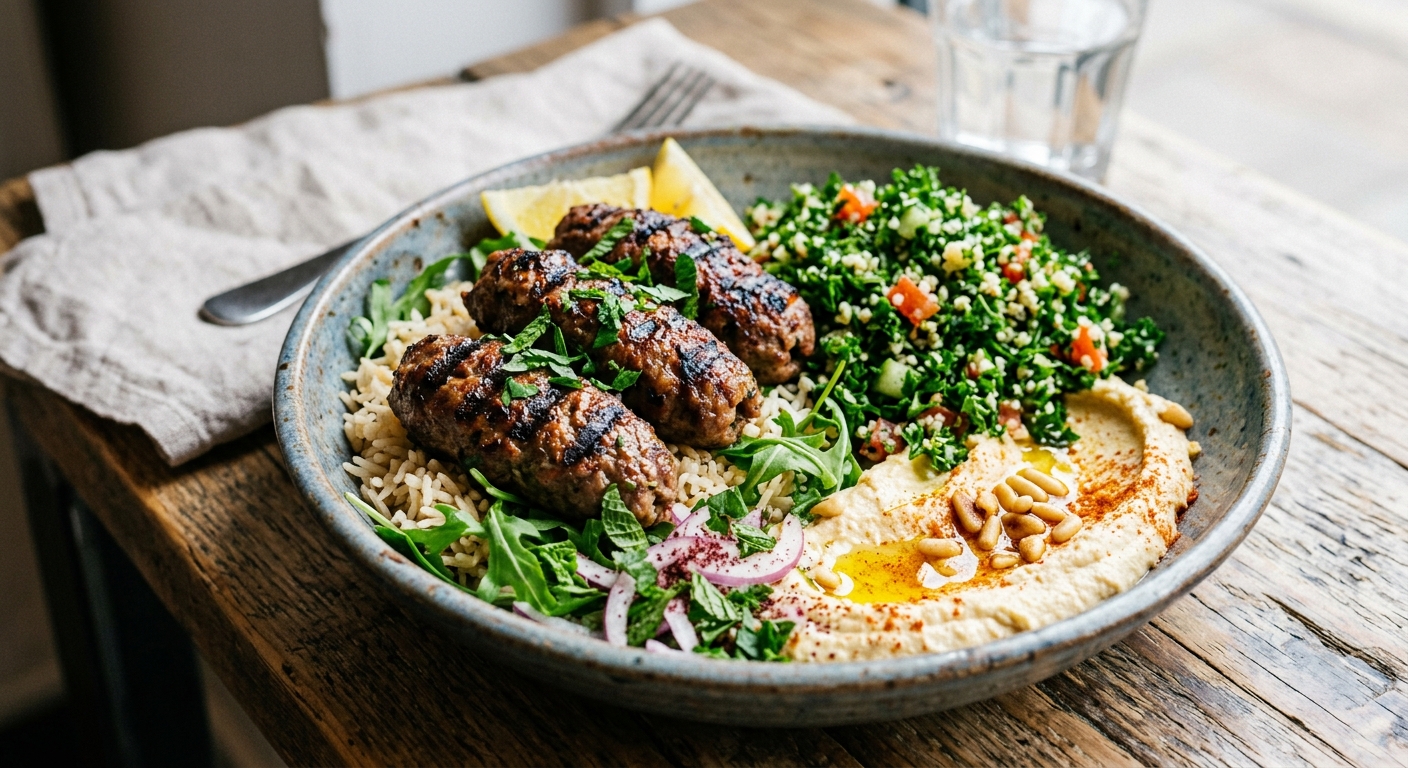
The lamb kofta bowl is one of the most nutritionally complete meals you can build around a single protein source. Ground lamb, seasoned with cumin, coriander, cinnamon, and fresh herbs, provides all nine essential amino acids in generous amounts, with leucine levels high enough to fully trigger muscle protein synthesis. Paired with chickpea-based hummus and a parsley-dominant tabbouleh, this bowl layers complementary proteins while stacking folate, vitamin C, iron, and zinc into a single satisfying meal.
What sets this recipe apart from a standard kofta platter is the deliberate nutritional architecture. The tabbouleh is made with a higher parsley-to-bulgur ratio than traditional versions, maximising vitamin K, vitamin C, and chlorophyll-rich antioxidants. The hummus is prepared with a generous tahini base to add methionine, the sulfur amino acid that pairs perfectly with the lysine-rich chickpeas to form a more complete plant protein alongside the lamb. Together, the three components create a macro and micronutrient profile that rivals clinical sports nutrition formulas, except it tastes extraordinary.
Every cooking method below is calibrated to preserve the lamb’s moisture and the volatile aromatic compounds in the spice blend. Whether you are searing on the stovetop for char and crust, gently poaching in the slow cooker for maximum tenderness, finishing in a pressure cooker for speed, or roasting in the oven for hands-off caramelisation, the kofta emerges juicy, deeply spiced, and ready to anchor a bowl that genuinely satisfies on every level.
4
servings
Ingredients
- 600 gground lamb (20% fat)
- 1 mediumbrown onion, finely grated and squeezed dry
- 4 clovesgarlic, minced (divided use)
- 3 tbspfresh flat-leaf parsley, finely chopped (for kofta)
- 2 tspground cumin
- 1.5 tspground coriander
- 0.5 tspground cinnamon
- 0.5 tspsmoked paprika
- 0.25 tspcayenne pepper
- 1 tspColima Sea SaltMicroplastic Free Salt (for kofta)
- 0.5 tspblack pepper (for kofta)
- 240 gcooked chickpeas (or one 400g can, drained and rinsed)
- 60 gtahini (sesame paste)
- 3 tbspfresh lemon juice (divided use)
- 3 tbspextra-virgin olive oil (divided use)
- 2 tbspice-cold water
- 2 clovesgarlic, minced (for hummus)
- 80 gfine bulgur wheat, dry
- 120 mlboiling water
- 60 gfresh flat-leaf parsley, finely chopped (for tabbouleh)
- 20 gfresh mint leaves, finely chopped
- 3 mediumripe tomatoes, finely diced (about 300g)
- 4 stalksspring onions, thinly sliced
- 2 tbspextra-virgin olive oil (for tabbouleh)
- 2 tbspfresh lemon juice (for tabbouleh)
- —Colima Sea SaltMicroplastic Free Salt and black pepper to taste
- —Pinch of ground sumac and paprika, for garnish
- —Warm flatbread, to serve (optional)
Instructions
Click on an item below to shop for the recommended items for this recipe on Amazon.
As an Amazon Associate, we earn from qualifying purchases.
- Make the kofta mixture: Combine the ground lamb, grated onion (squeezed very dry in a kitchen towel), 4 minced garlic cloves, 3 tbsp parsley, cumin, coriander, cinnamon, smoked paprika, cayenne, 1 tsp salt, and 0.5 tsp black pepper in a large bowl. Mix with your hands for 2 minutes until the mixture becomes cohesive and slightly sticky. Cover and refrigerate for 15 minutes.
- While the kofta chills, prepare the tabbouleh: Place the bulgur wheat in a heatproof bowl and pour over 120ml boiling water. Cover tightly with plastic wrap and let it steam for 12 minutes, then fluff with a fork and spread on a plate to cool. In a large bowl, combine the chopped parsley, mint, diced tomatoes, and spring onions. Add the cooled bulgur, 2 tbsp olive oil, 2 tbsp lemon juice, and season generously with salt and pepper. Toss well and set aside so the flavours meld.
- Make the hummus: Combine the chickpeas, tahini, 2 minced garlic cloves, 3 tbsp lemon juice, and a pinch of salt in a food processor. Blend for 1 minute. With the motor running, drizzle in 2 tbsp ice-cold water and 1 tbsp olive oil. Process for 3 to 4 minutes until very smooth and aerated. Season to taste. Transfer to a bowl, cover with plastic wrap pressed to the surface, and set aside.
- Shape and cook the kofta: Divide the chilled lamb mixture into 16 equal portions (about 37g each). Roll each into a log shape roughly 8cm long. Heat 2 tbsp olive oil in a large heavy-bottomed skillet or cast iron pan over medium-high heat until shimmering. Working in two batches of 8, add the kofta in a single layer without crowding.
- Sear the kofta for 3 to 4 minutes on the first side without moving them, until a deep brown crust forms. Turn with tongs and cook for another 3 minutes on the second side, then roll onto the remaining surfaces for 2 more minutes until cooked through and caramelised on all sides (internal temperature should reach 70C or 160F). Transfer to a warm plate and tent loosely with foil while the second batch cooks.
- Assemble the bowls: Spoon a generous layer of hummus onto each bowl, using the back of the spoon to create a wide swirl with a shallow well in the centre. Add a mound of tabbouleh to one side. Nestle 4 kofta per serving into the hummus well. Drizzle with the remaining olive oil, dust with sumac and paprika, and serve immediately with warm flatbread if desired.
- Prepare the kofta mixture as in the stovetop method, combining lamb, grated onion, 4 garlic cloves, parsley, and all spices. Mix thoroughly for 2 minutes. Shape into 16 logs, then place them in a single layer on a parchment-lined tray and freeze for 20 minutes. This firming step is critical for slow cooker kofta, as it prevents them from falling apart during the long, moist cook.
- Line the base of the slow cooker insert with a sheet of parchment paper cut to size. Arrange the firmed kofta in a single layer directly on the parchment (use a 6-quart or larger slow cooker, or cook in two layers separated by a second sheet of parchment, rotating halfway through). Add 3 tbsp of water around the edges, not over the kofta, to create a gentle steaming environment.
- Cook on Low for 3 to 4 hours, or until the kofta are cooked through and register at least 70C or 160F on an instant-read thermometer. Do not lift the lid during the first 2 hours. If you want a caramelised exterior, transfer the cooked kofta to a baking sheet and place under a preheated broiler or grill at maximum heat for 90 seconds per side, watching closely.
- While the kofta cook, prepare the tabbouleh using the bulgur soaking method described in the stovetop steps. Allow it to sit at room temperature for the full cook time so the parsley, tomato, and lemon flavours develop fully. Make the hummus in the food processor as described in the stovetop steps and refrigerate until assembly.
- Assemble the bowls exactly as described in the stovetop method: swirl of hummus, mound of tabbouleh, 4 kofta per bowl, olive oil drizzle, and a pinch of sumac and paprika.
- Prepare and shape the kofta mixture as described in the stovetop steps. Refrigerate for 15 minutes while you set up the Instant Pot. Set the Instant Pot to Saute mode on High heat. Add 1 tbsp olive oil and heat until the display reads Hot.
- Working in two batches, add 8 kofta to the pot and sear for 2 minutes on one side only, just enough to build a caramelised crust on one face without cooking through. Remove with tongs and set aside on a plate. This searing step is optional but adds a significant layer of Maillard reaction flavour to the final dish. Deglaze the pot with 60ml of water, scraping up any browned bits with a wooden spoon to prevent a burn warning.
- Insert the trivet or steamer rack into the Instant Pot. Arrange all 16 kofta in a single layer on the trivet (use a parchment sling if needed for easy removal). The 60ml of water beneath will create sufficient steam for pressure cooking. Secure the lid, set the valve to Sealing, and press Pressure Cook on High for 8 minutes.
- When the cycle completes, perform a Quick Release by carefully turning the valve to Venting. Open the lid away from you. Check that the kofta have reached an internal temperature of 70C or 160F. If not, reseal and cook on High pressure for 2 more minutes.
- While pressure builds and the kofta cook, use the time to prepare the tabbouleh (bulgur soaks in just 12 minutes of covered rest) and blitz the hummus in the food processor. Both components are fully ready within the 20-minute window of the pressure cooker cycle including pressurisation time. Assemble bowls as described in the stovetop method and serve immediately.
- Preheat your oven to 220C or 425F (200C fan or 400F fan). Line a large rimmed baking sheet with foil and set a wire oven rack on top. Lightly brush the rack with 1 tsp of the olive oil to prevent sticking. Prepare the kofta mixture, mix for 2 minutes, and refrigerate for 15 minutes as in the stovetop method.
- Shape the chilled lamb mixture into 16 logs and arrange them on the prepared wire rack, spacing them at least 2cm apart so heat can circulate freely. Brush the tops lightly with 1 tbsp of olive oil, which accelerates browning in the dry oven environment.
- Roast in the centre of the oven for 20 to 22 minutes, until the kofta are deeply browned on the exterior and cooked through to 70C or 160F internally. For extra caramelisation, switch the oven to Broil or Grill mode for the final 2 minutes, watching closely. Remove from the oven and rest for 3 minutes before assembling.
- While the kofta roast, prepare the tabbouleh: steep the bulgur in boiling water for 12 minutes, fluff and cool, then combine with parsley, mint, tomatoes, spring onions, 2 tbsp olive oil, 2 tbsp lemon juice, salt, and pepper. The oven’s 20-minute cook time gives you enough hands-free time to complete both the tabbouleh and the hummus simultaneously.
- Make the hummus in the food processor as described in the stovetop method, blending for a full 3 to 4 minutes for maximum creaminess. Assemble the bowls with hummus swirl, tabbouleh, 4 kofta per serving, a drizzle of remaining olive oil, sumac, and paprika.
Nutrition Breakdown
Per 1 serving (makes 4)
Vitamins & Minerals
% Daily Value based on a 2,000 calorie diet (FDA reference)
🧬 Essential Amino Acids
% of recommended daily intake (RDA) per serving
🛡 Antioxidant Profile
The Nutrition Science
Lamb is one of the most nutrient-dense red meats available, and ground lamb at 20% fat provides haem iron, a form with up to 40% bioavailability compared to the 2 to 20% bioavailability of non-haem iron from plant sources. This bowl strategically combines haem iron from the lamb with the non-haem iron from parsley and chickpeas, and the vitamin C from tomatoes and fresh lemon juice acts as a powerful absorption enhancer by reducing ferric iron to the more soluble ferrous form in the gut. The result is a significantly higher net iron absorption than either food group could achieve alone.
The protein architecture of this bowl is particularly sophisticated. Lamb provides all nine essential amino acids with an especially high leucine content, the amino acid that acts as the primary anabolic signal for the mTOR pathway responsible for muscle protein synthesis. The research consensus is that approximately 2,500 to 3,000mg of leucine per meal is required to maximally stimulate mTOR, and a single serving of this bowl delivers 2,980mg, placing it precisely within that anabolic threshold. The complementary chickpeas and tahini add additional lysine and methionine, making this bowl effective not just for muscle building but for connective tissue repair and immune function.
Parsley, used here in quantities far beyond typical garnish levels, is one of the richest culinary sources of vitamin K1 (phylloquinone), with 60g providing approximately 1,640mcg, far exceeding the 120mcg daily adequate intake. Vitamin K1 is essential for carboxylation of osteocalcin, a protein that embeds calcium into bone matrix. It also plays a role in activating coagulation factors II, VII, IX, and X. The luteolin and apigenin flavones in parsley additionally inhibit aromatase and COX-2 enzymes, providing anti-inflammatory benefits that are particularly relevant for recovery from resistance training.
Pro Tips
- Grating the onion rather than dicing it is essential. The grated texture disperses moisture and flavour throughout the lamb evenly, and squeezing it dry prevents the kofta mixture from becoming too wet and losing structural integrity during cooking.
- For the creamiest possible hummus, rub the drained chickpeas between two kitchen towels to remove their papery skins before blending. This extra 3-minute step makes an audible difference in the final texture.
- Tabbouleh is always better after 30 minutes of resting at room temperature. The lemon juice slightly wilts the parsley and draws juices from the tomato, creating a cohesive dressing that soaks into the bulgur. Make it first and let it sit while everything else comes together.
This is such a smart macro/micronutrient combo, and I’m really curious about something: that lamb is hitting you with heme iron AND methylation donors like choline and betaine, plus the B12 is crucial for one-carbon metabolism. I’ve been experimenting with this exact angle in my own diet, trading chicken for lamb more often because I noticed better energy levels on the methylation support front. The lemon in the tabbouleh is the cherry on top too, since that citric acid helps mineral absorption. Have you noticed any difference in how you recover after workouts when you’re rotating in these nutrient-dense proteins versus leaner cuts?
Eddie, you’re hitting on something I wish I’d paid attention to years ago when I started lifting at 62. The complete amino acid profile plus those methylation nutrients is exactly the kind of nutrient density older adults need, especially if we’re trying to build muscle while supporting metabolic health. That said, I’m curious how you’re thinking about the leucine distribution across your meals, since this 35g serving should give you a solid leucine hit, but I find a lot of people frontload their protein and miss the threshold on other meals. Have you noticed any difference in recovery when you’re hitting that heme iron and B12 consistently like this?
Steve, you’ve touched on something I see clinically all the time, especially in patients over 60. That leucine distribution absolutely matters for muscle protein synthesis, and the heme iron/B12 consistency is doing double duty here: the heme iron supports oxygen transport for recovery, while B12 deficiency will tank your methylation capacity and energy metabolism. I’d add that the lamb’s carnitine content is also working quietly to support mitochondrial function, which becomes more relevant as we age. Have you tracked whether spacing protein more evenly across the day (versus frontloading) changed your recovery markers at all?