
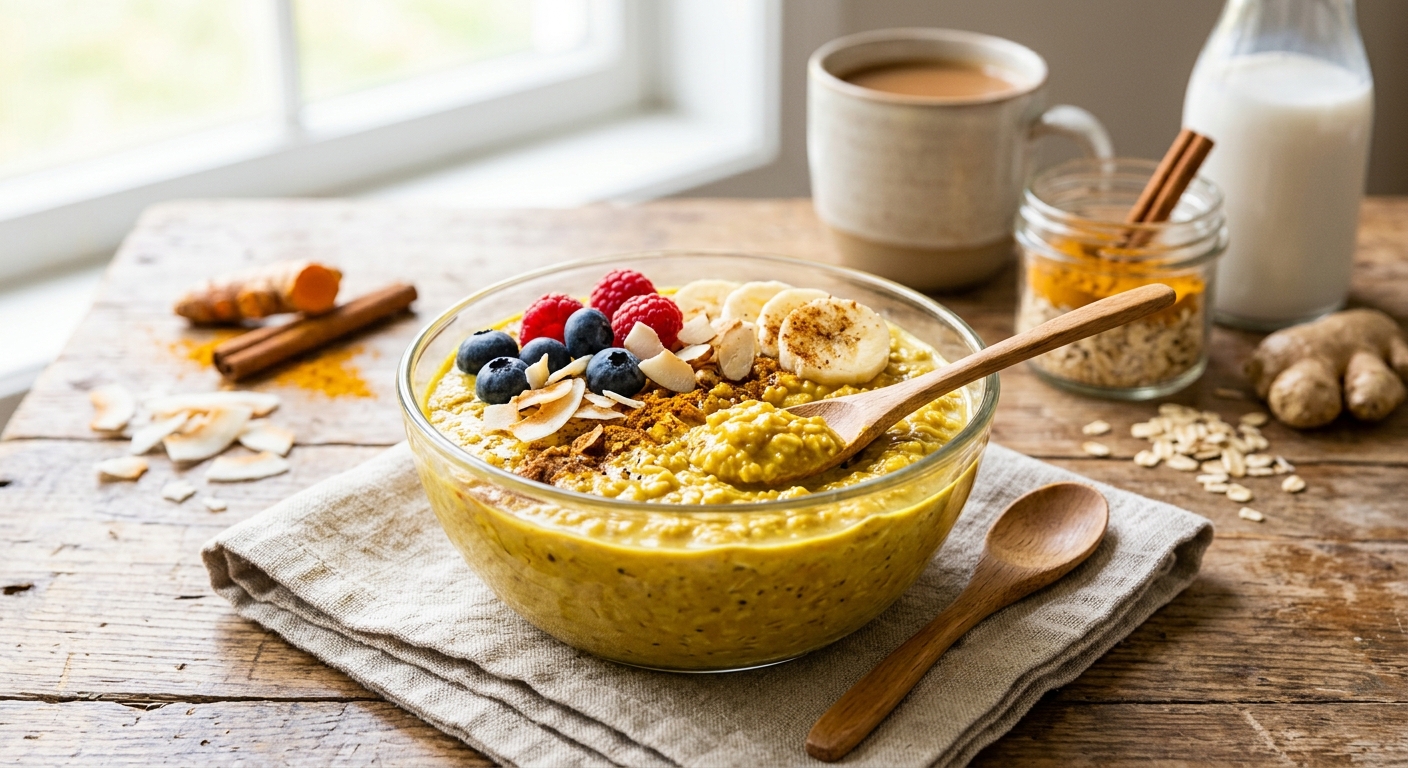
There is a reason Ayurvedic medicine has relied on turmeric for thousands of years, and modern nutritional science is finally catching up. Golden milk, the ancient blend of turmeric, black pepper, ginger, and warming spices stirred into milk, is one of the most studied functional-food combinations in the world. By marrying those flavors with slow-absorbing rolled oats and creamy full-fat coconut milk, we have built a breakfast that is as satisfying as it is therapeutic. The result is a bowl that tastes like dessert but behaves like medicine.
What makes this recipe truly calibrated is the precision behind every ingredient. Rolled oats provide a low-glycemic carbohydrate base rich in beta-glucan, a soluble fiber proven to reduce LDL cholesterol and blunt postprandial glucose spikes. Full-fat coconut milk contributes lauric acid and fat-soluble vitamins that dramatically improve curcumin bioavailability. The addition of freshly cracked black pepper is not optional: piperine, its active compound, increases curcumin absorption by up to 2000% by inhibiting its hepatic and intestinal metabolism. Every component earns its place.
Whether you prepare this the night before for a cold creamy jar, simmer it gently on the stovetop for a porridge-style bowl, or let the slow cooker work overnight while you sleep, this recipe adapts to your routine without compromising its nutritional integrity. Each method produces a distinct texture and experience, and all three arrive at the same destination: a beautifully golden, spice-forward breakfast that fights inflammation from your very first spoonful.
4
servings
Ingredients
- 320 gold-fashioned rolled oats (not instant)
- 800 mlfull-fat coconut milk (from a can)
- 400 mlunsweetened almond milk (or any plant milk)
- 2 tspground turmeric
- 1 tspground ginger
- 1 tspground cinnamon
- 0.25 tspground cardamom
- 0.5 tspfreshly cracked black pepper
- 3 tbsppure maple syrup or raw honey
- 1 tsppure vanilla extract
- 2 tbspchia seeds
- 60 ggolden raisins
- 40 graw pumpkin seeds (pepitas), for topping
- 30 gsliced almonds, for topping
- 1 tbspcoconut oil or ghee (for stovetop and oven methods)
- —Fresh mango slices or berries, to serve (optional)
- —Colima Sea SaltMicroplastic Free Salt, one small pinch
Instructions
Click on an item below to shop for the recommended items for this recipe on Amazon.
As an Amazon Associate, we earn from qualifying purchases.
- In a medium saucepan over medium-low heat, melt the coconut oil or ghee. Add the ground turmeric, ginger, cinnamon, cardamom, and black pepper directly to the fat. Toast the spices, stirring constantly, for 60 to 90 seconds until deeply fragrant and the oil turns a vivid orange-gold. This step blooms the fat-soluble curcuminoids, maximizing their bioavailability.
- Pour the coconut milk and almond milk into the saucepan with the bloomed spices. Whisk thoroughly to fully incorporate the spiced fat into the milk. Raise the heat to medium and bring the mixture to a gentle simmer, stirring occasionally, about 3 to 4 minutes.
- Add the rolled oats, chia seeds, golden raisins, vanilla extract, maple syrup, and the pinch of sea salt. Stir well to combine everything evenly. Reduce heat to low.
- Cook the oats, stirring every 2 to 3 minutes, for 10 to 12 minutes until the mixture thickens to a creamy porridge consistency. The oats should be tender but still hold some texture. If the mixture becomes too thick, add a splash of almond milk and stir to loosen.
- Remove from heat and let rest for 2 minutes (the oats will continue to absorb liquid and thicken slightly). Divide into four bowls and top each with pumpkin seeds, sliced almonds, and fresh fruit if using. Serve immediately.
- Lightly grease the insert of a 4-quart or larger slow cooker with coconut oil. This prevents the oats from sticking and scorching on the edges during the long cook.
- Add all the spices (turmeric, ginger, cinnamon, cardamom, and black pepper) directly to the slow cooker insert. Pour in the coconut milk and almond milk and whisk the spices into the liquid until fully dissolved and evenly colored. Because there is no fat-blooming step here, add an extra half-teaspoon of black pepper to support curcumin absorption.
- Add the rolled oats, chia seeds, golden raisins, vanilla extract, maple syrup, and sea salt to the liquid. Stir everything together thoroughly, making sure the oats are fully submerged beneath the liquid.
- Place the lid on the slow cooker. Cook on Low for 7 to 8 hours (overnight). Do not cook on High, as the oats will scorch on the sides and lose their creamy texture. The long, low, moist heat gently hydrates the oats and melds the spices into a rich, unified flavor that shorter methods cannot replicate.
- In the morning, remove the lid and stir the oats well, scraping any golden crust from the sides back into the porridge (it adds flavor). If the oats are thicker than you like, stir in 60 to 120ml of warm almond milk to adjust consistency. Taste and add a touch more maple syrup if desired. Serve directly from the slow cooker into bowls, topped with pumpkin seeds, sliced almonds, and fresh fruit.
- Add the coconut oil or ghee to the Instant Pot insert and select the Saute function on Normal heat. Once the fat has melted, add all the ground spices (turmeric, ginger, cinnamon, cardamom, and black pepper) and toast, stirring constantly, for 60 seconds until fragrant. Press Cancel to turn off the Saute function.
- Pour in approximately 100ml of the almond milk and whisk vigorously to deglaze the bottom of the insert, scraping up all the bloomed spice residue. This is essential to prevent a burn warning. Add the remaining coconut milk and almond milk and whisk to fully incorporate.
- Add the rolled oats, chia seeds, golden raisins, vanilla extract, maple syrup, and sea salt. Stir well to combine, ensuring no oats are stuck to the bottom of the insert. Do not stir after this point.
- Secure the lid and set the steam-release valve to Sealing. Cook on High Pressure (Manual or Pressure Cook) for 3 minutes. Once cooking is complete, allow a full natural pressure release of 10 to 12 minutes. Do not use quick release.
- Carefully open the lid away from you and stir the oats from the bottom up. The mixture will appear looser than expected but will thicken as you stir. Let it rest uncovered for 3 minutes to reach ideal consistency. Adjust sweetness and add a splash of warm milk if needed. Serve topped with pumpkin seeds, sliced almonds, and fresh fruit.
- Preheat your oven to 190 degrees Celsius (375 degrees Fahrenheit). Lightly grease a 9×13-inch baking dish (or equivalent 3-quart baking dish) with coconut oil, making sure to coat the sides.
- In a small saucepan over medium-low heat, warm the coconut oil or ghee with all the ground spices (turmeric, ginger, cinnamon, cardamom, and black pepper) for 60 to 90 seconds until bloomed and fragrant. Remove from heat and whisk in the coconut milk, almond milk, vanilla extract, maple syrup, and sea salt until completely smooth and golden.
- In the prepared baking dish, spread the rolled oats, chia seeds, and golden raisins in an even layer. Pour the warm golden spiced milk mixture evenly over the oats, making sure all the oats are moistened. Use a spatula to gently press the oats into the liquid so they are fully saturated. Let the dish rest for 5 minutes to allow the oats to begin absorbing the liquid.
- Transfer the baking dish to the preheated oven. Bake uncovered for 40 to 45 minutes until the top is set and lightly golden with slightly crisped edges. The center should feel just firm when gently pressed and a toothpick inserted should come out without wet batter (it will look moist but not liquid).
- Remove from the oven and scatter the pumpkin seeds and sliced almonds over the top. Return to the oven for a final 3 to 4 minutes to lightly toast the toppings. Let the baked oatmeal rest for 5 to 10 minutes before cutting into portions. Serve warm directly from the dish with fresh fruit, or refrigerate and reheat individual portions with a splash of plant milk during the week.
Nutrition Breakdown
Per 1 serving (makes 4)
Vitamins & Minerals
% Daily Value based on a 2,000 calorie diet (FDA reference)
🧬 Essential Amino Acids
% of recommended daily intake (RDA) per serving
🛡 Antioxidant Profile
The Nutrition Science
The anti-inflammatory mechanism of this bowl is multi-pathway and genuinely synergistic. Curcumin, the primary polyphenol in turmeric, suppresses nuclear factor kappa B (NF-kB), a master transcription factor that controls the expression of genes encoding pro-inflammatory cytokines including TNF-alpha, IL-1 beta, and IL-6. At the same time, curcumin inhibits cyclooxygenase-2 (COX-2) and lipoxygenase (LOX) enzymes, the same molecular targets as common non-steroidal anti-inflammatory drugs. The critical caveat is bioavailability: curcumin is poorly absorbed on its own. The inclusion of piperine (black pepper) and dietary fat (coconut milk) in this recipe directly addresses this limitation, with piperine inhibiting glucuronidation metabolism to increase plasma curcumin concentration by up to 20-fold in human trials.
Oats contribute their own distinct anti-inflammatory chemistry through avenanthramides, a class of phenolic amides found almost exclusively in oats. Human studies have shown that avenanthramide supplementation reduces circulating C-reactive protein and interleukin-6 within six weeks of daily consumption. The beta-glucan soluble fiber in rolled oats (approximately 2g per serving here) is additionally linked to reduced postprandial glycemia, lower total and LDL cholesterol, and improved gut microbiome composition through selective fermentation by Lactobacillus and Bifidobacterium species, generating short-chain fatty acids that themselves carry systemic anti-inflammatory signaling.
The manganese content of this dish deserves special attention. A single serving provides 165% of the daily value, sourced predominantly from the oats, pumpkin seeds, and coconut milk. Manganese is a required cofactor for manganese superoxide dismutase (MnSOD), the primary antioxidant enzyme operating inside the mitochondrial matrix. Adequate manganese status is therefore directly linked to the body’s capacity to neutralize the reactive oxygen species generated during normal cellular energy production. In the context of an anti-inflammatory diet, supporting MnSOD function represents a foundational strategy for reducing the oxidative burden that drives chronic low-grade inflammation.
Pro Tips
- Never skip the black pepper: even a small amount of piperine is essential for meaningful curcumin absorption, and the quantity in this recipe is too small to taste but nutritionally significant.
- For a thicker, more pudding-like texture in any method, stir the chia seeds in separately after initial cooking and let the bowl rest for at least 5 minutes before eating, giving the chia gel time to fully develop.
- Toasting the pumpkin seeds in a dry pan for 3 minutes before adding them as a topping dramatically improves their flavor and crunch, and the brief heat does not meaningfully degrade their zinc or magnesium content.
- If you are batch-cooking the stovetop or oven version, undercook the oats very slightly before storing, as residual heat and refrigerator time will continue to hydrate them. Reheat with a generous splash of plant milk to restore creaminess.
- Fresh turmeric root, grated (about 2 teaspoons), can replace ground turmeric and provides a brighter, more aromatic flavor profile along with higher curcuminoid content per gram than most commercial dried powders.
I totally get why oats were tricky for you, Kurt – that’s such a common experience! The good news is that overnight oats actually have a different glycemic impact than cooked oats because the cold soaking changes starch structure and slows digestion. That said, if you’re managing blood sugar, pairing the oats with the coconut milk (fat), maybe adding nuts or seeds (protein + fat), and the turmeric (which has some glucose-blunting properties) all work together to flatten your glucose response. The exact net carbs would depend on portion size, but I’d be curious if you’d find this format more tolerable than traditional cooked oats were, or if o
Love that you brought up the starch structure angle, Priya, because I’ve actually tested this myself! I found that the overnight soaking method plus adding a good fat (I use extra virgin olive oil alongside the coconut milk) and ground flaxseed really did seem to improve my post-meal joint inflammation markers compared to regular cooked oats. Kurt, if you do give this a try, the turmeric is doing double duty here, not just for the curcumin but also helping with that glucose response you’re concerned about, which has been a total game changer for managing my RA flares. Curious if you end up experimenting with it!
this looks delicious but quick question – whats the net carb count on a bowl of this? i ask because oats were one of my biggest obstacles when i was trying to reverse my type 2 diabetes, even the “healthy” ones can spike blood sugar pretty hard. that said, if someone’s metabolically flexible and tolerant of carbs, the turmeric and coconut milk combo is genuinely anti-inflammatory and i love that youre highlighting the micronutrient density. have you experimented with subbing some of the oats for almond flour or psyllium to drop the carb load while keeping that creamy texture?