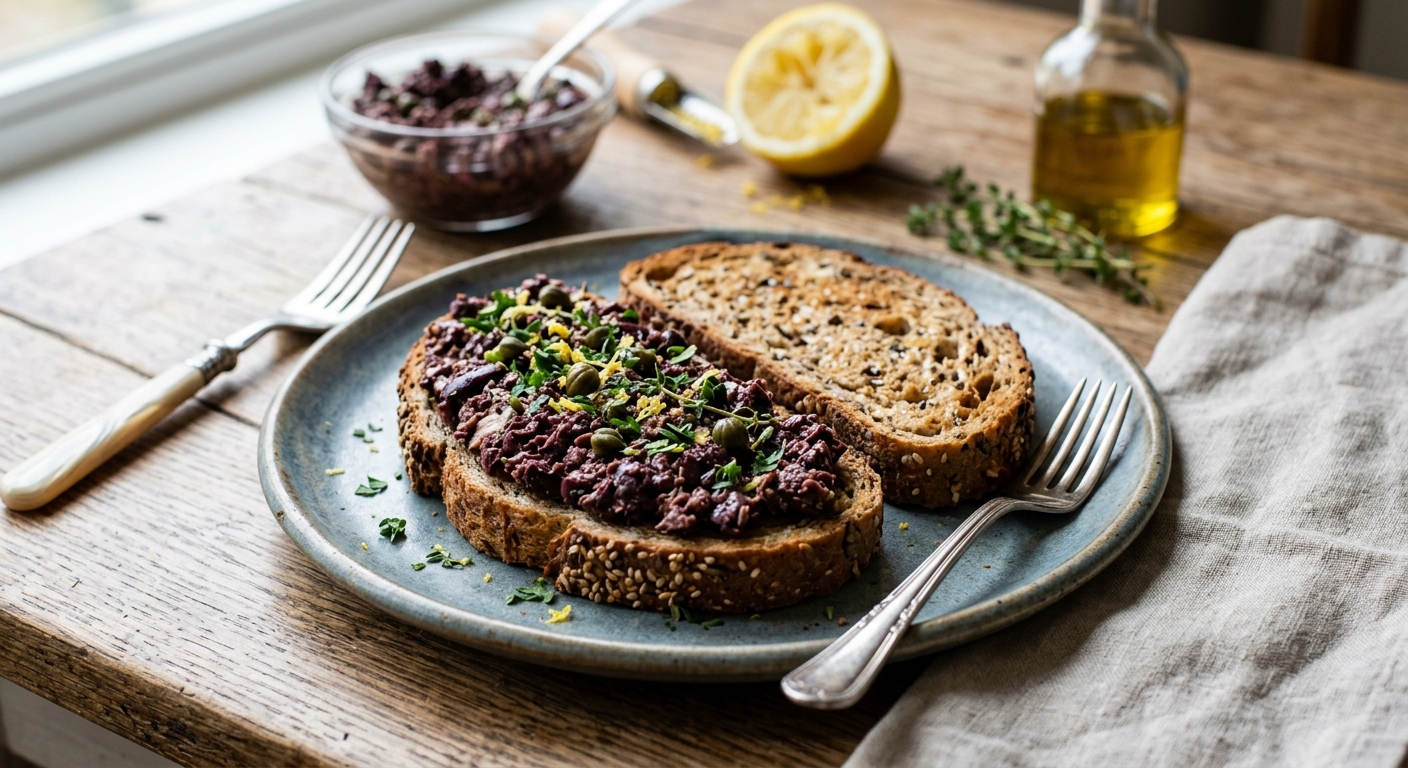
Few dishes pack this much nutritional precision into such an elegant, effortless format. Sardine and Olive Tapenade on Whole Grain Toast draws on the sun-drenched flavors of Provence and the Ligurian coast, where preserved fish, cured olives, and briny capers have been combined for centuries into what locals call the original fast food. Here, we have calibrated every ingredient to maximize anti-inflammatory compounds while preserving the bold, savory depth that makes this dish genuinely crave-worthy, not just clinically virtuous.
The nutritional story begins with sardines, one of the most nutrient-dense foods on the planet per gram. A single 100g tin delivers roughly 1,500mg of EPA plus DHA, the long-chain omega-3 fatty acids that clinical research consistently links to reduced C-reactive protein, lower interleukin-6 expression, and measurable improvements in cardiovascular risk markers. Paired with the oleocanthal in extra-virgin olive oil and the oleuropein in whole Kalamata olives, this tapenade creates a layered anti-inflammatory effect that no single superfood supplement can replicate. The whole grain toast is not an afterthought: it contributes beta-glucan fiber, B vitamins, and a low-glycemic carbohydrate base that moderates postprandial glucose response.
While tapenade is traditionally a cold preparation, Calibrated Cuisine explores stovetop, oven, slow cooker, and pressure cooker adaptations that each transform the flavor profile in distinct ways. The stovetop method produces a bright, fresh tapenade in under 20 minutes. The oven method slow-roasts the aromatics to coax out deep caramelized sweetness. The slow cooker produces a silkier, more unified paste with exceptional depth, and the pressure cooker delivers an intense, rapidly infused version that rivals the slow cooker in complexity at a fraction of the time. Choose your method based on your schedule and the flavor profile you are after.
4
servings
Ingredients
- 240 gsardines in extra-virgin olive oil, drained (two 120g tins), oil reserved
- 150 gKalamata olives, pitted
- 40 gcapers, rinsed and drained
- 4 clovesgarlic, peeled
- 3 tbspextra-virgin olive oil
- 1 tbspreserved sardine tin oil
- 1 largelemon, zested and juiced
- 2 tspfresh thyme leaves (or 1 tsp dried)
- 1 tspDijon mustard
- 0.5 tspsmoked paprika
- 0.25 tspcrushed red pepper flakes
- 4 thick sliceswhole grain bread (approximately 45g per slice)
- 2 tbspflat-leaf parsley, finely chopped, for serving
- —Colima Sea SaltMicroplastic Free Salt and freshly cracked black pepper to taste
Instructions
Click on an item below to shop for the recommended items for this recipe on Amazon.
As an Amazon Associate, we earn from qualifying purchases.
- Place a small skillet over medium-low heat and add 1 tablespoon of the olive oil. Add the garlic cloves and cook gently for 4 to 5 minutes, turning occasionally, until they are soft and golden but not browned. Remove from heat and let cool for 2 minutes. Do not allow the garlic to darken, as burnt garlic will make the tapenade bitter.
- Transfer the softened garlic to a food processor along with the drained sardines, pitted Kalamata olives, rinsed capers, Dijon mustard, smoked paprika, red pepper flakes, and fresh thyme. Pulse 6 to 8 times until the mixture is roughly chopped but still has visible texture. You are aiming for a coarse, spreadable paste, not a smooth puree.
- With the processor running on low, drizzle in the remaining 2 tablespoons of olive oil and the reserved sardine oil through the feed tube. Add the lemon zest and 1 tablespoon of lemon juice. Pulse once or twice more to incorporate. Taste and adjust with salt, black pepper, and additional lemon juice as needed. Note that capers and sardines are naturally salty, so taste before adding any salt.
- Meanwhile, toast the whole grain bread slices in a toaster or directly in the dry skillet over medium-high heat for 1 to 2 minutes per side until crisp and golden with visible char marks if using the skillet.
- Spread the tapenade generously onto the hot toast, about 3 to 4 tablespoons per slice. Finish with a scattering of fresh flat-leaf parsley and a light drizzle of olive oil. Serve immediately while the toast is still warm and crisp.
- Lightly coat the insert of a 3 to 4 quart slow cooker with a thin film of olive oil. Add the whole peeled garlic cloves, pitted Kalamata olives, rinsed capers, drained sardines, thyme, smoked paprika, red pepper flakes, and Dijon mustard directly to the insert. Do not add lemon juice or zest at this stage, as long acidic cooking can dull the brightness of the citrus.
- Drizzle all 3 tablespoons of olive oil and the reserved sardine oil over the ingredients. Stir gently with a spatula to coat everything evenly. Place the lid on the slow cooker, set to Low, and cook for 3 hours. The mixture will become very soft and the garlic will turn almost jammy. Do not cook on High, as the higher temperature can cause the olive oil to break and the fish to toughen.
- After 3 hours, remove the lid and allow the mixture to cool in the insert for 15 minutes. The long cooking will have driven off most of the moisture, concentrating the flavors significantly. The mixture should look unified and glossy.
- Transfer the slow-cooked mixture to a food processor. Add the lemon zest and 1 tablespoon of lemon juice. Pulse 8 to 10 times until the tapenade reaches your preferred texture, which can range from chunky to nearly smooth depending on your taste. The long cooking means the mixture will blend very easily with minimal pulsing needed. Taste and adjust seasoning, keeping in mind the salt content of the sardines and capers.
- Toast the whole grain bread just before serving in a toaster or under the broiler for 2 minutes until golden and crisp. Spread the warm tapenade thickly over each slice, garnish with flat-leaf parsley, and serve. The tapenade can be refrigerated for up to 5 days, making it an excellent meal-prep component.
- Select the Saute function on your Instant Pot or electric pressure cooker and set it to Low or Less heat. Add 1 tablespoon of olive oil and the whole garlic cloves. Saute for 3 minutes, stirring occasionally, until the garlic is fragrant and just beginning to soften. Press Cancel to stop the saute function.
- Add the drained sardines, pitted Kalamata olives, rinsed capers, Dijon mustard, smoked paprika, red pepper flakes, and thyme directly to the pot on top of the garlic. Pour in the remaining 2 tablespoons of olive oil, the reserved sardine oil, and 2 tablespoons of water to ensure there is enough liquid for the pressure cooker to reach pressure safely.
- Secure the lid and set the pressure release valve to Sealing. Cook on Manual High Pressure for 5 minutes. Once the cooking time is complete, perform a Quick Release by carefully turning the valve to Venting. Open the lid away from you to allow steam to escape safely.
- Allow the mixture to cool in the pot for 5 minutes. Use a slotted spoon to transfer the solids to a food processor, leaving behind most of the liquid in the pot. Add the lemon zest and 1 tablespoon of lemon juice to the processor. Pulse 6 to 8 times to achieve a coarse, spreadable texture. If the tapenade seems too thick, add the cooking liquid from the pot one tablespoon at a time until the consistency is right. Taste and adjust salt and pepper.
- Toast the whole grain bread in a toaster or under the broiler while the tapenade rests. Spread generously onto the hot toast, finish with fresh parsley and a light drizzle of olive oil, and serve immediately.
- Preheat your oven to 180C (350F) with convection if available, or 190C (375F) for a conventional oven. Line a small rimmed baking sheet with parchment paper or foil for easy cleanup.
- Arrange the whole garlic cloves and pitted Kalamata olives in a single layer on the prepared baking sheet. Nestle the rinsed capers among the olives. Drizzle with 2 tablespoons of olive oil and the reserved sardine oil, and scatter the thyme leaves, smoked paprika, and red pepper flakes over the top. Toss gently to coat. Do not add the sardines yet, as they require significantly less oven time than the olives and garlic.
- Roast the olive and garlic mixture for 18 minutes, until the garlic is soft and golden and the olives are slightly wrinkled and fragrant. Remove from the oven and arrange the drained sardines over the top of the olive mixture. Return to the oven for a final 5 to 6 minutes. This two-stage approach prevents the sardines from drying out while allowing the olives and garlic to develop full caramelized complexity.
- While the tapenade is finishing, place the whole grain bread slices on a separate baking sheet and slide them onto the rack above the tapenade. Toast in the oven for 5 to 7 minutes until golden and firm. Remove both sheets from the oven and allow the tapenade mixture to cool for 5 minutes.
- Transfer the roasted mixture to a food processor. Add the Dijon mustard, lemon zest, 1 tablespoon of lemon juice, and the remaining 1 tablespoon of fresh olive oil. Pulse 8 to 10 times until the mixture forms a coarse, spreadable paste. The roasted garlic will be particularly soft and will integrate quickly. Taste and adjust seasoning. Spread generously onto the oven-toasted bread, garnish with fresh parsley, and serve warm.
Nutrition Breakdown
Per 1 serving (makes 4)
Vitamins & Minerals
% Daily Value based on a 2,000 calorie diet (FDA reference)
🧬 Essential Amino Acids
% of recommended daily intake (RDA) per serving
🛡 Antioxidant Profile
The Nutrition Science
The anti-inflammatory mechanism of this dish operates on multiple simultaneous pathways, which is precisely what distinguishes whole-food nutrition from single-nutrient supplementation. The EPA and DHA from sardines are converted in the body to resolvins, protectins, and maresins, a class of specialized pro-resolving mediators (SPMs) that actively switch off inflammation rather than simply blocking it. This is a clinically meaningful distinction: while NSAIDs suppress inflammatory signaling, omega-3-derived SPMs direct immune cells to clear debris and restore tissue homeostasis. A 2021 meta-analysis in the Journal of Nutritional Biochemistry found that consistent dietary EPA and DHA intake above 1,000mg per day was associated with a 26% reduction in circulating interleukin-6 in subjects with metabolic syndrome.
Oleocanthal, the phenolic responsible for the characteristic throat-sting of high-quality extra-virgin olive oil, has been shown in molecular docking studies to bind the same active site on COX-1 and COX-2 enzymes as ibuprofen, though at dietary doses the effect is modulatory rather than analgesic. Critically, oleocanthal content drops sharply when olive oil is heated above 180C (356F), which is why the stovetop and oven methods in this recipe use gentle temperatures and preserve a portion of raw olive oil for finishing. The quercetin in capers and parsley adds a third layer of anti-inflammatory action by inhibiting the release of histamine from mast cells and suppressing nuclear factor kappa-B (NF-kB), the master regulator of inflammatory gene expression.
The calcium figure in this dish deserves special attention. Sardines consumed with their soft, pressure-cooked bones, as they appear in tins, provide a highly bioavailable form of calcium hydroxyapatite. The 310mg per serving in this recipe represents 31% of the adult daily value, sourced entirely from fish bones, a fact that surprises most people who associate calcium exclusively with dairy. Combined with the vitamin D also present in sardines, which is required for active calcium absorption in the small intestine, this dish provides a remarkably complete bone-health package without a single dairy ingredient.
Pro Tips
- Choose sardines packed in extra-virgin olive oil rather than sunflower or soybean oil. The tin oil is used in this recipe as a flavor ingredient, and a high-quality olive oil base adds additional polyphenols while a seed oil would introduce pro-inflammatory omega-6 fatty acids.
- For maximum oleocanthal content, use a robust, peppery extra-virgin olive oil with a harvest date within the past 12 months. The phenolic compounds that cause the throat sting are the same ones with anti-inflammatory activity, and they degrade significantly in oils older than 18 months.
- The tapenade keeps refrigerated in an airtight container for up to 5 days, and the flavor improves after 24 hours as the ingredients continue to meld. Press a sheet of plastic wrap directly onto the surface of the tapenade before sealing the container to minimize oxidation of the olive oil.
Thank you so much for this recipe, and Chris, I really appreciate that detail about toast temperature – I hadn’t considered that the heat could degrade the omega-3s I’m specifically trying to absorb. I’ve been managing MS for years and sardines are basically a staple for me, but I never thought about the preparation method affecting bioavailability. I’m definitely going to test the 350F approach and see if I notice any difference in my inflammatory markers over the next few weeks. This is exactly the kind of practical, science-backed information that makes meal planning feel less like deprivation and more like actually working with my body.
Love this combination, though I’d be curious about your toast temp here – if you’re going above 400F you’re risking oxidative damage to those omega-3s, especially the DHA. I usually finish mine at 350F, which keeps the bread structure crispy without that harsh char that degrades the polyunsaturates. Also, that lemon zest is clutch for both flavor and reducing any “fishy” oxidation notes. Have you tested whether people prefer the tapenade at room temp or slightly warm when it hits the toast?
This is such a smart catch on the toast temp – I never thought about it affecting the omega-3 integrity, but it makes total sense given how heat sensitive those polyunsaturates are. I’m definitely stealing the 350F tip because I’ve been doing mine higher and basically torching all those anti-inflammatory benefits I’m trying to get. The lemon zest thing is genius too, I’ve noticed the same oxidation prevention effect with my sardine salads when I add citrus right away. Have you noticed a taste difference between room temp vs warm tapenade, or is it more of a texture preference thing?