
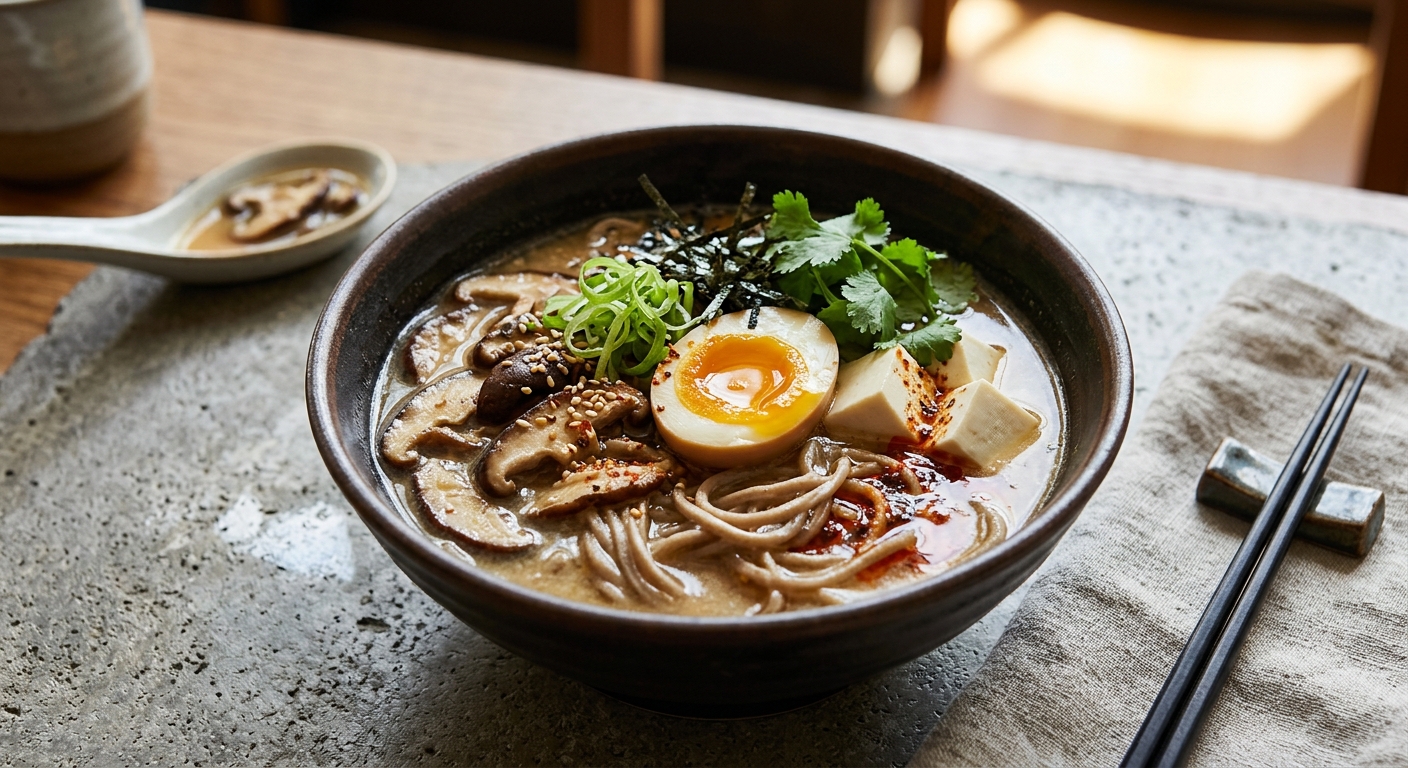
Ramen has always been comfort food, but this version earns its place at the table on purely scientific grounds too. The foundation is a shiitake-forward dashi broth fortified with white miso, a combination that pairs the well-documented immunomodulatory beta-glucans of Lentinula edodes with the probiotic-adjacent compounds and isoflavones of fermented soybean paste. Together they create a broth that is simultaneously anti-inflammatory, deeply umami, and genuinely nourishing rather than just warming.
Every component in this bowl was chosen with nutritional intent. Fresh shiitake mushrooms contribute ergothioneine, a master antioxidant that human cells actively transport and concentrate, as well as lentinan, a polysaccharide shown in multiple trials to enhance natural killer cell activity. Bok choy brings a surprising 74% DV of vitamin K and a substantial hit of vitamin C. Soft-boiled eggs round out the amino acid profile and supply choline, while a measured drizzle of toasted sesame oil adds the anti-inflammatory oleic and linoleic fatty acids that help the fat-soluble nutrients in this bowl reach circulation.
Calibrated Cuisine tested this recipe across three cooking methods and found each produces a meaningfully different bowl. The stovetop version gives you maximum control over broth clarity and noodle texture. The slow cooker produces an extraordinarily deep, almost stock-like broth perfect for meal-prep days. The pressure cooker delivers an intense, restaurant-quality result in under 30 minutes. Choose your method based on your schedule and the depth of broth you are after.
4
servings
Ingredients
- 200 gdried ramen noodles (100% buckwheat or wheat ramen)
- 300 gfresh shiitake mushrooms, stems removed and reserved, caps sliced 5mm thick
- 80 gwhite (shiro) miso paste
- 1400 mlfiltered water
- 15 gdried kombu (one 10cm piece)
- 20 gdried bonito flakes (katsuobushi), or substitute 10g dried wakame for vegan
- 300 gsilken tofu, cut into 2cm cubes
- 4 largeeggs
- 400 gbaby bok choy, halved lengthways (about 4 heads)
- 4 clovesgarlic, minced
- 20 gfresh ginger, peeled and finely grated
- 2 tbspreduced-sodium soy sauce (tamari for gluten-free)
- 1 tbsptoasted sesame oil
- 2 tsprice vinegar
- 1 tspcoconut sugar or honey
- 4 stalksspring onions (scallions), thinly sliced on the bias
- 2 tspsesame seeds, toasted
- 1 tspdried chili flakes (optional, for additional anti-inflammatory capsaicin)
- —Colima Sea SaltMicroplastic Free Salt and white pepper to taste
Instructions
Click on an item below to shop for the recommended items for this recipe on Amazon.
As an Amazon Associate, we earn from qualifying purchases.
- Make the dashi base: Combine the kombu and 1400ml cold filtered water in a medium saucepan. Let it soak for 10 minutes at room temperature, then place over medium-low heat. Slowly bring to 60 to 70C (just below a simmer, with small bubbles forming at the base of the pot). Hold at this temperature for 10 minutes. Remove the kombu and increase the heat to medium. Add the reserved shiitake stems and bonito flakes (or wakame). Bring to a gentle simmer, cook for 5 minutes, then strain through a fine-mesh sieve into a clean pot, pressing the solids to extract all liquid. Discard solids. You should have approximately 1.2 litres of clear amber dashi.
- Soft-boil the eggs: While the dashi steeps, bring a small saucepan of water to a rolling boil. Gently lower the eggs in with a spoon and cook for exactly 6 minutes and 30 seconds for a jammy, set-but-flowing yolk. Transfer immediately to an ice bath for 5 minutes, then peel carefully and set aside. For the marinated ramen egg effect, place peeled eggs in a small zip-lock bag with 1 tbsp soy sauce and 1 tsp rice vinegar from the recipe’s measures and refrigerate for up to 30 minutes while you finish the broth.
- Build the aromatic base: Return the strained dashi to medium heat. Add the garlic, grated ginger, and sliced shiitake caps. Simmer gently for 8 minutes until the mushrooms are completely tender and have released their full depth of flavor into the broth. Add the soy sauce (reserving the 1 tbsp used for the eggs), coconut sugar, and rice vinegar. Taste and adjust seasoning with white pepper and a pinch of sea salt if needed.
- Add the tofu and bok choy: Reduce the heat to low. Gently slide the silken tofu cubes into the broth and warm through for 2 minutes without stirring (stirring will break them up). Add the bok choy halves cut-side down. Cover the pot and steam-simmer for 3 to 4 minutes until the bok choy is vibrant green and the stems are just tender but still have a slight bite.
- Dissolve the miso: Remove the pot from the heat entirely. Place the miso paste in a small bowl and ladle about 60ml of hot broth over it. Whisk until completely smooth with no lumps, then stir the miso mixture back into the pot. Do not return the pot to heat once the miso is added. This preserves the probiotic compounds and active enzymes that contribute to the dish’s gut-health benefits.
- Cook the noodles and assemble: Cook the ramen noodles in a separate pot of boiling water according to packet instructions (typically 3 to 4 minutes). Drain and divide among four warmed deep bowls. Ladle the miso broth generously over the noodles, distributing the shiitake, tofu, and bok choy evenly. Halve each egg and place two halves on top. Drizzle each bowl with sesame oil, then garnish with spring onions, sesame seeds, and chili flakes if using. Serve immediately.
- Build the slow cooker broth: Place the kombu piece, reserved shiitake stems, whole garlic cloves (no need to mince for this method), ginger cut into coins rather than grated, soy sauce, rice vinegar, coconut sugar, and 1400ml cold water directly into the slow cooker insert. Add the sliced shiitake caps on top. Do not add miso, tofu, bok choy, or noodles at this stage. Place the lid on and cook on Low for 6 to 8 hours, or on High for 3 to 4 hours if pressed for time.
- Remove the large aromatics: About 15 minutes before serving, use tongs or a slotted spoon to fish out and discard the kombu, shiitake stems, and large ginger coins. Leave the sliced shiitake caps and the garlic in the broth (the garlic will have become very soft and sweet; mash it against the side of the insert with the spoon to dissolve it into the broth for more body). Taste the broth and adjust with white pepper and a small pinch of sea salt.
- Add the bok choy and tofu: Nestle the bok choy halves cut-side up into the hot broth in the slow cooker. Gently place the silken tofu cubes around the bok choy. Replace the lid and cook on High for 10 to 12 minutes until the bok choy is tender but still bright green and the tofu is warmed through.
- Soft-boil the eggs and cook noodles: While the bok choy cooks, bring a saucepan of water to a rolling boil. Cook the eggs for 6 minutes 30 seconds, transfer to an ice bath, peel, and marinate as described in the stovetop method if desired. In the same saucepan, cook the ramen noodles according to packet instructions. Drain and set aside.
- Dissolve the miso and serve: Switch the slow cooker to Keep Warm. In a small bowl, whisk the miso paste with 60ml of hot broth from the insert until completely smooth. Stir the dissolved miso back into the slow cooker. Add the sesame oil directly to the insert and stir gently. Divide the noodles among four deep bowls, ladle the broth over with the shiitake, tofu, and bok choy, then top each bowl with a halved soft-boiled egg, spring onions, sesame seeds, and chili flakes.
- Saute the aromatics: Set the Instant Pot or electric pressure cooker to Saute mode on Normal heat. Add the sesame oil and heat for 1 minute. Add the minced garlic and grated ginger and saute for 90 seconds, stirring constantly, until fragrant and just beginning to turn golden. Add the sliced shiitake caps and reserved stems and saute for 3 minutes until they begin to soften and release moisture. This brief saute step develops a roasted-mushroom depth that distinguishes this method from the others.
- Pressure cook the broth: Add the soy sauce, rice vinegar, and coconut sugar to the pot and stir to deglaze any browned bits from the base. Add the kombu and pour in 1400ml cold water. Do not add the miso, tofu, bok choy, eggs, or noodles. Seal the lid, ensure the vent is set to Sealing, and cook on Manual or Pressure Cook mode at High Pressure for 15 minutes. Allow a full natural pressure release of at least 10 minutes before switching the vent to Venting to release any remaining steam.
- Strain and finish the broth: Open the lid carefully. Remove and discard the kombu and shiitake stems using tongs. The sliced caps will have given everything they have to the broth; you can discard them too for a clear broth, or keep them for texture (recommended). Taste the broth and adjust seasoning. Switch the Instant Pot back to Saute mode on Low. Gently add the silken tofu cubes and bok choy halves and simmer for 3 to 4 minutes until the bok choy is just tender. Cancel the Saute mode.
- Soft-boil the eggs: While the pressure was building and releasing, cook the eggs in a separate saucepan of boiling water for exactly 6 minutes 30 seconds, transfer to an ice bath for 5 minutes, and peel. Marinate briefly in soy sauce and rice vinegar if desired. Cook the ramen noodles in the same saucepan according to packet instructions and drain well.
- Dissolve the miso and plate: Ladle 60ml of the hot broth into a small bowl, whisk in the miso paste until completely lump-free, then stir the mixture back into the Instant Pot insert. Divide the cooked noodles among four warmed bowls. Ladle the broth over generously, ensuring each bowl gets a fair share of shiitake, tofu, and bok choy. Place two egg halves per bowl, then finish with spring onions, toasted sesame seeds, and chili flakes.
Nutrition Breakdown
Per 1 serving (makes 4)
Vitamins & Minerals
% Daily Value based on a 2,000 calorie diet (FDA reference)
🧬 Essential Amino Acids
% of recommended daily intake (RDA) per serving
🛡 Antioxidant Profile
The Nutrition Science
The anti-inflammatory architecture of this bowl rests on two mechanistically distinct pillars: the immunomodulatory polysaccharides of shiitake mushrooms, and the NF-kB-suppressing isoflavones of fermented miso. Lentinan, a beta-1,3/1,6-glucan isolated from Lentinula edodes, binds to Dectin-1 and TLR2 receptors on macrophages and dendritic cells, triggering a measured, training-type immune activation rather than acute inflammation. This is the mechanism behind multiple Japanese clinical trials showing improved natural killer cell counts in patients consuming shiitake or its extracts regularly. Cooking the mushrooms in liquid efficiently extracts lentinan into the broth, meaning every sip delivers the active compound.
Miso’s contribution operates through a different pathway. The fermentation of soybeans by Aspergillus oryzae converts bound isoflavone glycosides into bioavailable aglycones, primarily genistein and daidzein, at rates significantly higher than unfermented soy. These aglycones inhibit IKK-beta, the kinase that phosphorylates the NF-kB inhibitor IkB, effectively reducing the transcription of pro-inflammatory cytokines including IL-6, TNF-alpha, and COX-2. Critically, miso must not be boiled to preserve this activity, which is why every method in this recipe adds miso off the heat. A single serving of this ramen provides approximately 12 to 18mg of isoflavone aglycones, within the range associated with measurable anti-inflammatory outcomes in epidemiological studies of Japanese cohorts.
The ergothioneine content of fresh shiitake mushrooms (approximately 5 to 8mg per 100g) deserves special attention. Unlike most dietary antioxidants, ergothioneine has a dedicated membrane transporter (OCTN1, encoded by the SLC22A4 gene) that actively concentrates it in tissues with high oxidative stress, particularly mitochondria, red blood cells, and neurons. This selectivity means ergothioneine is not simply scavenging free radicals indiscriminately; it is delivered precisely where oxidative load is highest. Population studies have associated higher plasma ergothioneine levels with reduced cardiovascular mortality and slower cognitive decline, making the shiitake in this bowl a genuinely functional food component rather than a cosmetic addition.
Pro Tips
- Never add miso to boiling broth. Always dissolve it in a ladleful of hot (not boiling) liquid first and stir in off the heat to preserve its active enzymes, isoflavones, and any surviving beneficial microorganisms from fermentation.
- For the deepest umami broth, refrigerate the dashi or slow-cooker broth overnight before adding miso. The cold rest allows glutamates to redistribute and intensify, producing a noticeably more complex flavor without any additional sodium.
- Use the shiitake stems: they are tough to eat but packed with lentinan and flavor. Always add them to the broth at the start of cooking and remove before serving. Dried shiitake stems are even more concentrated and can be batch-simmered and frozen for future broths.
- Buckwheat ramen noodles contribute additional rutin (a quercetin glycoside with demonstrated anti-inflammatory and capillary-strengthening effects) and lower the overall glycemic load of the bowl by approximately 2 points compared to refined wheat ramen.
- The optional chili flakes are not purely cosmetic. Capsaicin activates TRPV1 receptors and has been shown to transiently suppress NF-kB activity through a distinct pathway from the isoflavones, providing a brief, additive anti-inflammatory effect that makes the spicy version of this bowl nutritionally superior.



Great question about the dried shiitake powder, Jasmine! I actually ran some informal experiments with this last year, and the concentrated umami is fantastic, but here’s the nuance: you do get more ergothioneine (that rare amino acid with serious antioxidant punch) in the dried form, but rehydrating the mushrooms and using both the solids and soaking liquid tends to give you a more balanced beta-glucan extraction compared to powder alone. The cell wall polysaccharides are pretty delicate in processing. Also curious, Carey, whether you’ve tried tempering the broth richness with extra bone broth simmering time and a splash of kombu dashi instead
okay so i love this concept but im gonna be honest – ramen broth is usually a flare trigger for me because of how rich and fatty it gets, even with the health benefits. that said, when im in remission this looks amazing and i’m really curious about the shiitake powder idea jasmine mentioned, like would that make the broth easier to digest or would it concentrate stuff too much? also super practical question – do you find the silken tofu sits okay with folks or do you ever sub it for something more neutral? im always looking for ways to get those minerals without sending my gut into overdrive
This is such a solid breakdown of what makes this bowl actually work for immune function, not just taste good. I’m curious whether you’ve experimented with adding dried shiitake powder to the broth itself for an even more concentrated dose of those beta-glucans, or if the fresh mushrooms give you the bioavailability you’re looking for? I’ve been thinking a lot lately about how miso and fermented ingredients layer in their own immune support through the live cultures, and the fact that you’re hitting copper and selenium together like this is smart because they work synergistically.