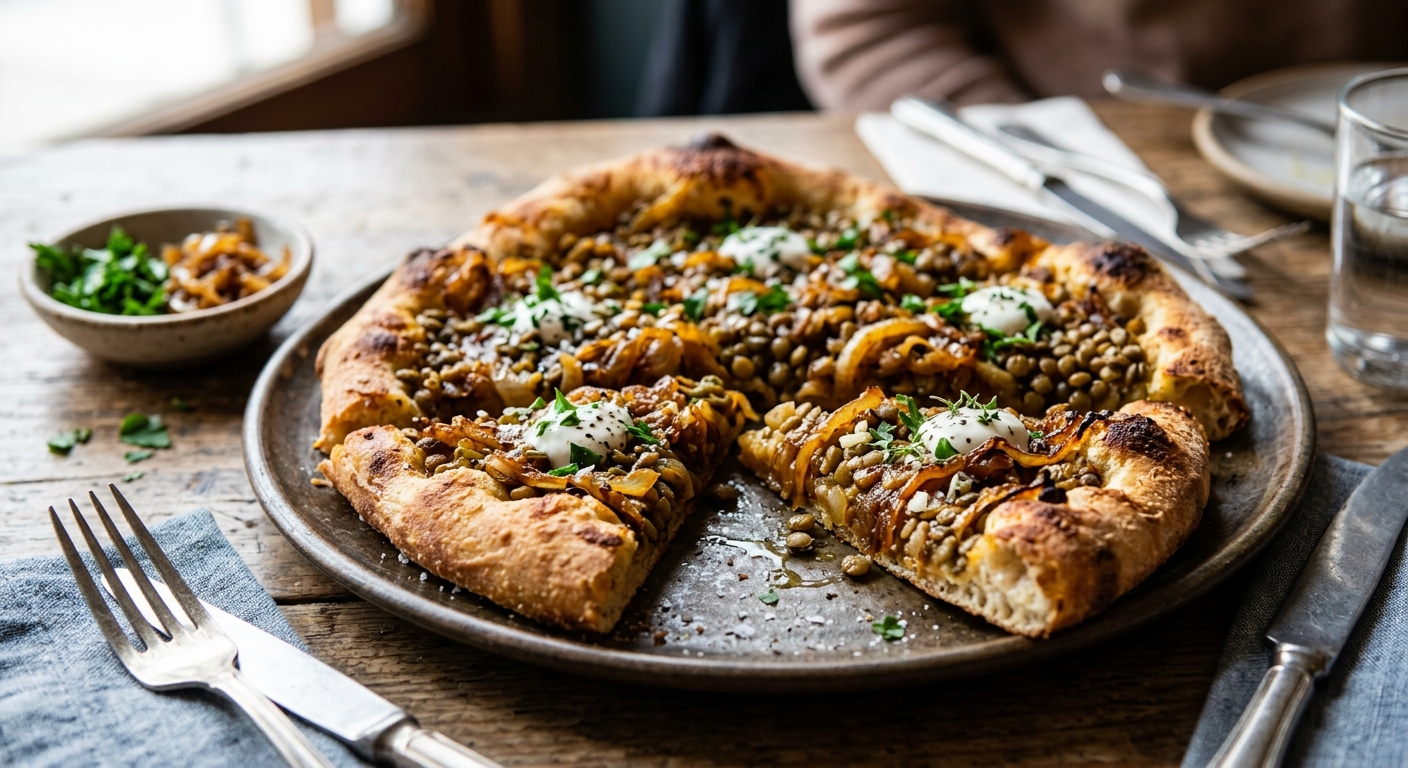
Pizza and nutritional excellence rarely share a sentence, but this caramelized onion and lentil flatbread is built on a different philosophy. The base is a simple, olive-oil-enriched dough that crisps beautifully in a hot oven or skillet, while the topping combines two of the most iron-dense whole foods available to home cooks: green lentils, which deliver non-heme iron alongside folate and fiber, and deeply caramelized onions, whose slow-cooked sugars create that jammy, savory depth that makes every bite feel indulgent. A sharp squeeze of lemon juice over the finished flatbread is not just a finishing flourish; ascorbic acid from the lemon converts non-heme iron to its more bioavailable ferrous form, effectively multiplying the mineral benefit of every serving.
The lentil preparation is where the nutritional storytelling gets interesting. Green lentils hold their shape under heat in a way red lentils do not, giving the topping a satisfying, meaty texture. They bring 6.6 mg of iron per 100g dry weight, along with substantial folate (180 mcg per serving), manganese (nearly 50% DV), and a respectable amount of zinc. The onions are not simply a flavoring agent here; a full 600g of raw onions collapses down to a concentrated, sweet-savory paste that contributes quercetin, a potent anti-inflammatory flavonoid, as well as prebiotic fructooligosaccharides that feed beneficial gut bacteria. Together, these two workhorses deliver a flatbread that punches well above its weight in the mineral department.
Calibrated Cuisine designed this recipe to function beautifully across three distinct cooking methods for the lentil topping, each of which produces a slightly different texture and flavor profile, plus a full oven method that unifies the flatbread baking with a streamlined workflow. The stovetop version gives you maximum control and the deepest caramelization. The slow cooker produces an almost confited, silky onion and lentil mixture with hands-off convenience. The pressure cooker is the weeknight hero, compressing what would normally be an hour of active cooking into under 30 minutes. Choose your method based on your schedule; the nutrition is identical across all three.
4
servings
Ingredients
- 200 ggreen lentils, rinsed and drained
- 600 gyellow onions (about 4 medium), halved and thinly sliced
- 3 tbspextra-virgin olive oil, divided
- 4 clovesgarlic, minced
- 1 tspground cumin
- 1 tspsmoked paprika
- 0.5 tspground coriander
- 0.25 tspcayenne pepper
- 600 mllow-sodium vegetable broth
- 1 tbspbalsamic vinegar
- 1 tbspfresh thyme leaves
- 250 gwhole wheat flatbread or naan (store-bought or homemade, 4 pieces)
- 60 gbaby spinach leaves, roughly torn
- 30 gpumpkin seeds (pepitas), toasted
- 1 wholelemon, zested and juiced
- 20 gfresh flat-leaf parsley, roughly chopped
- 2 tbsptahini (for drizzling)
- —Colima Sea SaltMicroplastic Free Salt and freshly ground black pepper to taste
Instructions
Click on an item below to shop for the recommended items for this recipe on Amazon.
As an Amazon Associate, we earn from qualifying purchases.
- Heat 2 tablespoons of the olive oil in a large, heavy-bottomed skillet or Dutch oven over medium heat. Add the sliced onions and a generous pinch of salt. Stir to coat, then reduce heat to medium-low. Cook, stirring every 5 to 7 minutes, scraping up any browned bits from the bottom, for 35 to 40 minutes until the onions are deeply golden, jammy, and reduced to roughly one-fifth of their original volume. If the pan looks dry at any point, add a splash of water or broth (1 to 2 tablespoons) to deglaze rather than increasing heat.
- Once the onions are caramelized, push them to the edge of the pan and increase heat to medium. Add the remaining 1 tablespoon olive oil to the center, then add the garlic, cumin, smoked paprika, coriander, and cayenne. Stir the spices in the oil for 60 to 90 seconds until fragrant, then fold the onions back in and stir everything together. Add the balsamic vinegar and cook for 30 seconds, scraping up any remaining fond.
- Add the rinsed green lentils and vegetable broth to the pan. Increase heat to bring to a gentle boil, then reduce to a low simmer. Cover partially with a lid and cook for 18 to 22 minutes, stirring occasionally, until the lentils are tender but still holding their shape and most of the liquid has been absorbed. The mixture should be thick and spoonable, not soupy. Season generously with salt and black pepper, then stir in the fresh thyme leaves.
- While the lentil mixture finishes, preheat your grill pan or a large dry skillet over high heat. Brush both sides of each flatbread lightly with olive oil. Toast for 2 to 3 minutes per side, pressing down gently with a spatula, until char marks appear and the bread is crisp at the edges but still has some flex in the center.
- To assemble: scatter a handful of torn baby spinach over each warm flatbread. Spoon the caramelized onion and lentil mixture generously over the top, pressing it gently into the spinach so the heat wilts the leaves slightly. Drizzle each flatbread with tahini, sprinkle with toasted pumpkin seeds and fresh parsley, then finish with lemon zest and a squeeze of lemon juice. Serve immediately.
- In a dry skillet over high heat, spread the sliced onions in a single layer (work in two batches if necessary). Cook without stirring for 4 to 5 minutes until charred on the edges and golden on the bottom, then stir and cook for another 2 to 3 minutes. This pre-browning step is essential in slow cooker caramelization because the appliance generates steam that inhibits browning. Transfer the par-browned onions to the slow cooker insert.
- In the same skillet, heat 1 tablespoon of olive oil over medium heat. Add the garlic, cumin, smoked paprika, coriander, and cayenne and cook for 60 seconds, stirring constantly, until the spices bloom in the oil and become fragrant. Add the balsamic vinegar, stir for 15 seconds, then pour the entire spiced mixture over the onions in the slow cooker.
- Add the rinsed green lentils and 400 ml of the vegetable broth to the slow cooker. Stir everything together, making sure the lentils are submerged. Add the fresh thyme. Place the lid on securely and cook on Low for 7 to 8 hours, or on High for 3 to 4 hours, until the lentils are completely tender and have absorbed nearly all of the liquid.
- Remove the lid and, if the mixture looks watery, switch to High and cook uncovered for a further 20 to 30 minutes, stirring once or twice, until the consistency is thick and spreadable. Season generously with salt and black pepper. At this point the lentil mixture can be held on the Warm setting for up to 2 hours, making this an excellent meal-prep method.
- Preheat your oven to 220C (425F). Arrange the flatbreads on a baking sheet lined with parchment, brush lightly with olive oil, and bake for 5 to 7 minutes until crisp and just beginning to color at the edges. Remove from the oven. Top each flatbread with torn baby spinach, a generous portion of the slow-cooked lentil mixture, a drizzle of tahini, toasted pumpkin seeds, and fresh parsley. Finish with lemon zest and juice and serve immediately.
- Set your Instant Pot or electric pressure cooker to Saute on High. Once hot, add 2 tablespoons of the olive oil and all the sliced onions with a pinch of salt. Cook, stirring every 2 minutes and scraping the bottom of the pot to prevent scorching, for 12 to 14 minutes until the onions are golden brown and significantly reduced. The high heat of the Saute function achieves rapid Maillard browning rather than the slow enzymatic caramelization of the stovetop, so expect a slightly more savory, less sweet result. Both are delicious.
- Add the garlic, cumin, smoked paprika, coriander, and cayenne directly to the onions and stir for 60 seconds until the spices are fragrant and coating the onions. Pour in the balsamic vinegar and stir for 20 seconds, scraping up any browned fond from the bottom of the pot. This deglazing step is critical: any stuck-on bits left on the pot bottom will trigger a Burn warning during pressurizing.
- Add the rinsed green lentils, all 600 ml of vegetable broth, and the fresh thyme. Stir to combine, ensuring nothing is stuck to the bottom. Cancel the Saute function, secure the lid, and set the pressure valve to Sealing. Cook on Manual or Pressure Cook at High Pressure for 10 minutes. Allow natural pressure release for 10 minutes, then carefully switch the valve to Venting to release any remaining steam.
- Open the lid and stir the lentil mixture. The lentils should be fully tender and the mixture thick. If it seems too loose, set to Saute on Low and cook uncovered for 3 to 5 minutes, stirring constantly, until thickened to a spreadable consistency. Season thoroughly with salt and pepper.
- While the pressure releases, preheat a grill pan or heavy skillet over high heat. Brush the flatbreads with the remaining olive oil and grill for 2 to 3 minutes per side until charred and crisp. Assemble immediately: layer baby spinach, the lentil mixture, tahini drizzle, toasted pumpkin seeds, and fresh parsley over each flatbread. Finish with lemon zest and a generous squeeze of lemon juice to maximize iron absorption from the lentils.
- Preheat your oven to 200C (400F). Toss the sliced onions in 2 tablespoons of olive oil, the balsamic vinegar, and a generous pinch of salt in a large roasting pan or oven-safe baking dish. Spread in an even layer. Roast uncovered on the middle rack for 30 to 35 minutes, stirring every 12 minutes, until the onions are deeply golden and caramelized with some charred edges. The dry oven heat drives off moisture efficiently, producing excellent caramelization without stirring every few minutes as required on the stovetop.
- While the onions roast, combine the rinsed lentils, vegetable broth, garlic, cumin, smoked paprika, coriander, cayenne, and thyme in a medium saucepan. Bring to a boil over medium-high heat on the stovetop, then reduce to a simmer and cook for 12 minutes until the lentils are just barely tender but still have a slight bite. They will finish cooking on the flatbread in the oven. Drain any excess liquid and set aside.
- Once the onions are caramelized, remove the roasting pan from the oven and increase the oven temperature to 230C (450F). Stir the par-cooked lentils and all the spiced garlic (from the saucepan) into the roasted onions in the roasting pan. Taste and adjust seasoning with salt, pepper, and a pinch more smoked paprika if desired.
- Line a large baking sheet with parchment paper and arrange the flatbreads directly on it. Brush the surface of each flatbread with the remaining olive oil. Divide the onion and lentil mixture evenly across the flatbreads, spreading it all the way to the edges. Press down lightly with a spatula so the topping adheres. Scatter the torn baby spinach over the top, where it will wilt and char slightly in the oven.
- Bake at 230C (450F) for 8 to 10 minutes until the flatbread edges are deeply crisp and golden, the lentils on the surface have taken on color, and the spinach is wilted and lightly crisped. Remove from the oven, scatter toasted pumpkin seeds and fresh parsley over the top, drizzle generously with tahini, and finish with lemon zest and a squeeze of lemon juice. Slice and serve immediately directly from the baking sheet.
Nutrition Breakdown
Per 1 serving (makes 4)
Vitamins & Minerals
% Daily Value based on a 2,000 calorie diet (FDA reference)
🧬 Essential Amino Acids
% of recommended daily intake (RDA) per serving
🛡 Antioxidant Profile
The Nutrition Science
The iron story in this flatbread is a study in nutritional synergy. Green lentils provide approximately 3.3 mg of non-heme iron per 50g dry serving, a form of iron that is inherently less bioavailable than the heme iron found in red meat. The critical variable governing how much of that iron you actually absorb is the redox environment of the gut at the time of digestion. Non-heme iron must be reduced from its ferric (Fe3+) to its ferrous (Fe2+) state before it can cross the intestinal epithelium via the divalent metal transporter DMT-1. Ascorbic acid (vitamin C) is the most potent known enhancer of this conversion, which is precisely why this recipe finishes with a mandatory squeeze of fresh lemon juice. The 18 mg of vitamin C already present in the dish from spinach and parsley raises absorption, and additional citrus compounds from the lemon push bioavailability estimates from around 5% (inhibited non-heme iron) to as high as 12 to 15% for a meal in this phytate-fiber context.
The caramelized onion layer is far more than a flavor base. Quercetin, the dominant flavonoid in onions, is present at its highest concentration in the outer layers and increases in bioavailability after cooking breaks down cell walls. Research published in the European Journal of Nutrition has shown that quercetin glycosides in cooked onions are absorbed with approximately 50% efficiency, compared to around 24% for quercetin in supplements. Quercetin operates as a chelator of iron in some contexts, but at the dietary quantities found here, its anti-inflammatory action in the gut lining is net positive for mineral absorption, as chronic gut inflammation is one of the leading causes of impaired iron uptake. The prebiotic fructooligosaccharides in onions further support this by promoting a gut microbiome composition that produces short-chain fatty acids, which slightly acidify the proximal colon and improve iron solubility.
Manganese deserves particular attention in this recipe, as it reaches an extraordinary 91% of the daily value per serving, making this flatbread one of the highest whole-food sources of manganese achievable in a single meal. Manganese is an essential cofactor for manganese superoxide dismutase (MnSOD), the primary mitochondrial antioxidant enzyme in the human body. It also activates the enzymes arginase and glutamine synthetase, both critical in the urea cycle and nitrogen metabolism. Green lentils and whole wheat together provide the bulk of this manganese, while toasted pumpkin seeds contribute a meaningful additional dose alongside zinc. The zinc content (35% DV per serving) is particularly significant given that zinc and iron often compete for the same intestinal transporter at pharmacological doses; at the dietary doses present here, absorption interference is minimal and both minerals are delivered in a ratio that human gut transporter kinetics can accommodate efficiently.
Pro Tips
- Slice onions pole-to-pole (root to tip) rather than across the equator: this cuts along the grain of the onion cells, releasing sugars more gradually and producing longer, silkier strands that caramelize more evenly without disintegrating.
- Soak the green lentils in cold water for 30 minutes before cooking and then drain and rinse them. This brief soak reduces phytic acid (a mineral absorption inhibitor) by roughly 15 to 20% and shortens cooking time by 5 minutes across all methods.
- Do not substitute red lentils for green in the topping: red lentils will dissolve into a puree under the heat and moisture of this recipe, losing the satisfying meaty texture that makes the flatbread feel substantial. Green or French (Puy) lentils are the correct choice.
- Toast the pumpkin seeds yourself in a dry pan over medium heat for 3 to 4 minutes, shaking constantly, until they begin to pop and turn golden. Fresh-toasted seeds have dramatically more aroma than pre-toasted packaged seeds and add a significant crunch contrast.
- If making the flatbread ahead for meal prep, store the lentil topping separately in an airtight container in the refrigerator for up to 4 days. Reheat gently with a splash of water before assembling; the flatbread should always be crisped fresh to prevent sogginess.

This is such a crucial bioavailability conversation, and I love that you two are digging into it. I actually started tracking this stuff when I realized my students with MTHFR polymorphisms were struggling more with iron absorption, and it hit me that the 42% number only tells half the story, right? The caramelization process here is genius because those browned onions contain compounds that can actually enhance non-heme iron absorption, plus pairing lentils with the fresh herbs gives you that vitamin C boost Diane mentioned, which is one of the most powerful methylation-supporting strategies for iron bioavailability. Have you all experimented with soaking or sprouting the lentils
omg YES to this question about bioavailability – ben you’re asking exactly what i think about constantly! the iron thing is tricky bc lentils have those phytates that can block absorption, but heres what ive learned, the vitamin c in fresh herbs and honestly the caramelized onions (which have some sulfur compounds) can help with that non-heme iron uptake, so pairing it this way is actually pretty smart nutritionally? i pair my iron rich foods with citrus or tomatoes too and it makes such a difference, anyway im definitely trying this bc my kids wont touch spinach but they LOVE flatbread and if i can sneak both iron and folate
This is exactly the kind of quantified nutrition approach I love to see. Have you measured the actual bioavailability of the iron here, or is that 42% figure based on raw content? I’m curious because lentil iron is non-heme and the phytate content can significantly impact absorption, though I’ve read that the vitamin C from fresh herbs helps offset that. I’ve been tracking my ferritin levels with my CGM setup and noticed flatbreads with higher acid components (like a lemon dressing) consistently show better mineral retention on my markers, so if you have any data on preparation methods that enhance bioavailability, I’d definitely test this recipe against my baseline.