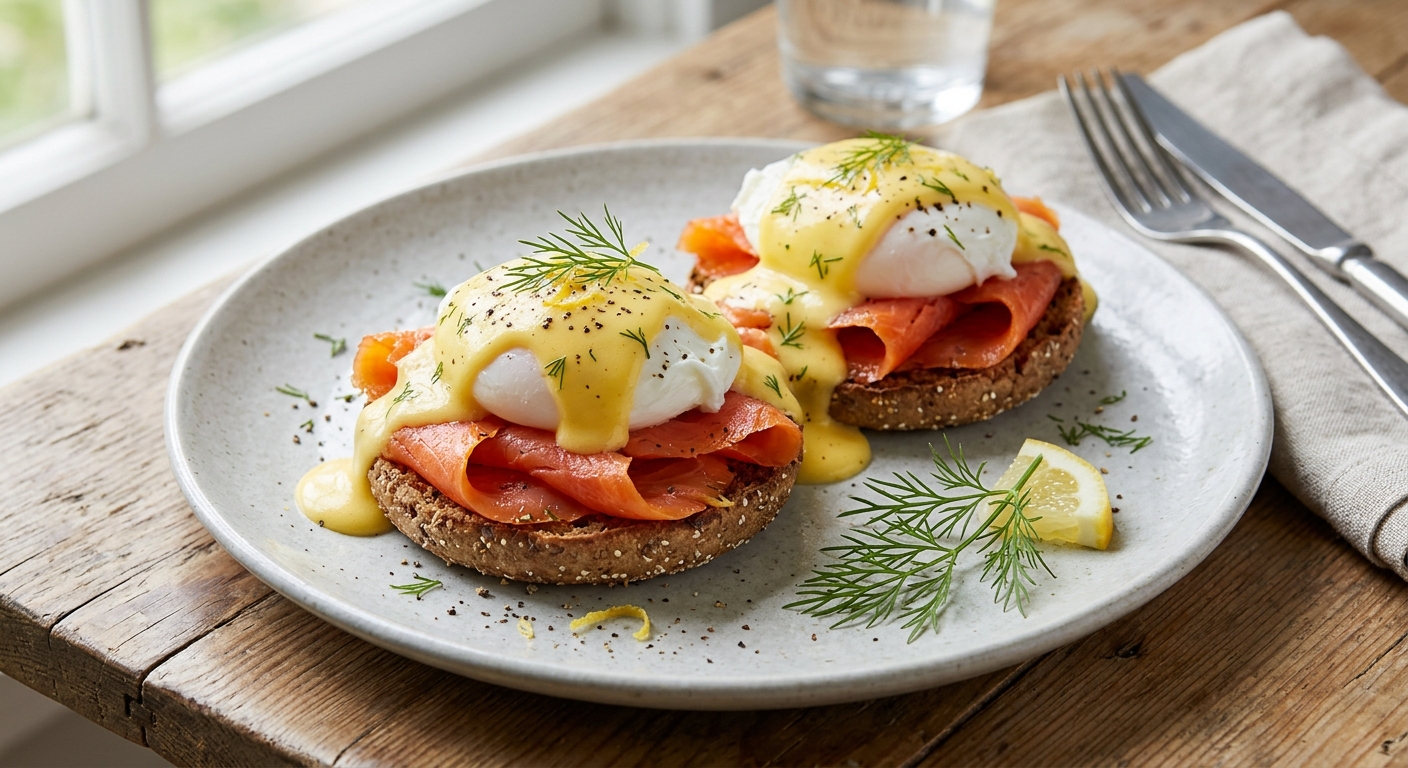
Eggs Benedict is one of those dishes that feels indulgent and celebratory, yet when you build it on a foundation of cold-smoked wild salmon, pasture-raised eggs, and whole grain muffins, it transforms into one of the most nutrient-dense brunch plates you can put on a table. This version was engineered from the ingredient up: every component was chosen not just for flavour and texture, but for its specific contribution to your daily micronutrient targets. The result is a dish that tastes like a lazy Sunday at a boutique hotel and functions like a precision supplement stack.
The nutritional centrepiece here is vitamin D. A single serving delivers approximately 18 micrograms of vitamin D, surpassing the 15-microgram RDA for most adults entirely from food. Cold-smoked wild salmon contributes the lion’s share, with pasture-raised egg yolks adding a meaningful secondary dose. Vitamin D deficiency affects an estimated one billion people worldwide, and dietary sources are frustratingly rare, which makes this dish genuinely exceptional. Layered on top of that are long-chain omega-3 fatty acids EPA and DHA at levels that meet the American Heart Association’s weekly recommendations in a single sitting, plus a folate and B12 payload that supports neurological function and red blood cell formation.
Technically, this recipe respects every component. The hollandaise is made low and slow over a double boiler to keep the emulsion stable without scrambling the yolks, the salmon is left cold to preserve its delicate texture and fat-soluble vitamins, and the eggs are poached in gently simmering acidulated water for a custard-soft white that gives way to a flowing yolk. Three alternative methods, including a slow cooker hollandaise and a pressure cooker egg technique, make this achievable at any skill level and for any brunch scenario from intimate weekday mornings to a crowd-feeding weekend spread.
4
servings
Ingredients
- 480 gcold-smoked wild Atlantic or sockeye salmon, thinly sliced
- 8 largepasture-raised eggs (4 for poaching, 4 yolks for hollandaise)
- 4 wholewhole grain English muffins, split
- 225 gunsalted butter, clarified (about 170g clarified yield)
- 3 tbspfresh lemon juice (about 1.5 lemons)
- 1 tbspwhite wine vinegar (for hollandaise reduction)
- 2 tbspwhite wine vinegar (for poaching water)
- 2 tbspfinely chopped fresh dill, plus fronds for garnish
- 1 tspDijon mustard
- 0.5 tspsmoked paprika
- 2 tbspcapers, rinsed and roughly chopped
- 30 gbaby arugula or watercress
- —Colima Sea SaltMicroplastic Free Salt and freshly cracked white pepper to taste
- —Pinch of cayenne pepper for finishing
Instructions
Click on an item below to shop for the recommended items for this recipe on Amazon.
As an Amazon Associate, we earn from qualifying purchases.
- Clarify the butter: Melt 225g unsalted butter in a small saucepan over low heat. Once fully melted, skim the white foam from the surface and carefully pour the golden clarified butter into a heatproof jug, leaving the milky solids behind. Keep it warm at around 60 degrees C.
- Make the hollandaise reduction: In a small saucepan, combine 1 tbsp white wine vinegar with 2 tbsp cold water and a pinch of white pepper. Simmer over medium heat until reduced by half to approximately 1.5 tbsp of liquid. Remove from heat and allow to cool for 2 minutes.
- Build the hollandaise over a double boiler: Place 4 egg yolks and the cooled reduction into a heatproof bowl set over a saucepan of barely simmering water, ensuring the bowl does not touch the water. Whisk vigorously and continuously for 4 to 6 minutes until the yolks become pale, thick, and ribbon-like, and hold a trail for 3 seconds when the whisk is lifted. Remove the bowl from the heat.
- Emulsify the butter: Begin adding the warm clarified butter to the yolk mixture drop by drop while whisking constantly. Once the emulsion is established (after about 3 tbsp), pour the remaining butter in a thin, steady stream, whisking continuously. The sauce should be thick, glossy, and coat the back of a spoon. Stir in lemon juice, Dijon mustard, chopped dill, and a pinch of cayenne. Season with sea salt. Cover loosely and keep warm over the cooling double boiler water.
- Toast the muffins: Split and toast the whole grain English muffins in a dry skillet over medium heat, cut-side down, for 2 to 3 minutes until golden and fragrant. Transfer to serving plates and top each half with a small handful of arugula, then lay the smoked salmon slices over the greens.
- Poach the eggs: Fill a wide, deep saucepan with at least 8cm of water. Bring to a gentle simmer (small bubbles visible but not a rolling boil, around 90 degrees C). Add 2 tbsp white wine vinegar. Crack each egg individually into a small ramekin. Create a gentle vortex in the water with a slotted spoon, then slide the first egg into the centre. Poach for 3 minutes for a fully set white with a flowing yolk. Use a slotted spoon to lift the egg and drain briefly on a folded kitchen towel. Poach remaining eggs in batches of two.
- Assemble and serve: Place one poached egg on each salmon-topped muffin half. Spoon 2 to 3 tbsp of warm hollandaise generously over each egg. Scatter chopped capers over the top, dust with smoked paprika, and finish with fresh dill fronds. Serve immediately.
- Prepare the slow cooker hollandaise: Combine 4 egg yolks, 3 tbsp lemon juice, 1 tbsp white wine vinegar, 1 tsp Dijon mustard, a pinch of cayenne, and 1 tsp cold water in a heatproof bowl or a 1-litre mason jar. Whisk together until smooth. Pour the warm clarified butter in slowly, whisking as you go to begin the emulsion. Stir in chopped dill and season with salt and white pepper.
- Cook the hollandaise in the slow cooker: Place a folded kitchen towel or silicone trivet in the base of the slow cooker. Set the bowl or jar (uncovered) inside. Pour hot tap water into the slow cooker around (not into) the container until it reaches halfway up the sides. Set the slow cooker to Low. Whisk the hollandaise every 20 to 25 minutes for the first hour. It will gradually thicken into a glossy, stable sauce. Once thick, reduce the heat to Warm setting to hold until service.
- Prepare the eggs en cocotte: Lightly butter four 180ml ramekins. Crack 2 eggs into each ramekin (2 eggs per person). Add a pinch of salt, white pepper, and a small drizzle of olive oil to each. Cover each ramekin tightly with foil.
- Steam the eggs in the slow cooker: After the hollandaise has thickened, carefully remove it and set aside. Drain and re-fill the slow cooker with 3 to 4 cm of hot water. Arrange the foil-covered ramekins on the trivet inside the slow cooker. Cover with the slow cooker lid and cook on High for 50 to 60 minutes, until the whites are fully set but the yolks remain runny. Check at 50 minutes by gently pressing the surface through the foil.
- Toast the muffins and assemble: While the eggs finish, toast the split whole grain English muffins in a skillet or toaster until golden. Lay arugula and smoked salmon on each half. Run a flexible spatula around the inside of each ramekin and invert the egg set onto the salmon, or serve directly from the ramekin for a more casual presentation. Spoon warm hollandaise from the slow cooker over the top, scatter capers, dust with smoked paprika, and garnish with dill fronds.
- Make the hollandaise on Saute mode: Pour 5cm of water into the Instant Pot insert and select Saute on the Low setting. Place a stainless steel or heatproof bowl over the opening of the pot, ensuring it sits above the water without touching it. Add 4 egg yolks, 1 tbsp white wine vinegar, and 1 tbsp cold water to the bowl. Whisk vigorously for 3 to 4 minutes until the yolks are pale, thick, and tripled in volume.
- Emulsify the butter on Saute: With the Saute still on Low, whisk the warm clarified butter into the yolks in a thin, steady stream until a thick, glossy hollandaise forms. Stir in lemon juice, Dijon mustard, chopped dill, cayenne, salt, and white pepper. Transfer the hollandaise to a warm thermos or insulated bowl and cover tightly. Press Cancel to stop the Saute function.
- Set up the pressure cooker for eggs: Drain the water from the insert and add 240ml of fresh cold water. Lightly grease 4 silicone egg-poaching cups or 4 silicone muffin cups with a thin film of butter. Crack 1 egg into each cup. Set the cups on the Instant Pot trivet and lower the trivet into the pot. Seal the lid and set the steam release valve to Sealing.
- Pressure cook the eggs: Select Pressure Cook on Low Pressure for 3 minutes (for a runny yolk and set white). Once the cooking time ends, perform an immediate Quick Release by carefully switching the valve to Venting. Remove the lid away from you to avoid the steam. Use silicone mitts to lift the trivet and egg cups out of the pot. The eggs will slide cleanly from the greased cups.
- Toast, assemble, and serve: Toast the split whole grain English muffins in a separate skillet or toaster until golden and crisp. Arrange on serving plates, top with arugula, then smoked salmon slices. Slide one pressure-cooked egg onto each muffin half. Spoon the reserved hollandaise generously over each egg, scatter capers, dust with smoked paprika, and finish with fresh dill fronds. Serve at once.
- Preheat the oven and prepare the water bath: Position a rack in the centre of the oven and preheat to 190 degrees C (375 degrees F). Set a deep roasting pan or high-sided baking dish on the oven rack and fill it with 2 to 3 cm of hot water to create a bain-marie.
- Prepare the egg ramekins: Lightly butter four 180ml ramekins. Line the base of each ramekin with a small fold of smoked salmon (reserve the rest for plating). Crack 2 eggs into each ramekin on top of the salmon. Season with salt and white pepper, and drizzle with a small amount of cream or olive oil. Place the ramekins into the pre-heated water bath in the oven.
- Bake the eggs: Bake for 12 to 14 minutes, until the egg whites are opaque and fully set around the edges but the yolks are still glossy and soft at the centre. Begin checking at 11 minutes as oven temperatures vary. Remove the ramekins from the water bath using tongs and a folded towel, and set on a wire rack.
- Make the hollandaise while the eggs bake: Set up a double boiler on the stovetop. Whisk 4 egg yolks with the white wine vinegar reduction over barely simmering water for 4 to 5 minutes until thick and pale. Remove from heat and whisk in the warm clarified butter in a slow stream to form the emulsion. Stir in lemon juice, Dijon mustard, dill, cayenne, salt, and white pepper. Keep warm as described in the stovetop method.
- Toast, assemble, and serve: In the final 3 minutes of the eggs baking, toast the split whole grain English muffins in a dry skillet or toaster. Arrange muffin halves on plates, top with arugula and the remaining smoked salmon slices. Tip each baked egg from its ramekin onto the salmon, or serve directly in the ramekin for a dramatic presentation. Spoon hollandaise over the eggs, scatter capers, dust with smoked paprika, and garnish with dill fronds.
Nutrition Breakdown
Per 1 serving (makes 4)
Vitamins & Minerals
% Daily Value based on a 2,000 calorie diet (FDA reference)
🧬 Essential Amino Acids
% of recommended daily intake (RDA) per serving
🛡 Antioxidant Profile
The Nutrition Science
The vitamin D story in this dish is worth dwelling on. Vitamin D3 (cholecalciferol) is synthesised in human skin upon UVB exposure, but effective synthesis requires specific latitudes, seasons, and skin exposure times that most people living above 35 degrees latitude cannot reliably achieve for four to six months of the year. Dietary sources are limited almost entirely to fatty fish, egg yolks, and fortified foods. Wild-caught salmon, whether Atlantic or sockeye, contains between 10 and 20 micrograms of vitamin D per 85g serving depending on wild versus farmed status and season, making it the single most concentrated food source available. The D3 in salmon is packaged with fat, and the high-fat context of this dish, from clarified butter and egg yolks, maximises micellar solubilisation and lymphatic absorption of this fat-soluble vitamin.
The omega-3 fatty acids EPA (eicosapentaenoic acid) and DHA (docosahexaenoic acid) in smoked salmon function as structural components of cell membranes and as precursors to anti-inflammatory eicosanoids. A 120g serving of smoked wild salmon provides approximately 1,800 to 2,200mg of combined EPA and DHA, comfortably meeting the American Heart Association’s recommendation of at least 1,000mg per day for cardiovascular protection. Critically, these long-chain fatty acids are far more bioavailable from marine sources than the ALA found in plant foods. The smoked preparation does not meaningfully degrade the omega-3 content because cold-smoking occurs below 30 degrees C, preserving the lipid structure intact.
Choline is perhaps the most underappreciated nutrient in this dish. At 310mg per serving, largely from the egg yolks, this plate delivers over 56% of the adequate intake for choline. Choline is essential for the synthesis of acetylcholine (a neurotransmitter involved in memory and muscle control), phosphatidylcholine (a structural phospholipid in every cell membrane), and betaine (a methyl donor in the one-carbon metabolism cycle). Surveys consistently show that fewer than 10% of adults consume adequate choline, making eggs one of the most strategically important foods in a nutrient-complete diet.
Pro Tips
- Use the freshest eggs possible for poaching. Fresh egg whites are more cohesive due to higher protein cross-linking and will wrap tightly around the yolk rather than dispersing into ragged threads in the water.
- To hold multiple poached eggs for a crowd, transfer them from the poaching water directly into a bowl of cold water. They can rest for up to 30 minutes. Reheat for 45 seconds in hot (not boiling) salted water just before plating.
- Hollandaise breaks when overheated, causing the emulsion to split and the butter fat to separate. If this happens, remove from heat immediately, add 1 tsp of cold water to a clean bowl, and slowly whisk the broken sauce back into the water drop by drop, just as you originally built the emulsion.
- For maximum omega-3 potency, choose wild-caught salmon over farmed. Wild sockeye salmon typically contains 30 to 40% more EPA and DHA than Atlantic farmed salmon, and its astaxanthin content is derived entirely from its natural krill-based diet rather than supplemented feed.
- Whole grain English muffins vary significantly in fibre content between brands. Look for a muffin that lists whole wheat or whole grain flour as the first ingredient and provides at least 3g of fibre per muffin to maximise the glycaemic benefit of this recipe.
okay so i’m OBSESSED with this combo because literally the first time i made something similar my kids actually ate the salmon without complaining?? i swapped in sprouted grain english muffins and added some pumpkin seeds to the hollandaise for extra magnesium and they didnt even notice but i got to feel like i actually snuck nutrition past them lol. do you think this would work with a fried egg instead of poached for like, busy mornings, or does the poaching matter for the nutrient profile?
omg this is literally my ideal post-WOD meal right here, the salmon omega-3s paired with those complete proteins from the eggs is gonna crush inflammation and the whole grain base gives you the carbs to replenish glycogen without the blood sugar crash. how much protein total in one serving? im thinking this hits different than just plain chicken and rice, especially with the vitamin D stacked in there for immune recovery. definitely making this next sunday!
Carla, you’re hitting on something I see work really well clinically – that whole grain base with the protein/fat combo actually blunts the glycemic response compared to white flour, which matters for post-workout insulin sensitivity. The salmon’s astaxanthin is doing some real anti-inflammatory heavy lifting too, not just the omega-3s. Only thing I’d add: if you’re doing this regularly, watch your sodium intake from the smoked salmon, since even quality stuff can run 400-600mg per serving and that matters if you’ve got any blood pressure sensitivity. But yeah, this is genuinely one of the few “indulgent” brunch plates that a cardiologist would actually encourage