
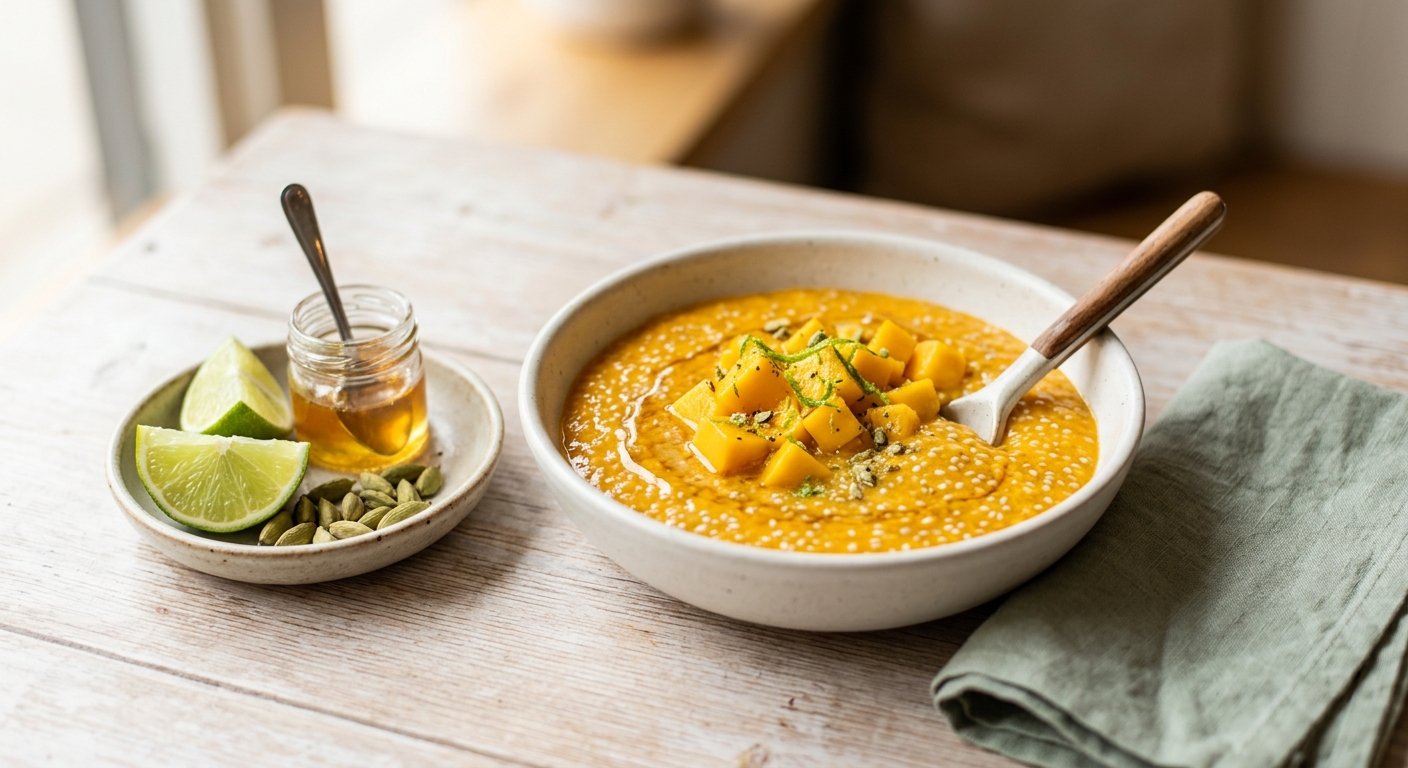
There is a reason mango lassi has been served at Indian tables for centuries: the combination of ripe mango, cool yogurt, and warm spice is one of the most naturally satisfying flavor compositions in world cuisine. This recipe takes that beloved drink and transforms it into a nutrient-dense chia pudding that delivers measurable, meaningful amounts of vitamins A, C, and calcium in a single serving. It is not health food disguised as dessert. It is genuinely both.
The chia seed base does the heavy nutritional lifting here. When soaked in a blend of full-fat plain yogurt and whole milk, chia seeds form a gel matrix that provides sustained energy, soluble fiber to blunt blood sugar spikes, and a scaffold for the calcium-rich dairy to cling to. The result is a pudding with a luxurious, almost panna-cotta-like texture that holds up for days in the refrigerator, making it one of the most practical meal-prep breakfasts in the Calibrated Cuisine repertoire.
The warm mango compote layer is where the vitamin story reaches its peak. A single 200g serving of ripe Alphonso or Ataulfo mango provides roughly 1680 mcg RAE of beta-carotene, translating to approximately 56% of the daily recommended intake for vitamin A. Add fresh lime juice and you stack a meaningful hit of vitamin C on top. Ground cardamom and a whisper of saffron do not just add depth of flavor: cardamom contains trace antioxidants including linalool and 1,8-cineole, while saffron contributes the carotenoid crocin, giving this pudding an antioxidant profile that very few breakfasts can match.
4
servings
Ingredients
- 400 gripe Alphonso or Ataulfo mango flesh, fresh or thawed from frozen (about 2 large mangoes)
- 480 gfull-fat plain yogurt (preferably whole-milk, unsweetened)
- 240 mlwhole milk
- 80 gwhite chia seeds
- 3 tbspraw honey or pure maple syrup, divided
- 2 tbspfresh lime juice (about 1 large lime)
- 1 tsplime zest
- 0.75 tspground cardamom
- 0.25 tspground turmeric
- 1 pinchsaffron threads (about 20 threads), bloomed in 1 tbsp warm water
- 1 tsppure vanilla extract
- 200 mlfresh mango juice or mango nectar (for the compote)
- 1 tbspcornstarch
- —Toasted unsweetened coconut flakes, for garnish
- —Fresh mint leaves, for garnish
- —Pinch of Colima Sea SaltMicroplastic Free Salt
Instructions
Click on an item below to shop for the recommended items for this recipe on Amazon.
As an Amazon Associate, we earn from qualifying purchases.
- Make the chia base first: in a large mixing bowl, whisk together the yogurt, whole milk, 2 tablespoons of honey, vanilla extract, lime zest, and the bloomed saffron water (including the threads). Whisk until completely smooth and the saffron color is evenly distributed, about 90 seconds.
- Add the chia seeds to the yogurt mixture and whisk vigorously for 1 full minute to ensure no clumping. Let the mixture sit for 5 minutes, then whisk again. Divide evenly among four 300ml jars or glasses. Cover tightly with plastic wrap and refrigerate for a minimum of 4 hours, or overnight. The pudding is ready when it holds its shape and the chia seeds have fully hydrated into a thick, spoonable gel.
- When ready to serve, make the mango compote: combine 300g of the mango flesh and the mango juice in a small saucepan over medium heat. Cook, stirring occasionally, until the mango softens and begins to break down, about 5 minutes.
- In a small bowl, whisk the cornstarch with 2 tablespoons of cold water until smooth. Add to the saucepan along with the remaining 1 tablespoon of honey, lime juice, cardamom, turmeric, and a pinch of sea salt. Stir constantly over medium heat until the compote thickens and becomes glossy, about 3 to 4 more minutes. Remove from heat and allow to cool for 10 minutes. The compote should be pourable but have distinct body.
- Dice the remaining 100g of raw mango into small cubes. Spoon the warm or room-temperature mango compote generously over each chilled chia pudding. Top with fresh mango cubes, toasted coconut flakes, and a sprig of fresh mint. Serve immediately or refrigerate the compote separately for up to 3 days.
- Prepare the chia pudding base exactly as in the Stovetop method: whisk yogurt, whole milk, 2 tablespoons of honey, vanilla, lime zest, and bloomed saffron together until smooth, then fold in chia seeds with a vigorous whisk, rest 5 minutes, whisk again, and divide into four jars. Refrigerate for at least 4 hours.
- For the slow cooker mango compote, add 350g of the mango flesh directly into the slow cooker insert. Pour in the mango juice, add the remaining 1 tablespoon of honey, cardamom, turmeric, lime juice, and a pinch of sea salt. Stir briefly to combine. Do not add the cornstarch yet as prolonged cooking breaks down its thickening power.
- Cook on Low for 2 hours with the lid slightly ajar (prop it open with a wooden spoon handle). The mango will collapse completely and the liquid will concentrate. Stir once at the 1-hour mark. The compote is ready when it is thick enough to fall from a spoon in slow, heavy ribbons.
- Transfer the compote to a blender or use an immersion blender to puree until silky smooth. Return to the slow cooker insert (switched off) and stir in the cornstarch whisked with 2 tablespoons of cold water. Switch the slow cooker to High for 10 minutes, stirring twice, until the compote glosses up from the cornstarch. The residual heat is sufficient to activate the starch without a separate saucepan.
- Allow the compote to cool to room temperature (it will continue to thicken as it cools). Dice the remaining 50g of raw mango. Spoon the compote over the chilled chia puddings, finish with fresh mango, coconut flakes, and mint. The slow cooker compote can be stored in a sealed jar in the refrigerator for up to 5 days and tastes even better the next day.
- Prepare and refrigerate the chia pudding base first: whisk yogurt, whole milk, 2 tablespoons of honey, vanilla, lime zest, and bloomed saffron until uniform. Stir in chia seeds with vigorous whisking, rest 5 minutes, whisk once more, then pour into four jars. Seal and refrigerate for at least 4 hours.
- For the pressure cooker compote, add 350g of mango flesh, mango juice, 1 tablespoon of honey, cardamom, turmeric, lime juice, and a pinch of sea salt into the pressure cooker insert. Stir to combine. Do not add cornstarch before pressure cooking as it can cause scorching on the bottom and produce a BURN warning on electric models.
- Secure the lid and set the valve to Sealing. Cook on High Pressure for 3 minutes. Allow a natural pressure release for 5 minutes, then carefully switch the valve to Venting to release any remaining steam. Open the lid away from you. The mango will have transformed into a concentrated, steaming, deeply aromatic puree.
- Use an immersion blender directly in the insert to blitz the compote smooth, or transfer to a countertop blender. Return to the insert and switch the pressure cooker to Saute mode (medium heat). Whisk cornstarch with 2 tablespoons of cold water until smooth and stir into the bubbling compote. Cook on Saute, stirring constantly, for 2 to 3 minutes until thickened and glossy. Press Cancel to stop the heat.
- Cool the compote for 10 minutes. Dice the remaining 50g of raw mango. Remove the chia pudding jars from the refrigerator, spoon the warm compote over each one, and finish with diced fresh mango, toasted coconut flakes, and fresh mint. The pressure cooker method produces the most intensely flavored compote of all three methods.
Nutrition Breakdown
Per 1 serving (makes 4)
Vitamins & Minerals
% Daily Value based on a 2,000 calorie diet (FDA reference)
🧬 Essential Amino Acids
% of recommended daily intake (RDA) per serving
🛡 Antioxidant Profile
The Nutrition Science
The vitamin A story in this pudding begins with beta-carotene, a provitamin A carotenoid that the small intestine converts to retinol via the enzyme beta-carotene 15,15-monooxygenase. Alphonso mangoes are among the most concentrated food sources of beta-carotene available, providing roughly 1.8mg per 100g of edible flesh. Fat significantly enhances carotenoid absorption because beta-carotene is lipophilic and depends on bile-salt micelles for intestinal uptake. The full-fat yogurt and whole milk in this recipe are not incidental: they are a deliberate formulation choice to maximize the bioavailability of every microgram of the provitamin A you are consuming. Studies have shown that adding as little as 3 to 5 grams of dietary fat to a carotenoid-rich meal can increase absorption threefold compared to a fat-free version of the same meal.
Chia seeds are the structural backbone of this recipe, but they are also doing serious nutritional work. At 80g across four servings, they contribute approximately 2.6g of alpha-linolenic acid (ALA) per serving, representing over 160% of the adequate intake for omega-3 fatty acids. They are also the primary source of magnesium (around 95mg per serving), which plays a critical co-factor role in over 300 enzymatic reactions including those governing vitamin D metabolism, a nutrient that works in tandem with the calcium delivered by the yogurt and milk. The calcium in dairy is among the most bioavailable dietary calcium sources, with an absorption fraction of roughly 32%, compared to around 20 to 25% for most plant sources.
The spice trio of cardamom, turmeric, and saffron deserves more than a footnote. Turmeric’s curcuminoids are poorly absorbed on their own, but when consumed with fat (present here from yogurt) and heat (applied during compote cooking), bioavailability improves substantially. Saffron’s crocin has attracted serious attention in clinical literature for its effects on mood regulation and cognitive function, with one meta-analysis noting effects comparable to low-dose SSRIs in mild depression. Cardamom contains the monoterpenes 1,8-cineole and alpha-terpinyl acetate, which have demonstrated antimicrobial activity in vitro. Taken together, this pudding is not just a source of macronutrients: it is a concentrated delivery system for bioactive plant compounds that work synergistically at the cellular level.
Pro Tips
- For the silkiest chia pudding texture, use white chia seeds rather than black. Both are nutritionally equivalent, but white chia seeds hydrate slightly more evenly and produce a more uniform, pale golden color that lets the saffron hue shine through.
- Bloom the saffron in warm (not boiling) water for at least 10 minutes before adding it. The water should turn a deep amber-orange. This step extracts the water-soluble crocin pigment and safranal aroma compounds far more efficiently than adding dry threads directly to the pudding.
- If using frozen mango for the compote, do not thaw it fully before cooking. Adding semi-frozen mango to the saucepan or pressure cooker gives the fruit a fresher, brighter flavor because it spends less total time at temperature, preserving more of its volatile aromatic esters.
Oh, this is exactly the kind of recipe I’m planning to feature in next month’s class! I’ve made traditional mango lassis for years, but I love how you’ve incorporated the chia seeds to boost the calcium and create that creamy texture without relying on condensed milk like older recipes do. The fact that one bowl delivers such concentrated micronutrients really shows how thoughtful ingredient selection beats calorie counting every time. I’m curious whether you’ve found the Alphonso mangoes work better than other varieties for the beta-carotene content, or if that’s more about their flavor profile?
This sounds absolutely delicious, and I’m really curious about a couple things before I try it! Since I manage Hashimoto’s, I need to be careful with iodine levels in dairy and chia seeds, and I’m wondering if you have any data on the iodine content here? Also, would this work if I swapped the yogurt for coconut yogurt and used a non-dairy milk, or would that significantly impact those calcium numbers you mentioned? I’ve been experimenting with AIP-friendly versions of creamy puddings and mango is such a bright, naturally sweet way to make them feel indulgent without the inflammation triggers.
Love this recipe idea for postpartum recovery, honestly! The full-fat yogurt and chia combo is such a win for both DHA and choline (especially if you use whole milk yogurt), and that mango vitamin C helps with iron absorption during the healing phase. I’ve been experimenting with adding a tablespoon of ground flax to similar puddings to bump up the omega-3s, since so many of us are borderline deficient postpartum and it affects milk supply and baby’s brain development. Have you calculated the choline content here, or would you consider that in a future nutritional breakdown?