
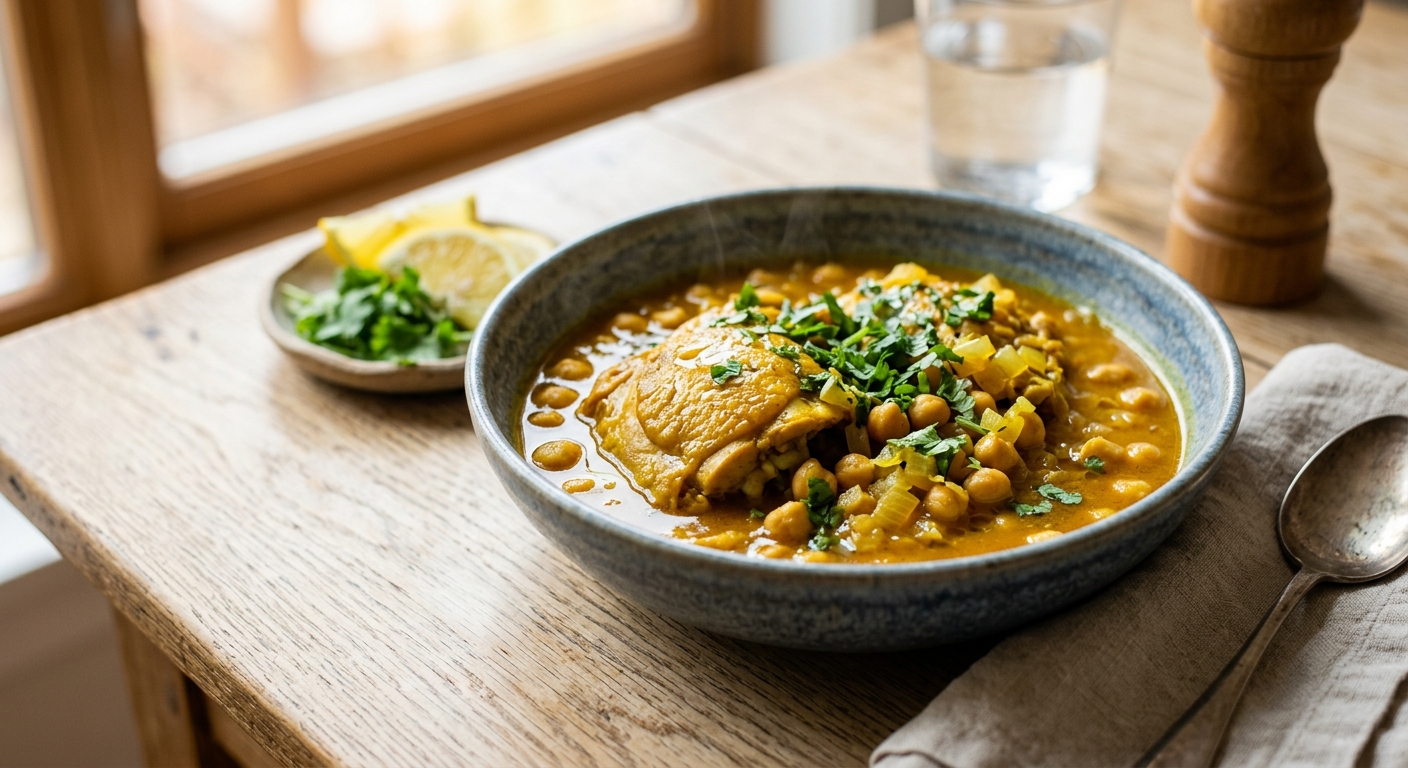
Some dishes earn their place on the table by taste alone. Others earn it by what they do for your body. This Turmeric Chicken and Chickpea Stew does both without compromise. The base is built on a soffritto of onion, garlic, and ginger, bloomed with ground turmeric, cumin, coriander, and smoked paprika in hot olive oil, a technique that dramatically increases the bioavailability of fat-soluble curcuminoids. Bone-in, skin-off chicken thighs are seared until deeply golden before the chickpeas, tomatoes, and stock are added, creating a broth that is simultaneously rich, bright, and complex.
Chickpeas are the unsung nutritional heroes of this stew. A single serving provides roughly 30% of your daily folate needs and a meaningful hit of plant-based iron, while the chicken thighs contribute heme iron that your body absorbs at three to four times the rate of non-heme sources. Finishing the stew with a full 90g of baby spinach per serving and a squeeze of fresh lemon juice is not a garnish choice; it is a deliberate nutritional decision. The vitamin C in the lemon accelerates non-heme iron absorption by up to 67%, and the heat from the stew wilts the spinach just enough to concentrate its folate and beta-carotene without destroying them.
Whether you build this on the stovetop in under an hour, let a slow cooker do the work overnight, or have it on the table in 35 minutes via a pressure cooker, the result is a stew that tastes like it took all day and performs like a daily multivitamin in bowl form. This is Calibrated Cuisine at its most purposeful: every ingredient chosen for flavour and function, every technique designed to maximise what you get from each bite.
4
servings
Ingredients
- 900 gbone-in, skin-off chicken thighs (about 4 large)
- 3 tbspextra-virgin olive oil, divided
- 1 largeyellow onion, finely diced
- 5 clovesgarlic, minced
- 30 gfresh ginger, peeled and finely grated
- 2 tspground turmeric
- 1.5 tspground cumin
- 1 tspground coriander
- 1 tspsmoked paprika
- 0.25 tspground black pepper (to activate curcumin)
- 0.25 tspcayenne pepper (optional, for heat)
- 400 gcanned chickpeas, drained and rinsed (one 400g can)
- 400 gcanned fire-roasted crushed tomatoes (one 400g can)
- 480 mllow-sodium chicken stock
- 240 mlfull-fat coconut milk
- 120 gbaby spinach
- 1 tbspfresh lemon juice, plus wedges for serving
- 15 gfresh cilantro, roughly chopped
- —Colima Sea SaltMicroplastic Free Salt and freshly ground black pepper to taste
Instructions
Click on an item below to shop for the recommended items for this recipe on Amazon.
As an Amazon Associate, we earn from qualifying purchases.
- Pat the chicken thighs completely dry with paper towels and season both sides generously with salt and pepper. Drying the surface is critical for achieving a proper sear rather than steaming.
- Heat 2 tablespoons of olive oil in a large, heavy-bottomed Dutch oven or braising pan over medium-high heat until shimmering. Add the chicken thighs in a single layer, smooth-side down. Sear without moving them for 4 to 5 minutes until a deep golden-brown crust forms. Flip and sear the other side for 3 minutes. Work in batches if needed to avoid crowding. Transfer seared chicken to a plate and set aside. The chicken will not be cooked through at this stage.
- Reduce the heat to medium. Add the remaining 1 tablespoon of olive oil to the same pot. Add the diced onion and a pinch of salt. Cook, stirring occasionally and scraping up any brown bits from the chicken, for 5 to 6 minutes until the onion is soft and translucent. Add the garlic and grated ginger and cook for 90 seconds until fragrant.
- Add the turmeric, cumin, coriander, smoked paprika, black pepper, and cayenne (if using) directly to the onion mixture. Stir constantly for 60 to 90 seconds, toasting the spices in the residual oil. This step blooms fat-soluble curcuminoids and dramatically improves both flavour and bioavailability. The mixture will be very fragrant and deeply golden.
- Pour in the fire-roasted crushed tomatoes and stir to combine with the spice paste. Cook for 2 minutes until the tomatoes darken slightly and the mixture thickens. Add the drained chickpeas, chicken stock, and coconut milk. Stir well to incorporate everything.
- Nestle the seared chicken thighs back into the pot, submerging them as much as possible in the liquid. Bring the stew to a gentle boil, then reduce heat to low, partially cover the pot, and simmer for 25 to 30 minutes until the chicken is cooked through and registers 74 degrees Celsius (165 degrees Fahrenheit) on an instant-read thermometer.
- Remove the chicken thighs and place them on a cutting board. Use two forks to pull the meat from the bone, shredding it into large, rustic chunks. Discard the bones. Return the shredded chicken to the pot.
- Add the baby spinach in two or three large handfuls, stirring gently between additions until each batch wilts into the stew, about 1 to 2 minutes total. Stir in the lemon juice and taste for seasoning, adjusting salt and pepper as needed. Ladle into bowls and top with fresh cilantro and lemon wedges.
- Season the chicken thighs on both sides with salt and pepper. If time permits, heat 2 tablespoons of olive oil in a large skillet over medium-high heat and sear the chicken for 4 minutes per side until golden. This step is optional for the slow cooker but adds substantial flavour. Transfer to the slow cooker insert.
- In the same skillet (or in a fresh pan with 1 tablespoon of oil if skipping the sear), cook the diced onion over medium heat for 4 minutes until softened. Add the garlic and ginger and cook for 60 seconds. Add the turmeric, cumin, coriander, smoked paprika, black pepper, and cayenne. Stir over the heat for 60 seconds until the spices are bloomed and fragrant. Scrape the entire onion and spice mixture into the slow cooker insert over the chicken.
- Add the drained chickpeas, fire-roasted crushed tomatoes, and chicken stock directly to the slow cooker. Stir gently to distribute everything around the chicken. Do not add the coconut milk or spinach at this stage, as prolonged heat causes coconut milk to separate and spinach to lose colour and texture.
- Place the lid on the slow cooker. Cook on Low for 6 to 8 hours or on High for 3 to 4 hours. The chicken is done when it pulls away from the bone effortlessly and the broth is deeply flavoured and slightly thickened from the chickpea starch.
- Remove the chicken thighs and shred the meat from the bone using two forks. Discard the bones. Return the shredded chicken to the slow cooker. Stir in the coconut milk and increase the setting to High if on Low. Replace the lid and cook for a further 10 minutes until the coconut milk is fully incorporated and the stew is hot.
- Turn off the slow cooker. Add the baby spinach in large handfuls, stirring gently until it wilts from the residual heat, about 2 to 3 minutes. Stir in the lemon juice, taste, and adjust seasoning. Serve topped with fresh cilantro and lemon wedges.
- Set the Instant Pot or electric pressure cooker to Saute mode on High. Add 2 tablespoons of olive oil and heat until the display reads Hot. Season chicken thighs with salt and pepper. Working in batches, sear the chicken smooth-side down for 3 to 4 minutes until golden, then flip for 2 minutes. Transfer to a plate. This step is highly recommended in a pressure cooker as it builds the flavour foundation in the same pot.
- Add the remaining 1 tablespoon of olive oil to the pot. Add the diced onion and cook on Saute for 3 minutes, scraping up any brown bits from the bottom of the pot with a wooden spoon. These bits must be fully deglazed or the pressure cooker may trigger a Burn warning. Add the garlic and ginger and cook for 60 seconds. Add all the dry spices (turmeric, cumin, coriander, paprika, black pepper, cayenne) and stir constantly for 45 seconds until bloomed.
- Pour in the fire-roasted crushed tomatoes and stir vigorously to deglaze any remaining fond from the bottom of the pot. This is your final opportunity to prevent a Burn warning. Add the reduced amount of chicken stock (360ml) and the drained chickpeas. Stir to combine. Do not add the coconut milk before pressure cooking, as dairy and coconut milk can scorch under pressure.
- Nestle the seared chicken thighs into the liquid. Secure the lid and set the valve to Sealing. Cancel Saute mode and select Pressure Cook (or Manual) on High Pressure for 12 minutes. It will take approximately 8 to 10 minutes for the pot to come to pressure before the countdown begins.
- When the cook time ends, allow a natural pressure release for 10 minutes, then carefully switch the valve to Venting to release any remaining pressure. Open the lid away from you. Remove the chicken thighs and shred the meat from the bone. Return the shredded chicken to the pot.
- Set the pot back to Saute mode on Normal. Stir in the coconut milk and simmer for 3 to 4 minutes until the stew is heated through and reaches your desired consistency. Turn off Saute mode. Add the baby spinach and stir until wilted, about 1 to 2 minutes. Stir in the lemon juice and adjust seasoning. Serve immediately with cilantro and lemon wedges.
- Preheat your oven to 175 degrees Celsius (350 degrees Fahrenheit) with a rack positioned in the lower third. Pat chicken thighs dry and season both sides with salt and pepper.
- Heat 2 tablespoons of olive oil in a large oven-safe Dutch oven over medium-high heat on the stovetop until shimmering. Sear the chicken thighs smooth-side down for 5 minutes until deeply golden and crusted. Flip and sear for 3 minutes on the second side. Transfer to a plate. The oven braise rewards a thorough sear; take your time here.
- Reduce stovetop heat to medium. Add the remaining tablespoon of oil, then the diced onion and a pinch of salt. Cook for 5 minutes until softened. Add the garlic and ginger and stir for 90 seconds. Add the turmeric, cumin, coriander, smoked paprika, black pepper, and cayenne. Toast the spices, stirring constantly, for 90 seconds until the kitchen smells intensely fragrant and the mixture is a vivid amber paste.
- Add the crushed tomatoes and stir into the spice paste. Cook for 3 minutes on the stovetop until the tomatoes reduce slightly and the paste darkens. Add the drained chickpeas, the full 480ml of chicken stock, and the coconut milk. Stir to combine and bring to a gentle simmer.
- Nestle the seared chicken thighs into the broth, bone-side up, so the meat sits partially submerged. Place the lid on the Dutch oven and carefully transfer it to the preheated oven. Braise for 45 minutes, then remove the lid and continue cooking uncovered for a further 10 minutes to allow the surface to reduce and concentrate slightly.
- Remove the Dutch oven from the oven using heavy oven mitts. Check that the chicken registers 74 degrees Celsius (165 degrees Fahrenheit) at the thickest part. Remove the thighs, shred the meat from the bone, and return the chicken to the pot. The broth will be noticeably richer and more deeply coloured than the stovetop version.
- Place the Dutch oven back on the stovetop over low heat. Add the baby spinach in batches and stir gently until wilted. Stir in the lemon juice and adjust salt and pepper. Serve directly from the Dutch oven at the table, topped with fresh cilantro and lemon wedges.
Nutrition Breakdown
Per 1 serving (makes 4)
Vitamins & Minerals
% Daily Value based on a 2,000 calorie diet (FDA reference)
🧬 Essential Amino Acids
% of recommended daily intake (RDA) per serving
🛡 Antioxidant Profile
The Nutrition Science
The anti-inflammatory power of this stew is not accidental; it is stacked. Turmeric’s active compound, curcumin, is famously poorly absorbed on its own. This recipe addresses that directly in two ways: the spices are bloomed in olive oil (curcumin is fat-soluble, and dietary fat increases absorption by up to 8-fold), and black pepper is included deliberately, as its piperine content has been shown in pharmacokinetic studies to increase curcumin bioavailability by approximately 2,000% by inhibiting hepatic and intestinal glucuronidation. At 2 teaspoons of turmeric across four servings, each bowl delivers a clinically relevant dose of roughly 180mg of curcuminoids.
The iron story in this stew is equally well-engineered. Chicken thighs provide heme iron (found in haemoglobin and myoglobin), which is absorbed at a rate of 15 to 35% regardless of other dietary factors. The chickpeas provide non-heme iron, which is normally absorbed at only 2 to 20%, but that rate climbs sharply in the presence of vitamin C. The lemon juice added at the end of cooking supplies roughly 9mg of vitamin C per serving, and the wilted spinach contributes an additional 15mg. Research published in the American Journal of Clinical Nutrition confirms that 25mg to 75mg of vitamin C consumed simultaneously with a non-heme iron source can increase its absorption by 67%. This is why finishing with lemon juice is a nutritional imperative, not a flavour afterthought.
Coconut milk does more than add richness. The medium-chain triglycerides (MCTs) it contains, primarily lauric acid and caprylic acid, serve as a second lipid vehicle for the fat-soluble carotenoids, specifically the beta-carotene from spinach and lycopene from the tomatoes. Studies show that carotenoid absorption is negligible without concurrent fat intake; a 2004 study in the Journal of Nutrition demonstrated that adding avocado oil to a salad increased beta-carotene absorption by 13.6-fold compared to a fat-free dressing. Full-fat coconut milk performs a similar function here, ensuring that the vivid colour you see in the bowl translates into genuine nutritional benefit at the cellular level.
Pro Tips
- Use fire-roasted crushed tomatoes rather than standard crushed tomatoes. The dry-heat roasting process increases the lycopene content by breaking down the cellular matrix of the tomato and concentrating available carotenoids by 25 to 35% compared to raw tomatoes.
- Do not add the lemon juice during cooking. Vitamin C is heat-sensitive and degrades rapidly above 70 degrees Celsius. Adding it off the heat or just before serving preserves the maximum amount available to enhance iron absorption.
- Store leftover stew in an airtight container in the refrigerator for up to 4 days, or freeze in individual portions for up to 3 months. The flavour improves significantly on day two as the spices continue to bloom in the residual fat. Reheat gently over medium-low heat to preserve the spinach texture.

That’s impressive about your eight year consistency with turmeric, Irene – I’m curious if you’ve noticed the anti-inflammatory effects compound over time or if they plateau? I ask because I started looking into curcumin absorption about two years ago when I ramped up my resistance training at 62, and learned that pairing it with black pepper and fat (like the chicken thighs in this recipe) makes a real difference in bioavailability. What I really like about this stew though is the chickpea protein – at roughly 15g per cup cooked, it hits around 2.5g of leucine, which is right at that threshold for muscle protein synthesis in older adults, especially
Oh, this is exactly the kind of recipe I’ve been waiting to see! I’ve been using turmeric consistently for about eight years now to manage my RA, and I’ve noticed such a real difference in my joint pain and CRP levels when I eat it regularly, especially in dishes like this where it’s combined with other anti-inflammatory powerhouses. The chickpeas plus spinach for iron absorption is brilliant, and I’m thrilled you highlighted the curcumin content, not just the trendy factor. I’ll definitely be making this, though I’m planning to add some extra virgin olive oil at the end and maybe a squeeze of lemon to boost the curcumin bioavailability since that’s
This is going straight into my next class rotation, and I’m already thinking about how to build a whole lesson around the iron bioavailability here – that combination of heme iron from the chicken thighs plus the vitamin C from tomatoes and spinach is exactly what I used to accidentally do in my old recipes decades ago, but now I can actually explain the science to my students! Irene, your eight year consistency with turmeric is inspiring, and Steve, that’s such a smart question about absorption because I’ve found that adding a bit of black pepper and a healthy fat (like the chicken) makes a real difference in how people respond to their turmeric dishes.