
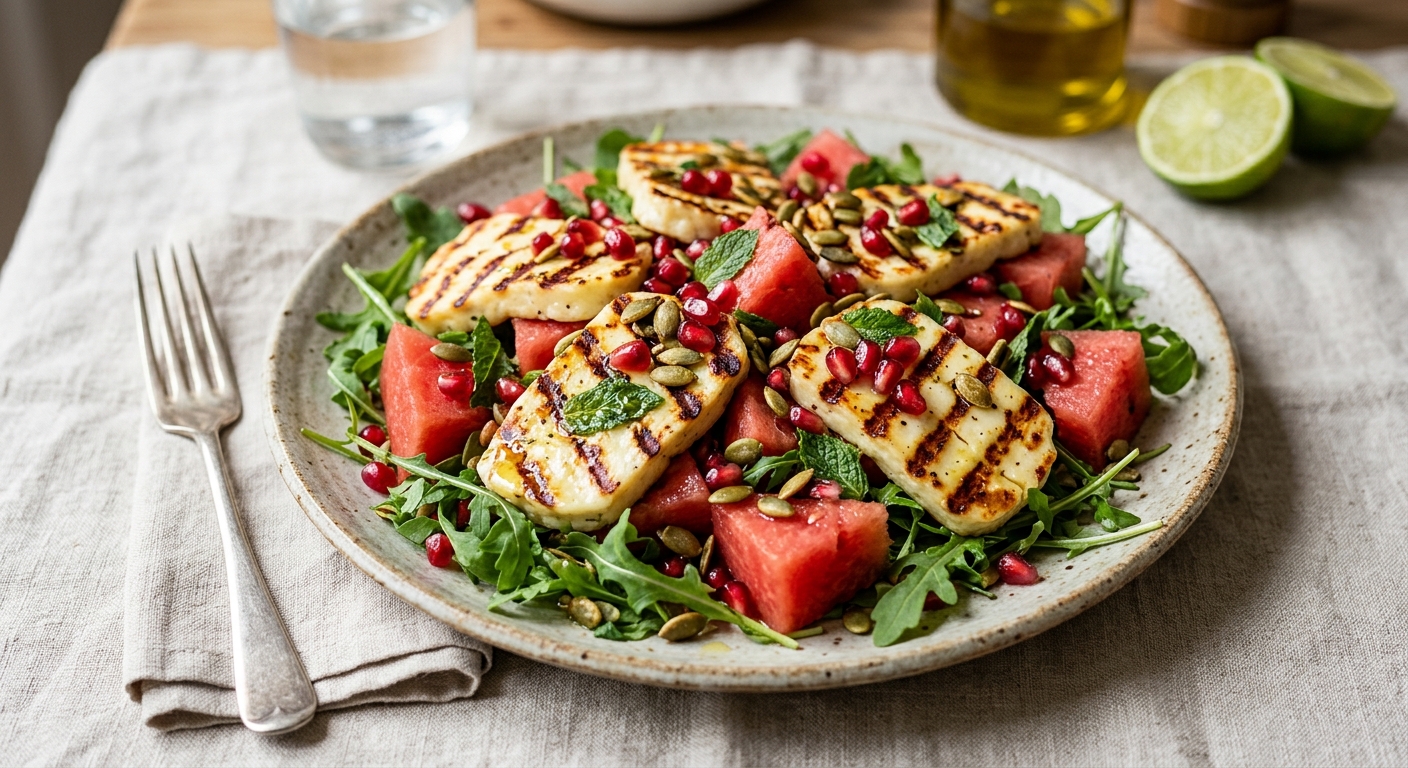
There are few flavour pairings in the culinary world as unexpectedly perfect as salty halloumi cheese and sweet, ice-cold watermelon. The contrast is electric: caramelised, squeaky cheese against cool, crisp fruit, all tied together with fresh mint, peppery rocket, and a punchy honey-lime vinaigrette. This is the salad you bring to a summer gathering and watch disappear in minutes. But beyond its showstopping looks and flavour, this dish is one of the most efficient calcium delivery systems you can put on a plate.
Halloumi is made primarily from sheep’s milk, sometimes blended with goat’s milk, and it is extraordinarily dense in calcium. A 100-gram serving provides roughly 700 mg of calcium, nearly 54% of the recommended daily intake before you have even considered the other ingredients. Unlike soft cheeses that melt away in a pan, halloumi’s high melting point means it can be seared directly on a hot surface, developing a gorgeous golden crust while its interior stays firm and chewy. That Maillard reaction on the surface also deepens its savoury, briny complexity and makes every bite more satisfying.
Watermelon contributes far more than hydration and sweetness here. It is one of the richest dietary sources of lycopene, the red carotenoid antioxidant linked to reduced bone loss and lower markers of oxidative stress. Combined with the vitamin K from rocket and fresh mint, the magnesium from pumpkin seeds, and the anti-inflammatory phenolics in extra-virgin olive oil, this salad functions as a genuinely targeted meal for bone and joint health. Every element earns its place on the plate, both nutritionally and culinarily.
4
servings
Ingredients
- 500 ghalloumi cheese, sliced 1 cm thick
- 800 gseedless watermelon, rind removed, cut into 2 cm triangles or chunks
- 80 gwild rocket (arugula)
- 30 gfresh mint leaves, larger leaves torn
- 40 gpumpkin seeds (pepitas), lightly toasted
- 80 gpomegranate arils (seeds from about half a pomegranate)
- 3 tbspextra-virgin olive oil, divided
- 2 tbspfresh lime juice (about 2 limes)
- 1 tbspraw honey
- 1 tspza’atar spice blend
- 0.5 tspAleppo pepper flakes (or mild chilli flakes)
- —Colima Sea SaltMicroplastic Free Salt and cracked black pepper to taste
- —Colima Sea SaltMicroplastic Free Salt for finishing (such as Maldon)
Instructions
Click on an item below to shop for the recommended items for this recipe on Amazon.
As an Amazon Associate, we earn from qualifying purchases.
- Pat the halloumi slices completely dry with paper towels on both sides. Any surface moisture will steam the cheese rather than sear it, preventing caramelisation. Set aside on a clean plate.
- Whisk together 2 tablespoons of the olive oil, the lime juice, honey, and Aleppo pepper flakes in a small bowl until emulsified. Season with a pinch of fine sea salt and cracked black pepper. Set the dressing aside.
- Heat a cast iron skillet or ridged grill pan over medium-high heat for at least 2 to 3 minutes until the pan is genuinely hot. Brush the pan lightly with the remaining 1 tablespoon of olive oil using a folded paper towel held with tongs.
- Lay the halloumi slices in a single layer, leaving a little space between each. Press gently with a spatula to ensure full contact with the surface. Sear undisturbed for 2 to 3 minutes until deep golden-brown and releasing easily from the pan. Flip once and cook for a further 1 to 2 minutes on the second side. Work in two batches if your pan is smaller than 30 cm to avoid crowding. Remove to a warm plate and dust immediately with the za’atar spice blend while still hot.
- While the halloumi rests for 1 minute, arrange the rocket and torn mint leaves across a large serving platter. Scatter the watermelon pieces over the greens.
- Lay the warm za’atar-dusted halloumi slices over the watermelon and greens. Scatter the pomegranate arils and toasted pumpkin seeds over the entire salad.
- Drizzle the honey-lime dressing generously over everything. Finish with a few flakes of Maldon sea salt and a final crack of black pepper. Serve immediately while the halloumi is still warm and yielding.
- Combine 3 tablespoons of olive oil in the slow cooker insert with the za’atar, Aleppo pepper flakes, a pinch of fine sea salt, and 2 garlic cloves (lightly smashed, optional but recommended for this method). Stir to create a fragrant infused oil base.
- Place the halloumi slices in a single layer in the seasoned oil in the slow cooker. If your insert is small, overlap slightly rather than stacking, but a single layer is ideal. Spoon some of the oil over the top surface of the cheese.
- Cover and cook on Low for 2 hours. The halloumi will soften considerably and turn from bright white to a pale ivory-gold, absorbing the aromatics. It will not brown, but the flavour transformation is remarkable. Check at 90 minutes: the cheese should be tender and slightly yielding when pressed with a spatula.
- While the halloumi finishes, whisk together the lime juice and honey in a small bowl. Arrange the rocket and mint across a wide serving platter and scatter the watermelon chunks over the top.
- Using a wide spatula or flat spoon, carefully lift the softened halloumi slices from the slow cooker and arrange over the salad. Drizzle a tablespoon of the fragrant cooking oil directly over the salad as part of the dressing, then add the whisked lime-honey mixture. The warm confit oil and citrus juice will combine on the platter to create a naturally emulsified warm dressing.
- Scatter the pomegranate arils and toasted pumpkin seeds over the top. Finish with flaky sea salt and cracked black pepper. Serve immediately, as the warm cheese will begin to firm slightly as it cools.
- Pour 120 ml (half a cup) of water into the Instant Pot or pressure cooker insert. Place the steam rack (trivet) inside. Arrange the halloumi slices on a small heat-safe plate or directly on the steam rack in a single layer. If using a plate, ensure steam can still circulate around the cheese.
- Seal the lid and set the pressure release valve to Sealing. Cook on Manual or Pressure Cook at High Pressure for 2 minutes. When the cycle completes, perform a quick pressure release immediately by carefully turning the valve to Venting. Open the lid away from you. The halloumi will be softened and very tender. Remove the cheese carefully with a spatula and pat the surfaces dry with paper towels. Discard the steaming water.
- Switch the Instant Pot to Saute mode on High (or use the Sear or Browning function). Add 1 tablespoon of olive oil to the now-dry insert. When the oil shimmers, working in batches if needed, sear the steam-softened halloumi slices for 1 to 2 minutes per side until golden and lightly crisped on the exterior. The pre-steamed interior will be especially creamy. Remove and dust with za’atar immediately.
- While the halloumi cools for just 1 minute, whisk together the remaining 2 tablespoons of olive oil, lime juice, honey, and Aleppo pepper flakes in a small bowl to make the dressing. Taste and adjust seasoning with fine sea salt.
- Arrange the rocket and mint on a large serving platter. Add the watermelon pieces, then lay the seared halloumi over the top. Scatter pomegranate arils and toasted pumpkin seeds over everything, drizzle generously with the honey-lime dressing, and finish with flaky sea salt and cracked black pepper. Serve right away.
- Preheat your oven to 220C (430F) with convection fan on if available, or 230C (445F) for a conventional oven. Line a large rimmed baking sheet with parchment paper. The high temperature is essential: anything lower and the halloumi will simply sweat and become rubbery rather than caramelise.
- In a medium bowl, toss the halloumi slices with 1 tablespoon of olive oil, the za’atar, Aleppo pepper flakes, and a light crack of black pepper. Turn the slices to ensure even coating on all surfaces. Arrange in a single layer on the prepared baking sheet with at least 1 cm of space between slices.
- Roast on the upper-middle rack for 10 minutes, then carefully flip each slice using a thin spatula or offset spatula. Return to the oven for a further 8 to 10 minutes until both sides are deep golden-amber and the edges show some caramelised browning. The cheese will be firm on the outside and molten-soft inside. Remove from the oven and allow to rest on the tray for 2 minutes.
- While the halloumi roasts, whisk together the remaining 2 tablespoons of olive oil, lime juice, honey, and a small pinch of fine sea salt in a jar or bowl until fully combined and slightly thickened. Taste and adjust the balance of sweet and sour to your preference.
- Arrange the rocket and mint leaves across a large serving platter. Distribute the watermelon pieces over the greens, then lay the roasted halloumi slices over the top, capturing any caramelised pan juices by scraping them over the cheese with a spatula.
- Scatter pomegranate arils and toasted pumpkin seeds over the entire platter. Drizzle the honey-lime dressing over everything. Finish with a generous pinch of flaky sea salt. Serve while the cheese is still warm from the oven.
Nutrition Breakdown
Per 1 serving (makes 4)
Vitamins & Minerals
% Daily Value based on a 2,000 calorie diet (FDA reference)
🧬 Essential Amino Acids
% of recommended daily intake (RDA) per serving
🛡 Antioxidant Profile
The Nutrition Science
Calcium absorption from food is a more nuanced process than simply eating calcium-rich ingredients. Halloumi’s calcium is bound in a highly bioavailable form within the cheese matrix, and research suggests that the fat naturally present in full-fat sheep’s milk cheese actually facilitates fat-soluble vitamin absorption simultaneously. Crucially, vitamin K2 (menaquinone), which is present in fermented and aged dairy products including halloumi, plays a distinct and underappreciated role in bone metabolism: it activates osteocalcin, the protein responsible for anchoring calcium into the hydroxyapatite crystal lattice of bone tissue. Without adequate vitamin K, dietary calcium can circulate in the bloodstream but fail to be incorporated into bone where it is needed most.
Lycopene from watermelon deserves particular attention in the bone health context. While most people associate lycopene with cardiovascular protection, a growing body of clinical evidence suggests it also functions as an inhibitor of osteoclast activity. Osteoclasts are the cells responsible for bone resorption, the continuous breakdown phase of bone remodelling. Elevated oxidative stress accelerates osteoclast activity and contributes to net bone loss over time. Studies have found that lycopene supplementation reduces urinary markers of bone resorption, and the form found in raw watermelon is highly bioavailable, particularly when consumed with the dietary fat present in this salad’s olive oil dressing.
Pumpkin seeds are one of the most magnesium-dense whole foods available, providing roughly 37% of the RDA per 30-gram serving. Magnesium is required for the conversion of vitamin D into its active hormonal form (calcitriol), meaning that magnesium deficiency can create a functional vitamin D deficiency even when serum vitamin D levels appear adequate. The combination of halloumi’s calcium and phosphorus, rocket’s vitamin K, watermelon’s lycopene, pumpkin seeds’ magnesium, and olive oil’s anti-inflammatory phenolics makes this salad a genuinely synergistic bone-health meal rather than a collection of individual nutrients simply listed on a label.
Pro Tips
- Never skip drying the halloumi thoroughly before searing. Surface moisture creates steam that prevents the Maillard reaction and results in pale, rubbery cheese instead of the caramelised, golden crust that makes this dish.
- Cut the watermelon into triangles or irregular chunks rather than perfect cubes. Irregular surfaces hold more of the honey-lime dressing and create a more visually dynamic platter.
- If making this ahead for entertaining, keep all components separate and assemble at the table. The dressing should only be added at the last moment, as the salt in halloumi will draw moisture from the watermelon and make the rocket wilt within 10 minutes of dressing.
Oh wow, this combo is calling my name / halloumi is one of those foods that my gut actually tolerates really well compared to other cheeses, probably because of how it’s processed. I’m definitely making this for a summer dinner and tracking how the watermelon’s natural sugars + the salty halloumi affects my digestion – I have a hunch the lycopene will help with some of my inflammation markers. The mint is a nice bonus too since I’ve noticed peppermint seems to calm my IBS flare-ups. Have you tested this with any probiotic elements, or would you recommend adding a fermented component like a simple yogurt drizzle?
love that zack flagged the synergy angle, that’s smart! but im gonna be real – halloumi is so calcium heavy that id actually be careful pairing it with my iron absorption, especially since watermelon doesnt have much vitamin C to help counter that. with my ferritin levels id probably add some fresh citrus to the dressing or eat this alongside something iron rich later, but for anyone not managing anemia this looks like such a beautiful bone support plate for summer!
halloumi is legit underrated for mineral density, man. that calcium plus the magnesium hit is solid, but what really caught my eye is the vitamin K pairing with the watermelon’s lycopene – thats actually synergistic for bone and cardiovascular health. greta nailed it on the digestibility angle too, the high melting point means less lactose degradation during cooking. im adding this to my client rotation for sure, especially ones dealing with magnesium depletion from training.