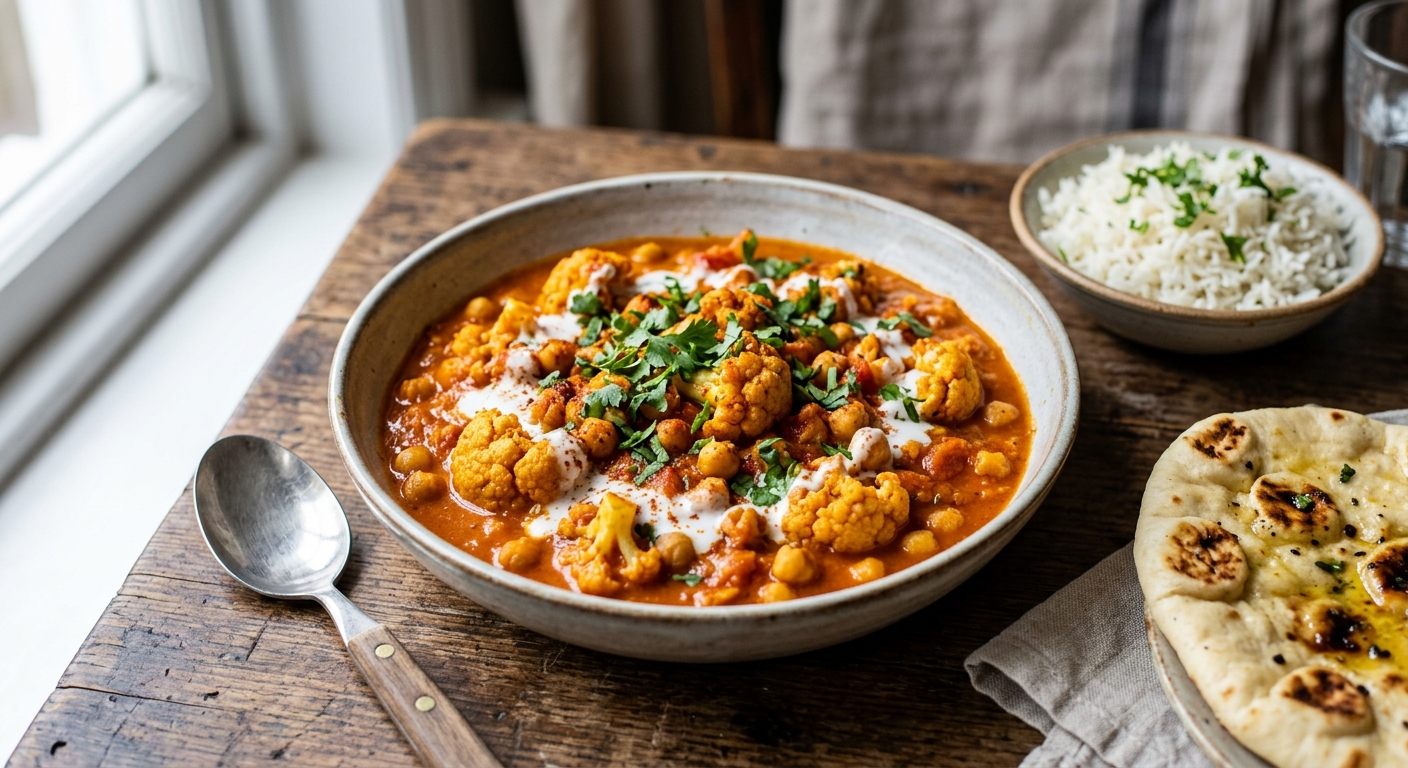
Tikka masala is one of the most beloved curry dishes in the world, and for good reason: its balance of tangy tomato, warming spice, and creamy sauce is deeply satisfying. This plant-based version replaces the traditional chicken with two nutritional heavyweights, cauliflower and chickpeas, without sacrificing a single note of flavour. The cauliflower absorbs the spiced sauce beautifully, while the chickpeas provide a hearty, protein-dense base that keeps you full for hours.
From a nutritional standpoint, this dish was engineered to be genuinely complete. Chickpeas are one of the most nutrient-dense legumes available, offering substantial iron, folate, manganese, and plant-based protein in every serving. Paired with cauliflower, which contributes vitamin C to enhance non-haem iron absorption, and a tomato base rich in lycopene, this tikka masala delivers measurable, calibrated nutrition that stands up to scrutiny. The coconut milk adds healthy medium-chain triglycerides and transforms the sauce into the silky, restaurant-quality texture you expect.
Whether you are building a muscle-supportive meal plan, following a plant-based diet, or simply want a weeknight dinner that tastes spectacular and fuels your body properly, this recipe is built for you. Three distinct cooking methods, stovetop, slow cooker, and pressure cooker, give you full flexibility. An oven method is also included for those who want the deepest cauliflower caramelisation possible before the sauce comes together.
4
servings
Ingredients
- 600 gcauliflower, cut into medium florets (roughly 1 medium head)
- 480 gcanned chickpeas, drained and rinsed (two 240g drained cans)
- 400 gcanned crushed tomatoes
- 270 mlfull-fat coconut milk
- 1 largeyellow onion, finely diced
- 4 clovesgarlic, minced
- 20 gfresh ginger, peeled and grated (about a 4cm piece)
- 2 tbsptomato paste
- 3 tbspextra-virgin olive oil or Avocado Oil100% Pure Avocado Oil
- 2 tspgaram masala
- 1.5 tspground cumin
- 1.5 tspground coriander
- 1 tspground turmeric
- 1 tspsmoked paprika
- 0.5 tspcayenne pepper (adjust to heat preference)
- 1 tspColima Sea SaltMicroplastic Free Salt, plus more to taste
- 1 tspcoconut sugar or brown sugar
- 15 gfresh cilantro (coriander), roughly chopped, for garnish
- 1 tbspfresh lemon juice
- —Black pepper to taste
Instructions
Click on an item below to shop for the recommended items for this recipe on Amazon.
As an Amazon Associate, we earn from qualifying purchases.
- Heat 2 tablespoons of oil in a large Dutch oven or heavy-bottomed pot over medium-high heat until shimmering. Add the cauliflower florets in a single layer and cook undisturbed for 3 to 4 minutes until deeply golden on the cut side. Toss and cook for another 2 minutes. The cauliflower does not need to be fully cooked at this stage. Remove with a slotted spoon and set aside.
- Reduce heat to medium and add the remaining 1 tablespoon of oil to the same pot. Add the diced onion and cook, stirring occasionally, for 7 to 8 minutes until softened and beginning to turn golden at the edges. Do not rush this step; properly caramelised onion is the foundation of a complex-tasting sauce.
- Add the minced garlic and grated ginger to the pot and stir continuously for 90 seconds until fragrant. Add the tomato paste and stir it into the onion mixture, cooking for 2 minutes until it deepens in colour to a brick red. This step cooks out the raw tomato paste and activates fat-soluble spice compounds.
- Add all the spices: garam masala, cumin, coriander, turmeric, smoked paprika, and cayenne. Stir vigorously for 60 seconds, coating the onion paste in the spices and allowing the heat to bloom them in the oil.
- Pour in the crushed tomatoes and stir well, scraping up any browned bits from the pot bottom. Add the coconut milk, coconut sugar, and 1 teaspoon of salt. Stir to combine, then return the seared cauliflower to the pot along with the drained chickpeas.
- Bring the sauce to a gentle boil, then reduce heat to low. Cover the pot partially with a lid and simmer for 18 to 20 minutes, stirring every 5 minutes, until the cauliflower is completely tender when pierced with a knife and the sauce has thickened to a rich, coating consistency.
- Remove from heat. Stir in the lemon juice and taste for seasoning, adjusting salt, cayenne, or sugar as needed. Ladle into bowls and garnish generously with fresh cilantro. Serve with basmati rice or warm naan.
- In a small skillet, heat 1 tablespoon of oil over medium heat. Add the diced onion and cook for 5 to 6 minutes until softened. Add the garlic, ginger, and tomato paste and cook for 2 minutes, stirring constantly. Add all the spices and stir for 60 seconds to bloom them. This brief pre-cooking step is essential for a slow cooker: raw spices added directly to a slow cooker taste flat and muddy rather than vibrant.
- Transfer the spiced onion mixture to the slow cooker insert. Add the crushed tomatoes, coconut sugar, salt, and black pepper. Stir well to combine everything into a uniform sauce base.
- Add the cauliflower florets and drained chickpeas to the slow cooker. Toss gently to coat all the vegetables in the sauce. Do not add the coconut milk yet; adding it at the start of a long cook cycle can cause it to break and become grainy.
- Cover and cook on Low for 6 to 7 hours or on High for 3 to 3.5 hours. The cauliflower should be very tender and the sauce should have deepened in colour and aroma considerably.
- In the final 30 minutes of cooking, pour in the coconut milk and stir gently to incorporate. Replace the lid and allow it to heat through fully on Low.
- Once cooking is complete, stir in the lemon juice and taste for seasoning. The slow cooker can sometimes mute salt, so you may need to add a pinch more. Garnish with fresh cilantro and the remaining tablespoon of olive oil drizzled over the top for richness. Serve with basmati rice.
- Set your Instant Pot or electric pressure cooker to Saute mode on medium heat. Add 2 tablespoons of oil and saute the diced onion for 4 to 5 minutes until softened. Add the garlic, ginger, and tomato paste and stir for 90 seconds. Add all the spices and stir for another 60 seconds to bloom them in the oil. Press Cancel to exit Saute mode.
- Add the crushed tomatoes and use a wooden spoon to deglaze the pot completely, scraping up all browned bits from the bottom. This step is critical in a pressure cooker: any food stuck to the base can trigger a burn warning and prevent the pot from coming to pressure.
- Add the drained chickpeas, cauliflower florets, coconut sugar, salt, and 60ml of water to help the pot come to pressure. Do not add the coconut milk before pressure cooking; the high heat can cause it to curdle and may interfere with pressurisation. Stir to combine.
- Secure the lid and set the steam release valve to Sealing. Cook on Manual or Pressure Cook mode at High Pressure for 5 minutes. When the timer ends, immediately perform a Quick Release by carefully turning the valve to Venting. Open the lid away from you.
- Stir in the coconut milk and lemon juice. Switch back to Saute mode on Low and simmer uncovered for 3 to 4 minutes if you prefer a thicker sauce, stirring gently to avoid breaking up the cauliflower. Taste for seasoning and adjust salt. Garnish with fresh cilantro and serve immediately.
- Preheat your oven to 220 degrees Celsius (425 degrees Fahrenheit). Toss the cauliflower florets with 1.5 tablespoons of oil, 0.5 teaspoon of salt, 0.5 teaspoon of garam masala, and 0.5 teaspoon of turmeric directly on a large rimmed baking sheet. Spread into a single layer with cut sides facing down. Roast on the middle rack for 22 to 25 minutes, flipping once halfway, until the edges are deeply caramelised and the florets have some charred spots. Remove and set aside. Reduce oven temperature to 190 degrees Celsius (375 degrees Fahrenheit).
- While the cauliflower roasts, build the sauce on the stovetop. Heat the remaining 1.5 tablespoons of oil in a large oven-safe skillet or braiser over medium heat. Saute the diced onion for 7 to 8 minutes until golden. Add the garlic, ginger, and tomato paste and cook for 2 minutes. Add the remaining spices (the quantities of garam masala, cumin, coriander, smoked paprika, and cayenne, minus what was used on the cauliflower) and stir for 60 seconds to bloom them.
- Pour the crushed tomatoes into the skillet, stir well, and simmer for 5 minutes until the sauce thickens slightly. Add the coconut milk, coconut sugar, and salt. Stir to combine and bring to a gentle simmer for 3 minutes. The sauce should be flavourful and slightly thicker than you ultimately want, as the oven will concentrate it further.
- Add the drained chickpeas to the sauce and stir. Nestle the roasted cauliflower florets into the sauce, pressing them gently to partially submerge. Transfer the skillet to the oven (uncovered) and bake at 190 degrees Celsius for 20 to 25 minutes until the sauce is bubbling, slightly reduced, and the cauliflower has absorbed the surrounding flavours.
- Remove from the oven and allow to rest for 5 minutes. Stir in the lemon juice and taste for seasoning. The concentrated oven sauce often needs a small pinch more salt. Garnish with fresh cilantro and serve directly from the skillet for a dramatic presentation alongside warm naan or basmati rice.
Nutrition Breakdown
Per 1 serving (makes 4)
Vitamins & Minerals
% Daily Value based on a 2,000 calorie diet (FDA reference)
🧬 Essential Amino Acids
% of recommended daily intake (RDA) per serving
🛡 Antioxidant Profile
The Nutrition Science
The iron story in this dish is particularly important for plant-based eaters. Chickpeas provide approximately 4.7mg of non-haem iron per 240g drained serving, but non-haem iron is absorbed at roughly 2 to 20% efficiency depending on the meal context, compared to 15 to 35% for haem iron from animal sources. This is where the recipe design becomes nutritionally strategic: the 62mg of vitamin C per serving, derived from cauliflower and tomatoes, converts ferric iron (Fe3+) to the more bioavailable ferrous form (Fe2+) in the gut, reliably increasing non-haem iron absorption by two to threefold. This co-consumption principle is one of the most evidence-backed dietary strategies in plant-based nutrition.
Chickpeas are also one of the most valuable legume sources of folate, providing around 140mcg per drained cup. Folate (vitamin B9) is critical for DNA synthesis, red blood cell formation, and methylation reactions throughout the body. Combined with the folate contribution from cauliflower and tomatoes, a single serving of this tikka masala provides approximately 45% of the 400mcg daily reference value, making it an exceptional choice during periods of increased cellular demand. The manganese content, reaching 70% DV per serving, is primarily driven by chickpeas and supports superoxide dismutase activity, the body’s primary enzymatic antioxidant defence.
The turmeric in this recipe deserves specific attention. Curcumin, the active polyphenol in turmeric, has been studied extensively for its ability to inhibit NF-kB, a transcription factor that governs inflammatory gene expression. Critically, curcumin’s bioavailability is low on its own, but fat-soluble compounds dramatically increase absorption. The olive oil and coconut milk in this recipe serve both culinary and pharmacokinetic purposes, creating a lipid vehicle that solubilises curcumin and raises blood plasma concentrations meaningfully compared to consuming turmeric without fat.
Pro Tips
- For the deepest flavour in any method, toast your whole spices (cumin seeds, coriander seeds) in a dry pan before grinding them fresh. Pre-ground spices work well, but freshly ground increases aromatic compound concentration by roughly 30 to 40% due to volatile oil retention.
- Do not skip the tomato paste cooking step. Frying tomato paste in oil for 2 full minutes triggers Maillard reactions that develop a complex, umami-rich depth impossible to achieve by simply adding it raw to the sauce.
- If your canned chickpeas are very firm, the sauce will be at its best if you allow the finished dish to rest off heat for 10 minutes before serving. This brief rest allows the chickpeas to absorb more sauce and the overall flavour to equilibrate.

Love the iron callout here, though I’d gently push back on the “complete amino acid profile” claim – chickpeas alone are actually limiting in methionine, so you’d really need that cauliflower plus other components (like the coconut milk or any grains served alongside) to round it out. That said, the turmeric in tikka masala is such an underrated polyphenol source, and curcumin’s bioavailability jumps significantly with black pepper and fat, which this recipe nails with the coconut base. Have you tested whether your readers notice the anti-inflammatory effects more when they pair this with something like brown rice versus eating it solo?
Pete makes a solid point on the amino acid profile, but I’d say the real win here is that the coconut milk actually bridges that gap nicely since it carries some of the limiting amino acids chickpeas miss. That said, the iron story is where this gets interesting for me – you’re hitting that 38% partly through the chickpeas and tomato sauce, but the turmeric and ginger are doing heavy lifting on absorption and reducing anti-nutrients that would normally tank bioavailability. The roast on the cauliflower before simmering is the technique detail I’d emphasize, since you’re not boiling away those polyphenols that enhance iron uptake.
This looks amazing and I’m so glad you’re breaking down the amino acid piece carefully, Pete and Chris, because that nuance matters when you’re managing autoimmune stuff like I am. I’m curious though, Anna here, does anyone know offhand if this recipe uses iodized salt or if there’s flexibility there? I’ve had to be pretty cautious with iodine levels since my Hashimoto’s diagnosis, and I’m wondering if this could work with a non-iodized option without throwing off the flavor balance. Also, I’m seeing the garam masala in there – would this be adaptable for AIP by swapping out the spices, or is the warming effect from them pretty central