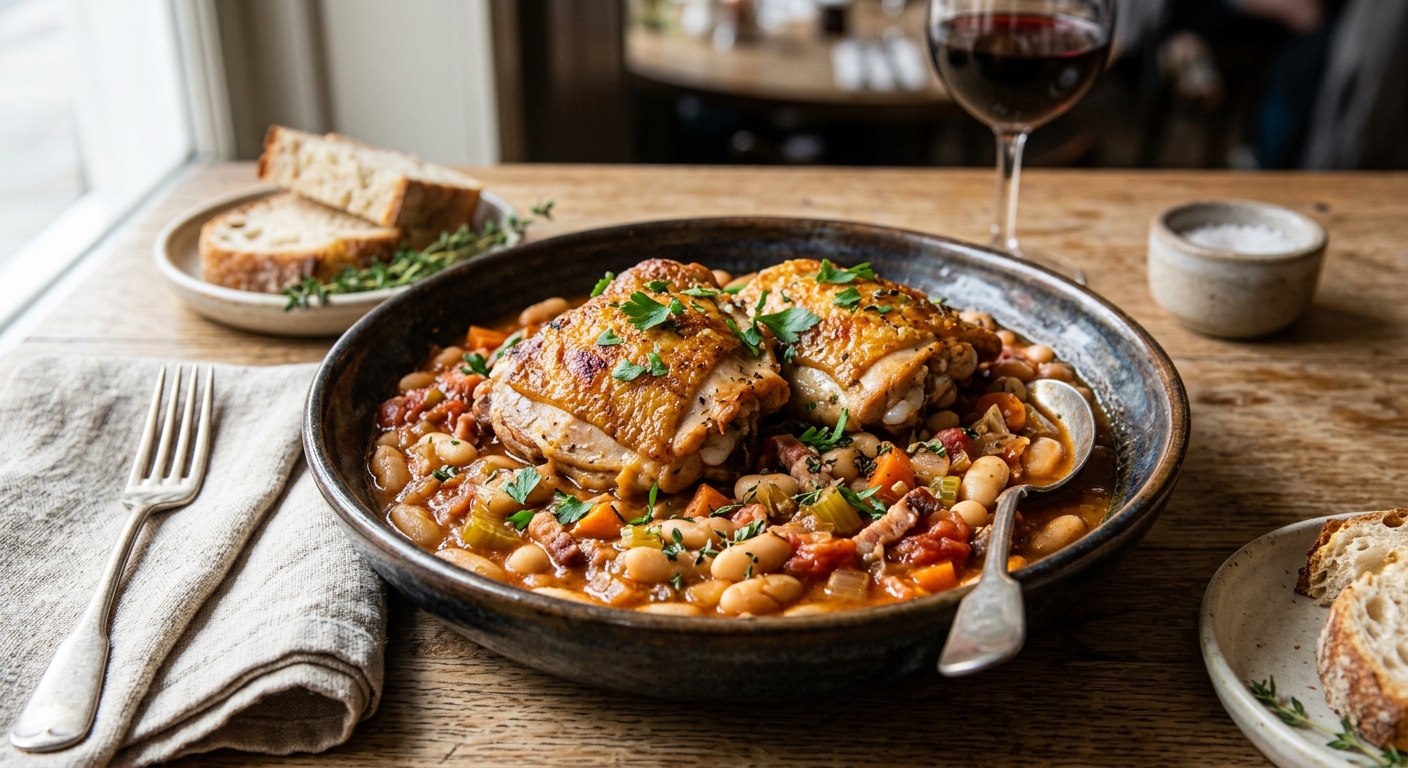
Cassoulet is one of the great peasant dishes of southern France, born in the Languedoc region where cooks have been slow-braising beans with meat for centuries. Our Calibrated Cuisine version strips the dish back to its nutritional core: bone-in, skin-on chicken thighs for maximum collagen and flavour, plus two full cans of cannellini beans that together form a near-complete amino acid profile to rival any protein shake. The result is a deeply savoury, herb-scented braise that tastes like it took all day, whether you make it in 45 minutes on the stovetop or let a slow cooker do the work while you sleep.
What sets this cassoulet apart from other high-protein recipes is the deliberate layering of complementary proteins. Chicken thighs contribute all nine essential amino acids in substantial quantities, while cannellini beans add lysine and leucine at levels that push this single bowl past the daily RDA thresholds for several essential amino acids. The tomato base brings lycopene and vitamin C, the latter of which actively boosts iron absorption from the beans by up to three-fold, a synergy that nutritional scientists call the ascorbate-iron enhancement effect. Meanwhile, garlic, thyme, and bay leaf are not just flavour additions but genuine sources of quercetin and rosmarinic acid, two polyphenols with well-documented anti-inflammatory properties.
Whether you are an athlete chasing muscle-protein synthesis targets, a busy parent trying to feed a family something nourishing, or simply someone who loves a bowl of something deeply comforting on a cold evening, this cassoulet earns its place at the centre of your rotation. Each of the four cooking methods below is written as a genuinely distinct process, not just a copy-paste with different times, so you can choose the technique that fits your schedule without sacrificing the dish’s trademark richness.
4
servings
Ingredients
- 900 gbone-in, skin-on chicken thighs (about 4 large)
- 800 gcanned cannellini beans, drained and rinsed (2 x 400g cans)
- 400 gcanned crushed tomatoes
- 150 gpancetta or smoked bacon lardons
- 1 mediumyellow onion, finely diced
- 1 mediumcarrot, peeled and diced into 1cm pieces
- 2 stalkscelery, diced into 1cm pieces
- 6 clovesgarlic, minced
- 240 mldry white wine (such as Sauvignon Blanc or Pinot Grigio)
- 480 mllow-sodium chicken stock
- 2 tbsptomato paste
- 2 tbspextra-virgin olive oil
- 1 tbspfresh thyme leaves (or 1 tsp dried)
- 2 leavesdried bay leaves
- 1 tspsmoked paprika
- 60 gfresh flat-leaf parsley, roughly chopped (for finishing)
- 40 gcoarse breadcrumbs (for stovetop and oven crust, optional)
- —Colima Sea SaltMicroplastic Free Salt and freshly ground black pepper to taste
Instructions
Click on an item below to shop for the recommended items for this recipe on Amazon.
As an Amazon Associate, we earn from qualifying purchases.
- Pat the chicken thighs thoroughly dry with paper towels, then season generously on both sides with salt and pepper. Dry skin is essential for a deep golden sear, so do not skip this step.
- Heat the olive oil in a large Dutch oven over medium-high heat until shimmering. Place the chicken thighs skin-side down in a single layer. Do not move them. Sear undisturbed for 7 to 8 minutes until the skin is deep golden-brown and releases easily from the pan. Flip and sear the flesh side for 3 minutes. Transfer to a plate, leaving all rendered fat in the pot.
- Reduce heat to medium. Add the pancetta lardons to the fat in the pot and cook, stirring occasionally, for 4 to 5 minutes until lightly crisped and the fat has rendered. Add the diced onion, carrot, and celery. Cook, stirring every couple of minutes, for 6 to 7 minutes until the vegetables have softened and the onion is translucent.
- Add the minced garlic, tomato paste, and smoked paprika. Stir constantly for 90 seconds until the tomato paste turns brick-red and slightly caramelised, which eliminates raw acidity and deepens flavour. Pour in the white wine and use a wooden spoon to scrape up all the brown fond from the bottom of the pot. Let the wine reduce by half, about 3 minutes.
- Add the crushed tomatoes, chicken stock, thyme, and bay leaves. Stir to combine, then nestle the seared chicken thighs back into the pot skin-side up, ensuring the skin sits above the liquid so it stays crisp rather than steaming. Bring to a gentle simmer, then reduce heat to medium-low, partially cover, and cook for 25 to 30 minutes until the chicken is cooked through and the internal temperature reads 75 degrees C (165 degrees F).
- Remove the chicken thighs and set aside briefly. Add the drained cannellini beans to the pot and stir to combine. Use a fork to lightly mash about a quarter of the beans directly in the pot to naturally thicken the broth into a creamy, stew-like consistency. Simmer uncovered for 5 minutes.
- Return the chicken to the pot. If using the breadcrumb crust, scatter the coarse breadcrumbs over the top of each chicken thigh and press gently to adhere. Place the uncovered pot under a preheated broiler for 3 to 4 minutes until the breadcrumbs are golden and crisp. Remove bay leaves, scatter with fresh parsley, and serve directly from the pot.
- Before loading the slow cooker, perform a quick stovetop sear: heat the olive oil in a large skillet over medium-high heat. Season the chicken thighs with salt and pepper, then sear skin-side down for 5 to 6 minutes until golden. You do not need to cook through, just develop colour and render the fat. Set chicken aside. In the same skillet, cook the pancetta for 3 to 4 minutes until lightly crisped. Remove with a slotted spoon and set aside. Drain all but one teaspoon of fat from the skillet.
- In the same skillet over medium heat, saute the onion, carrot, and celery in the remaining fat for 4 minutes until slightly softened. Add the garlic, tomato paste, and smoked paprika and stir for 60 seconds. Pour in the white wine and scrape up any browned bits, letting the wine reduce for 2 minutes. This deglazing step concentrates flavour that will form the flavour base of your slow-cooked cassoulet.
- Transfer the vegetable and wine mixture to the base of the slow cooker insert. Add the crushed tomatoes, chicken stock, thyme, bay leaves, and the crisped pancetta. Stir to combine. Add the drained cannellini beans and stir again to distribute evenly throughout the liquid.
- Nestle the seared chicken thighs on top of the bean mixture skin-side up, pressing them down slightly so they are partially submerged but the skin remains above the liquid. This positioning keeps the chicken moist without making the skin rubbery. Season the surface lightly with salt and pepper.
- Place the lid on the slow cooker and cook on Low for 6 to 8 hours or on High for 3 to 4 hours. The cassoulet is ready when the chicken is fall-off-the-bone tender and the beans have absorbed the surrounding flavours. In the last 30 minutes of cooking, remove the lid slightly ajar to allow some liquid to reduce and the sauce to concentrate.
- Remove the bay leaves. Use two forks to pull the chicken meat partially off the bone in large shreds directly in the pot, or serve the thighs whole. Stir a fork through the beans to lightly crush a portion of them, thickening the broth naturally. Taste and adjust seasoning. Ladle into bowls and top generously with fresh flat-leaf parsley.
- Set your Instant Pot or electric pressure cooker to Saute mode on High. Add the olive oil and heat until shimmering. Season the chicken thighs with salt and pepper. Working in a single layer, sear skin-side down for 5 to 6 minutes until deeply golden. The Saute mode produces intense direct heat, making it excellent for browning. Flip and sear the other side for 2 minutes. Remove and set aside.
- Without wiping the pot, add the pancetta lardons and cook on Saute for 3 minutes until lightly rendered. Add the onion, carrot, and celery, stirring for 3 minutes until beginning to soften. Add the garlic, tomato paste, and smoked paprika and stir for 60 seconds. Pour in the white wine and scrape the bottom of the pot clean of all browned bits, this is critical in a pressure cooker to prevent the burn warning. Let the wine reduce for 90 seconds.
- Add the crushed tomatoes and chicken stock. Stir well, then taste the liquid for seasoning. Because pressure cooking concentrates flavours, season conservatively at this stage, you can adjust salt and pepper after cooking. Add thyme, bay leaves, and drained cannellini beans. Stir gently to combine without breaking up the beans.
- Nestle the seared chicken thighs into the liquid, pressing them down so they are fully submerged. Fully submerging the chicken under pressure produces extremely moist, tender meat that would normally require 90 minutes of braising. This is a deliberate departure from the stovetop method where the skin stays above the liquid.
- Cancel Saute mode. Secure the lid, set the valve to Sealing, and cook on Manual High Pressure for 15 minutes. Allow a natural pressure release for 10 minutes, then carefully turn the valve to Venting to release any remaining steam. Open the lid away from you.
- Remove the chicken thighs. The skin will be soft from pressure cooking, so if you prefer a crisped skin, place the thighs on a foil-lined baking sheet and broil for 3 to 4 minutes until the skin re-crisps while you finish the beans. Set the pot back to Saute mode and simmer the bean mixture uncovered for 5 minutes, lightly crushing some beans with a fork to thicken the sauce. Remove bay leaves, return the chicken, scatter with fresh parsley, and serve.
- Preheat your oven to 175 degrees C (350 degrees F). Pat the chicken thighs completely dry and season aggressively with salt and pepper on both sides. Heat olive oil in an oven-safe Dutch oven over medium-high heat on the stovetop. Sear the chicken thighs skin-side down for 7 to 8 minutes without moving them until the skin is a deep, crackled golden-brown. This longer stovetop sear is possible here because the oven will finish the cooking gently. Flip and sear the flesh side for 2 minutes. Remove and set on a plate.
- Reduce heat to medium. Cook the pancetta lardons in the rendered fat for 4 minutes until crisped. Add the onion, carrot, and celery and cook for 6 minutes, stirring occasionally, until fully softened and just beginning to caramelise at the edges. Add the garlic, tomato paste, and smoked paprika. Stir and cook for 2 minutes until the paste turns a deep brick-red. Deglaze with white wine, scraping up all the fond, and reduce for 3 minutes.
- Add the crushed tomatoes, chicken stock, thyme, and bay leaves. Stir to combine and bring to a simmer. Taste the braising liquid and season with salt and pepper. Stir in the drained cannellini beans and distribute them evenly. The liquid level should come about two-thirds of the way up the beans, not covering them completely, so the top layer of beans bakes into a slightly textured crust.
- Nestle the seared chicken thighs into the bean mixture skin-side up, pressing down slightly. The skin must sit proud of the liquid surface for the oven’s dry heat to render it crisp during the long, slow bake. Scatter the coarse breadcrumbs evenly over the entire surface of the cassoulet, covering both the chicken and the beans. Drizzle a thin thread of olive oil over the breadcrumbs to help them toast.
- Transfer the Dutch oven, uncovered, to the preheated oven. Bake for 50 minutes. After 50 minutes, check that the breadcrumb crust is deeply golden and the chicken skin beneath it is crisp. If the crust needs more colour, increase the temperature to 220 degrees C (425 degrees F) for the final 10 minutes. The cassoulet is done when the internal temperature of the chicken reaches 75 degrees C (165 degrees F) and the sauce is thick and bubbling at the edges.
- Remove from the oven and let the cassoulet rest, uncovered, for 10 minutes before serving. This resting period allows the sauce to tighten slightly and the chicken juices to redistribute. Remove the bay leaves, scatter generously with fresh flat-leaf parsley, and bring the Dutch oven straight to the table for a dramatic presentation.
Nutrition Breakdown
Per 1 serving (makes 4)
Vitamins & Minerals
% Daily Value based on a 2,000 calorie diet (FDA reference)
🧬 Essential Amino Acids
% of recommended daily intake (RDA) per serving
🛡 Antioxidant Profile
The Nutrition Science
The protein story in this cassoulet is a textbook example of complementary protein combining, though the chicken alone is already a complete source. Chicken thighs provide all nine essential amino acids in proportions that closely mirror human muscle tissue requirements, making them arguably the most bioavailable protein source in everyday cooking. Cannellini beans, meanwhile, are notably rich in lysine, the amino acid that is typically limiting in grain-based diets, and they contribute meaningful leucine levels, the branch-chain amino acid that serves as the primary trigger for muscle protein synthesis via the mTOR signalling pathway. The combined effect is a dish where every essential amino acid exceeds its RDA in a single serving, a benchmark that very few single-dish meals achieve.
Iron absorption from this dish deserves special attention. The cannellini beans provide non-haem iron (roughly 4.2mg per serving), which has a baseline absorption rate of only 2 to 8 percent under typical conditions. However, the vitamin C from parsley and crushed tomatoes (approximately 22mg per serving) converts ferric non-haem iron to the more soluble ferrous form, increasing its absorption rate by two to four times. This is why finishing the dish with fresh parsley is not merely garnish: it is a functional nutritional step. Additionally, the presence of haem iron from the chicken and pancetta creates a further enhancement effect known as the meat factor, which independently boosts non-haem iron absorption in the same meal.
The glycemic load of 11, sitting at the low end of the medium range, is largely attributable to the structural properties of cannellini beans. White beans contain a high proportion of resistant starch and soluble fibre, particularly pectin-like polysaccharides that slow gastric emptying and attenuate the postprandial glucose response. Research published in the American Journal of Clinical Nutrition consistently shows that legume-containing meals reduce the glycemic response not only of that meal but of the subsequent meal as well, a phenomenon called the second-meal effect, likely mediated by gut fermentation of resistant starch into short-chain fatty acids that modulate hepatic glucose output.
Pro Tips
- Do not use canned beans that have been pre-seasoned with salt or herbs: plain rinsed cannellini beans absorb the braising liquid far more effectively and give you full control over the final seasoning.
- If you want to reduce the saturated fat content without sacrificing flavour, swap the pancetta for two teaspoons of smoked paprika and an extra tablespoon of olive oil: you lose some salty richness but retain the smoky backbone.
- Cassoulet improves significantly on day two: the proteins and starches in the beans continue to absorb the braising liquid overnight in the fridge, producing a denser, more flavourful dish. Reheat gently on the stovetop with a splash of stock to loosen.

That cassoulet sounds fantastic, and you’re absolutely right about chicken thighs being more forgiving. I’d say the real win here is hitting 42g protein per bowl – at my age I’m obsessed with getting at least 30-40g per meal to trigger muscle protein synthesis, and beans plus chicken is exactly the combo I’ve been leaning on. For the smokiness with kids, you could probably just reduce the smoked paprika a bit without losing the dish’s soul, but honestly the bigger question I’d have is whether this hits around 2.7-3g of leucine per serving? That’s the real threshold that matters for us older folks, and sometimes people focus on total protein but leuc
This sounds wonderful, and I’m so glad you’re highlighting chicken thighs, they’re genuinely one of my favorite anti-inflammatory proteins! I’ve found over the years that the fat content not only makes them more forgiving to cook but also helps my body absorb fat-soluble vitamins better, which has made a real difference in my joint health. I do have a question though, are there beans in this that I missed in the excerpt, or would you consider adding white beans for the fiber and additional anti-inflammatory compounds? I’ve been experimenting with bean and legume combinations for years and they’ve become such a cornerstone of managing my RA alongside good quality proteins like these thighs.
omg YES to chicken thighs, theyre so much more flavorful than breast and way harder to dry out which is clutch when youre feeding picky eaters! is this kid-friendly as written or would i need to dial back the smokiness? my crew gets weird about “too fancy” food but i feel like beans plus chicken is such an easy win for sneaking in zinc and iron, im so here for it!!