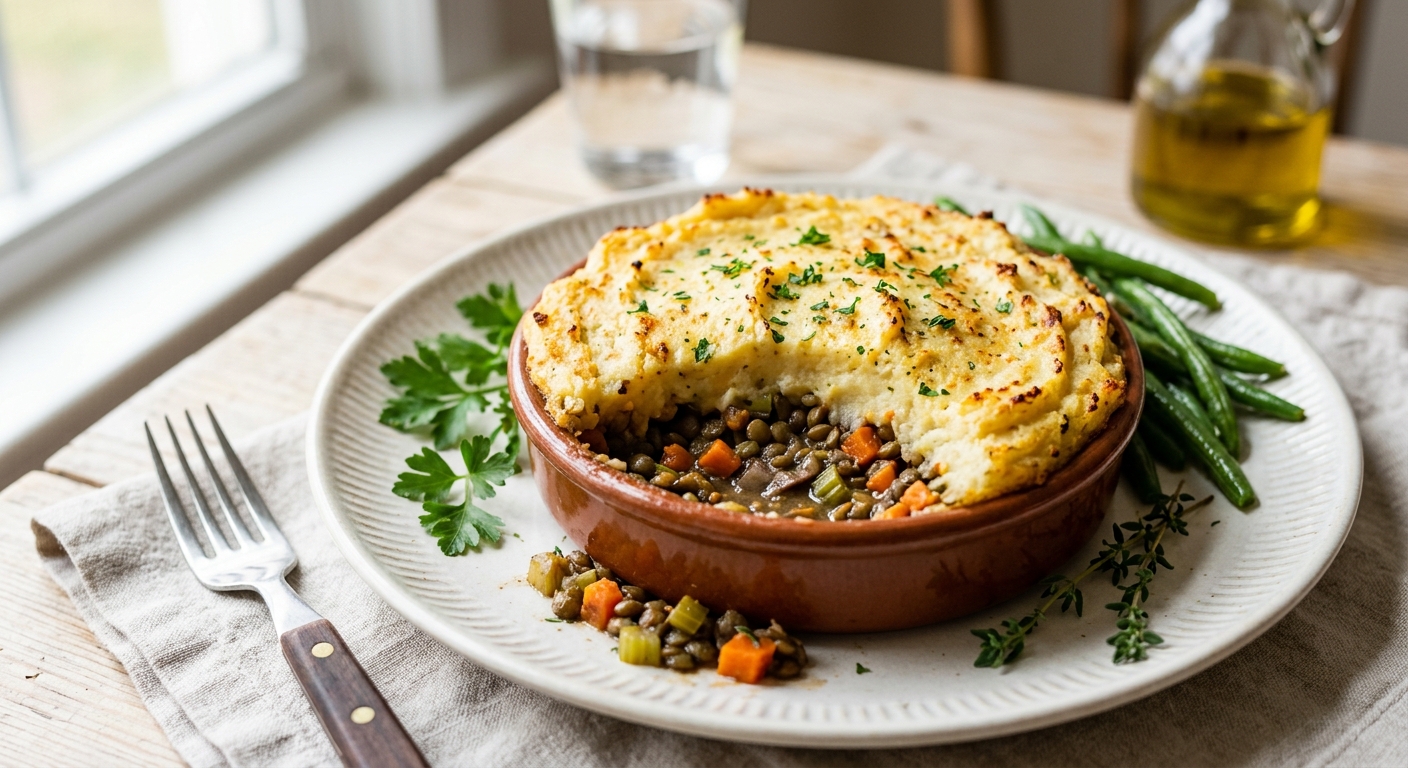
Shepherd’s pie is one of those deeply comforting dishes that feels like it was engineered for cold evenings and hungry households. This plant-based version replaces the traditional lamb mince with green lentils, which are not merely a substitute but a genuine nutritional upgrade. Green lentils are among the most iron-dense plant foods on the planet, delivering approximately 3.3mg of non-heme iron per 100g cooked weight. Combined with the vitamin C contributions from tomato paste, sweet peppers, and peas, the iron bioavailability in this dish is significantly enhanced, turning what might be modest absorption into something the body can genuinely use.
The cauliflower mash topping is more than a clever low-carb swap. Cauliflower is a cruciferous powerhouse, contributing sulforaphane, glucosinolates, vitamin C, and vitamin K. When roasted before mashing, as this recipe encourages, the cauliflower develops nutty, caramelized depth that transforms the topping from bland to genuinely craveable. A generous hand with olive oil and nutritional yeast adds richness, umami, and a meaningful dose of B12 for those following a plant-based diet.
What makes this dish particularly well-suited to the Calibrated Cuisine philosophy is how elegantly it layers multiple mineral sources. The lentils anchor the iron, folate, and potassium story. The mushrooms add ergothioneine and selenium. The dark leafy spinach stirred in at the end contributes additional iron, vitamin K, and magnesium. The result is a single-dish meal that reads like a precisely curated supplement stack, but tastes like Sunday dinner.
4
servings
Ingredients
- 250 gdried green lentils, rinsed and picked over
- 900 gcauliflower florets (about 1 large head)
- 3 tbspextra-virgin olive oil, divided
- 1 largeyellow onion, finely diced
- 3 clovesgarlic, minced
- 2 mediumcarrots, peeled and diced into 1cm pieces
- 2 stalkscelery, diced into 1cm pieces
- 200 gcremini mushrooms, finely chopped
- 1 mediumred bell pepper, diced
- 2 tbsptomato paste
- 400 gcanned diced tomatoes
- 600 mllow-sodium vegetable broth
- 150 gfrozen peas, thawed
- 80 gfresh baby spinach
- 1 tspsmoked paprika
- 1 tspground cumin
- 1 tspdried thyme
- 1 tspdried rosemary, crumbled
- 2 tbspWorcestershire sauce (vegan variety)
- 1 tbspbalsamic vinegar
- 3 tbspnutritional yeast
- 60 mlunsweetened oat milk or plant milk of choice
- 1 tspDijon mustard
- —Colima Sea SaltMicroplastic Free Salt and freshly ground black pepper to taste
- —Fresh thyme or flat-leaf parsley, to garnish
Instructions
Click on an item below to shop for the recommended items for this recipe on Amazon.
As an Amazon Associate, we earn from qualifying purchases.
- Preheat your oven to 200C (400F) for finishing the assembled pie. Bring a large pot of salted water to a boil. Add the cauliflower florets and cook for 12 to 14 minutes until completely tender when pierced with a fork. Drain thoroughly and return to the pot. Allow to steam-dry for 2 minutes over very low heat, shaking the pot occasionally, then remove from heat.
- While the cauliflower cooks, heat 2 tablespoons of the olive oil in a large Dutch oven or deep oven-safe skillet over medium heat. Add the onion with a pinch of salt and cook, stirring occasionally, for 6 to 8 minutes until soft and translucent with golden edges. Add the garlic and cook 1 minute more until fragrant.
- Increase heat to medium-high. Add the carrots, celery, mushrooms, and bell pepper. Cook, stirring every 2 minutes, for 8 to 10 minutes until the mushrooms have released their liquid and that liquid has fully evaporated, leaving the vegetables lightly caramelized.
- Push the vegetables to the sides of the pot and add the tomato paste to the center. Cook the paste, pressing and stirring it, for 90 seconds until it darkens slightly and smells sweet and roasted. Stir in the smoked paprika, cumin, thyme, and rosemary and cook for 30 seconds until fragrant.
- Add the rinsed lentils, canned tomatoes, vegetable broth, Worcestershire sauce, and balsamic vinegar. Stir everything together and bring to a boil. Reduce heat to medium-low, cover partially with a lid, and simmer for 28 to 32 minutes, stirring occasionally, until the lentils are fully tender and the filling has thickened to a stew-like consistency. If the filling is still soupy, remove the lid and simmer uncovered for 5 more minutes. Stir in the peas and spinach and cook for 2 minutes until the spinach is wilted. Season generously with salt and pepper.
- Mash the drained cauliflower with the remaining 1 tablespoon olive oil, oat milk, nutritional yeast, Dijon mustard, salt, and pepper. Mash vigorously with a potato masher or use a hand blender for an ultra-smooth result. Taste and adjust seasoning.
- If your Dutch oven is oven-safe, spoon the cauliflower mash over the lentil filling in an even layer and rough up the surface with a fork to create peaks that will brown. If not, transfer the filling to a 23 x 33cm (9 x 13 inch) baking dish first, then top with the mash. Bake at 200C (400F) for 20 to 25 minutes until the topping is golden and the filling is bubbling at the edges. Rest 5 minutes before serving, garnished with fresh thyme or parsley.
- In a large skillet over medium-high heat, warm 2 tablespoons of the olive oil. Add the onion and cook for 5 minutes until softened. Add the garlic, carrots, celery, mushrooms, and bell pepper and cook for 6 minutes, stirring frequently, until the mushrooms are dry and beginning to brown. Add the tomato paste and cook for 90 seconds, stirring constantly. Stir in the smoked paprika, cumin, thyme, and rosemary for 30 seconds. This sauteing step is essential: it builds the flavor base that the slow cooker cannot create on its own.
- Scrape the entire skillet contents into the slow cooker insert. Add the rinsed lentils, canned tomatoes, vegetable broth, Worcestershire sauce, and balsamic vinegar. Stir well to combine. The liquid level should just cover the lentils. Cook on Low for 6.5 to 7 hours or on High for 3 to 3.5 hours, until the lentils are completely tender and have begun to break down slightly, thickening the sauce.
- About 30 minutes before serving, preheat your broiler to high. Boil or steam the cauliflower florets in a separate pot for 12 to 14 minutes until very tender. Drain thoroughly and steam-dry for 2 minutes. Mash with the remaining 1 tablespoon olive oil, oat milk, nutritional yeast, Dijon mustard, salt, and pepper until smooth and creamy.
- Remove the slow cooker lid and stir the peas and spinach into the hot lentil filling. Replace the lid and let sit on Low (or Warm setting) for 10 minutes until the greens are wilted and peas are heated through. Taste and adjust seasoning with salt and pepper.
- Transfer the lentil filling to a large broiler-safe baking dish. Spoon the cauliflower mash over the top in an even layer and use a fork to create textured ridges across the surface. Slide under the broiler 12 to 15cm (5 to 6 inches) from the element and broil for 5 to 8 minutes, watching closely, until the peaks are deeply golden and the edges are bubbling. Rest for 5 minutes before garnishing and serving.
- Set your 6-quart or larger Instant Pot or electric pressure cooker to Saute mode on High. Once hot, add 2 tablespoons olive oil. Add the onion and cook for 4 to 5 minutes until softened. Add the garlic and cook 1 minute. Add the carrots, celery, mushrooms, and bell pepper and saute for 6 to 7 minutes, stirring frequently, until the mushrooms are dry and lightly browned. Add the tomato paste and stir for 90 seconds until darkened. Add the smoked paprika, cumin, thyme, and rosemary and stir for 30 seconds.
- Press Cancel to end Saute mode. Add the rinsed lentils, canned tomatoes, 500ml of the vegetable broth (reduce from the standard amount, as pressure cooking retains all liquid), Worcestershire sauce, and balsamic vinegar. Scrape the bottom of the pot thoroughly with a wooden spoon or spatula to deglaze any stuck bits, which would otherwise trigger a burn warning. Stir to combine.
- Secure the lid and set the pressure valve to Sealing. Cook on Manual or Pressure Cook mode at High Pressure for 18 minutes. While the lentils cook, bring a separate pot of salted water to a boil and cook the cauliflower florets for 12 to 14 minutes until completely tender. Drain, steam-dry, and mash with the remaining 1 tablespoon olive oil, oat milk, nutritional yeast, Dijon mustard, salt, and pepper until very smooth. Keep warm.
- When the pressure cycle ends, allow a natural pressure release for 10 minutes, then carefully switch the valve to Venting to release any remaining pressure. Open the lid and stir the filling. If the filling appears too thin, press Saute and simmer uncovered for 5 minutes, stirring, until the desired thick consistency is reached. Stir in the peas and spinach, press Cancel, replace the lid without sealing, and let sit for 3 minutes until the greens are wilted. Season with salt and pepper.
- Preheat your oven broiler to high. Transfer the lentil filling to a broiler-safe baking dish. Spread the cauliflower mash evenly over the top and rake with a fork to create ridged peaks. Place under the broiler for 5 to 7 minutes, watching carefully, until the mash is golden brown and the filling bubbles around the edges. Rest 5 minutes, garnish with herbs, and serve.
- Preheat the oven to 190C (375F). On a large rimmed baking sheet, toss the cauliflower florets with 1.5 tablespoons of the olive oil, a generous pinch of salt, and black pepper. Spread in a single layer. Roast on the upper oven rack for 30 to 35 minutes, flipping once halfway through, until the florets are deeply golden and caramelized at the edges. Roasting rather than boiling removes excess moisture and adds nutty complexity to the mash.
- While the cauliflower roasts, heat the remaining 1.5 tablespoons olive oil in a large Dutch oven or oven-safe braising dish over medium-high heat on the stovetop. Cook the onion for 6 minutes until soft and golden. Add the garlic, carrots, celery, mushrooms, and bell pepper and cook, stirring, for 8 to 10 minutes until everything is lightly caramelized and the mushroom liquid has fully evaporated. Add the tomato paste and cook for 90 seconds, then add the smoked paprika, cumin, thyme, and rosemary and stir 30 seconds.
- Add the rinsed lentils, canned tomatoes, vegetable broth, Worcestershire sauce, and balsamic vinegar. Stir thoroughly, bring to a simmer on the stovetop, and season with salt and pepper. Cover the Dutch oven with a tight-fitting lid or a layer of foil sealed around the edges. Transfer to the 190C oven and braise for 45 to 55 minutes, until the lentils are completely tender and the filling is thick and saucy. Check at the 40-minute mark: if liquid is mostly absorbed and lentils are tender, proceed; if lentils need more time, return for 10 more minutes.
- Remove the Dutch oven from the oven and increase the temperature to 220C (425F). Remove the lid and stir the peas and spinach into the hot filling until the spinach wilts, about 2 minutes. Taste and adjust seasoning generously.
- Transfer the roasted cauliflower to a bowl and mash with the oat milk, nutritional yeast, Dijon mustard, salt, and pepper until smooth and creamy. Because the cauliflower was roasted rather than boiled, you may need a splash more oat milk to reach a spreadable consistency. Taste and adjust seasoning.
- Spoon the cauliflower mash over the lentil filling directly in the Dutch oven, creating an even layer. Use a fork to draw deep furrows and peaks across the entire surface. Return to the oven, uncovered, at 220C (425F) for 18 to 22 minutes until the topping is richly browned, with charred peaks, and the filling is vigorously bubbling at the edges. Rest for 8 minutes before serving garnished with fresh herbs.
Nutrition Breakdown
Per 1 serving (makes 4)
Vitamins & Minerals
% Daily Value based on a 2,000 calorie diet (FDA reference)
🧬 Essential Amino Acids
% of recommended daily intake (RDA) per serving
🛡 Antioxidant Profile
The Nutrition Science
The iron story in this dish hinges on a critical distinction: plant foods contain non-heme iron (Fe3+), which must be reduced to ferrous iron (Fe2+) before intestinal absorption is possible. Vitamin C, acting as a reducing agent, facilitates this conversion directly in the gut lumen. This recipe is deliberately engineered to co-locate iron sources (lentils, spinach) with vitamin C donors (bell pepper provides 128mg per 100g raw weight, tomatoes contribute an additional 14mg, and peas add roughly 40mg per 100g). The result is a meal where iron and its primary absorption enhancer arrive in the same digestive bolus, which clinical absorption studies suggest can increase non-heme iron uptake by 2 to 4 times compared to eating the same iron sources without vitamin C.
Folate from lentils operates as a methyl-group donor in one-carbon metabolism, the biochemical highway that drives DNA synthesis, repair, and methylation of homocysteine. A single serving here provides 232mcg, more than half the 400mcg daily recommendation, meaning this dish alone makes a meaningful contribution to cardiovascular protection and neural tube health. The nutritional yeast adds fortified B12, which acts synergistically with folate in this same metabolic pathway: both are essential co-factors for methionine synthase, the enzyme that recycles homocysteine to methionine. Suboptimal B12 renders dietary folate functionally useless, making this pairing nutritionally deliberate.
Cauliflower’s sulforaphane content deserves particular attention. Unlike most antioxidants that directly neutralize free radicals in a one-to-one exchange, sulforaphane is an indirect antioxidant: it upregulates the Nrf2 transcription factor, which in turn activates the production of endogenous antioxidant enzymes including superoxide dismutase, catalase, and glutathione peroxidase. This enzymatic cascade can process millions of free radicals per second, giving sulforaphane a leverage effect far exceeding most dietary antioxidants. Roasting cauliflower at high temperature does modestly reduce glucoraphanin content compared to raw consumption, but the flavor trade-off and the rich complementary antioxidant profile from the rest of this dish more than compensate.
Pro Tips
- For maximum iron absorption, avoid drinking tea or coffee with this meal: the tannins and chlorogenic acid in both beverages can reduce non-heme iron absorption by 60 to 70% when consumed simultaneously. Enjoy your tea at least 1 hour before or after eating.
- Green lentils hold their shape better than red lentils during long cooking, giving the filling a meaty, chunky texture. If you substitute red lentils, reduce the stovetop liquid by 100ml and shorten the cook time by 10 minutes as they break down more readily and will thicken the filling faster.
- The cauliflower mash can be made up to 2 days ahead and refrigerated. When assembling, add an extra splash of oat milk and stir well before spreading, as the mash thickens considerably when chilled.
- This pie freezes exceptionally well: portion and freeze individual servings in airtight containers for up to 3 months. Reheat from frozen in a 180C (350F) oven for 35 to 40 minutes, covered with foil for the first 25 minutes, then uncovered to re-crisp the topping.
- To boost the zinc and selenium content further, add 2 tablespoons of toasted pumpkin seeds scattered over the filling before applying the mash, contributing an additional 4mg of zinc per serving and complementing the mushrooms’ selenium content.


Looks solid on the micronutrient front, but I’m curious how you’re hitting the protein distribution here – what’s the total grams per serving and is it concentrated enough to trigger muscle protein synthesis? I’ve been learning the hard way that iron density means nothing if you’re not also getting around 25-30g of quality protein per meal to maintain muscle mass as we age. The lentils help, but do you know the leucine content? Just asking because I wish someone had hammered this into my head at 60 before I started lifting at 62.
This is exactly the kind of quantified approach I love seeing, especially with iron bioavailability data. I’d be curious whether you tested the absorption rates with and without the vitamin C content from the vegetables here, since non-heme iron absorption can vary wildly (I’ve seen studies suggesting 2-20% depending on phytate content and co-factors). My CGM has shown me that lentil-based meals tend to keep my glucose steady around 110-120 for hours, so pairing with the cauliflower mash instead of traditional potatoes probably improves the glycemic load significantly – have you noticed any difference in satiety or energy levels compared to standard shepherd’s pie recipes?
this looks amazing and im definitely making it, but im wondering how the lentil texture holds up for you? ive found green lentils are usually my move during remission since theyre firmer, but even then sometimes the skin texture gets me during a flare. were you thinking of blending part of the filling to make it smoother if someone needed it, or does the savory broth situation keep it digestible enough as is?