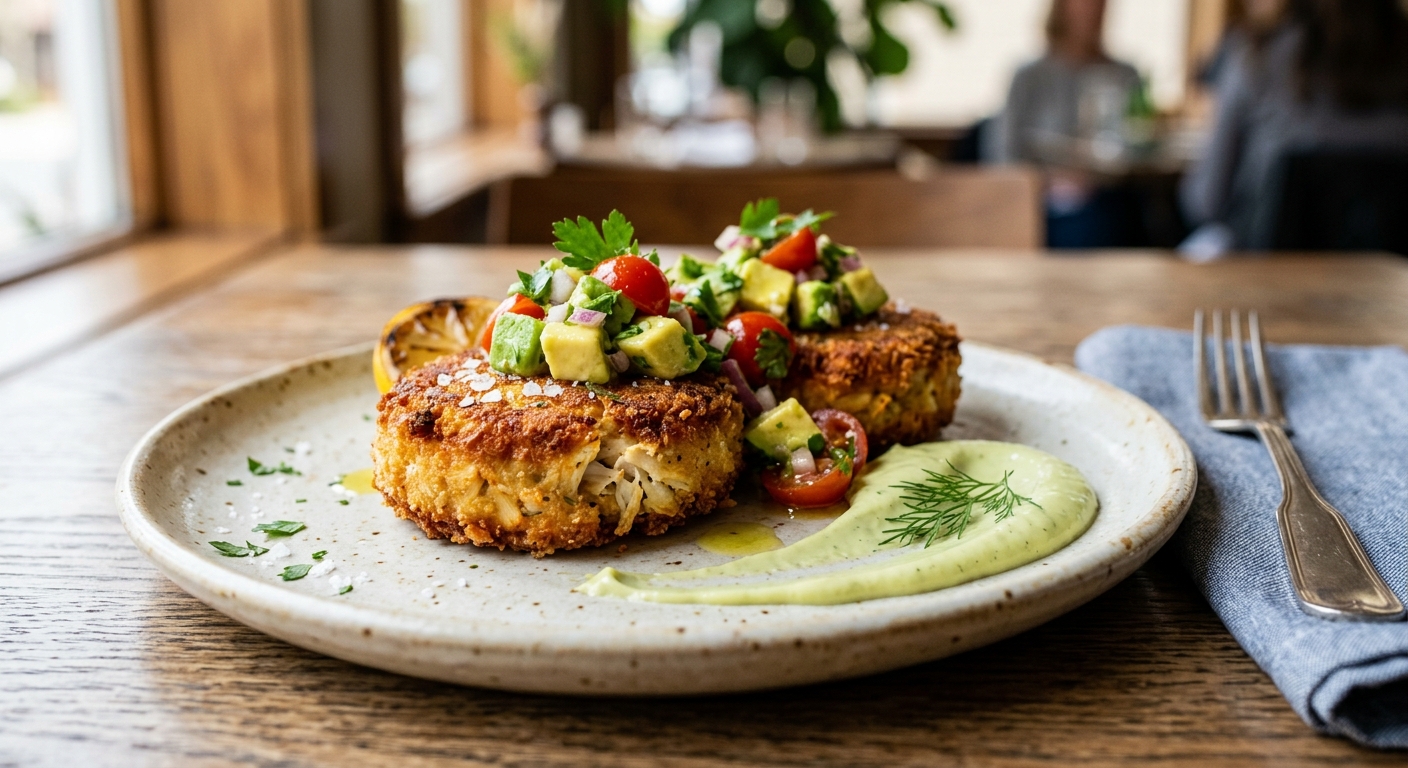
Crab is one of the most mineral-dense proteins on the planet, yet it rarely gets the nutritional recognition it deserves. A single 85-gram serving of cooked blue crab delivers over 400% of your daily selenium needs alongside meaningful zinc, copper, and B12. Pair that with the monounsaturated fats and potassium from fresh avocado, and you have a dish that is genuinely calibrated to fortify your body at the cellular level. These crab cakes are not a vehicle for filler. They are built around a high crab-to-binder ratio, keeping the mineral payload front and centre.
The technique here borrows from professional seafood kitchens: a light panko crust for crunch, a touch of Dijon and Old Bay for complexity, and cold-chilled crab mixture to help the cakes hold their shape without excess egg or breadcrumb. The avocado component is more than a garnish. Blended with lime juice and a whisper of jalapeño, it becomes a creamy sauce whose oleic acid actively enhances the absorption of fat-soluble micronutrients present in the dish, including the carotenoids from the fresh herbs and paprika.
Whether you pan-sear them on the stovetop for maximum crust, bake them in the oven for a hands-off approach, or use less conventional methods for meal prep and batch cooking, each technique has been precisely calibrated to preserve the delicate texture of crab while ensuring food-safe internal temperatures. This is comfort food with a scientifically validated nutritional purpose.
4
servings
Ingredients
- 450 gfresh or pasteurised lump crab meat, picked over for shells
- 60 gpanko breadcrumbs, divided (40g in mixture, 20g for coating)
- 2 largeeggs, lightly beaten
- 3 tbspmayonnaise (full-fat)
- 1 tbspDijon mustard
- 1 tspOld Bay seasoning
- 1 tspsmoked paprika
- 2 tbspfresh flat-leaf parsley, finely chopped
- 2 tbspfresh chives, finely sliced
- 1 tbspfresh lemon juice
- 1 tspWorcestershire sauce
- 3 tbspextra-virgin olive oil, for cooking
- 2 largeripe avocados, halved and pitted
- 2 tbspfresh lime juice
- 0.5 smalljalapeño, deseeded and finely minced
- 1 smallgarlic clove, minced
- 2 tbspGreek yogurt (full-fat)
- —Colima Sea SaltMicroplastic Free Salt and freshly ground black pepper to taste
- —Lemon wedges and fresh micro-herbs, to serve
Instructions
Click on an item below to shop for the recommended items for this recipe on Amazon.
As an Amazon Associate, we earn from qualifying purchases.
- In a large mixing bowl, gently combine the crab meat, 40g panko, beaten eggs, mayonnaise, Dijon, Old Bay, smoked paprika, parsley, chives, lemon juice, and Worcestershire sauce. Use a flexible spatula and fold rather than stir to keep the crab lumps as intact as possible. Season with salt and pepper. Cover the bowl and refrigerate for at least 30 minutes. This chilling step is non-negotiable for stovetop cooking as it firms the mixture so the cakes hold their shape in the hot pan.
- While the mixture chills, prepare the avocado cream. Scoop the avocado flesh into a food processor or blender. Add the lime juice, jalapeño, garlic, Greek yogurt, and a generous pinch of salt. Blitz until completely smooth, about 60 seconds, scraping down the sides once. Taste and adjust lime and salt. Transfer to a bowl, press cling film directly onto the surface to prevent browning, and refrigerate until needed.
- Remove the chilled crab mixture from the refrigerator. Divide it into 8 equal portions using a kitchen scale for consistency (approximately 75g each). Shape each portion into a disc about 2cm thick and 7cm in diameter. Spread the remaining 20g panko on a flat plate. Gently press each cake into the panko on both sides to form a light, even coating. Place the coated cakes on a parchment-lined tray.
- Set a large, heavy-bottomed skillet (stainless steel or cast iron) over medium-high heat. Add the olive oil and allow it to heat until shimmering, about 90 seconds. You want the oil hot enough that a panko crumb dropped in sizzles immediately. Carefully lay 4 crab cakes into the pan, leaving at least 3cm between each. Do not crowd the pan or the cakes will steam rather than sear.
- Cook undisturbed for 3 to 4 minutes until the bottom is a deep golden-amber colour. Use a thin, flexible spatula to carefully flip each cake in one confident movement. Cook the second side for a further 3 to 4 minutes until equally golden and the internal temperature reaches 63°C (145°F). Transfer to a wire rack set over a baking sheet. Repeat with the remaining 4 cakes, adding a touch more oil if the pan looks dry. Serve immediately with the chilled avocado cream and lemon wedges.
- Preheat your oven to 220°C (425°F) conventional or 200°C (400°F) fan-forced. Line a large rimmed baking sheet with parchment paper and brush the parchment generously with 2 tablespoons of the olive oil. This oiled surface is key to achieving a golden underside without a skillet.
- Prepare the crab cake mixture exactly as in the stovetop method: combine crab, 40g panko, eggs, mayonnaise, Dijon, Old Bay, smoked paprika, parsley, chives, lemon juice, and Worcestershire sauce with a folding motion. Season, cover, and refrigerate for 30 minutes. Prepare and refrigerate the avocado cream as described.
- Shape the chilled mixture into 8 equal discs, approximately 75g each and 2cm thick. Press each cake gently into the remaining 20g panko to coat both sides. Arrange all 8 cakes on the oiled baking sheet with at least 4cm of space between each. Drizzle or brush the tops lightly with the remaining tablespoon of olive oil. This top coat of oil is what creates browning in the dry heat of the oven.
- Bake on the centre rack for 16 to 18 minutes until the cakes are set through and lightly golden on the bottom. Switch the oven to the grill or broil setting on high. Broil the cakes for 2 to 4 minutes, watching closely, until the tops are deeply golden and speckled brown. The internal temperature should read 63°C (145°F).
- Remove from the oven and allow the cakes to rest on the baking sheet for 2 minutes before transferring with a thin spatula. This brief rest prevents them from falling apart. Plate 2 cakes per person alongside a generous dollop of the avocado cream and lemon wedges. Finish with fresh micro-herbs.
- Prepare the crab cake mixture by combining crab, 40g panko, eggs, mayonnaise, Dijon, Old Bay, smoked paprika, parsley, chives, lemon juice, and Worcestershire sauce. Fold gently to preserve crab lumps. Season with salt and pepper. Because the slow cooker environment is moist, add an extra tablespoon of panko (50g total in the mixture) to help the cakes hold their structure during steaming. Cover and refrigerate for at least 30 minutes.
- Prepare the avocado cream as directed and refrigerate with cling film pressed to the surface.
- Cut 8 squares of aluminium foil, approximately 15cm x 15cm each. Shape the chilled crab mixture into 8 discs (about 75g each). Place each disc in the centre of a foil square and fold the foil loosely up around the sides of the cake, leaving the top open. This creates individual foil cups that support the cakes laterally without trapping steam on top. Do not use the panko coating for this method as it will go soggy in the moist environment.
- Pour 120ml of water into the base of the slow cooker insert to create the steam environment. Arrange the foil-cupped cakes in a single layer in the slow cooker. If your slow cooker is not wide enough for all 8, stack a second layer with a small piece of parchment between layers. Cook on Low for 2 hours. The cakes will be fully cooked, pale, and set through.
- Remove the cakes from the foil cups. Heat a skillet over high heat with 1 tablespoon of olive oil until smoking. Sear each cake for 60 to 90 seconds per side just to develop colour and a light crust. This post-sear takes 3 to 4 minutes total for all cakes. Serve immediately with avocado cream and lemon wedges.
- Prepare the crab cake mixture combining crab, 50g panko (slightly more than usual to account for moisture absorption), eggs, mayonnaise, Dijon, Old Bay, smoked paprika, parsley, chives, lemon juice, and Worcestershire. Fold carefully, season, cover, and refrigerate for 30 minutes minimum. Prepare the avocado cream and refrigerate covered.
- While the mixture chills, cut 8 squares of aluminium foil (15cm x 15cm). Shape the chilled mixture into 8 equal discs, approximately 75g each and 2cm thick. Wrap each cake loosely in its foil square, folding the edges up to form an open-top cup. Skip the panko coating as it does not crisp under pressure.
- Pour 240ml of cold water into the pressure cooker insert. Place the trivet or steamer rack inside. Arrange the foil-cupped crab cakes on the trivet in a single layer, open side up. If using a 6-quart Instant Pot, all 8 should fit in one layer. Secure the lid and set the pressure valve to Sealing. Select Manual or Pressure Cook on High and set the timer for 5 minutes.
- Once the cooking time is complete, perform a quick pressure release by carefully turning the valve to Venting. Wait for all steam to escape before opening the lid. Use tongs to remove each foil cup. The cakes will be fully cooked and tender, with an internal temperature well above 63°C (145°F). Gently unwrap the foil.
- Heat a large skillet or griddle over high heat. Add 1 tablespoon of olive oil and heat until shimmering and just beginning to smoke. Working in batches, sear each crab cake for 75 to 90 seconds per side to build a lightly golden crust. The cakes are already cooked so this step is purely about texture and the Maillard reaction flavour development. Serve at once with the cold avocado cream and lemon wedges.
Nutrition Breakdown
Per 1 serving (makes 4)
Vitamins & Minerals
% Daily Value based on a 2,000 calorie diet (FDA reference)
🧬 Essential Amino Acids
% of recommended daily intake (RDA) per serving
🛡 Antioxidant Profile
The Nutrition Science
Selenium is arguably the most underappreciated essential trace mineral in the Western diet, and crab is its most concentrated culinary source. The selenium in shellfish exists primarily as selenocysteine, the biologically active form that is incorporated directly into selenoproteins, including the glutathione peroxidase family that neutralises hydrogen peroxide and lipid hydroperoxides within cells. A single serving of these crab cakes provides nearly twice the adult RDA of selenium (55 mcg), which is especially significant given that soil depletion has progressively reduced selenium content in plant-based foods over the past four decades.
Zinc from shellfish, particularly crab, is among the most bioavailable dietary forms available. The zinc in animal protein is not bound to phytates (as it is in legumes and whole grains), meaning absorption rates from this dish approach 40 to 50% compared to the 15 to 20% typical of plant sources. Zinc is required for the catalytic activity of over 300 enzymes and plays irreplaceable roles in immune signalling, DNA synthesis, and the structural integrity of transcription factors. The omega-3 fatty acids contributed by the crab (primarily EPA and DHA, approximately 480mg combined per serving) synergise with the dish’s anti-inflammatory antioxidant profile to support endothelial function and reduce platelet aggregation.
The avocado in this recipe is far more than a textural counterpoint. Its high oleic acid content (approximately 9g of monounsaturated fat per half avocado) acts as a lipid carrier, significantly enhancing the intestinal absorption of fat-soluble antioxidants including astaxanthin, vitamin E, and the carotenoid lutein contributed by the fresh herbs. Research published in the Journal of Nutrition demonstrates that co-consuming carotenoid-rich foods with a source of monounsaturated fat can increase carotenoid absorption by 3 to 5-fold. The Greek yogurt in the avocado cream adds a meaningful dose of iodine and additional B12, reinforcing the thyroid-supportive mineral profile of this meal.
Pro Tips
- Use the freshest lump crab you can source. Pasteurised refrigerated crab is excellent and far superior to canned crab, which is often waterlogged and fragrant with preservatives. Fresh-picked Dungeness or blue crab will give the highest selenium and zinc yield.
- Do not skip the 30-minute refrigeration step, especially for the stovetop and oven methods. The cold firms the proteins and starch in the binder so the cakes hold together when they hit a hot surface. If time allows, 2 hours of chilling produces even more stable cakes.
- To prevent the avocado cream from browning, press cling film directly onto the surface of the puree so there is zero air contact. The lime juice provides additional oxidation protection. Made this way, the cream stays vibrant green for up to 4 hours in the refrigerator.
Charlotte raises such a great point about the fat-soluble synergy here. I’d add that if those crab cakes include any herbs in the breading, it could amplify the mineral story even further, especially if someone used something like nettle or mushroom powder for umami depth. I’ve noticed in my own nutrition work that pairing selenium-rich foods with adaptogenic mushrooms like shiitake or maitake seems to help with stress resilience around cortisol and thyroid support, since selenium is crucial for selenoprotein synthesis. Did you source any of the herbs in these cakes for their mineral density, or were they more flavor-focused?
Ooh, this looks incredible! I’m curious about the mineral bioavailability here since the selenium in crab is already highly absorbable, but I wonder if the avocado’s fat content is actually optimizing absorption even further, especially if you’re pairing it with any acidic elements in a sauce? I’ve been researching how different mineral combinations work synergistically for my thesis, and this feels like such a smart, practical example of stacking nutrients intentionally. Also kind of obsessed with how this delivers selenium without relying on Brazil nuts, which some people find heavy in selenium / low in other cofactors. Definitely making this!
Charlotte, this is such a thoughtful breakdown and yes, the fat-soluble synergy here is exactly what I’ve been looking for since my MS diagnosis. I’ve found that the selenium from seafood absorbs so much better when paired with the lipid matrix of avocado, and if there’s any lemon or vinegar in a sauce, that acidic environment genuinely seems to help my body utilize it more efficiently, though I know the research is still evolving on the exact mechanisms. I really appreciate you pointing out the Brazil nut alternative angle too, because I used to rely on them and found myself hitting selenium ceiling way too easily, which actually triggered some inflammation for me personally. This approach feels so much more balanced
This is such a grounded observation about your own mineral tolerance, Nadia, and I’m really glad you’re tuning in to those inflammation signals from excess selenium. The acidic environment point you mentioned is solid too, since stomach pH genuinely does influence trace mineral ionization and uptake. I’m curious whether you’ve experimented with any other stress-modulating herbs alongside meals like this one, since I’ve noticed that HPA axis dysregulation can sometimes interfere with nutrient absorption efficiency overall, and something like rhodiola or ashwagandha paired with your selenium-rich meals might support both relaxation and bioavailability simultaneously. Have you found certain herbs or mushrooms that feel synergistic with
Alex, I really appreciate you connecting the HPA axis piece to absorption, that’s something I don’t see discussed nearly enough in MS nutrition spaces. I’ve been experimenting with reishi mushroom tea about 30 minutes before meals, partly for the stress modulation you’re describing but also because the beta-glucans seem to support my gut barrier integrity, which I think indirectly helps with mineral uptake. I haven’t tried rhodiola yet but that’s genuinely on my list now, especially since I’ve noticed my selenium tolerance improves on lower-stress days. Do you have experience with how these adaptogens interact with seafood specifically, or is that something you’re still exploring?