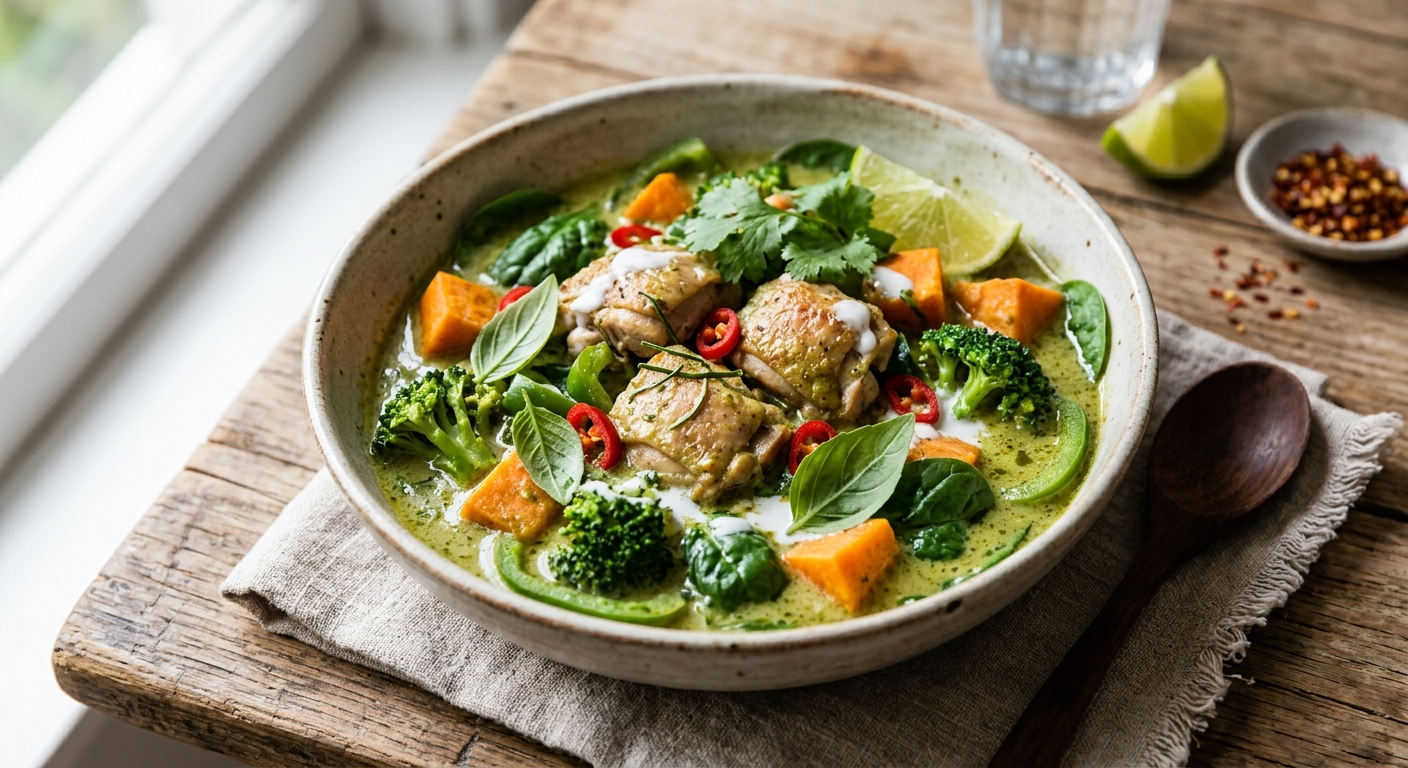
Green Thai curry is one of those rare dishes that manages to be simultaneously indulgent and extraordinarily nourishing. The base of this recipe, built around a house-blended green curry paste, fresh coconut milk, and responsibly sourced chicken thighs, delivers a layered complexity that takes just minutes to achieve at home. Unlike the pale, watery imitations served at many restaurants, this version is vivid, herbal, and bracingly fragrant, thanks to fresh lemongrass, kaffir lime leaves, and a generous hand with Thai basil.
From a nutritional engineering standpoint, this curry is a masterclass in combining complementary foods. Chicken thighs bring not just protein but a meaningful amount of haem iron and zinc, while the spinach and broccoli contribute non-haem iron and folate. The vitamin C from green capsicum dramatically improves non-haem iron absorption, a pairing that is intentional and scientifically validated. Coconut milk adds medium-chain triglycerides that support fat-soluble vitamin absorption, making the beta-carotene in the sweet potato significantly more bioavailable. Every ingredient earns its place on the plate.
Whether you reach for your Dutch oven, slow cooker, pressure cooker, or oven, the recipe has been individually calibrated for each method so you are not simply reading a stovetop recipe with a different time stamp. The slow cooker version builds flavour through gentle infusion; the pressure cooker locks in nutrients under sealed steam; the oven method uses a covered braise that creates an almost sauce-thick curry with caramelised edges. Choose your method based on your schedule and equipment, and expect a result that tastes like it took all day regardless of which path you take.
4
servings
Ingredients
- 700 gboneless skinless chicken thighs, cut into 4cm pieces
- 400 mlfull-fat coconut milk (one 400ml can)
- 200 mllow-sodium chicken stock
- 80 ggreen Thai curry paste (store-bought or homemade)
- 250 gsweet potato, peeled and cut into 2cm cubes
- 180 gbroccoli, cut into small florets
- 150 ggreen capsicum (bell pepper), thinly sliced
- 100 gbaby spinach, loosely packed
- 120 gsnap peas, trimmed
- 2 tbspfish sauce
- 1 tbspcoconut sugar or light brown sugar
- 2 tbspfresh lime juice
- 4 stalksfresh lemongrass, bruised and tied in a knot
- 6 leavesfresh or frozen kaffir lime leaves, torn
- 3 clovesgarlic, finely minced
- 1 tbspfresh ginger, finely grated
- 1 tbspcoconut oil or Avocado Oil100% Pure Avocado Oil
- 20 gfresh Thai basil leaves
- 10 gfresh coriander leaves, for garnish
- 1 tbsptoasted sesame seeds, for garnish
- —Colima Sea SaltMicroplastic Free Salt and white pepper to taste
- —Steamed jasmine rice or cauliflower rice to serve
Instructions
Click on an item below to shop for the recommended items for this recipe on Amazon.
As an Amazon Associate, we earn from qualifying purchases.
- Pat the chicken pieces dry with paper towel and season lightly with salt and white pepper. Heat the coconut oil in a wide Dutch oven or heavy-based saucepan over medium-high heat until shimmering. Add the chicken in a single layer, working in batches if needed, and sear for 2 to 3 minutes per side until golden brown. The browning is not just aesthetic; the Maillard reaction creates dozens of new flavour compounds that elevate the entire dish. Transfer seared chicken to a plate and set aside.
- Reduce the heat to medium. Add the garlic and ginger to the same pot and fry for 30 seconds, stirring constantly, until fragrant but not browned. Add the green curry paste and stir-fry it in the residual oil for 90 seconds, pressing it against the base of the pot. This step, known as blooming the paste, activates fat-soluble aromatic compounds in the lemongrass, galangal, and chilli that form the backbone of the curry.
- Pour in about one third of the coconut milk, stirring vigorously to deglaze the pot and emulsify the paste into the milk. Once smooth and bubbling, add the remaining coconut milk, the chicken stock, lemongrass stalks, and torn kaffir lime leaves. Stir in the fish sauce and coconut sugar. Bring to a gentle simmer over medium heat.
- Return the seared chicken to the pot along with the sweet potato cubes. Partially cover and cook at a steady simmer for 12 minutes, until the sweet potato is just beginning to soften. Add the broccoli florets and green capsicum, stir gently, and continue simmering uncovered for 6 to 8 minutes until both the vegetables and chicken are fully cooked through (internal chicken temperature 74C).
- Remove and discard the lemongrass stalks and kaffir lime leaves. Add the snap peas and baby spinach, folding them in gently. Cook for 90 seconds until the spinach has wilted and the snap peas are bright green but still have a slight bite. Remove from heat immediately to preserve colour and texture.
- Stir in the lime juice and taste, adjusting with additional fish sauce for saltiness, lime for brightness, or coconut sugar if the curry is too sharp. Ladle over steamed jasmine rice and finish with fresh Thai basil, coriander, and a scattering of toasted sesame seeds.
- In a small skillet over medium heat, warm the coconut oil and fry the garlic, ginger, and green curry paste together for 2 minutes, stirring constantly, until the paste is fragrant and slightly darkened. This brief stovetop bloom is essential when using a slow cooker because the low-and-slow environment does not generate the dry heat needed to activate the fat-soluble aromatics in the paste. Scrape the bloomed paste into the slow cooker insert.
- Add the full-fat coconut milk, chicken stock, fish sauce, coconut sugar, bruised lemongrass stalks, and torn kaffir lime leaves to the slow cooker. Whisk gently to combine with the paste. Nestle the raw chicken thigh pieces into the liquid, then tuck the sweet potato cubes around and underneath the chicken so they are submerged. Season lightly with white pepper.
- Place the lid on the slow cooker and cook on Low for 5 to 6 hours or on High for 2.5 to 3 hours. Resist the urge to lift the lid during cooking; each peek adds 20 to 30 minutes to the effective cooking time. The chicken will be completely tender and the sweet potato will be soft and beginning to absorb the curry colour.
- With 30 minutes remaining on the cook time, remove the lid and add the broccoli florets and green capsicum. Replace the lid and continue cooking. The residual steam and heat are sufficient to cook these vegetables through without overcooking them.
- At the end of the cook time, stir in the snap peas and baby spinach directly into the hot curry with the heat turned off. Replace the lid for 5 minutes; the trapped heat will wilt the spinach and soften the snap peas perfectly without further cooking. Remove and discard the lemongrass and kaffir lime leaves.
- Stir in the fresh lime juice and Thai basil. Taste and adjust seasoning with fish sauce or coconut sugar. Serve over rice and garnish with fresh coriander and toasted sesame seeds. Note that slow-cooked chicken thighs will be exceptionally tender and may shred slightly, which is a feature rather than a flaw in this method.
- Select the Saute function on your Instant Pot (or heat your stovetop pressure cooker over medium-high flame). Add the coconut oil and, once hot, sear the chicken pieces in a single layer for 2 minutes per side until golden. Work in two batches to avoid steaming. Transfer chicken to a plate. Add the garlic and ginger to the pot and saute for 30 seconds, then add the green curry paste and stir-fry for 60 to 90 seconds until aromatic and slightly sticking.
- Pour in 100ml of the coconut milk and use a wooden spoon or silicone spatula to scrape up all the browned bits from the base of the pot. This deglazing step is critical for pressure cookers; any stuck residue can trigger the burn sensor and prevent the cooker from reaching pressure. Once the base is clean, add the remaining coconut milk, chicken stock, fish sauce, coconut sugar, lemongrass, and kaffir lime leaves.
- Return the seared chicken to the pot and add the sweet potato cubes. Do not add broccoli, snap peas, capsicum, or spinach at this stage; these will be added after pressure release. Stir gently to distribute everything evenly. Secure the lid and set the valve to Sealing. Cancel the Saute function.
- Cook on High Pressure for 8 minutes. Allow a natural pressure release for 5 minutes, then carefully switch the valve to Venting to release remaining steam. Remove the lid away from you to avoid the steam. Check that the chicken reads at least 74C internally. Remove and discard the lemongrass and kaffir lime leaves.
- Select Saute mode again and bring the curry to a simmer. Add the broccoli, green capsicum, and snap peas and cook, stirring occasionally, for 3 to 4 minutes until just tender-crisp. Turn off the Saute function and fold in the baby spinach and Thai basil, allowing residual heat to wilt the greens for about 60 seconds.
- Stir in the fresh lime juice and taste for seasoning, adjusting with fish sauce or coconut sugar as needed. If the sauce is thinner than desired, let it simmer on Saute for an additional 2 to 3 minutes. Serve over steamed rice and garnish with coriander and toasted sesame seeds.
- Preheat your oven to 175C (350F) with a rack positioned in the lower-middle position. On the stovetop, heat the coconut oil in a large oven-safe Dutch oven over medium-high heat. Season the chicken pieces with salt and white pepper, then sear in batches for 2 to 3 minutes per side until well browned. Transfer to a plate. This initial browning is especially important in the oven method since the enclosed environment later will not provide additional caramelisation.
- Reduce the stovetop heat to medium. Add the garlic and ginger to the Dutch oven and cook for 30 seconds. Add the green curry paste and fry, stirring frequently, for 90 seconds until the paste is darkened and very fragrant. The kitchen should smell intensely of lemongrass and chilli at this point. Deglaze with approximately 100ml of the coconut milk, scraping up all the fond from the base.
- Add the remaining coconut milk, chicken stock, fish sauce, coconut sugar, lemongrass stalks, and kaffir lime leaves. Stir well and bring to a simmer. Return the seared chicken to the pot and add the sweet potato cubes, pressing them below the surface of the liquid. Also add the broccoli florets and green capsicum at this stage because the oven’s lower, steadier heat will not overcook them as it would on a stovetop boil.
- Place the lid on the Dutch oven but leave it very slightly ajar (about 1cm offset) to allow gentle steam release and sauce concentration. Transfer to the preheated oven and braise for 35 minutes, checking once at the 20-minute mark to ensure the liquid is gently simmering and not boiling rapidly. If it looks too vigorous, reduce the oven temperature by 10 degrees.
- After 35 minutes, carefully remove the Dutch oven from the oven using heavy oven mitts. Remove and discard the lemongrass and kaffir lime leaves. Stir in the snap peas and baby spinach directly into the hot curry; the residual heat from the braising liquid is sufficient to wilt the spinach and soften the snap peas in about 2 minutes without placing the pot back in the oven.
- Stir in the lime juice and Thai basil. Taste and adjust with fish sauce for depth or extra lime juice for brightness. The sauce will be noticeably thicker and more concentrated than the stovetop version. Serve directly from the Dutch oven at the table for a dramatic presentation, garnished generously with fresh coriander and toasted sesame seeds.
Nutrition Breakdown
Per 1 serving (makes 4)
Vitamins & Minerals
% Daily Value based on a 2,000 calorie diet (FDA reference)
🧬 Essential Amino Acids
% of recommended daily intake (RDA) per serving
🛡 Antioxidant Profile
The Nutrition Science
The iron story in this curry is particularly compelling because it exploits what nutritional scientists call the iron absorption enhancer effect. Chicken thighs supply haem iron, the most bioavailable form, which is absorbed at roughly 15 to 35% efficiency regardless of other dietary factors. The spinach and broccoli contribute non-haem iron, which on its own is absorbed at only 2 to 20% efficiency, but the 72mg of vitamin C from the green capsicum and lime juice can increase that rate by up to fourfold by reducing ferric iron (Fe3+) to the more absorbable ferrous form (Fe2+) directly in the gut lumen. The result is a dish where the sum of iron absorption is significantly greater than its parts.
The fat matrix in this recipe is equally deliberate. Full-fat coconut milk provides medium-chain triglycerides (MCTs), primarily lauric acid, which are metabolised differently from long-chain fats: they pass directly to the liver via the portal vein rather than the lymphatic system, making them a rapid energy source. More importantly for micronutrient uptake, the fat content of the curry dramatically increases the absorption of fat-soluble compounds including the beta-carotene from sweet potato (bioavailability increases by 300 to 500% when consumed with fat), the lutein and zeaxanthin from spinach, and the quercetin from capsicum. This is not incidental; it is the biochemical reason that traditional Thai cuisine has always combined vegetables with coconut milk.
Chicken thighs were chosen over breast meat for both flavour and nutritional reasons. Thighs contain roughly 25% more zinc and nearly twice the riboflavin (B2) of breast meat, along with higher concentrations of oleic acid, the same monounsaturated fat found in olive oil. The slightly higher fat content also means that the chicken remains moist across all four cooking methods, particularly important in the slow cooker and oven braise where extended heat exposure can dry out leaner cuts. For athletes and those with elevated protein turnover, the leucine content of 3180mg per serving is particularly relevant: research consistently shows that a leucine threshold of approximately 2500 to 3000mg per meal is required to maximally stimulate muscle protein synthesis via the mTORC1 signalling pathway.
Pro Tips
- For the deepest flavour, make your own green curry paste by blending 6 green chillies, 2 stalks of lemongrass (white part only), 4 kaffir lime leaves, 3 cloves of garlic, 1 thumb of galangal, 1 tsp coriander seeds (toasted), 0.5 tsp cumin seeds (toasted), 1 tsp shrimp paste, and a small bunch of coriander roots with just enough water to form a paste. Homemade paste has noticeably brighter, grassier flavour than jarred versions.
- To maximise iron absorption from this meal, avoid drinking tea or coffee for at least one hour before and after eating. Tannins in both beverages bind to non-haem iron and can reduce absorption by up to 60%, directly undercutting the nutritional design of the dish.
- If you want to increase the protein content without adding calories, substitute the 200ml of chicken stock with an equal volume of unsalted bone broth, which adds an additional 8 to 10g of glycine and proline-rich collagen protein per serving, supporting joint and gut lining health.

This sounds absolutely delicious and I’m really intrigued by the iron content! Quick question before I dive in: does the recipe use any nightshades in the green curry paste (I’m thinking chili peppers), and are you using a specific type of Thai basil? I’m following a modified AIP protocol for my Hashimoto’s, so nightshades are a no-go for me, but I’m wondering if I could swap the curry paste for a homemade version with green cardamom and ginger instead. Also, is the iron primarily from the chicken or are there iron-rich vegetables in there that might pair well with the coconut milk for better absorption? Would love to adapt this if
Hey Anna, I love this question because iron absorption is such a game changer, especially with Hashimoto’s! Most green curry pastes do contain chilis (nightshades), so your homemade swap with cardamom and ginger is totally smart, and honestly those spices have their own anti-inflammatory benefits. The iron likely comes from both the chicken and any leafy greens in the recipe, and here’s the thing: that coconut milk actually supports fat-soluble nutrient absorption, plus if there’s any fresh lime juice or herbs in there, the vitamin C really does boost iron bioavailability, which is perfect for you. I’d just double-check what other veggies are
What a thoughtful exchange, and Tammy, you’ve really highlighted something I teach constantly in my classes: the synergy between ingredients matters just as much as the individual nutrients! I’m making a similar curry next week for my community group, and I’m actually planning to do a side-by-side tasting with both a traditional paste and a nightshade-free version so folks can see how those warming spices like cardamom and ginger truly shine when they’re the stars. The coconut milk point is so important too, because I spent years making thinner curry broths before learning how that fat actually unlocks the iron absorption you’re describing. Anna, if you do go the homemade paste route,
Solid nutritional breakdown here, especially that iron bioavailability angle with the vitamin C from the fresh herbs helping absorption. Quick question though: what’s the total carb load per serving? I’m trying to figure out if this works better for my recovery days or if I should pair it with something more carb-dense post-ride, since 38g protein is great but I’m usually looking at a 3:1 or 4:1 carb to protein ratio depending on the training phase. Does the coconut milk bring the calories up enough to make this work standalone, or are you typically serving it over rice?
ooh im excited about this one bc the vitamin c angle is exactly what i look for, but im curious about something else – are you using heme or non-heme protein sources here? the chicken is great obviously, but if youre pairing it with any legumes or doing a veggie-forward version, that vitamin c from the fresh herbs becomes even more critical for iron absorption since non-heme iron is trickier to absorb. also wondering if youre avoiding dairy in the coconut milk since calcium can compete with iron uptake – i learned that the hard way when my ferritin tanked after adding greek yogurt to everything. the carb ratio question is solid though, id probably serve it over
Yeah, the non-heme iron point is huge, especially if someone swaps the chicken for tofu or adds lentils like some versions do. That vitamin C synergy becomes even more critical then, so the fresh cilantro and lime juice are basically doing heavy lifting beyond just flavor. I’m curious too whether the recipe specifies total carbs per serving since coconut milk + rice is a pretty significant carb load, and depending on your training phase that matters way more than just the iron absorption mechanics. Did your ferritin actually recover once you ditched the yogurt, or did you need to dial in timing separately? I ask because I track my iron status pretty closely when I’m in high-volume training blocks