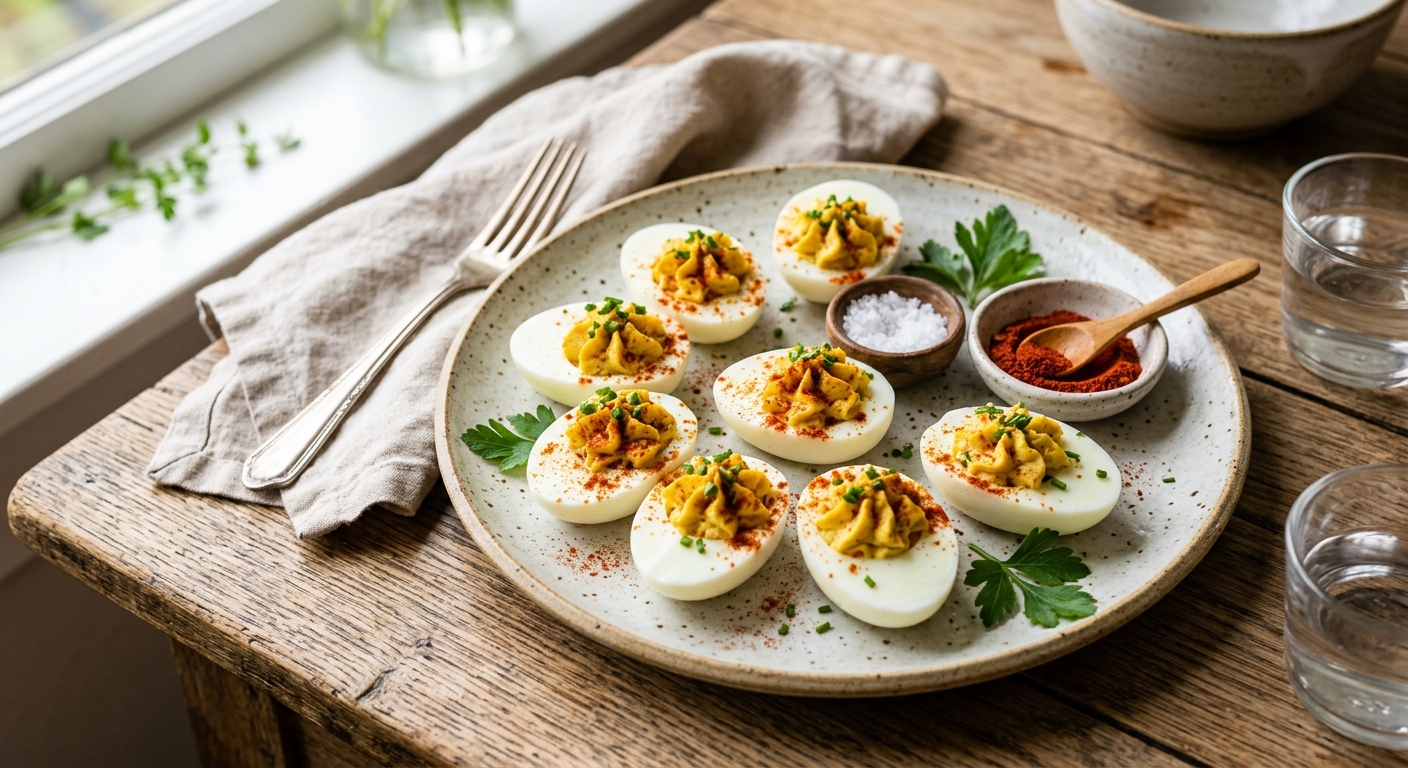
Deviled eggs have graced party platters for decades, but their nutritional profile deserves far more attention than their retro reputation suggests. Each egg white cup cradles a dense payload of complete protein, healthy fats, and a spectrum of fat-soluble vitamins that rival more fashionable superfoods. The real star, though, is choline: a single large egg yolk contains roughly 147mg of this essential nutrient, and most adults consume less than half of their adequate intake on any given day. A serving of four deviled egg halves brings you meaningfully close to the daily target in one elegant, two-bite package.
This recipe replaces the traditional mayonnaise base with a blend of full-fat Greek yogurt and a small amount of quality extra-virgin olive oil, preserving the luxuriously creamy texture while adding probiotic benefit and reducing the ratio of omega-6 fats. A generous hit of smoked Spanish paprika, a pinch of cayenne, and a whisper of apple cider vinegar give the filling its signature depth and brightness, while whole-grain mustard adds a subtle pop of texture and glucosinolate antioxidants that whole-seed mustard uniquely retains. The result is a filling that tastes sophisticated enough for a dinner party and nutritionally calibrated enough to anchor a high-protein snack or light lunch.
What makes this recipe especially practical is its flexibility across cooking methods. Whether you prefer the control of a stovetop simmer, the gentle hands-off approach of a slow cooker water bath, or the speed of a pressure cooker, we have mapped out genuinely distinct techniques for each, including an oven method that produces the most consistently peelable shells of all. Each approach yields the same golden, perfectly set yolk, free of the gray-green ring that plagues carelessly cooked eggs.
4
servings
Ingredients
- 8 largeeggs, at room temperature
- 60 gfull-fat Greek yogurt
- 1 tbspextra-virgin olive oil
- 1 tspwhole-grain Dijon mustard
- 1 tspapple cider vinegar
- 1 tspsmoked Spanish paprika, plus extra for garnish
- 0.25 tspcayenne pepper
- 0.5 tspgarlic powder
- 2 tbspfresh chives, finely sliced
- —Colima Sea SaltMicroplastic Free Salt and freshly ground black pepper to taste
Instructions
Click on an item below to shop for the recommended items for this recipe on Amazon.
As an Amazon Associate, we earn from qualifying purchases.
- Place the eggs in a single layer in a medium saucepan and cover with cold water by at least 2.5 cm (1 inch). Do not stack the eggs. Add 1 teaspoon of fine sea salt to the water, which helps coagulate any white that escapes a hairline crack and makes peeling slightly easier.
- Set the pan over medium-high heat and bring to a full rolling boil uncovered, watching the pot closely. The moment vigorous bubbling begins across the entire surface, reduce the heat to medium-low to maintain a gentle but active simmer rather than a hard boil, which agitates and toughens the whites.
- Simmer for exactly 11 minutes from the point of the rolling boil. While the eggs cook, prepare an ice bath in a large bowl using at least 500g of ice and enough cold water to submerge all eggs.
- After 11 minutes, transfer the eggs immediately to the ice bath using a slotted spoon. Let them cool completely for at least 15 minutes. This stops carryover cooking instantly and causes the egg white to contract slightly away from the shell membrane, making peeling easier.
- Peel each egg under a thin stream of cool running water. Gently crack the wide end first, where the air pocket sits, then peel in one fluid motion from that end. Halve the eggs lengthwise with a sharp chef’s knife wiped clean between cuts for clean edges. Pop the yolks into a medium bowl and arrange the whites on a serving platter, cut-side up.
- Mash the yolks thoroughly with a fork until no lumps remain. Add the Greek yogurt, olive oil, whole-grain mustard, apple cider vinegar, smoked paprika, cayenne, and garlic powder. Mix vigorously with the fork or a small silicone spatula until completely smooth and creamy. Season with salt and black pepper. The filling should hold a soft peak when scooped.
- Transfer the filling to a piping bag fitted with a large star tip, or use a zip-lock bag with one corner snipped off. Pipe a generous swirl into each egg white half. Dust lightly with extra smoked paprika, scatter the sliced chives over the top, and serve immediately or refrigerate uncovered for up to 30 minutes before covering with cling film.
- Place a folded kitchen towel or silicone trivet on the base of your slow cooker insert. This raises the eggs off the direct heat of the base and prevents hot-spot cracking. Pour 120ml (half a cup) of water into the bottom of the insert beneath the towel or trivet, which creates steam during cooking.
- Arrange the 8 eggs directly on top of the towel or trivet in a single layer. Do not stack. Place the lid on the slow cooker and set to Low. Cook for 3 hours 30 minutes. Resist lifting the lid during cooking, as heat loss can extend cooking time significantly.
- While the eggs cook, prepare the ice bath: fill a large bowl with plenty of ice and cold water. When the timer ends, transfer the eggs directly to the ice bath using tongs and cool for a full 15 minutes. The shells will appear slightly speckled or tan from the steam, which is purely cosmetic.
- Peel the eggs by gently tapping all around the shell on the countertop to create a fine web of cracks, then peeling under cool running water. Slow-cooker eggs typically peel in large, satisfying pieces. Halve lengthwise and remove the yolks into a medium mixing bowl.
- Prepare the filling exactly as in the stovetop method: mash the yolks until smooth, then blend in the Greek yogurt, olive oil, whole-grain mustard, apple cider vinegar, smoked paprika, cayenne, and garlic powder. Adjust seasoning with salt and black pepper. Pipe or spoon the filling into the white halves, dust with additional smoked paprika, and finish with sliced chives.
- Pour 240ml (1 cup) of cold water into the inner pot of your pressure cooker or Instant Pot. Place the wire trivet or steamer basket that came with the appliance into the pot. Arrange the eggs on the trivet in a single layer; if your trivet is small, use the steamer basket and stack eggs only if necessary, nesting them carefully.
- Lock the lid into place and set the steam release valve to Sealing. Select Manual or Pressure Cook and set to High Pressure for 5 minutes. The pot will take approximately 8 to 10 minutes to come up to pressure before the 5-minute countdown begins.
- When the cook cycle ends, do not touch the valve. Allow a full natural pressure release for exactly 5 minutes by simply leaving the pot alone. After 5 minutes, carefully quick-release any remaining pressure by moving the steam valve to Venting. Open the lid away from you.
- Immediately transfer the eggs to a prepared ice bath using tongs. Cool for a minimum of 5 minutes (longer is fine). The combination of steam cooking and the ice bath shock makes the membrane separate cleanly from the white, resulting in impressively smooth, unblemished egg whites after peeling.
- Peel each egg, halve lengthwise, and remove the yolks into a bowl. Mash the yolks until completely smooth and lump-free. Add the Greek yogurt, olive oil, whole-grain mustard, apple cider vinegar, smoked paprika, cayenne, and garlic powder, then mix until silky and uniform. Taste and season with salt and pepper. Pipe or spoon the filling into the whites, dust with smoked paprika, and top with fresh chives before serving.
- Preheat your oven to 160 C (325 F) with a rack positioned in the centre. Place one egg into each cavity of a standard 12-cup muffin tin. Do not grease the tin. The cups hold the eggs steady and prevent rolling, ensuring they heat evenly from all sides.
- Slide the muffin tin into the preheated oven and bake for exactly 30 minutes. Do not open the oven door during cooking. You may notice a faint brown spot where the egg shell contacts the hot metal; this is harmless and disappears after peeling.
- Prepare a large ice bath while the eggs bake. When the timer goes off, use oven mitts to remove the muffin tin and immediately transfer each egg to the ice bath using tongs. Let the eggs cool in the ice bath for at least 15 minutes. The thermal shock is essential here, as oven-cooked eggs benefit significantly from a rapid cool-down to stop carryover heat.
- Peel each egg carefully. Oven-baked eggs peel exceptionally cleanly with minimal effort. Halve the eggs lengthwise and transfer the yolks to a medium bowl, arranging the white halves on your serving platter.
- Mash the yolks with a fork until completely smooth. Add the Greek yogurt, olive oil, whole-grain mustard, apple cider vinegar, smoked paprika, cayenne, and garlic powder. Stir vigorously until the filling is uniform, velvety, and holds a soft shape. Season with salt and black pepper to taste. Pipe or spoon generously into each white half. Finish with a dusting of smoked paprika and a scatter of fresh chives. Serve within 2 hours for best texture.
Nutrition Breakdown
Per 1 serving (makes 4)
Vitamins & Minerals
% Daily Value based on a 2,000 calorie diet (FDA reference)
🧬 Essential Amino Acids
% of recommended daily intake (RDA) per serving
🛡 Antioxidant Profile
The Nutrition Science
Choline is classified as an essential nutrient, yet surveys consistently show that fewer than 10% of Americans meet the adequate intake of 550mg per day for men and 425mg for women. This shortfall matters because choline is the rate-limiting substrate for synthesising acetylcholine, the neurotransmitter governing memory consolidation and muscle coordination, as well as phosphatidylcholine, the dominant structural phospholipid in every cell membrane in the human body. Egg yolks are by a significant margin the richest dietary source of choline available, providing roughly 147mg per large yolk. Four egg yolks, as in this recipe’s single serving, deliver approximately 378mg, covering 69% to 89% of the adequate intake depending on sex, from a single dish.
The protein quality of eggs is measured by the Digestible Indispensable Amino Acid Score (DIAAS), where whole egg scores approximately 1.13, meaning it exceeds the reference protein for all indispensable amino acids. This makes eggs one of a small number of foods classified as a complete, high-quality protein source. The addition of Greek yogurt in the filling contributes further leucine and isoleucine, the branched-chain amino acids most directly linked to the activation of mTORC1 signalling and muscle protein synthesis. For anyone eating higher-protein to support body composition, this dish provides bioavailable protein that is efficiently partitioned toward lean tissue maintenance.
Smoked paprika is nutritionally underestimated as a spice. Beyond its culinary role, it delivers a meaningful concentration of carotenoids including capsanthin, capsorubin, and beta-carotene, along with vitamin E as tocopherol. The fat from the egg yolk and olive oil in this recipe is not merely flavour-delivering: fat-soluble carotenoids require dietary fat present in the same meal for micellar solubilisation and subsequent absorption in the small intestine. The natural fat matrix of the egg yolk and the added olive oil therefore actively enhance bioavailability of the paprika’s antioxidants, making the nutritional whole of this dish greater than the sum of its parts.
Pro Tips
- Room-temperature eggs are less likely to crack during any cooking method. Remove eggs from the refrigerator at least 20 minutes before cooking, especially for the oven and pressure cooker methods.
- For the smoothest possible filling, press the mashed yolk mixture through a fine-mesh sieve before adding the wet ingredients. This extra 2-minute step eliminates any remaining granular texture and produces a genuinely restaurant-quality piped result.
- Deviled eggs are best assembled within 2 hours of serving. If prepping ahead, store the cooked, halved whites and the yolk filling separately in covered containers in the refrigerator for up to 24 hours, then pipe just before serving to prevent the whites from drying out and the filling from discolouring.

Choline is criminally underrated, especially for kids – you’re onto something. Pro tip: don’t overcook those yolks even slightly, since heat destroys choline (aim for that creamy, jammy center). I’ve started using a 6-minute soft boil instead of the standard 10-12 minute hard boil, and the texture is noticeably silkier while preserving more of the nutrient density. Greek yogurt swap is clutch too, adds extra choline plus better mouthfeel than mayo-heavy versions.
oh my gosh YES to the choline focus, i was literally just reading about how important it is for brain development and i realized my kids probably arent getting nearly enough! do you have any tips for making these more kid friendly? my oldest will eat basically anything but the younger two are texture people and im wondering if maybe a creamier filling would work better for them, or if id be messing with the nutrient profile too much by adding extra greek yogurt? also obsessed that youre using smoked paprika instead of regular, the flavor upgrade probably makes it easier to sneak these onto a party platter without anyone realizing theyre getting such a micronutrient boost haha
Creamier filling is totally the move for texture-sensitive kids, and honestly you’re not sacrificing much by adding more Greek yogurt since you’re already getting that choline hit from the yolks themselves. I usually do a 2:1 yolk to yogurt ratio for little ones, keeps the protein solid while making it spoonable, and you could even pipe it back in if they prefer that visual. The paprika trick absolutely works as a stealth nutrient play, especially since kids respond to color and smoke flavor reads as “special” rather than “healthy,” which is half the battle with picky eaters.