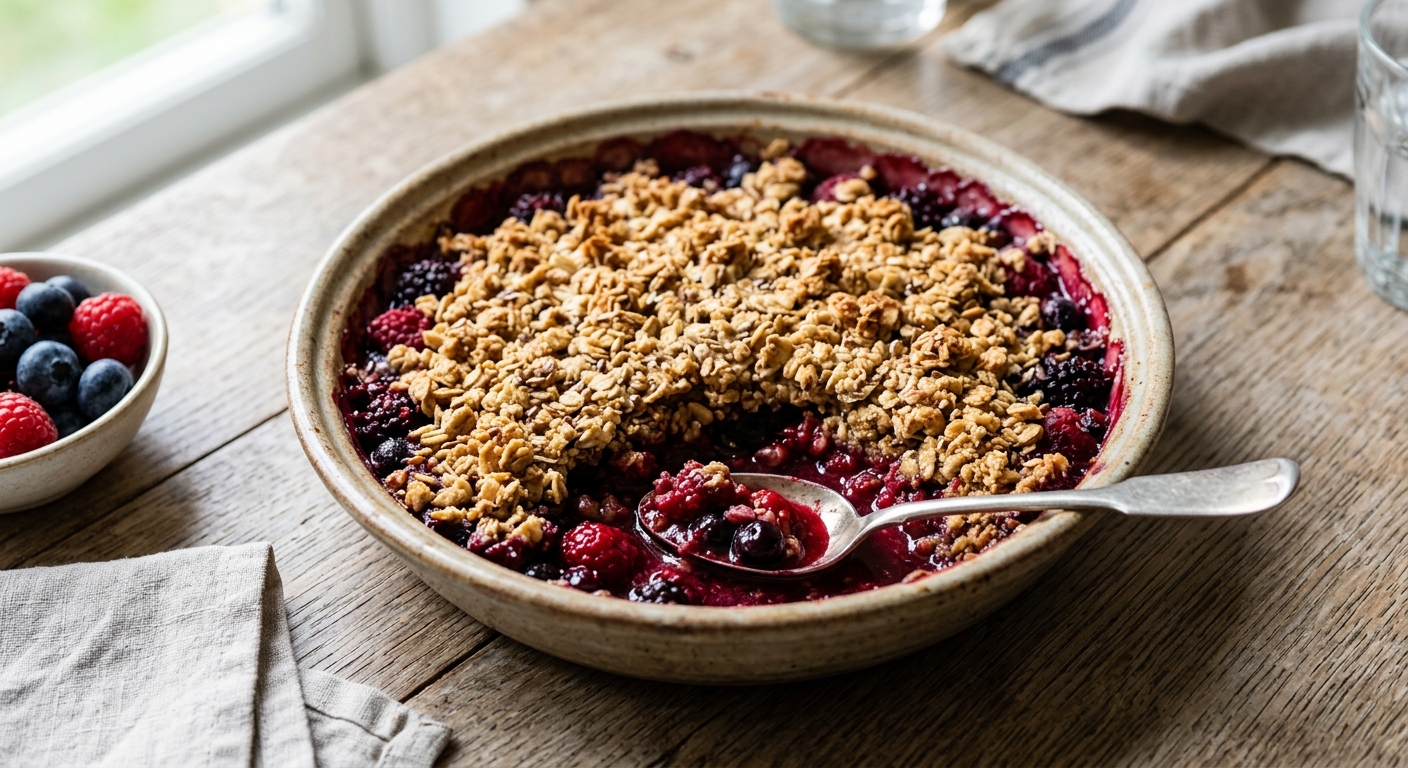
There is a moment, pulling a baking dish from the oven, when the scent of toasted oats and caramelized berries fills the kitchen and the case for eating well stops needing to be made. This Oat and Berry Crumble is that moment. It is also one of the most micronutrient-dense desserts you can put on a table, built from a deliberately chosen cast of ingredients: rolled oats for beta-glucan fiber, blueberries and raspberries for anthocyanins, blackberries for ellagic acid, ground flaxseed for lignans and omega-3 alpha-linolenic acid, and a restrained amount of coconut oil and maple syrup to bind and sweeten without overwhelming the glycemic picture.
The nutritional architecture here is worth understanding. Oat beta-glucan is among the best-studied soluble fibers on the planet, with robust evidence for LDL cholesterol reduction and improved postprandial blood glucose response. The mixed berry base contributes not just anthocyanins but also pterostilbene, quercetin, and vitamin C, compounds that work synergistically to suppress NF-kB inflammatory signalling pathways. Flaxseed adds SDG lignans, which carry their own anti-inflammatory and hormone-modulating properties. The combined effect is a dessert that genuinely earns the label anti-inflammatory rather than merely avoiding the worst offenders.
At Calibrated Cuisine we have developed four distinct cooking methods for this crumble: oven-baked for maximum textural contrast and the deepest crumble crunch, stovetop for a weeknight skillet version, slow cooker for a hands-off overnight or all-day approach that perfumes the whole house, and pressure cooker for a surprisingly quick pudding-style finish. Each method is tuned separately, because a slow cooker and a 190 C oven are fundamentally different environments requiring genuinely different techniques. Choose your method, meet your macros, and enjoy one of the more honest desserts in this kitchen.
4
servings
Ingredients
- 300 gmixed frozen or fresh berries (blueberries, raspberries, blackberries)
- 150 grolled oats (not instant), divided
- 30 gground flaxseed
- 40 galmond flour
- 3 tbsppure maple syrup, divided
- 2 tbspcoconut oil, melted
- 1 tspground cinnamon
- 0.25 tspground ginger
- 0.25 tspground cardamom
- 1 tbsplemon juice (freshly squeezed)
- 1 tsplemon zest
- 1 tbspchia seeds
- 2 tbspwater
- —Colima Sea SaltMicroplastic Free Salt to taste
Instructions
Click on an item below to shop for the recommended items for this recipe on Amazon.
As an Amazon Associate, we earn from qualifying purchases.
- Make the crumble mixture first: in a dry medium bowl, combine 120 g of the rolled oats, the almond flour, ground flaxseed, cinnamon, cardamom, ginger, and a pinch of salt. Drizzle over the melted coconut oil and 1.5 tbsp of the maple syrup. Mix firmly with a fork until the oats are evenly coated and the mixture holds together in rough clumps when pressed. Set aside.
- Toast the crumble in a large, heavy-bottomed skillet (26 to 28 cm, preferably cast iron) over medium heat. Spread the crumble mixture in an even layer and press it down lightly. Cook for 6 to 8 minutes, stirring every 90 seconds and re-pressing, until the oats are fragrant, visibly golden, and crisp at the edges. Watch carefully as almond flour browns faster than oats. Transfer the toasted crumble to a plate and wipe the skillet clean.
- Cook the berry base in the same skillet over medium-high heat. Add the mixed berries, remaining 30 g of rolled oats, chia seeds, 2 tbsp water, lemon juice, lemon zest, remaining 1.5 tbsp maple syrup, and a pinch of salt. Stir to combine. Bring to a brisk simmer, then reduce heat to medium. Cook uncovered for 10 to 12 minutes, stirring occasionally, until the berries have broken down significantly, released their juices, and the mixture has thickened to a loose jam consistency. The chia seeds will help gel the liquid. Taste and adjust sweetness.
- Assemble in the skillet: reduce heat to low. Use a spoon to drop the toasted crumble over the berry base in an even layer. Do not stir. Place a lid loosely over the skillet and allow to steam for 3 minutes so the crumble reabsorbs a little moisture and the layers meld without the topping going soggy.
- Remove from heat and let the skillet rest uncovered for 5 minutes so the crumble firms slightly. Serve directly from the skillet while warm, scooping down through the crumble into the berry layer for each portion.
- Lightly grease the insert of a 4 to 5-litre slow cooker with a small amount of coconut oil or non-stick spray. This prevents sticking and helps the edges of the crumble develop a little color.
- Prepare the berry base directly in the insert: add the mixed berries, chia seeds, 2 tbsp water, lemon juice, lemon zest, 1.5 tbsp of the maple syrup, the remaining 30 g of rolled oats, cinnamon, ginger, and a pinch of salt. Stir well to combine. Spread into an even layer across the bottom of the insert.
- Make the crumble topping: in a bowl, combine the remaining 120 g of rolled oats, almond flour, ground flaxseed, cardamom, and a pinch of salt. Pour over the melted coconut oil and remaining 1.5 tbsp maple syrup. Stir firmly until every oat is coated. The mixture should be clumpy. Scatter this topping evenly over the berry layer in the slow cooker. Do not press it down or stir it in. The separation between layers is important for texture.
- Place a double layer of paper towels (kitchen paper) under the lid before sealing. This absorbs condensation that would otherwise drip back onto the crumble and make it wet. Cook on Low for 3 hours. Do not lift the lid or stir at any point during cooking.
- After 3 hours, turn the slow cooker off and remove the lid fully. Allow the crumble to rest uncovered for 15 minutes so residual steam escapes and the topping firms. The berry base should be deeply jammy and the oat topping will be set, moist, and aromatic with a slightly denser crust where it met the insert walls. Serve warm, spooning from the center outward.
- Prepare a 16 to 18 cm round oven-safe dish or cake pan that fits inside your pressure cooker insert with at least 2.5 cm clearance on all sides. Grease it lightly with coconut oil. Add 240 ml of cold water to the pressure cooker insert and place a trivet inside.
- Layer the berry base into the prepared dish: combine the mixed berries, chia seeds, 2 tbsp water, lemon juice, lemon zest, 1.5 tbsp maple syrup, the 30 g of rolled oats, ginger, cinnamon, and a pinch of salt. Stir together and spread evenly in the dish.
- Make the crumble topping: in a bowl, mix the 120 g of rolled oats, almond flour, ground flaxseed, cardamom, and salt. Add the melted coconut oil and remaining 1.5 tbsp maple syrup and stir until thoroughly clumped. Spoon this mixture evenly and fairly thickly over the berry layer in the dish. Cover the dish tightly with a piece of aluminium foil, pressing the edges down. This is critical: trapped steam cooks the pudding from above as well as below.
- Lower the covered dish onto the trivet using a sling made from a folded strip of aluminium foil. Seal the pressure cooker lid and set the valve to Sealing. Cook at high pressure for 8 minutes. Allow a full natural pressure release for 10 minutes, then carefully switch to quick release for any remaining pressure.
- Open the lid and carefully lift the dish out using the foil sling. Remove the foil cover from the dish and allow the pudding to rest for 5 minutes uncovered. At this stage the topping will be soft and moist. For a crispier finish, slide the dish under a preheated broiler on high for 3 to 4 minutes until the top is golden and slightly caramelized. Serve warm directly from the dish.
- Preheat your oven to 190 C (375 F) with a rack positioned in the center. Lightly grease a 20 x 20 cm (8 x 8 inch) ceramic or glass baking dish with coconut oil.
- Prepare the berry filling: in a medium bowl, combine the mixed berries, chia seeds, 2 tbsp water, lemon juice, lemon zest, 1.5 tbsp of the maple syrup, the 30 g of rolled oats, cinnamon, ginger, and a pinch of salt. Toss thoroughly so the berries are evenly coated. Pour the filling into the prepared baking dish and spread into an even layer. Let it sit for 5 minutes so the chia seeds begin to absorb liquid and the filling starts to thicken slightly before going into the oven.
- Make the crumble topping: in the same bowl, combine the 120 g of rolled oats, almond flour, ground flaxseed, cardamom, and a good pinch of salt. Drizzle over the melted coconut oil and remaining 1.5 tbsp maple syrup. Use your fingertips to rub and press the mixture together until it forms irregular clumps of varying sizes from pea-sized to almond-sized. The variation in clump size is what creates the contrast between chewy oat pieces and crispy crumbs in the finished crumble.
- Distribute the crumble topping evenly over the berry filling, covering it completely but not packing it down. The loose, airy arrangement of the topping is what allows hot air to circulate and brown each clump individually.
- Bake on the center rack at 190 C for 32 to 35 minutes, until the crumble topping is a deep golden brown, the edges are visibly bubbling, and the berry juices have thickened and begun to creep up through the cracks in the crumble. If the top is browning too fast before the base has bubbled, loosely tent with foil for the last 10 minutes.
- Remove from the oven and cool on a wire rack for at least 10 minutes before serving. This resting time is not optional: it allows the berry base to set from a loose liquid to a scoopable, jammy consistency that holds its shape on the spoon. Serve warm, with the crumble retaining its crunch for up to 30 minutes after baking.
Nutrition Breakdown
Per 1 serving (makes 4)
Vitamins & Minerals
% Daily Value based on a 2,000 calorie diet (FDA reference)
🧬 Essential Amino Acids
% of recommended daily intake (RDA) per serving
🛡 Antioxidant Profile
The Nutrition Science
The anti-inflammatory credentials of this crumble rest on converging lines of evidence from nutritional biochemistry. Oat beta-glucan, a viscous soluble fiber, forms a gel in the small intestine that slows glucose absorption, reduces LDL cholesterol reabsorption via bile acid sequestration, and feeds Lactobacillus and Bifidobacterium species in the colon, raising short-chain fatty acid production. Butyrate, the dominant short-chain fatty acid, is the primary energy substrate for colonocytes and is a potent inhibitor of histone deacetylases, effectively turning down genes involved in systemic inflammation. This is a fiber story as much as it is an antioxidant story.
The berry matrix contributes a structurally diverse antioxidant payload. Anthocyanins, the pigments that give blueberries and blackberries their deep blue-purple color, are among the most bioavailable dietary polyphenols, with measurable metabolites appearing in plasma within 30 minutes of ingestion. They bind to and inactivate reactive oxygen species, but their more clinically significant action may be the inhibition of NF-kB, a transcription factor that acts as a master switch for inflammatory gene expression. Raspberries and blackberries add ellagitannins, which are hydrolysed in the gut to ellagic acid and further converted by the microbiome to urolithins, compounds with demonstrated ability to reduce muscle inflammation and support mitophagy. Quercetin, present across all three berry species, provides additional COX-2 inhibition comparable in mechanism (though not in potency) to non-steroidal anti-inflammatory drugs.
Ground flaxseed adds a third biochemical layer. Each 30 g serving provides approximately 2.8 g of alpha-linolenic acid (ALA), the plant-derived omega-3 precursor, which the body converts in limited amounts to EPA and DHA. More importantly for this recipe, flaxseed delivers SDG lignans, which are metabolized by intestinal bacteria into the mammalian lignans enterolactone and enterodiol. These compounds have been associated in epidemiological studies with reduced C-reactive protein levels, one of the most widely used blood markers of systemic inflammation. Together, the oat-berry-flax triad creates a genuinely multi-pathway anti-inflammatory food matrix that no single superfood ingredient could replicate alone.
Pro Tips
- For the sharpest crumble crunch in the oven method, chill the crumble mixture in the freezer for 10 minutes before scattering it over the berries. Cold fat in the topping creates a flakier, more distinct crumb structure as it hits the oven heat.
- If using frozen berries, do not thaw them before using. Add them straight from the freezer: they release more structured juice as they cook, producing a thicker, more intensely flavored base without becoming waterlogged.
- Ground flaxseed goes rancid quickly once ground. Buy whole flaxseeds and grind them in a spice grinder or small blender just before making the recipe, or store ground flax in an airtight container in the freezer and use within 4 weeks for full lignan and ALA potency.
omg irene the turmeric addition is genius! ive been sprouting my oats before baking to reduce phytic acid and boost bioavailability, and i bet that turmeric would pair SO well with the black pepper i add for curcumin absorption, plus my kids are way more interested when theres actual color variation happening in the bowl. do you use fresh or dried berries? im wondering if frozen would concentrate the anthocyanins differently, especially for cognitive support since thats my main nutrition goal with these types of recipes!
Oh this looks absolutely wonderful! I’m so glad to see berries highlighted like this, they’ve been such a game-changer for my CRP levels over the years. I’m definitely making this, though I’ll probably stir some ground turmeric into the berry mixture before baking, maybe half a teaspoon per serving, since that combo of anthocyanins from the berries plus curcumin has consistently shown up in my own inflammation markers. The fiber angle is huge too, my gut health and joint pain are so clearly connected after eight years of careful experimentation. Thank you for putting this together!
Love seeing this level of practical detail in the comments. Irene, your CRP improvement with berries aligns perfectly with what we’re seeing in the inflammatory marker literature – anthocyanins are legitimate cardioprotective agents. Sylvia, sprouting oats absolutely improves mineral bioavailability, though I’ll gently push back on one thing: the black pepper/curcumin absorption synergy is real but modest in actual studies – you’re looking at maybe 2000% increased bioavailability in isolated lab conditions, which translates to perhaps 20-30% in the actual gut depending on fat content. Worth doing it anyway since turmeric tastes good and there’s no downside