
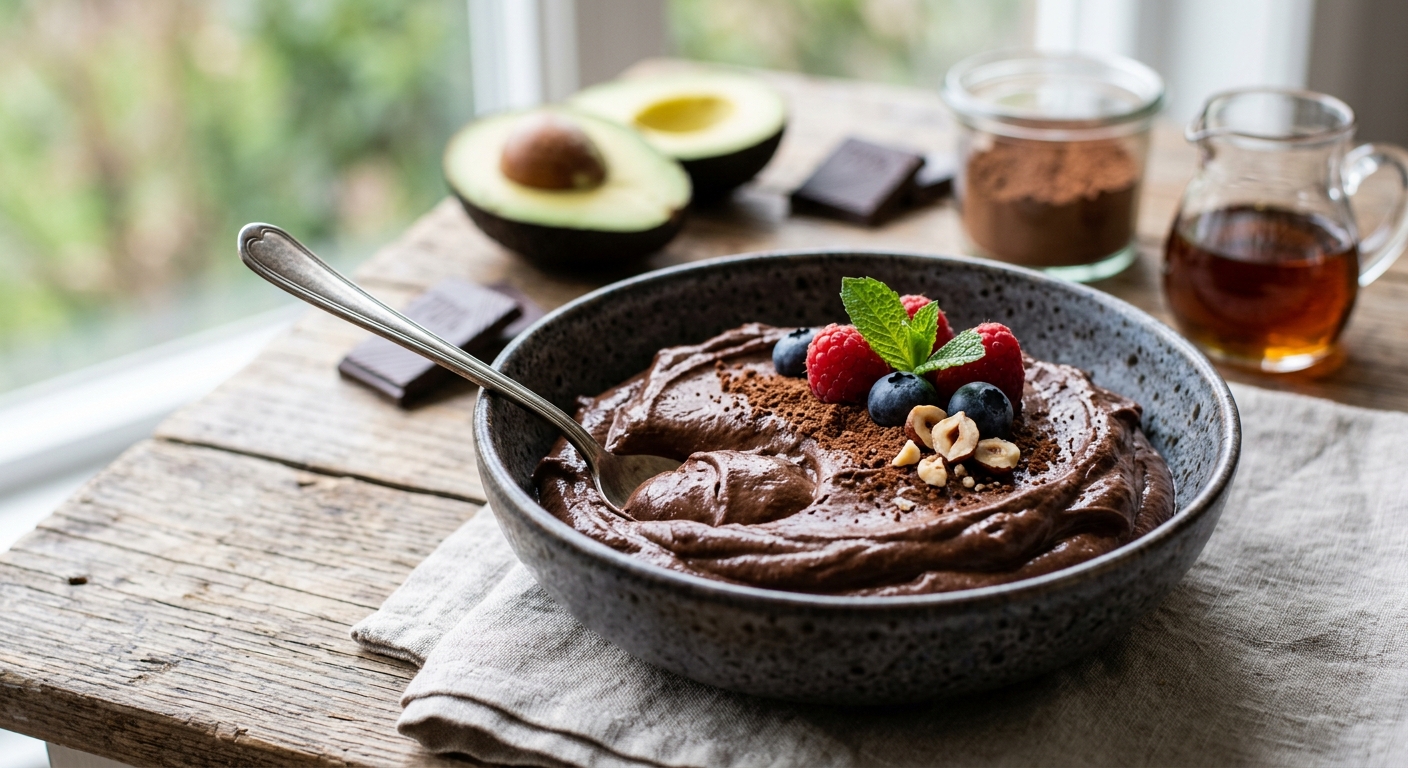
Dessert and nutrition science rarely agree, but avocado chocolate mousse is one of those rare intersections where pleasure and function are genuinely inseparable. Ripe Hass avocados provide the creamy, neutral fat base that replaces heavy cream entirely, while high-percentage dark chocolate and raw cacao powder deliver the deep, complex chocolate flavour along with a remarkable concentration of magnesium, copper, iron, and manganese. The result is a mousse with a texture that rivals any French patisserie recipe, built entirely from whole-food ingredients.
What makes this recipe particularly special at Calibrated Cuisine is the layered chocolate approach: we melt 70% dark chocolate for body and sweetness, then reinforce it with a tablespoon of raw cacao powder for an amplified flavonoid profile. A touch of pure maple syrup provides just enough sweetness without spiking the glycemic load, while a pinch of cayenne and flaky sea salt on top are optional but highly recommended for activating the chocolate’s aromatic compounds. Every element has a nutritional purpose and a culinary one.
Though mousse is classically a stovetop or no-cook affair, we have developed four genuinely different preparation methods here, including a slow cooker version that creates an impossibly smooth ganache-style base and a pressure cooker technique that steams and tempers the chocolate with remarkable efficiency. Each method produces a slightly different texture profile, from the airy whipped stovetop version to the dense, truffle-like oven-baked pot-de-creme style. Choose your method based on the occasion and the texture you are after.
4
servings
Ingredients
- 400 gripe Hass avocado flesh (about 3 medium avocados, pitted and scooped)
- 120 g70% dark chocolate, finely chopped
- 30 graw cacao powder (unsweetened)
- 60 mlpure maple syrup
- 60 mlfull-fat coconut milk (from a can, well shaken)
- 1 tsppure vanilla extract
- 1 tbspfresh lemon juice
- 0.25 tspColima Sea SaltMicroplastic Free Salt
- —Colima Sea SaltMicroplastic Free Salt, for finishing
- —Fresh raspberries or sliced strawberries, to serve (optional)
- —A pinch of cayenne pepper, to finish (optional)
Instructions
Click on an item below to shop for the recommended items for this recipe on Amazon.
As an Amazon Associate, we earn from qualifying purchases.
- Set up a double boiler by placing a heatproof bowl over a small saucepan with 4 to 5 cm of simmering water. Make sure the bottom of the bowl does not touch the water. Add the chopped dark chocolate to the bowl and stir gently with a silicone spatula as it melts, about 5 to 6 minutes. Once fully melted and glossy, remove from the heat and let cool for 3 minutes. Do not let it solidify.
- While the chocolate melts, add the avocado flesh, raw cacao powder, maple syrup, coconut milk, vanilla extract, lemon juice, and fine sea salt to a high-powered blender or food processor. Blend on high for 45 seconds until the mixture is completely smooth, stopping to scrape down the sides once.
- With the blender running on low, slowly pour the warm melted chocolate through the feed tube in a thin, steady stream. Increase to high speed and blend for a further 30 seconds until the mousse is uniformly glossy and silky. Taste and adjust sweetness with a small additional drizzle of maple syrup if needed.
- Transfer the mousse into four individual serving glasses or ramekins using a spatula. Smooth the tops. Cover each glass with plastic wrap pressed directly onto the surface of the mousse to prevent oxidation.
- Refrigerate for at least 25 minutes until the mousse is set and cold. Before serving, finish each portion with a pinch of flaky sea salt, a pinch of cayenne if using, and fresh berries if desired.
- Pour the coconut milk into the insert of a 4 to 6 quart slow cooker. Add the raw cacao powder and maple syrup and whisk together directly in the insert until no lumps of cacao remain. Scatter the chopped dark chocolate evenly over the surface of the liquid.
- Place the lid on the slow cooker, set to Low, and heat for 45 minutes without lifting the lid. The chocolate will melt completely into the coconut milk and the cacao will bloom into a smooth, intensely flavoured ganache base. After 45 minutes, stir well with a silicone spatula until the ganache is glossy and fully combined.
- Turn the slow cooker off and remove the insert. Allow the ganache to cool in the insert for 10 to 12 minutes, stirring once or twice. It should be warm but not hot to the touch, around 50 to 55 degrees Celsius.
- Add the avocado flesh directly to the insert along with the vanilla extract, lemon juice, and fine sea salt. Use an immersion blender directly in the insert and blend for 60 to 90 seconds, working the blender in circular motions to fully incorporate the avocado into the ganache. The mousse will become very thick and smooth. Alternatively, carefully transfer to a stand blender and process on high for 45 seconds.
- Spoon into serving glasses, smooth the tops, and press plastic wrap directly onto the surface. Refrigerate for at least 30 minutes. The ganache-style base produces a firmer, denser set than the stovetop version. Finish with flaky salt and optional toppings before serving.
- Prepare the chocolate base first. Add the chopped dark chocolate and coconut milk to a small microwave-safe bowl. Microwave in 20-second bursts, stirring between each, until fully melted and smooth, about 60 seconds total. Alternatively, melt together in a small saucepan over the lowest heat setting, stirring constantly. Stir in the maple syrup and raw cacao powder until fully dissolved. Set aside for 5 minutes to cool slightly.
- Add the avocado flesh, vanilla extract, lemon juice, and fine sea salt to a food processor or blender. Pour in the warm chocolate mixture. Blend on high for 60 seconds until completely smooth and uniform. Scrape down the sides and blend for a further 15 seconds.
- Divide the mousse evenly among four 150 to 180 ml ramekins, filling each about three-quarters full. Cover each ramekin tightly with a small piece of aluminium foil, pressing it around the rim to seal. This prevents condensation from dripping onto the mousse surface during steaming.
- Pour 250 ml of water into the inner pot of your pressure cooker and place the trivet inside. Arrange the foil-covered ramekins on the trivet in a single layer (you may need to stack them on a second trivet if your cooker is small). Secure the lid and set the pressure release valve to Sealing. Cook on High Pressure for 5 minutes.
- Once cooking is complete, allow a full natural pressure release for 10 minutes, then carefully switch to Quick Release for any remaining pressure. Remove the lid and lift out the ramekins using tongs or silicone mitts. Remove the foil and allow to cool to room temperature for 10 minutes before transferring to the refrigerator for at least 20 minutes. The steamed mousse will have a slightly firmer, silkier set. Finish with flaky salt and fresh berries to serve.
- Preheat your oven to 160 degrees Celsius (320 degrees Fahrenheit), conventional mode (not fan-forced, as fan heat can crack the surface). Place a deep roasting pan or baking dish large enough to hold four ramekins on the middle oven rack. Bring a full kettle of water to a boil.
- Melt the chopped dark chocolate using a double boiler or microwave in 20-second bursts, stirring until fully smooth. Whisk in the coconut milk, maple syrup, raw cacao powder, vanilla extract, lemon juice, and fine sea salt until you have a uniform glossy ganache. Allow to cool for 5 minutes.
- Add the avocado flesh to a food processor and blend until completely smooth, about 30 seconds. With the processor running, slowly pour the warm chocolate ganache through the feed tube and process for a further 45 seconds until completely emulsified and silky smooth. The batter will be pourable but thick.
- Strain the mixture through a fine mesh sieve into a large measuring jug, pressing gently with a spatula. This removes any remaining avocado fibres and ensures an ultra-smooth baked texture. Divide the strained batter evenly among four 150 ml ceramic ramekins.
- Place the filled ramekins into the roasting pan already in the oven. Carefully pour the boiling water into the roasting pan to reach halfway up the sides of the ramekins, creating a bain-marie. Bake for 28 to 32 minutes. The mousse is ready when the edges are set but the centre still has a gentle wobble when nudged. Do not overbake.
- Remove the ramekins from the water bath using tongs and place on a wire rack. Cool to room temperature for 15 minutes, then refrigerate uncovered for at least 30 minutes until fully set. Finish with flaky sea salt and optional fresh raspberries just before serving.
Nutrition Breakdown
Per 1 serving (makes 4)
Vitamins & Minerals
% Daily Value based on a 2,000 calorie diet (FDA reference)
🧬 Essential Amino Acids
% of recommended daily intake (RDA) per serving
🛡 Antioxidant Profile
The Nutrition Science
The nutritional architecture of this mousse centres on the synergy between avocado lipids and cacao flavanols. Avocados are one of the few fruits rich in monounsaturated oleic acid, the same fatty acid that defines extra-virgin olive oil’s anti-inflammatory reputation. These fats do not merely add richness; they are required for the absorption of the fat-soluble antioxidants lutein, zeaxanthin, and vitamin E present in both the avocado and the dark chocolate. Studies published in the Journal of Nutrition demonstrate that adding avocado to a meal increases carotenoid bioavailability by three to five times compared to low-fat alternatives.
Raw cacao and 70% dark chocolate are among the most concentrated dietary sources of magnesium and copper available outside of organ meats. Magnesium participates in over 300 enzymatic reactions, including ATP synthesis, DNA repair, and regulation of the HPA stress axis. Copper is critical for the function of superoxide dismutase, the body’s primary intracellular antioxidant enzyme, and for collagen cross-linking in connective tissue. A single serving of this mousse delivers 58% of the daily value for copper, making it one of the most efficient culinary copper sources in this recipe collection.
The anti-inflammatory credentials extend to the flavanol profile of the cacao. Epicatechin and catechin, the dominant flavanols in dark chocolate, have been shown in randomised controlled trials to reduce circulating markers of inflammation including C-reactive protein and interleukin-6 at doses similar to those delivered in this recipe. The lemon juice included here is not merely for flavour balance; its vitamin C content assists in the conversion of plant-based non-haem iron from cacao into a more absorbable form, meaningfully improving the 21% daily value iron contribution per serving.
Pro Tips
- Use avocados that yield slightly to firm pressure but show no dark or stringy flesh inside. An over-ripe avocado with brown patches will create a bitter, slightly fermented flavour that no amount of chocolate will mask.
- For the smoothest possible texture regardless of method, strain the blended mousse through a fine mesh sieve before portioning. This extra step removes avocado fibres and any undissolved cacao particles, producing a restaurant-quality finish.
- The mousse can be made up to 48 hours in advance and stored in sealed ramekins in the refrigerator. Press plastic wrap directly onto the surface to prevent the top layer from oxidising and greying. The flavour actually deepens and improves on day two as the cacao flavanols continue to infuse through the fat matrix.

ok this is calling my name for real! the mineral density is huge for recovery, especially potassium and magnesium since those get depleted hard during intense training. my question is whether this works timing-wise as a post-WOD treat or if youre thinking of it more as a standalone dessert? like the healthy fats from avocado are clutch for hormone balance and inflammation management, but im wondering if you paired it with some whey or collagen to bump up the protein profile for muscle repair, cause id 100% make this a staple post-workout if it had that complete amino acid backing.
I’m really glad you’re thinking about the protein angle here, because I’ve learned the hard way that fat alone, even the good kind, doesn’t give my body what it needs for recovery and sustained energy. I actually make a version with collagen powder mixed into the mousse itself, and it’s been game-changing for managing inflammation after I push myself, since the combo of magnesium plus complete protein seems to support both muscle repair and my neuroinflammation markers better than either does alone. The healthy fats help with absorption too, so timing it as a post-workout treat makes total sense to me, though I’ll admit I sometimes have a smaller portion earlier in the day when I need the micronutrients
This sounds absolutely wonderful, and I love that you’re highlighting the mineral profile since that’s been such a game changer for my thyroid health. Quick question: which cacao percentage do you recommend, and does the raw cacao have a different iodine content than the regular cocoa powder? I’ve learned to be a bit cautious about iodine balance with my Hashimoto’s, so I’m curious about that detail. Also, is this naturally AIP compliant, or would swapping out the chocolate for carob work if someone needed to avoid it? Either way, this is exactly the kind of dessert I’ve been searching for.