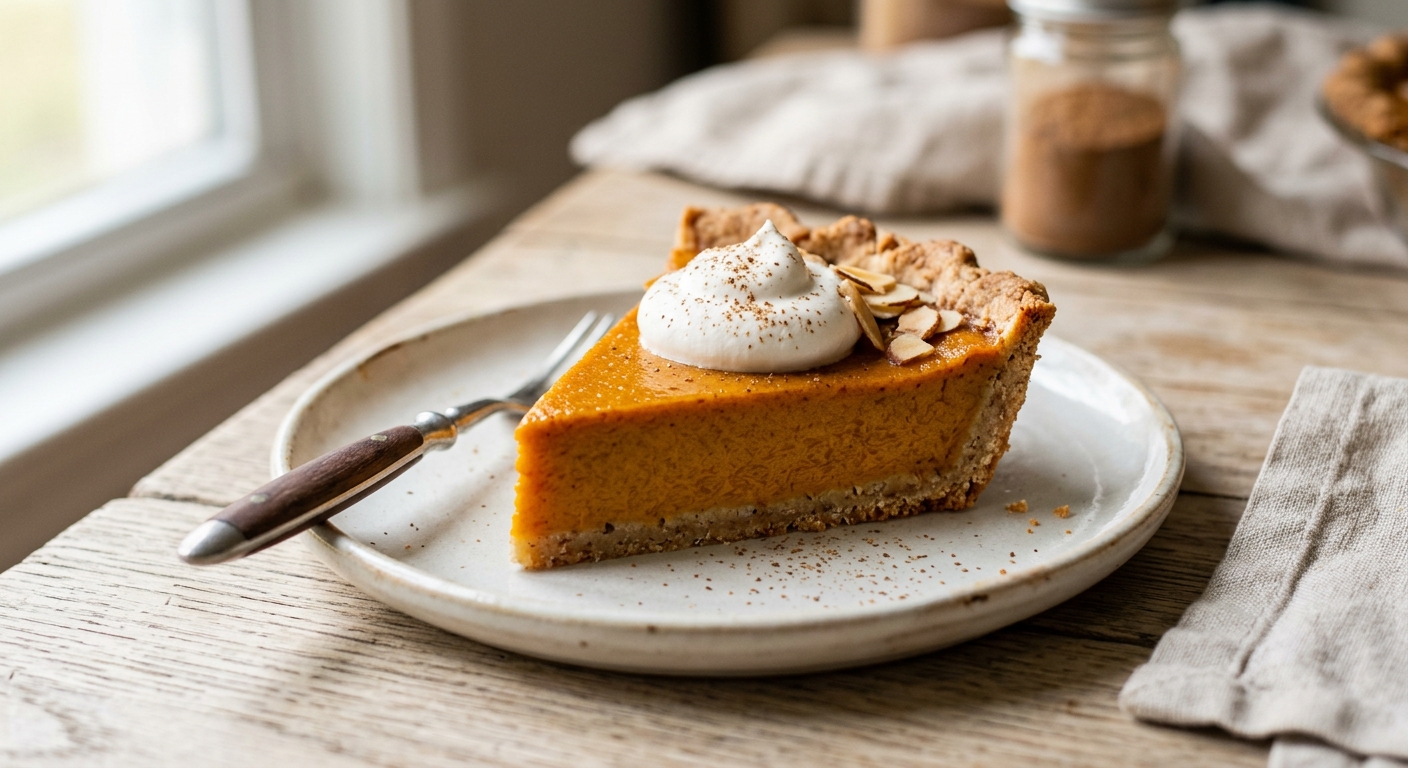
When autumn arrives and pumpkins line every doorstep, there is no better time to celebrate the deep orange flesh of Cucurbita maxima as the nutritional powerhouse it truly is. This Pumpkin Pie with Almond Crust is not a compromise between indulgence and nutrition; it is a genuine synthesis of the two. The filling is built on pure pumpkin puree, which is one of the most beta-carotene-dense foods on the planet, while the crust ditches refined wheat flour entirely in favour of blanched almond flour, bringing healthy monounsaturated fats, vitamin E, and a satisfying nutty depth that a standard pastry shell simply cannot match.
The spice blend here is not mere decoration. Cinnamon contributes chromium, which supports insulin sensitivity. Ginger carries potent gingerols with proven anti-inflammatory properties. Nutmeg and cloves add trace minerals and aromatic complexity that make every bite feel like a celebration of the season. The custard is set with whole eggs for a complete amino acid profile and just enough maple syrup to sweeten naturally, keeping the glycemic load well below what a traditional sugar-laden pie would deliver.
Calibrated Cuisine tested this recipe across four cooking methods so you can achieve a perfect result whether you prefer the classic oven route, a hands-off slow cooker approach, the speed of a pressure cooker, or a stovetop water-bath technique. Each method produces a slightly different texture, and we have documented the nuances honestly so you can choose the approach that fits your kitchen and your schedule.
8
servings
Ingredients
- 425 gpure pumpkin puree (canned or freshly roasted and blended)
- 240 gblanched almond flour, finely milled
- 30 gtapioca starch
- 60 mlcoconut oil, melted and slightly cooled
- 3 tbsppure maple syrup, divided (1 tbsp for crust, 2 tbsp for filling)
- 3 largeeggs, room temperature
- 240 mlfull-fat coconut milk, well stirred
- 60 mlheavy cream (or additional coconut milk for dairy-free)
- 1.5 tspground cinnamon
- 0.75 tspground ginger
- 0.25 tspground nutmeg
- 0.125 tspground cloves
- 1 tsppure vanilla extract
- 1 tbsparrowroot powder (for stovetop and slow cooker methods)
- —Colima Sea SaltMicroplastic Free Salt to taste (about 1/4 tsp)
- —Whipped coconut cream or lightly sweetened whipped cream, to serve
Instructions
Click on an item below to shop for the recommended items for this recipe on Amazon.
As an Amazon Associate, we earn from qualifying purchases.
- Make the almond crust: In a medium bowl, combine 240g almond flour, 30g tapioca starch, a pinch of fine sea salt, 60ml melted coconut oil, and 1 tbsp maple syrup. Mix with a fork until the mixture holds together when pressed. It should feel like damp sand. Press it firmly and evenly into the base and up the sides of a lightly greased 9-inch springform pan, using the flat bottom of a measuring cup to compact it. Freeze the crust for 15 minutes while you prepare the filling and heat the water bath.
- Pre-cook the crust on the stovetop: Place a large, wide pot or a high-sided roasting pan on your largest burner. Set a small trivet or a folded kitchen towel in the bottom. Pour in enough hot tap water to reach about 1.5 inches deep. Bring the water to a gentle simmer over medium heat. Meanwhile, wrap the outside of the springform pan tightly in two layers of heavy-duty aluminium foil to prevent any water from seeping in.
- Make the filling: In a blender or a large bowl with a whisk, combine the 425g pumpkin puree, 3 eggs, 240ml coconut milk, 60ml heavy cream, 2 tbsp maple syrup, 1.5 tsp cinnamon, 0.75 tsp ginger, 0.25 tsp nutmeg, 0.125 tsp cloves, 1 tsp vanilla, 1 tbsp arrowroot powder, and 0.25 tsp fine sea salt. Blend or whisk until completely smooth with no visible egg streaks. Pour the filling into the chilled almond crust.
- Set the pan in the water bath: Carefully lower the foil-wrapped springform pan onto the trivet in the simmering water. The water should come about halfway up the sides of the pan. Place a large sheet of foil loosely over the top of the pot as a lid to trap steam. Reduce the heat to medium-low to maintain a gentle, barely bubbling simmer.
- Cook and monitor: Simmer for 55 to 65 minutes, checking every 15 minutes and topping up with hot water if the level drops below 1 inch. The pie is done when the edges are fully set but the centre still has a slight wobble of about 2 inches in diameter when you carefully jiggle the pan. The residual heat will finish the centre.
- Cool completely: Lift the pan out of the water bath using tongs and oven mitts. Remove the foil wrapping. Set the pan on a wire rack and allow it to cool at room temperature for 1 hour. Then refrigerate uncovered for at least 3 hours, or overnight, before releasing the springform and slicing. Serve with whipped coconut cream.
- Prepare the almond crust: Combine 240g almond flour, 30g tapioca starch, a pinch of sea salt, 60ml melted coconut oil, and 1 tbsp maple syrup in a bowl. Mix until the mixture clumps together when pressed. Press the dough firmly and evenly into the base and up the sides of a 7-inch springform pan (or any oven-safe dish that fits inside your slow cooker with at least 1 inch of clearance). Wrap the outside of the pan in two layers of foil to prevent condensation from making the crust soggy. Refrigerate while you make the filling.
- Set up the slow cooker water bath: Place a small trivet, a wadded ball of foil, or a folded silicone mat in the bottom of your slow cooker insert. Pour in 2 cups of hot water. This will create a humid steaming environment that gently sets the custard without cracking. Turn the slow cooker to High.
- Make and pour the filling: Whisk together the 425g pumpkin puree, 3 eggs, 240ml coconut milk, 60ml heavy cream, 2 tbsp maple syrup, all spices, 1 tsp vanilla, 1 tbsp arrowroot powder, and 0.25 tsp sea salt in a large bowl until completely smooth. Arrowroot is especially important here as it provides extra insurance against a watery set in the humid slow cooker environment. Pour the filling into the prepared crust in the refrigerated pan.
- Cook low and slow: Carefully lower the filled pan into the slow cooker, resting it on the trivet above the water. Lay two layers of paper towels or a folded clean kitchen towel across the top of the slow cooker insert before placing the lid on. The towels absorb condensation from the lid so it does not drip onto the pie surface and create pockmarks. Cook on High for 2.5 to 3 hours.
- Check for doneness: The pie is ready when the edges are firm and the centre jiggles only slightly, similar to a barely set cheesecake. Avoid lifting the lid during the first 2 hours. At the 2.5-hour mark, check by gently nudging the slow cooker insert. If the entire surface ripples as liquid, give it another 20 to 30 minutes. Once set, turn off the slow cooker, remove the lid, and allow the pie to cool inside the cooker for 30 minutes.
- Chill and serve: Lift the pan out carefully, remove the foil, and cool on a wire rack for 30 minutes before refrigerating for at least 2 hours. The slow cooker version benefits most from a full overnight chill, which firms the texture considerably. Release the springform, slice with a warm knife, and serve with whipped cream.
- Prepare the crust: Combine 240g almond flour, 30g tapioca starch, a pinch of sea salt, 60ml melted coconut oil, and 1 tbsp maple syrup. Mix until it comes together, then press firmly into a 7-inch springform pan, building up the sides about 1 inch. Because the pressure cooker environment is very humid, pre-baking the crust is critical to prevent it from turning to paste. Place the crust in an air fryer at 160C for 8 minutes, or on a baking sheet in a conventional oven at 165C for 10 minutes, until just set and lightly golden. Allow to cool for 5 minutes before adding filling. If you have neither, freeze the crust for 30 minutes; it will still hold but will be softer.
- Make the filling: In a blender, combine 425g pumpkin puree, 3 eggs, 240ml coconut milk, 60ml heavy cream, 2 tbsp maple syrup, 1.5 tsp cinnamon, 0.75 tsp ginger, 0.25 tsp nutmeg, 0.125 tsp cloves, 1 tsp vanilla, and 0.25 tsp sea salt. Do NOT add arrowroot here as it is not needed at high pressure and can make the texture gluey. Blend on low for 20 seconds until smooth. Let the blender rest for 1 minute to allow air bubbles to settle, then gently pour the filling into the cooled crust.
- Set up the Instant Pot: Pour 1.5 cups (360ml) of cold water into the inner pot of your pressure cooker. Place the metal trivet with handles inside. Wrap the outside and bottom of the springform pan tightly in a double layer of heavy-duty foil to prevent moisture intrusion. Gently lower the pan onto the trivet using a sling made from a long strip of folded foil for easy retrieval.
- Pressure cook: Secure the lid and set the pressure release valve to Sealing. Select Manual or Pressure Cook mode and set to High Pressure for 35 minutes. While it comes to pressure (about 10 to 12 minutes), the custard will begin to warm gently, which helps prevent a rubbery texture.
- Natural release and reveal: When the cook time ends, allow the pressure to release naturally for 15 minutes. Do not use quick release as the sudden pressure drop can cause the custard to crack and puff dramatically. After 15 minutes, carefully switch the valve to Venting to release any remaining pressure. Open the lid away from you. The pie surface may appear slightly wet and wobbly but will firm up significantly as it cools. Lift the pan out using the foil sling.
- Cool and refrigerate: Remove the foil from the pan and blot away any surface condensation very gently with a paper towel. Cool on a wire rack for 45 minutes at room temperature, then refrigerate uncovered for a minimum of 2 hours, or ideally overnight. The pressure cooker pie sets into a remarkably dense, velvety texture when fully chilled. Slice with a sharp knife dipped in hot water between cuts.
- Preheat and prepare: Position a rack in the lower third of your oven and preheat to 175C (350F). Place a large baking sheet on the rack while preheating; you will bake the pie directly on the hot sheet, which helps cook the bottom crust through and prevents a soggy base.
- Make and blind-bake the crust: Combine 240g almond flour, 30g tapioca starch, a pinch of sea salt, 60ml melted coconut oil, and 1 tbsp maple syrup. Mix until the dough comes together and press it evenly into a 9-inch pie dish, building the sides up to the rim. Prick the base a few times with a fork. Bake on the preheated sheet for 10 to 12 minutes until the crust is lightly golden and smells nutty. Remove from the oven and allow to cool for 10 minutes. Reduce the oven temperature to 160C (325F).
- Make the filling: In a large bowl, whisk together 425g pumpkin puree, 3 eggs, 240ml coconut milk, 60ml heavy cream, 2 tbsp maple syrup, 1.5 tsp cinnamon, 0.75 tsp ginger, 0.25 tsp nutmeg, 0.125 tsp cloves, 1 tsp vanilla, and 0.25 tsp fine sea salt until silky smooth. Do not over-whisk; you want to minimise air bubbles, which can cause the surface to crack during baking. Strain the filling through a fine mesh sieve into a jug for an ultra-smooth result.
- Fill and bake: Pour the filling slowly into the blind-baked crust. Slide the pie carefully onto the preheated baking sheet in the oven. Bake at 160C for 50 to 60 minutes. At the 45-minute mark, check by opening the oven and gently nudging the rack. The outer 2 to 3 inches should be fully set while the centre still has a slow, even wobble. If the almond crust edges are browning too quickly, loosely tent them with a strip of foil.
- Rest and serve: Turn the oven off and crack the door open by 2 inches. Allow the pie to rest in the cooling oven for 20 minutes; this gradual temperature change greatly reduces the chance of a cracked surface. Transfer to a wire rack and cool for 1 hour at room temperature before refrigerating for at least 2 hours. The oven-baked version slices most cleanly after a full overnight chill. Serve at room temperature with a dollop of whipped coconut cream and a dusting of cinnamon.
Nutrition Breakdown
Per 1 serving (makes 8)
Vitamins & Minerals
% Daily Value based on a 2,000 calorie diet (FDA reference)
🧬 Essential Amino Acids
% of recommended daily intake (RDA) per serving
🛡 Antioxidant Profile
The Nutrition Science
The headline nutrient in this pie is vitamin A, specifically the provitamin A carotenoids beta-carotene and alpha-carotene that give pumpkin its vivid orange colour. A single 100g serving of canned pumpkin puree contains approximately 8500 IU (or 850 mcg RAE) of vitamin A, making it one of the most concentrated food sources available. Vitamin A is a fat-soluble nutrient critical for visual function (it is a structural component of rhodopsin, the photoreceptor pigment), immune cell differentiation, and epithelial integrity throughout the respiratory and gastrointestinal tracts. Crucially, the carotenoids in this recipe are consumed alongside the coconut milk and almond flour, both of which are rich in fat. Beta-carotene absorption from food increases dramatically in the presence of dietary fat, with research showing that as little as 3 to 5 grams of fat in the same meal can increase carotenoid bioavailability by 300 to 400 percent compared to a fat-free preparation.
The almond flour crust is far more than a gluten-free convenience. Blanched almonds are among the richest plant sources of alpha-tocopherol, the most biologically active form of vitamin E. At 5.8mg per serving, this pie provides nearly 40% of the daily value from the crust alone. Vitamin E acts synergistically with beta-carotene in a reciprocal antioxidant cycle: beta-carotene quenches singlet oxygen species while vitamin E interrupts lipid peroxidation chain reactions, and the two together provide broader cellular protection than either does independently. The almond flour also contributes magnesium (cofactor for over 300 enzymatic reactions), manganese (essential for mitochondrial superoxide dismutase), and copper (required for collagen cross-linking and iron metabolism).
The spice profile of this pie is not merely aromatic; it is pharmacologically meaningful at culinary doses. Ground cinnamon at 1.5 teaspoons per pie provides approximately 150mg of cinnamaldehyde, a compound that activates heat shock proteins and has been shown in randomised controlled trials to reduce fasting blood glucose and improve insulin sensitivity in adults with metabolic syndrome. Ginger’s active compounds, gingerols in fresh ginger and shogaols when dried, inhibit the 5-lipoxygenase and cyclooxygenase inflammatory pathways at concentrations achievable through dietary intake. Combined with the low glycemic load of this recipe, these spices transform what looks like a dessert into a genuinely functional food with measurable anti-inflammatory and glycaemic benefits.
Pro Tips
- For maximum beta-carotene content, use bright orange canned pumpkin puree labelled as 100% pure pumpkin rather than fresh roasted sugar pumpkin, which has a lower dry-matter concentration and typically lower carotenoid density than the Dickinson variety used in canned products.
- Press the almond crust with firm, even pressure using the flat base of a dry measuring cup and chill it thoroughly before adding filling; a cold, compacted crust holds its structure across all four cooking methods and prevents the edges from slumping.
- To test custard doneness accurately across any method, use an instant-read thermometer: the filling is fully set and food-safe when the internal temperature at the centre reads 74 to 77C (165 to 170F). Below this, the eggs are not fully coagulated; above 82C the custard will weep and crack.

Love the vitamin A density here, but I’m really curious about the glycemic load of a full slice – pumpkin puree sits around 7g net carbs per 100g, and with typical pie ratios that could spike my CGM pretty hard even with the almond crust buffer. Did you test this against a continuous glucose monitor or have any data on the actual glucose impact? I’ve found that adding an extra egg yolk and reducing sweetener by 20% keeps my postprandial response under 30 mg/dL rise, so I’m wondering if your version is optimized similarly.
This looks fantastic, but I’m curious how you’re thinking about the protein situation here – is that almond crust bringing enough to make this a legitimate dessert option for someone trying to hit their daily protein targets, or is this more of a treat to round out a meal that’s already got solid protein elsewhere? I’ve learned the hard way that vitamin A is great, but at 62 I need about 30-35g of protein per sitting to actually trigger muscle protein synthesis, and I’d hate for someone in my shoes to think a slice of pie is a complete post-workout snack. That said, the micronutrient density here is impressive and I’m definitely making this for Thanksgiving.
This looks so promising for fall, and I’m really appreciating the micronutrient breakdown! Quick question though – I know pumpkin pie traditionally relies on evaporated milk and sugar for texture, so I’m wondering if you used those here or found alternatives? Also, does the recipe include any nightshade spices (I have to avoid them with my Hashimoto’s), or is it sticking to cinnamon and nutmeg? I’d love to know if this could work with coconut milk instead of dairy, since I’m following a modified AIP protocol these days.