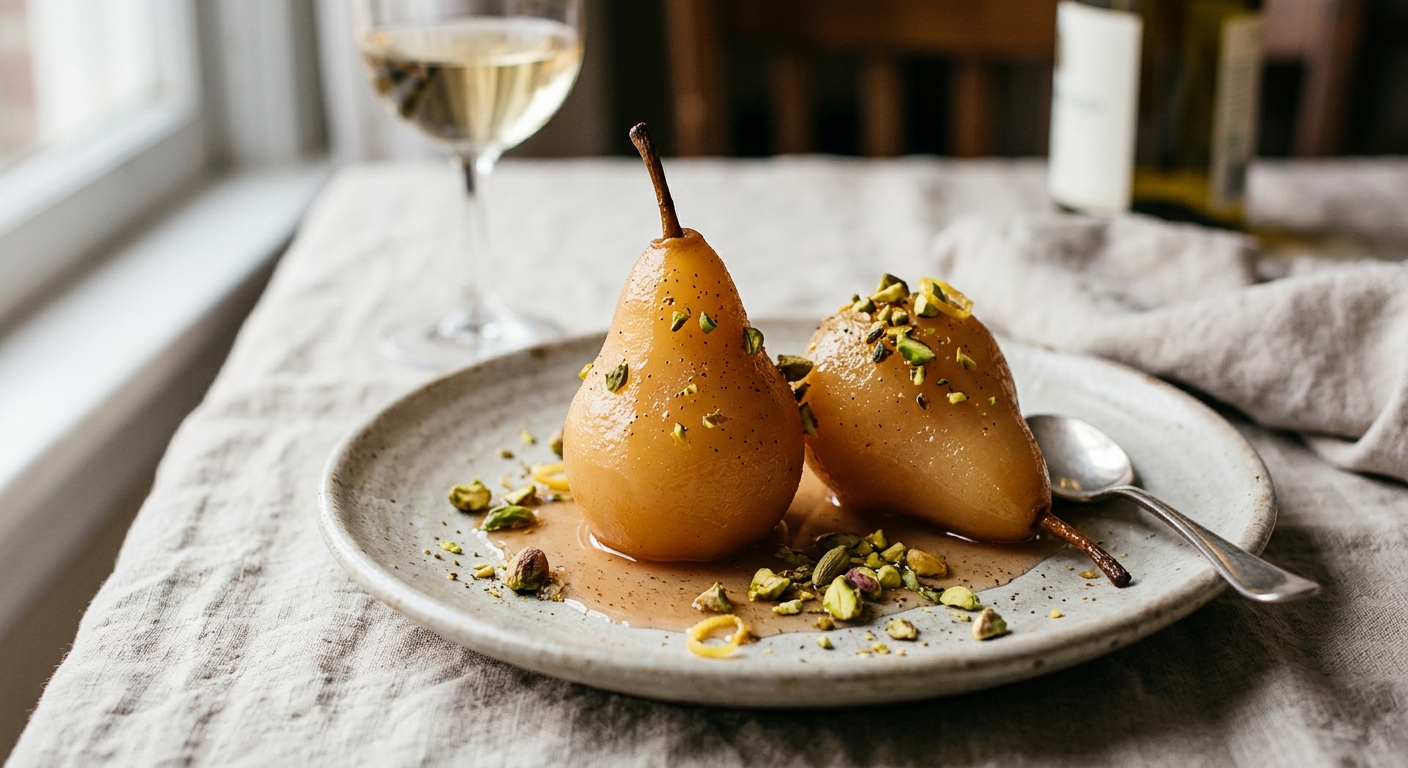
There is a persistent myth that dessert must come at the expense of nutrition. Poached Pears with Cardamom and Pistachios dismantles that idea entirely. This centuries-old European technique transforms a humble piece of fruit into a jewel-toned centerpiece, and in doing so, concentrates and preserves the pear’s formidable mineral profile in ways that raw consumption simply cannot match. The slow, gentle bath in a cardamom and white wine syrup softens cell walls just enough to enhance bioavailability of key phytonutrients while the reduction that follows creates a glossy, intensely flavored sauce with negligible added sugar per serving.
The nutritional architecture of this dish is quietly extraordinary. Pears are one of the most underrated sources of dietary copper, a trace mineral essential for iron metabolism, collagen synthesis, and neurological function that the majority of adults consume in insufficient quantities. Pair that with pistachios, which rank among the highest nut sources of manganese, vitamin B6, and plant-based protein, and you have a dessert that functions more like a targeted mineral supplement than an indulgence. Cardamom and vanilla contribute minor but real amounts of manganese and antioxidant polyphenols, while a finishing drizzle of raw honey provides prebiotic oligosaccharides alongside trace zinc and iron.
What elevates this recipe on Calibrated Cuisine is the obsessive attention to technique across every cooking method. Whether you prefer the watchful intimacy of stovetop poaching, the unattended luxury of a slow cooker, the speed of a pressure cooker, or the oven-braised approach that builds caramel depth, each method is calibrated for optimal texture, maximum syrup reduction, and consistent nutrient retention. Serve these pears warm with a spoonful of reduced poaching liquid and a scatter of roughly chopped pistachios for a dessert that earns its place on your daily micronutrient ledger.
4
servings
Ingredients
- 4 mediumfirm Bosc or Anjou pears (approximately 700g total), peeled with stems intact
- 500 mldry white wine (such as Pinot Grigio or Sauvignon Blanc)
- 250 mlwater
- 60 mlraw honey
- 60 gshelled raw pistachios, roughly chopped
- 6 wholegreen cardamom pods, lightly crushed
- 1 wholevanilla bean, split and seeds scraped
- 2 stripsfresh lemon zest (removed with a vegetable peeler)
- 1 tbspfresh lemon juice
- 1 smallcinnamon stick
- 3 wholeblack peppercorns
- —Pinch of Colima Sea SaltMicroplastic Free Salt
Instructions
Click on an item below to shop for the recommended items for this recipe on Amazon.
As an Amazon Associate, we earn from qualifying purchases.
- Peel the pears carefully from top to bottom using a vegetable peeler, preserving the stems. Use a melon baller or small paring knife to core each pear from the base, removing the seed cavity without breaking the fruit apart. Rub the peeled surface immediately with lemon juice to prevent oxidation.
- In a medium saucepan or straight-sided saute pan wide enough to hold all four pears snugly upright, combine the white wine, water, honey, crushed cardamom pods, vanilla bean and seeds, lemon zest strips, cinnamon stick, and peppercorns. Stir to dissolve the honey and bring the liquid to a gentle simmer over medium heat.
- Lower the pears into the simmering poaching liquid, standing them upright if the pan allows. The liquid should come about two-thirds up the sides of the pears. If necessary, add a splash more water. Cut a round of parchment paper (a cartouche) to fit the surface of the pan and lay it directly on the liquid to keep the pears submerged and promote even poaching.
- Maintain a very gentle simmer over low to medium-low heat. Poach for 20 to 25 minutes, turning each pear carefully halfway through with a slotted spoon, until a thin skewer inserted into the thickest part meets no resistance and the flesh is yielding but holds its shape. Bosc pears will take toward the longer end; Anjou toward the shorter.
- Remove the pears with a slotted spoon and transfer to a shallow dish. Remove the cartouche and increase the heat to medium-high. Boil the poaching liquid vigorously for 8 to 12 minutes, skimming any foam, until it reduces by approximately half and coats the back of a spoon lightly. Remove the whole spices.
- Spoon the warm reduction over the pears and allow to rest for 5 minutes. Arrange each pear on a plate, drizzle generously with the spiced syrup, and scatter roughly chopped pistachios over the top. Serve immediately while warm, or refrigerate in the syrup for up to 3 days and rewarm gently before serving.
- Peel and core the pears as described, preserving the stems and rubbing with lemon juice. In the insert of your slow cooker, whisk together the white wine, water, honey, lemon juice, and a pinch of sea salt until the honey is fully dissolved.
- Add the crushed cardamom pods, vanilla bean and seeds, lemon zest strips, cinnamon stick, and peppercorns directly to the liquid in the insert. Stir briefly to distribute the aromatics evenly across the base.
- Stand the pears upright in the slow cooker insert. If they do not stand steadily, nestle them on their sides, rotating positions once halfway through cooking. Pour any remaining liquid over the pears. The liquid level will rise as the pears release moisture during cooking.
- Place the lid on the slow cooker and cook on Low for 3 to 4 hours. Begin checking for doneness at the 3-hour mark by piercing the thickest part of a pear with a thin skewer or cake tester. The flesh should be completely tender with no resistance but the pears must still hold their shape. Do not overcook or they will collapse.
- Using a slotted spoon, carefully transfer the cooked pears to a shallow serving dish. Strain the poaching liquid through a fine mesh sieve into a small saucepan, discarding the whole spices. Bring the strained liquid to a brisk boil over medium-high heat and reduce for 10 to 15 minutes until syrupy and reduced by approximately half. This stovetop reduction step is essential to develop the concentrated flavor the closed slow cooker environment cannot achieve on its own.
- Spoon the warm syrup over the pears, scatter with chopped pistachios, and serve. Alternatively, cool the pears completely submerged in the syrup and refrigerate overnight for an even more deeply flavored result.
- Peel and core the pears, rub with lemon juice, and set aside. In the pressure cooker pot, combine the white wine, water (reduce to 180ml for pressure cooking), honey, lemon juice, cardamom pods, vanilla bean and seeds, lemon zest, cinnamon stick, peppercorns, and sea salt. Whisk briefly until the honey dissolves.
- Lower the pears into the pot, standing them upright or leaning them against each other if necessary. Do not stack them. Secure the lid and set the valve to the Sealing position. Select High Pressure and set the timer for 5 minutes. The pot will take approximately 8 to 10 minutes to reach pressure before the timer starts.
- When the 5-minute cook time completes, allow a full natural pressure release for 10 minutes. Do not touch the valve during this time. After 10 minutes of natural release, carefully turn the valve to Venting to release any remaining pressure, then open the lid away from your face.
- Test the pears immediately with a skewer. They should be completely tender. If they need more time, replace the lid (without pressure) and let them sit in the residual heat for 2 to 3 minutes. Use a slotted spoon to transfer the pears to a shallow dish, handling gently as pressure-cooked fruit is more fragile.
- Switch the Instant Pot or pressure cooker to the Saute function on Medium, or transfer the liquid to a saucepan on the stovetop. Boil the poaching liquid vigorously for 6 to 8 minutes until reduced by half and syrupy. Strain out the whole spices, then pour the reduction over the pears. Finish with chopped pistachios and serve warm.
- Preheat your oven to 160C (325F) with a rack positioned in the center. Peel and core the pears, rub with lemon juice, and arrange them upright in a snug ovenproof baking dish or small braiser. They should stand close together without much empty space, which helps keep them submerged in the liquid.
- In a small saucepan, combine the white wine, water, honey, lemon juice, cardamom pods, vanilla bean and seeds, lemon zest, cinnamon stick, peppercorns, and sea salt. Warm over medium heat, stirring until the honey fully dissolves and the liquid just begins to steam. Do not boil. Pour the warm spiced liquid directly over the pears in the baking dish. The liquid should come at least halfway up the sides of the pears.
- Tear a piece of parchment paper large enough to cover the baking dish and press it directly onto the surface of the liquid and pears, tucking the edges down inside the dish. This creates a sealed, moist environment that prevents the exposed tops of the pears from drying out. Cover the parchment with the dish lid or a tight layer of aluminum foil.
- Transfer to the preheated oven and bake for 45 to 55 minutes. At the 35-minute mark, carefully lift the foil and parchment and turn each pear using a large spoon, spooning liquid over any exposed areas. Re-cover and continue baking. The pears are done when a skewer inserted into the thickest part meets absolutely no resistance.
- Remove the baking dish from the oven and uncover. Carefully transfer the pears to a serving plate using a slotted spoon. Pour all of the poaching liquid through a fine mesh sieve into a small saucepan, discarding the whole spices. Bring to a boil over medium-high heat and reduce for 10 to 14 minutes until glossy and lightly syrupy. The oven-braised liquid will have more body than stovetop due to slight caramelization of natural fruit sugars.
- Spoon the warm caramelized syrup over the pears generously. Scatter with roughly chopped pistachios and a small pinch of flaky sea salt if desired to amplify the mineral-forward flavors. Serve warm or at cool room temperature.
Nutrition Breakdown
Per 1 serving (makes 4)
Vitamins & Minerals
% Daily Value based on a 2,000 calorie diet (FDA reference)
🧬 Essential Amino Acids
% of recommended daily intake (RDA) per serving
🛡 Antioxidant Profile
The Nutrition Science
Copper is the unsung hero of this recipe’s nutritional profile. A single serving delivers approximately 0.72mg, representing 80% of the adult daily value. Copper functions as a catalytic cofactor in more than 30 enzymatic reactions, most critically as part of ceruloplasmin, the protein responsible for oxidizing ferrous iron to ferric iron so it can be loaded onto transferrin for transport throughout the body. This means adequate copper intake is a prerequisite for effective iron utilization, and subclinical copper deficiency, which is more common than clinical deficiency, can manifest as iron-resistant anemia. Pistachios are the primary driver here, contributing roughly 0.38mg of copper per 15g serving, with pears adding an additional 0.10mg per medium fruit.
Manganese, the second star mineral of this dish, plays a structural role in the antioxidant enzyme manganese superoxide dismutase (MnSOD), the primary mitochondrial defense against superoxide radicals generated during normal cellular respiration. Chronic manganese insufficiency is associated with impaired bone matrix synthesis, reduced carbohydrate tolerance, and compromised antioxidant capacity. The combination of pears, pistachios, and cardamom in this recipe collectively provides approximately 0.85mg per serving, or 37% of the adequate intake. Notably, the poaching process does not leach significant manganese into the cooking liquid because it is tightly bound within the cellular matrix of the fruit rather than existing in free ionic form in the cytoplasm.
The choice of a white wine poaching medium is also nutritionally deliberate. The mild acidity (pH approximately 3.2 to 3.5) of dry white wine creates an aqueous environment that marginally enhances the stability of polyphenolic antioxidants, particularly chlorogenic acid, during thermal processing. Studies on polyphenol retention in poached fruit suggest that acidic poaching media preserve 15 to 25% more chlorogenic acid compared to water-only controls at the same temperature. The alcohol itself largely cooks off during both poaching and reduction, leaving behind the organic acids, trace minerals from the wine, and flavor-active esters that give the syrup its complexity.
Pro Tips
- Choose pears that are ripe but still firm to the touch, with no soft spots. Overripe pears will collapse during poaching regardless of method. The ideal pear for poaching feels like a slightly underripe eating pear.
- For a visually stunning presentation, use red-skinned Bosc pears and leave a thin ribbon of skin at the very top just below the stem to preserve the color contrast against the poaching syrup.
- The poaching syrup is valuable beyond this recipe. Any leftover reduction can be stored refrigerated for up to 2 weeks and used to dress yogurt parfaits, sweeten oatmeal, or glaze roasted root vegetables, preserving its mineral and polyphenol content in concentrated form.
omg this sounds absolutely gorgeous, and the micronutrient profile has me so excited! copper and manganese are such game changers for cognitive function and i’m always looking for ways to sneak those into my kids without them realizing its basically a supplement on a plate, haha. quick question though – do you have any thoughts on soaking the pistachios first to reduce phytic acid, or is the nutritional hit from the pear itself already so strong that its not as critical? my oldest actually tried sprouted mung beans in a dessert last week after i promised her it would make her “brain food” and she loved it, so im wondering if theres a sprouted element we could add here too
Oh Sylvia, YES! I’ve been tracking my copper intake for months now and honestly noticed such a difference in my energy levels and digestion – copper is crucial for that gut lining integrity that us IBS folks desperately need. Poached pears are also such a gentle option for sensitive systems, plus the honey-wine syrup sounds like it could feed beneficial bacteria… I’m definitely trying this and comparing it against my usual pear prep in my food diary! Tagging @MarcusG who’s been experimenting with mineral-dense desserts for his inflammatory markers.
Love that you’re tracking copper so intentionally, Greta! You’re absolutely right that it’s crucial for connective tissue and that gut barrier function. One thing I’d add: the skin of the pear is where a lot of that copper and manganese live, so poaching them whole really maximizes what you’re getting. Also, those pistachios are basically a copper powerhouse themselves, so this combo is genuinely synergistic rather than just coincidentally mineral-rich. The honey does have some prebiotic potential, though I’d be curious how the wine affects your IBS specifically since that’s so individual. Your food diary comparison sounds like such a smart way to track your own response!