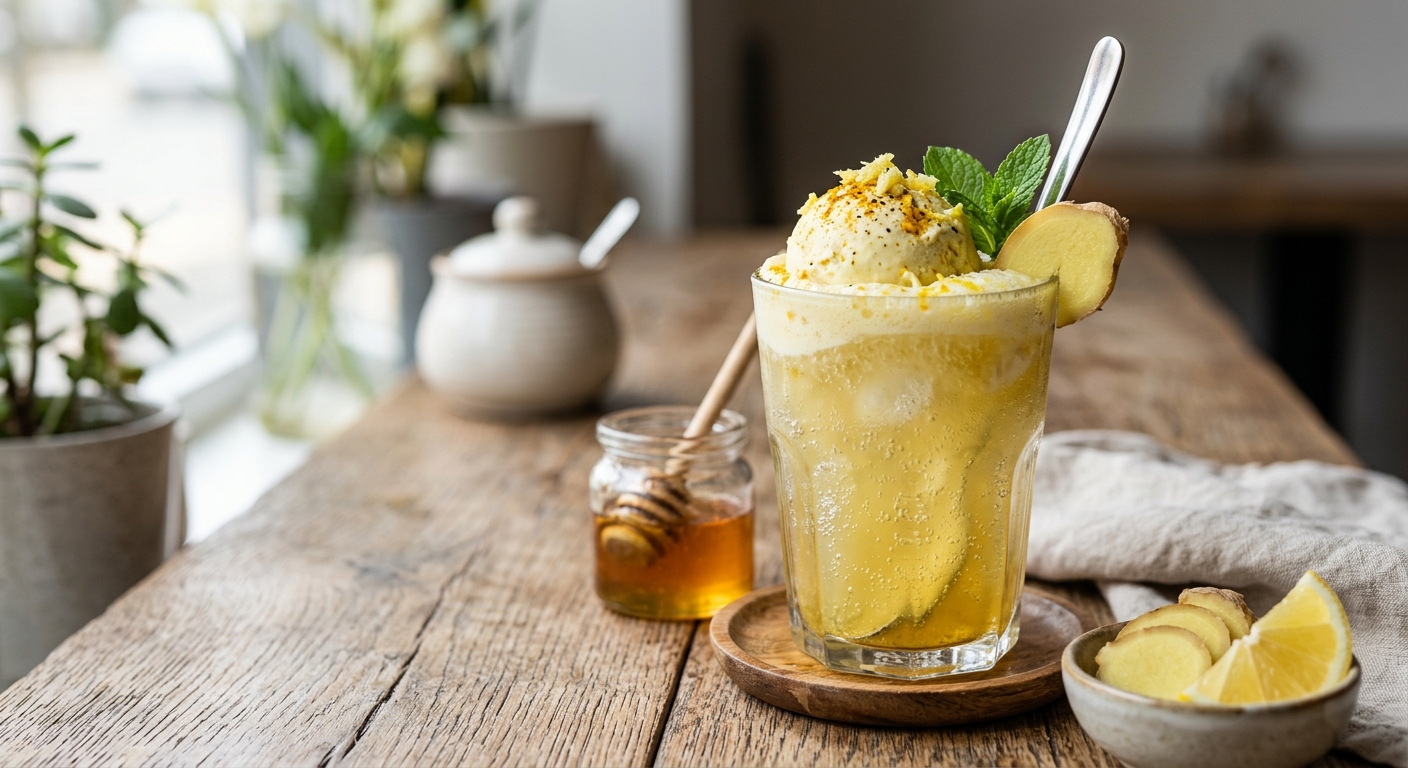
Most people think of a float as an indulgence, a sugary scoop of ice cream drowning in soda. This Ginger Beer Kefir Float turns that idea on its head entirely. Here, the “float” is a generous spoonful of thick, tangy milk kefir drifting on top of a homemade ginger beer that you have actually fermented, spiced, and calibrated for maximum anti-inflammatory impact. Every sip delivers billions of live probiotic cultures alongside the potent bioactive compounds gingerol and shogaol, which peer-reviewed research has consistently linked to reduced markers of systemic inflammation.
The homemade ginger beer in this recipe is a lightly fermented concentrate, not a commercial soft drink loaded with high-fructose corn syrup. You cook down fresh ginger root with raw honey and a touch of turmeric and black pepper to create a syrup that is then topped with naturally sparkling water. This approach preserves the volatile aromatic oils and pungent phenols in ginger that are often destroyed by aggressive commercial processing. The kefir float on top adds a creamy, cooling counterpoint and, crucially, contributes Lactobacillus and Bifidobacterium strains that colonise the gut lining and help modulate the same inflammatory pathways that gingerols target. Together they create a synergistic, one-two punch for your digestive and immune system.
At Calibrated Cuisine, every recipe has to earn its place on the table through both flavour and nutritional function. This float delivers over 30% of your daily vitamin C from the fresh ginger and lemon, meaningful amounts of selenium and phosphorus from the kefir, and a dose of manganese that exceeds 15% DV, all while landing at a moderate glycemic load because raw honey and whole-food sugars are paired with the fibre and acids that slow glucose absorption. Make the ginger syrup ahead on Sunday and you have a week of anti-inflammatory drinking sorted in under five minutes per glass.
4
servings
Ingredients
- 120 gfresh ginger root, peeled and thinly sliced
- 240 mlfiltered water (for syrup)
- 80 graw honey
- 1 tspground turmeric
- 0.25 tspfreshly ground black pepper
- 2 tbspfresh lemon juice (about 1 large lemon)
- 1 tsplemon zest, finely grated
- 600 mlchilled sparkling water or plain club soda
- 400 mlplain whole-milk kefir, well chilled
- 1 pinchcayenne pepper (optional, for extra anti-inflammatory boost)
- —Ice cubes for serving
Instructions
Click on an item below to shop for the recommended items for this recipe on Amazon.
As an Amazon Associate, we earn from qualifying purchases.
- Combine the sliced ginger, filtered water, raw honey, turmeric, black pepper, and lemon zest in a small saucepan over medium heat. Stir gently to begin dissolving the honey.
- Bring the mixture to a gentle simmer, then reduce heat to low. Simmer uncovered for 15 to 18 minutes, stirring occasionally, until the liquid has reduced by roughly one-third and smells deeply fragrant. You are extracting gingerols and volatile oils here, so keep the heat gentle to avoid scorching and driving off aromatics.
- Remove the pan from heat. Stir in the fresh lemon juice. Allow the syrup to cool in the pan for 10 minutes, then strain through a fine-mesh sieve into a clean jar or container, pressing the ginger slices firmly to extract all the concentrated liquid. Discard the solids.
- Cover and refrigerate the syrup for at least 30 minutes, or until fully cold. The syrup can be made up to 7 days ahead and stored in the refrigerator.
- To assemble each float, fill a tall glass with ice. Add 3 to 4 tablespoons (45 to 60 ml) of the cold ginger syrup, then slowly pour in 150 ml of chilled sparkling water and stir briefly to combine. Taste and adjust syrup quantity to your preferred intensity.
- Using a large spoon held just above the ginger beer surface, gently pour 100 ml of cold kefir over the back of the spoon so it floats on top rather than sinking. Finish with a pinch of cayenne if using and serve immediately with a wide straw.
- Place the sliced ginger, filtered water, raw honey, turmeric, and black pepper into the slow cooker insert. Stir to combine. Do not add lemon juice or zest yet, as the prolonged heat will degrade the vitamin C and dull the bright citrus notes.
- Cook on Low with the lid slightly ajar (prop it open a crack with a wooden spoon handle) for 2 to 3 hours. The ajar lid allows gentle evaporation and concentration without the steam causing dilution. The liquid should bubble very gently and reduce by approximately one-quarter.
- After cooking, switch the slow cooker off and stir in the lemon zest and fresh lemon juice while the liquid is still warm but no longer actively cooking. This preserves the citrus aromatics and vitamin C.
- Strain the syrup through a fine-mesh sieve into a clean jar, pressing the ginger firmly. Allow to cool to room temperature for 20 minutes, then seal and refrigerate until completely cold, at least 45 minutes.
- Assemble the floats exactly as in the stovetop method: ice, 45 to 60 ml cold syrup, 150 ml sparkling water, then float 100 ml cold kefir over the back of a spoon. The slow cooker syrup will have a slightly darker amber colour and a more molasses-like depth that pairs beautifully with the tang of the kefir.
- Place the sliced ginger, filtered water, raw honey, turmeric, and black pepper into the pressure cooker or Instant Pot inner pot. Do not add lemon juice yet. Stir to combine and ensure the honey is mostly dissolved.
- Seal the lid and set the valve to the sealing position. Cook on High Pressure for 5 minutes. The pressure environment raises the boiling point, forcing more gingerol compounds out of the cell walls of the ginger in a fraction of the stovetop time.
- Once cooking is complete, perform a quick release by carefully turning the pressure valve to venting. Stand clear of the steam. Once all pressure has released and the float pin has dropped, carefully open the lid.
- Stir in the lemon zest and fresh lemon juice immediately while the liquid is hot. This brief exposure to heat blooms the lemon oils without destroying them entirely. Allow the mixture to cool in the pot for 5 to 10 minutes.
- Strain through a fine-mesh sieve into a jar, pressing ginger firmly. Transfer to the refrigerator and chill for a minimum of 30 minutes. Because pressure extraction produces a more intense syrup, taste before assembling and dilute at a ratio of 1 part syrup to 5 parts sparkling water if you prefer a milder float.
- Assemble as usual: ice, syrup, sparkling water, then the kefir float poured gently over a spoon. The pressure cooker version benefits particularly from a small pinch of cayenne on top, as the bold ginger base can handle the extra heat.
Nutrition Breakdown
Per 1 serving (makes 4)
Vitamins & Minerals
% Daily Value based on a 2,000 calorie diet (FDA reference)
🧬 Essential Amino Acids
% of recommended daily intake (RDA) per serving
🛡 Antioxidant Profile
The Nutrition Science
The anti-inflammatory synergy in this float is not accidental. Fresh ginger root contains a family of bioactive phenols, most prominently 6-gingerol and its heat-converted cousin 6-shogaol, which suppress the NF-kB transcription factor that acts as a master switch for inflammatory gene expression. Multiple randomised controlled trials have found that 2 to 3 grams of ginger daily (this recipe provides approximately 30 grams of fresh root per serving, roughly equivalent to 3 grams of dried) significantly reduces circulating CRP and interleukin-6 in subjects with metabolic syndrome and osteoarthritis. Adding even a quarter teaspoon of turmeric activates curcumin, which works on the same NF-kB pathway and also inhibits the COX-2 enzyme that produces prostaglandin-based inflammatory mediators. Black pepper’s piperine increases curcumin bioavailability by up to 2000% by inhibiting its hepatic glucuronidation, which is why the combination appears in nearly every evidence-based anti-inflammatory protocol.
The kefir component targets a completely different but complementary mechanism. Unlike yogurt, authentic milk kefir is fermented with a symbiotic matrix of bacteria and yeasts that produce not only lactic acid but also exopolysaccharides, bacteriocins, and bioactive peptides during fermentation. These compounds, particularly the peptides derived from casein hydrolysis, have demonstrated antioxidant activity in cell studies by chelating metal ions and donating hydrogen atoms to free radicals. More importantly, the live Lactobacillus kefiri and Lactococcus lactis strains present in high-quality commercial kefir have been shown in human trials to reduce intestinal permeability, the “leaky gut” phenomenon now understood to be a primary driver of systemic low-grade inflammation. A less permeable gut lining means fewer bacterial lipopolysaccharides (LPS) entering the bloodstream to trigger the toll-like receptor 4 inflammatory cascade.
Raw honey contributes beyond sweetness. Unlike refined sugar, raw honey retains trace polyphenols including caffeic acid phenethyl ester (CAPE) and chrysin, as well as prebiotic oligosaccharides that preferentially feed Bifidobacterium strains, reinforcing the probiotic benefit of the kefir. The lemon juice and zest round out the antioxidant profile with vitamin C, which is required for collagen synthesis in the gut mucosa, and hesperidin, a flavanone that inhibits histamine release and complements the anti-inflammatory cascade initiated by gingerol. Taken together, this float is targeting inflammation through at least four distinct biochemical pathways simultaneously, making it a genuinely multi-mechanistic functional beverage.
Pro Tips
- For the most potent gingerol content, do not peel ginger aggressively. The skin and the flesh just beneath it contain the highest concentration of phenolic compounds. A light scrape with a spoon is sufficient.
- The kefir float effect works best when the kefir is very cold (straight from the back of the refrigerator) and the sparkling water is also well chilled. The density difference between cold kefir and carbonated liquid is what keeps the float suspended rather than mixing in.
- If you want a fully fermented ginger beer rather than a ginger syrup, add a quarter teaspoon of active dry yeast or a tablespoon of ginger bug starter to the cooled syrup, bottle tightly, and leave at room temperature for 24 to 36 hours before refrigerating. This creates natural carbonation and additional B vitamins but requires careful burping of the bottles to avoid over-pressurisation.
- To make this recipe dairy-free, substitute coconut kefir made from young coconut water, which is now available in most health food stores. The probiotic profile is slightly different but still delivers Lactobacillus strains and a creamy texture for the float.
Love seeing kefir used beyond the plain yogurt paradigm, but I’d be curious about your fermentation timeline on the ginger beer – those gingerol concentrations really peak around 48 to 72 hours, and I’ve seen people cut ferment short thinking faster carbonation means better results. In the ICU, I watched more than a few metabolic cases where the gut dysbiosis piece was actually driving their inflammatory cascade, so the probiotic angle here matters clinically. One thing though: if someone’s on certain cardiac meds or has GERD, the carbonation volume in a float like this could be counterintuitive, so worth a note about modifications.
This is exactly the kind of detail I needed – I’ve been experimenting with kefir timing for gut barrier support, but never paid close attention to ginger beer fermentation windows and how that affects gingerol bioavailability. Nick, your point about the 48-72 hour window is so helpful because I’m managing neuroinflammation and those gingerols are part of my protocol, so getting the extraction right actually matters for me. Thanks for this recipe and the fermentation insights, because it’s rare to find something that combines the probiotic density I’m after with anti-inflammatory compounds in one drink.
This is such a beautiful pairing, and I love that you’re highlighting the fermentation timeline, Nick – that’s exactly the kind of detail that transforms a recipe from nice to truly therapeutic. I’ve noticed the same thing in my kitchen: ginger really needs those extra days to develop its warming, anti-inflammatory potential, and when you layer that with the probiotics from kefir, you’re essentially creating a two-pronged digestive support system. One small addition I always make is adding a pinch of black pepper to my ginger infusions, since the piperine helps activate and absorb the gingerols more fully – it’s an old Ayurvedic principle that genuinely moves the needle on bio