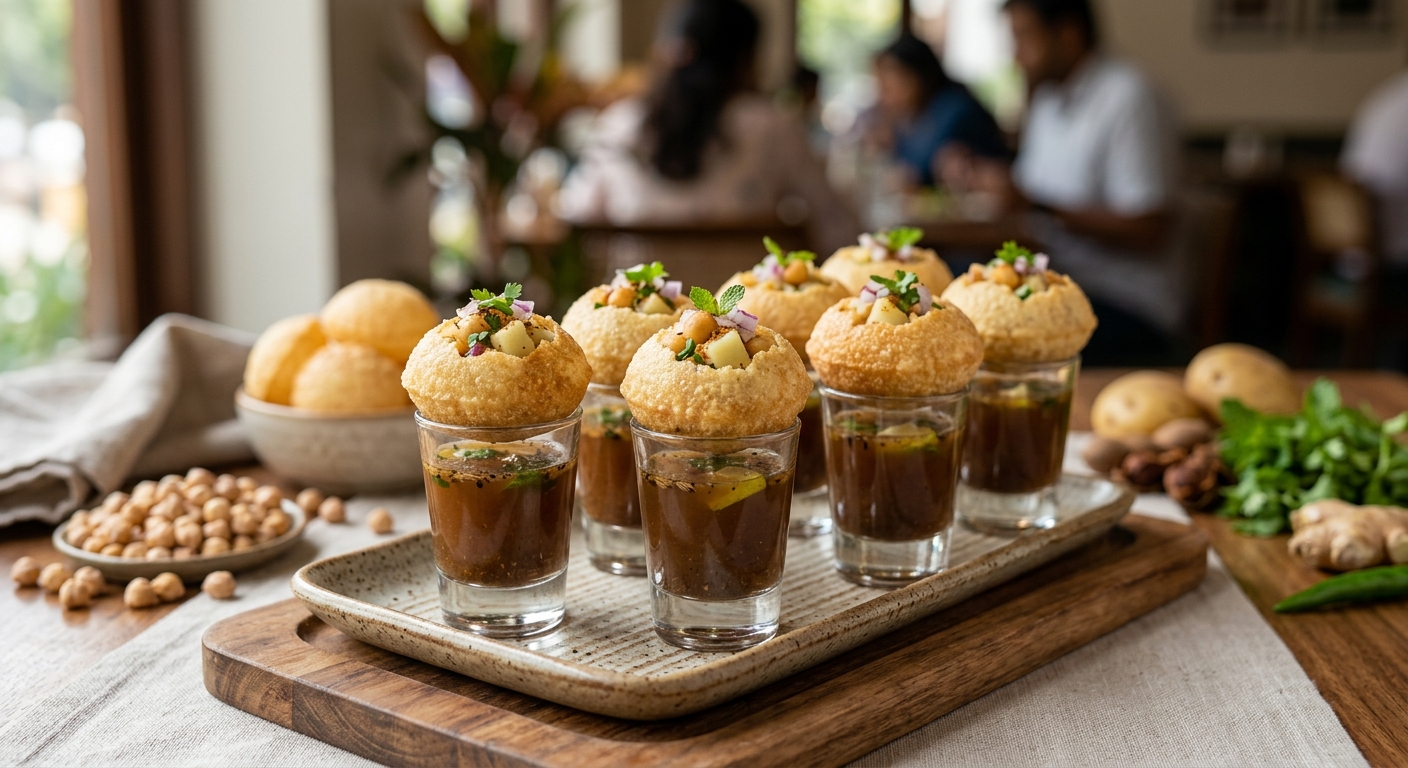
Pani puri is arguably the most theatrical street food on the planet. A vendor’s hands move like a conductor, puncturing each crisp shell, loading it with filling, and dunking it into a bucket of ice-cold, aggressively spiced water before pressing it into your palm. You have exactly one second to pop the whole thing into your mouth before the shell gives way. That explosion of textures and flavors, sour tamarind, fiery ginger, cooling mint, earthy cumin, and starchy chickpea, is one of the defining sensory experiences of South Asian food culture. At Calibrated Cuisine, we honor that experience entirely while showing you exactly what that little orb is doing for your body.
The nutritional story here is driven by a cast of humble but powerful ingredients. Dried chickpeas bring a formidable combination of non-heme iron (4.7 mg per 100 g cooked), folate, zinc, and resistant starch that feeds beneficial gut bacteria. Tamarind pulp, the soul of the pani, contributes tartaric acid, magnesium (28 mg per 30 g), and potassium while simultaneously enhancing the bioavailability of plant-based iron through its organic acid content. Black salt (kala namak) adds trace sulfur compounds and a distinctive eggy umami note, while roasted cumin delivers manganese and a cascade of terpenoid antioxidants. Together, these ingredients turn a fun snack into a genuine mineral matrix.
We have developed three distinct methods for preparing the filling and pani: a quick stovetop version, a slow cooker rendition that deepens the tamarind flavor over hours, and a pressure cooker approach that dramatically cuts dried-chickpea prep time. The crispy puri shells are baked in the oven regardless of which filling method you choose, giving you a lighter, home-friendly shell with exceptional crunch. Each method produces a slightly different flavor profile, and all are calibrated to deliver the same target nutrient payload per four-shot serving.
4
servings
Ingredients
- 150 gdried chickpeas, soaked overnight in cold water
- 200 gwaxy potatoes (about 2 medium), peeled and cubed
- 80 gtamarind block (seedless), broken into pieces
- 600 mlfiltered water, divided
- 40 gfresh mint leaves, packed
- 20 gfresh coriander (cilantro), leaves and tender stems
- 2 cmfresh ginger, peeled and roughly chopped
- 1 green chilliserrano or bird’s eye, roughly chopped (seeds in for heat)
- 1 tspcumin seeds, dry-toasted until fragrant
- 0.5 tspColima Sea SaltMicroplastic Free Salt (kala namak)
- 0.5 tspchaat masala
- 0.5 tspground roasted cumin
- 1 tspjaggery or light brown sugar
- 0.5 tspamchur (dried mango powder)
- 0.25 tspfreshly ground black pepper
- 120 gfine semolina (sooji/rava)
- 2 tbspfine plain flour (maida or all-purpose)
- 0.25 tspbaking soda
- 80 mlwarm sparkling water (for puri dough)
- 1 tbspAvocado Oil100% Pure Avocado Oil (sunflower or light vegetable), plus extra for brushing
- 0.5 tspColima Sea SaltMicroplastic Free Salt (for puri dough)
- 1 tspdried pomegranate seeds (anardana), lightly crushed
- 40 gcooked sprouted moong beans (optional, for extra zinc and folate)
- —Colima Sea SaltMicroplastic Free Salt and black pepper to taste
- —Ice cubes for serving the pani
Instructions
Click on an item below to shop for the recommended items for this recipe on Amazon.
As an Amazon Associate, we earn from qualifying purchases.
- Place soaked, drained chickpeas in a medium saucepan and cover with fresh cold water by at least 5 cm. Bring to a vigorous boil over high heat, skim any foam that rises, then reduce to a steady simmer. Cook uncovered for 30 to 35 minutes until the chickpeas are completely tender when pressed between thumb and finger but still hold their shape. Drain and set aside. In a separate small saucepan, cover the potato cubes with cold salted water, bring to a boil, and simmer for 10 to 12 minutes until knife-tender. Drain, return to the hot pan off the heat for 1 minute to steam-dry, then roughly crush with a fork, leaving some texture. Season with 0.25 tsp black salt and chaat masala.
- While the legumes cook, make the tamarind concentrate. Place the tamarind block in a small saucepan with 200 ml of the filtered water. Bring to a gentle simmer over medium-low heat, pressing the tamarind with the back of a spoon as it softens, about 8 to 10 minutes. Remove from heat and let cool for 5 minutes, then press the mixture firmly through a fine-mesh sieve into a bowl, extracting as much pulp as possible. Discard the fibrous solids. You should have approximately 150 ml of thick tamarind concentrate.
- Make the pani (spiced water). In a blender, combine the mint leaves, coriander, ginger, green chilli, toasted cumin seeds, and 100 ml of the remaining filtered water. Blend on high for 45 seconds until completely smooth. Strain through a fine-mesh sieve into a large bowl or jug, pressing the solids to extract maximum liquid. To this green base, whisk in the tamarind concentrate, jaggery, black salt, chaat masala, ground roasted cumin, amchur, and black pepper. Add the remaining 300 ml cold filtered water, taste, and adjust seasoning: add more jaggery for sweetness, chilli for heat, or black salt for depth. The pani should be intensely flavored, assertively sour, and slightly sweet. Chill with ice cubes for at least 15 minutes before serving.
- Make the puri dough while the pani chills. In a mixing bowl, combine the semolina, plain flour, baking soda, and fine sea salt. Add the neutral oil and rub it into the flour mixture until it resembles coarse sand. Gradually add the warm sparkling water, mixing with your fingers, until a firm, non-sticky dough forms. You may not need all the water. Knead firmly for 3 to 4 minutes until smooth. Cover tightly with a damp cloth and rest for exactly 20 minutes (this is critical for the semolina to fully hydrate and the gluten to relax, ensuring puffed shells).
- While the dough rests, preheat your oven to 220 C (200 C fan / 425 F / Gas 7). Roll the dough out on a lightly floured surface to about 2 mm thickness. Using a round cutter or the rim of a shot glass (approximately 5 cm diameter), cut out 16 circles. Arrange them on two lightly oiled baking sheets. Brush the tops very lightly with oil. Bake for 8 to 10 minutes, rotating the tray at the halfway mark, until puffed and golden with a few darker spots. They should feel hollow when tapped. Transfer to a wire rack and cool completely before filling (they will crisp further as they cool).
- Assemble the pani puri shots. Combine the cooked chickpeas with the crushed potato, crushed anardana seeds, and sprouted moong if using. Season assertively with remaining chaat masala and black salt. Use a finger or the back of a small spoon to gently tap a hole in the top of each puri, just large enough to insert a teaspoon of filling. Set 4 puris in shot glasses or small bowls per serving. Fill each puri with the chickpea-potato mixture, then pour the chilled pani directly over each filled puri so the shot glass captures the fragrant water beneath. Serve immediately and instruct guests to consume each shot in one bite.
- Drain and rinse the soaked chickpeas. Place them directly in the slow cooker insert along with the potato cubes, tamarind block pieces, jaggery, half the chaat masala (0.25 tsp), toasted cumin seeds, the green chilli (left whole), ginger, black pepper, and 500 ml of the filtered water. Stir briefly, making sure the tamarind pieces are submerged. Place the lid on and cook on Low for 7 to 8 hours or on High for 3.5 to 4 hours, until the chickpeas are completely tender and the tamarind has fully dissolved into the cooking liquid.
- After cooking, use a slotted spoon to remove the chickpeas and potato pieces and transfer to a bowl. Remove and discard the whole green chilli. Press the remaining liquid and any tamarind solids through a fine-mesh sieve back into the slow cooker insert (or a large bowl), extracting as much of the tamarind pulp as possible. Discard the fibrous solids. This strained liquid is your deeply flavored slow-cooked tamarind pani base, approximately 350 to 400 ml.
- Blend the fresh herb layer separately. In a blender, combine the mint leaves, coriander, and 60 ml of the remaining cold filtered water. Blend until completely smooth. Strain through a fine-mesh sieve into the tamarind pani base. Whisk in the black salt, remaining chaat masala, ground roasted cumin, amchur, and the remaining cold filtered water (approximately 140 ml) to reach the correct pani consistency (bright, assertively tangy, and heavily aromatic). Taste and adjust with extra black salt or jaggery. The slow-cooked pani will have a notably richer, more rounded sourness compared to the stovetop version. Chill with ice cubes.
- While the pani chills, prepare the filling. Roughly crush the cooked slow-cooker potatoes with a fork, leaving texture. Fold in the chickpeas and crushed anardana seeds. The slow-cooked chickpeas will have absorbed the tamarind and cumin flavors, so taste before adding extra seasoning. Add sprouted moong if using. Adjust salt and chaat masala to taste.
- Make and bake the puris following the identical dough method from the Stovetop instructions (steps 4 and 5): combine semolina, flour, baking soda, salt, and oil; add sparkling water to form a firm dough; rest 20 minutes covered; roll to 2 mm; cut 5 cm rounds; brush with oil; bake at 220 C for 8 to 10 minutes until puffed and hollow. Cool on a wire rack. Assemble in shot glasses with filling and cold pani as described in the Stovetop method, step 6.
- Drain and rinse the soaked chickpeas. Place them in the Instant Pot or stovetop pressure cooker with the potato cubes and 400 ml of the filtered water. Pressure cook on High for 18 minutes (Instant Pot: Manual or Pressure Cook mode, High pressure). For a stovetop pressure cooker, bring to full pressure over high heat, then reduce to medium and cook for 15 minutes. Allow full natural pressure release (approximately 12 to 15 minutes) rather than quick release; this prevents the chickpea skins from blowing off and keeps the potatoes intact.
- While pressure releases, make the tamarind concentrate and pani simultaneously. Place the tamarind block and 200 ml filtered water in a small saucepan over medium heat. Simmer for 8 minutes, pressing with a spoon. Strain through a fine-mesh sieve as described in Stovetop step 2. In a blender, blitz the mint, coriander, ginger, green chilli, and 100 ml cold water until smooth, then strain into the tamarind concentrate. Whisk in jaggery, black salt, chaat masala, ground roasted cumin, amchur, black pepper, and remaining 300 ml cold water. Chill with ice immediately.
- Open the pressure cooker once fully depressurized. Drain the chickpeas and potatoes, reserving a small amount of the starchy cooking liquid (2 to 3 tablespoons) to moisten the filling if needed. Roughly crush the potatoes, leaving chunks, and fold in the whole chickpeas, crushed anardana, and sprouted moong if using. The pressure-cooked potatoes will be notably creamier and silkier than stovetop boiled potatoes, producing a richer filling. Season with the remaining black salt and chaat masala; use the reserved cooking liquid to bind if the mixture seems dry.
- Make the puri dough. Combine semolina, plain flour, baking soda, and fine sea salt in a bowl. Rub in the oil until the mix resembles coarse sand. Add warm sparkling water gradually to form a firm dough. Knead for 3 to 4 minutes, cover with a damp cloth, and rest for 20 minutes. Preheat the oven to 220 C (200 C fan / 425 F).
- Roll the rested dough to 2 mm thickness on a lightly floured surface. Cut 16 rounds using a 5 cm cutter. Arrange on lightly oiled baking sheets, brush tops with oil, and bake for 8 to 10 minutes at 220 C, rotating trays at the halfway mark, until puffed, hollow when tapped, and golden. Cool completely on a wire rack. Assemble in shot glasses with the creamy pressure-cooker filling and ice-cold pani as described in Stovetop step 6.
- Preheat the oven to 220 C (200 C fan / 425 F / Gas 7). Place the peeled potato cubes on one half of a large rimmed baking sheet. Drizzle with the neutral oil and a pinch of sea salt. Roast for 20 to 22 minutes, flipping once at the 10-minute mark, until golden at the edges and completely tender inside. The oven roasting caramelizes the potato’s natural sugars, adding a nuttier, deeper flavor to the filling compared to boiling. While potatoes roast, use pre-cooked tinned chickpeas (400 g tin, drained and rinsed, equivalent to the cooked dried chickpeas) for the oven method to avoid a long legume cook. Pat the chickpeas dry and add them to the baking sheet for the final 8 minutes of potato roasting to lightly crisp and dry them out.
- Make the tamarind pani while the oven works. Combine tamarind, jaggery, and 200 ml warm water in a small saucepan over medium-low heat for 8 to 10 minutes until softened and dissolved. Strain through a fine-mesh sieve. Blitz mint, coriander, ginger, and green chilli with 100 ml cold water in a blender until smooth; strain and combine with the tamarind liquid. Add black salt, chaat masala, ground roasted cumin, amchur, black pepper, and the remaining 300 ml cold water. Stir in the toasted cumin seeds. Taste and balance. Chill aggressively with a generous handful of ice cubes.
- Remove the baking sheet from the oven. Roughly crush the roasted potatoes directly on the sheet, then fold in the roasted chickpeas, crushed anardana, and sprouted moong if using. Drizzle with 1 to 2 tablespoons of the chilled pani to moisten and season with remaining black salt and chaat masala. The filling will smell intensely of roasted cumin and caramelized starch.
- Make the puri dough. In a mixing bowl, combine semolina, plain flour, baking soda, and fine sea salt. Rub in the oil to sandy texture. Add warm sparkling water gradually to form a stiff dough, knead for 3 to 4 minutes, and rest covered for 20 minutes. Keep the oven at 220 C.
- Roll the rested dough to 2 mm on a lightly floured surface. Cut 16 rounds with a 5 cm cutter. Transfer to a freshly oiled baking sheet, brush tops lightly with oil, and bake in the centre of the 220 C oven for 9 to 11 minutes, watching carefully from minute 8, until deeply puffed, hollow-sounding when tapped, and golden-amber in colour. Because you are using the same oven for both filling and puris in this method, timing the sequence carefully keeps total active time under 55 minutes. Cool on a wire rack, then assemble as in Stovetop step 6.
Nutrition Breakdown
Per 1 serving (makes 4)
Vitamins & Minerals
% Daily Value based on a 2,000 calorie diet (FDA reference)
🧬 Essential Amino Acids
% of recommended daily intake (RDA) per serving
🛡 Antioxidant Profile
The Nutrition Science
The mineral density of this dish is no accident. Chickpeas are one of the most nutritionally complete legumes available, providing approximately 4.7 mg of non-heme iron per 100 g cooked weight alongside meaningful amounts of zinc (1.3 mg), folate (172 mcg), and magnesium (48 mg). However, raw chickpeas also contain phytic acid, an antinutrient that chelates divalent minerals and reduces their absorption by 20 to 50%. Overnight soaking (followed by discarding the soaking water) hydrolyzes a significant proportion of phytic acid through endogenous phytase enzyme activity, a step that is built into all three cooking methods in this recipe. Sprouted moong beans, listed as an optional addition, carry even lower phytic acid levels and provide an additional zinc and folate boost.
Tamarind is the unsung mineral hero of this dish. The pulp delivers tartaric acid, an organic acid that, like vitamin C, creates an acidic intestinal environment that favors the reduction of ferric iron (Fe3+) to ferrous iron (Fe2+), the only form actively transported across the intestinal mucosa. This means that the tamarind pani is not merely providing flavor. It is biochemically preparing the iron from the chickpea filling for absorption. The fresh mint and coriander in the pani add a measurable dose of vitamin C (approximately 18 mg per serving), which synergizes with the tartaric acid to further enhance iron uptake. This combination of organic acids and ascorbic acid working together on a legume-based filling is a beautiful example of traditional food wisdom that precedes modern nutritional science by centuries.
Manganese, which reaches 61% DV per serving, deserves particular attention. It arrives primarily from the semolina puris, chickpeas, and cumin, and it serves as a required cofactor for manganese superoxide dismutase (MnSOD), the primary antioxidant enzyme operating inside mitochondria. Adequate dietary manganese is therefore directly relevant to cellular energy metabolism and protection of mitochondrial DNA from oxidative damage. The cuminaldehyde and cymene terpenoids in toasted cumin seeds add a complementary layer of direct free-radical scavenging, making this spice more than a flavoring agent.
Pro Tips
- Toast the cumin seeds in a dry skillet over medium heat for 90 seconds until fragrant and a shade darker, then grind half coarsely and leave half whole. The dual texture adds both aromatic depth and satisfying crunch to the pani.
- Make the pani at least 30 minutes ahead and chill it as cold as possible. The thermal contrast between ice-cold pani and the room-temperature filled puri is a significant part of the sensory experience. A warm pani is a flat pani.
- If your puri shells are not puffing in the oven, the dough was either too wet or under-rested. The semolina needs a full 20-minute rest to hydrate; cutting this short produces flat crackers instead of hollow spheres. The sparkling water introduces carbon dioxide that helps the initial puff, so use it straight from a freshly opened bottle.






This is such a helpful point about the iron bioavailability, Pete! I’ve actually noticed this in my own Hashimoto’s journey, especially when I’m pairing mineral-rich foods, so I’m really curious about your take here. The oxalate concern definitely resonates with me, though I wonder if the vitamin C from the mint and lime in the pani water might help offset that inhibition? I’ve been exploring whether the fermentation angle (if any of these components are fermented) could also improve absorption, since that’s been game-changing for me personally. Would love to know if you’ve seen research on the balance between those polyphenolic acids and the oxalate load in tamar
Love this question, Pete! You’re totally right about oxalates, but I’d gently push back a bit here: the iron in chickpeas and potatoes is actually non-heme iron, so it’s already more sensitive to absorption inhibitors than heme iron from animal sources. The good news is that tamarind’s acidity (those polyphenolic acids you mentioned, plus the tartaric acid) actually works as a counterweight by lowering stomach pH, which enhances non-heme iron absorption. So while oxalates are present, the acidic environment from tamarind can more than compensate. Anna, for Hashimoto’s specifically, I’d suggest pairing this with
Oh, this is a clever angle! I’m genuinely curious about your iron bioavailability claims here though, since tamarind’s oxalates can actually inhibit mineral absorption in some contexts. That said, the polyphenolic acids in tamarind (especially ellagic and gallic acid derivatives) are known to enhance iron uptake by chelating it into more absorbable forms, so you might actually have a synergistic win here. Have you tested this experimentally, or are you working from the literature on tamarind’s antioxidant profile? I’ve been meaning to dig deeper into how the tannins in tamarind interact with mineral bioavailability, so this post just