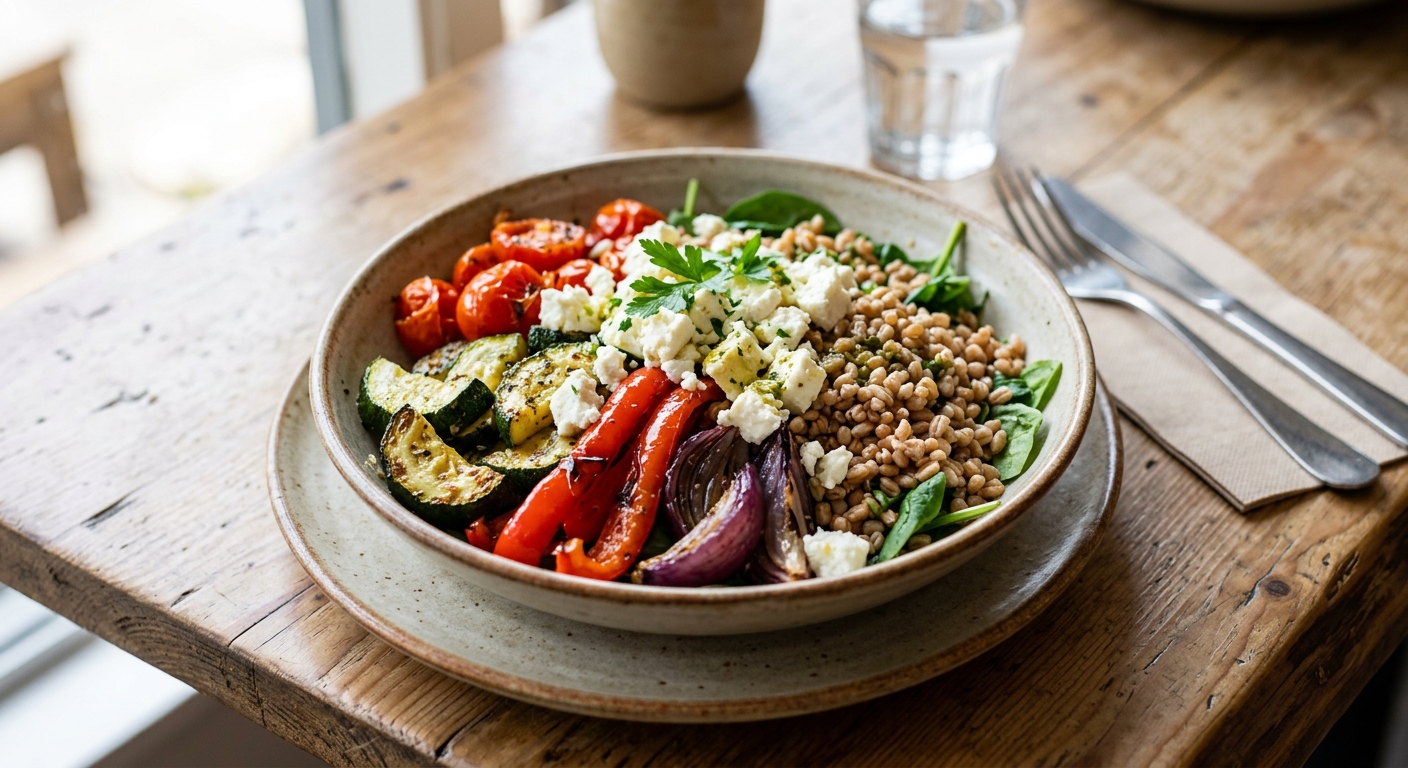
Some meals earn the title of nutritional architecture, and this Farro and Roasted Vegetable Bowl is exactly that. Built around ancient whole-grain farro, a grain that has been cultivated since the earliest days of agriculture, this bowl layers sweet roasted red bell pepper, earthy zucchini, caramelized red onion, and jewel-toned cherry tomatoes over a generous heap of chewy, nutty farro. Crumbled sheep’s-milk feta ties every element together with a bright, briny finish that makes each bite feel genuinely indulgent.
What separates this recipe from a typical grain bowl is the deliberate pairing of ingredients chosen to work together mineralogically. Farro is one of the most mineral-dense whole grains available, offering meaningful amounts of magnesium, zinc, manganese, and phosphorus in every serving. Roasting the vegetables rather than steaming them concentrates their natural sugars and deepens their antioxidant compounds through the Maillard reaction, all while preserving the majority of their water-soluble B vitamins. The extra-virgin olive oil used in roasting is not just a cooking fat; it is the vehicle that allows fat-soluble antioxidants like beta-carotene and lycopene to be absorbed with maximum efficiency.
Whether you prepare this on the stovetop with a watchful eye, set it in the slow cooker before leaving for work, or pressure-cook it in under thirty minutes, the result is a bowl that tastes like it came from a serious grain restaurant and functions like a precision-engineered nutritional supplement. This is what Calibrated Cuisine is all about: food that is completely delicious and completely deliberate.
4
servings
Ingredients
- 300 gpearled farro, rinsed well under cold water
- 2 mediumzucchini (about 400g), cut into 2cm half-moons
- 2 mediumred bell peppers (about 350g), cored and cut into 3cm strips
- 250 gcherry tomatoes, halved
- 1 largered onion (about 200g), cut into 2cm wedges, root intact
- 4 clovesgarlic, minced
- 180 gfeta cheese, crumbled (block feta preferred for texture)
- 60 gbaby spinach, packed
- 4 tbspextra-virgin olive oil, divided
- 900 mllow-sodium vegetable broth
- 2 tspdried oregano
- 1 tspsmoked paprika
- 1 tspground cumin
- 2 tbspred wine vinegar
- 30 gflat-leaf parsley, roughly chopped
- 40 gtoasted pumpkin seeds (pepitas)
- —Colima Sea SaltMicroplastic Free Salt and freshly ground black pepper to taste
- —Lemon wedges, to serve
Instructions
Click on an item below to shop for the recommended items for this recipe on Amazon.
As an Amazon Associate, we earn from qualifying purchases.
- Set a large oven-safe skillet or wide saute pan over medium-high heat. Add 2 tablespoons of olive oil and heat until shimmering. Add the red onion wedges cut-side down and cook undisturbed for 3 minutes until the cut faces develop a deep golden char. Flip and cook a further 2 minutes. Transfer to a plate.
- In the same pan, add the zucchini in a single layer and cook without stirring for 2 to 3 minutes until deeply golden on one side. Add the red bell pepper strips and toss together, cooking a further 3 minutes. Add the cherry tomatoes cut-side down, press gently, and cook 2 minutes until they blister and begin to collapse. Stir in the minced garlic, smoked paprika, and cumin and cook 60 seconds until fragrant. Season generously with salt and pepper. Transfer the entire vegetable mixture to the plate with the onions.
- Reduce heat to medium. In the same pan, add the remaining 2 tablespoons of olive oil. Add the rinsed farro and stir constantly for 2 to 3 minutes, toasting the grains until they smell nutty and begin to crackle faintly. This step is essential for stovetop farro.
- Pour in the vegetable broth carefully as it will steam aggressively. Add the dried oregano and stir well, scraping up any toasted bits from the pan bottom. Bring to a vigorous boil, then reduce heat to maintain a steady simmer. Cover with a tight-fitting lid and cook for 25 to 30 minutes, stirring twice during cooking, until the farro is tender but still has a distinct pleasant chew and almost all the broth has been absorbed. If the broth absorbs before the farro is tender, add hot water in 60ml increments.
- Remove the lid and stir in the baby spinach and red wine vinegar. The spinach will wilt in under a minute from the residual heat. Taste and adjust seasoning. Spoon the farro into four bowls, pile the reserved roasted vegetables on top, then scatter over the crumbled feta, toasted pumpkin seeds, and chopped parsley. Serve immediately with lemon wedges.
- Place the rinsed farro directly into the slow cooker insert. Add the red onion wedges, red bell pepper strips, and zucchini half-moons. Scatter the cherry tomatoes on top. No pre-browning is required; the slow cooker develops sweetness through long, gentle heat rather than caramelization.
- In a small bowl, whisk together the vegetable broth, minced garlic, dried oregano, smoked paprika, cumin, 2 tablespoons of olive oil, and red wine vinegar. Pour this seasoned liquid evenly over the farro and vegetables. Season generously with salt and pepper and stir gently to distribute everything.
- Place the lid firmly on the slow cooker. Cook on High for 3 to 4 hours or on Low for 6 to 7 hours. The farro is ready when it is completely tender and the vegetables are very soft and slightly melting into the broth. Do not lift the lid before the 3-hour mark on High or the 5-hour mark on Low, as this releases critical steam pressure.
- When cooking is complete, remove the lid and stir in the baby spinach. Replace the lid and allow the residual heat to wilt the spinach for 5 to 8 minutes. Taste the mixture carefully and adjust salt, pepper, and acidity with a little extra red wine vinegar if needed. The slow cooker can mute sharper flavors, so a confident final seasoning is important.
- Drizzle the remaining 2 tablespoons of olive oil over the finished bowl just before serving to restore brightness and add richness. Spoon into four bowls and top each with crumbled feta, toasted pumpkin seeds, and chopped parsley. Serve with lemon wedges alongside.
- Set the Instant Pot or electric pressure cooker to the Saute function on High. Add 2 tablespoons of olive oil and heat until it shimmers visibly. Add the red onion wedges cut-side down and cook undisturbed for 2 to 3 minutes until charred on the cut face. Add the red bell pepper strips and zucchini and cook, stirring occasionally, for 3 minutes. Add the cherry tomatoes, minced garlic, smoked paprika, and cumin and stir for 60 seconds until aromatic. Press Cancel to stop the Saute function.
- Add the rinsed farro directly to the pot over the vegetables. Pour in 750ml of the vegetable broth (reduce liquid by 150ml compared to stovetop, as no steam escapes under pressure). Add the dried oregano and red wine vinegar. Stir everything gently to ensure the farro is submerged in liquid. Season with salt and pepper.
- Secure the lid and set the pressure release valve to the Sealing position. Select Pressure Cook (or Manual) on High Pressure and set the timer for 12 minutes. The pot will take approximately 8 to 10 minutes to come to full pressure before the timer begins.
- When the 12-minute cook time is complete, allow the pressure to release naturally for 10 minutes. Do not rush this step with a quick release, as the sudden pressure drop makes the starches in the farro seize and become sticky. After 10 minutes of natural release, carefully turn the valve to Venting to release any remaining steam.
- Open the lid and stir in the baby spinach. The residual heat will wilt it within 2 minutes. If the mixture seems too thick, stir in a splash of the reserved vegetable broth to loosen it to your preferred consistency. Taste and adjust seasoning confidently. Ladle into four bowls, top with crumbled feta, toasted pumpkin seeds, and chopped parsley, and serve with lemon wedges.
- Preheat the oven to 220C (425F) with two racks: one in the upper third and one in the center. On a large rimmed baking sheet, toss the red onion wedges, red bell pepper strips, zucchini, and cherry tomatoes with 2 tablespoons of olive oil, smoked paprika, cumin, half the dried oregano, salt, and pepper. Spread into a single layer with no pieces overlapping. Scatter the minced garlic over the top.
- Place the baking sheet on the upper rack. Roast at 220C for 20 to 25 minutes, flipping the vegetables once at the 12-minute mark, until the edges are deeply caramelized and charred in spots and the cherry tomatoes have collapsed into jammy puddles. Do not rush this stage; the char is where flavor lives.
- Meanwhile, in a lidded Dutch oven or oven-safe pot, combine the rinsed farro, vegetable broth, remaining dried oregano, 1 tablespoon of olive oil, red wine vinegar, and a generous pinch of salt. Bring to a boil on the stovetop over high heat, stir once, then cover tightly with the lid or a double layer of foil secured around the rim for a very tight seal.
- Transfer the covered Dutch oven to the center oven rack at the same time you flip the vegetables. Bake at 220C for 25 minutes. After 25 minutes, check the farro: it should be tender and the broth almost fully absorbed. If liquid remains, return to the oven uncovered for 5 minutes. Remove both the baking sheet and the Dutch oven from the oven.
- Stir the baby spinach and the remaining 1 tablespoon of olive oil into the hot farro. The spinach will wilt immediately from the heat of the grain. Taste and adjust seasoning. Divide the farro among four bowls, layer the roasted vegetables generously on top, and finish with crumbled feta, toasted pumpkin seeds, and parsley. Serve with lemon wedges.
Nutrition Breakdown
Per 1 serving (makes 4)
Vitamins & Minerals
% Daily Value based on a 2,000 calorie diet (FDA reference)
🧬 Essential Amino Acids
% of recommended daily intake (RDA) per serving
🛡 Antioxidant Profile
The Nutrition Science
Farro’s exceptional mineral density stems from its status as an emmer wheat variety that has never undergone the aggressive selective breeding that stripped most of the bran from modern wheat cultivars. The pericarps and aleurone layers, which remain partially intact even in pearled farro, are the primary site of magnesium, zinc, phosphorus, and manganese storage in cereal grains. Magnesium alone plays a catalytic role in over 300 enzymatic reactions in human metabolism, including every step of ATP synthesis, making its presence here more than a footnote.
The combination of farro’s non-heme iron with the substantial vitamin C contribution from the red bell peppers is nutritionally strategic. Non-heme iron from plant sources is absorbed at rates of only 2 to 15 percent under normal circumstances, but the presence of vitamin C in the same meal can increase that absorption rate by up to four-fold by reducing Fe3+ to the more soluble Fe2+ form and forming an iron-ascorbate chelate that resists precipitation in the alkaline environment of the small intestine. A single red bell pepper in this recipe provides approximately 150mg of vitamin C, which is well above the threshold required to maximize this absorption-enhancing effect. The red wine vinegar provides additional organic acid support for mineral solubility.
The pumpkin seeds added as a finishing garnish are a deliberate mineral amplifier rather than a mere textural element. A 40g serving of pumpkin seeds contributes an additional 75mg of magnesium, 2.5mg of zinc, and meaningful amounts of the amino acid tryptophan, the biosynthetic precursor to both serotonin and niacin. When taken together, the farro, feta, roasted vegetables, olive oil, and pumpkin seeds form what nutritional biochemists would describe as a synergistic mineral matrix: each component enhancing the bioavailability of nutrients from the others through complementary mechanisms of absorption, solubilization, and co-factor activity.
Pro Tips
- Use block feta packed in brine rather than pre-crumbled feta. Block feta has a creamier, more complex flavor and holds its texture on the hot bowl without dissolving immediately into the grain.
- Do not skip rinsing the farro. Rinsing removes surface starch that would otherwise make the cooked grain clumpy, and it also removes phytic acid from the outer bran, which can bind to zinc and iron and reduce their absorption.
- The roasted vegetable component scales beautifully for meal prep. Double the vegetable quantities, roast them all at once on two baking sheets, and refrigerate the extra for up to four days. They reheat perfectly in a dry skillet over medium heat for 3 minutes, restoring their caramelized texture.
Mike’s onto something with the mushrooms – that umami depth would be killer. Quick question though: how are you thinking about this bowl’s carb timing? Farro sits around 35-40g carbs per cooked cup and honestly that’s perfect for my recovery window after harder sessions, but I’m curious if you’re positioning this as more of a general daily eating thing or if the mineral density is supposed to work for both loading and depletion days. The magnesium content alone makes it compelling for post-ride glycogen repletion, especially if those roasted veggies add some natural sugars to the mix.
oh man this looks incredible but im immediately thinking, what if you roasted some oyster or lion’s mane mushrooms in there alongside the vegetables? theyre honestly just as caramelizable as zucchini and youre getting this whole other mineral dimension plus the beta-glucans are no joke. ive been adding dried shiitake powder to grain bowls for months now and it amps up the umami in a way that makes you need less salt. feta is perfect with earthy mushrooms btw so it wouldnt clash at all
Oh wow, YES to the mushroom addition! I’m actually researching beta-glucans and immune modulation for my thesis right now, so I’m totally here for this. The umami angle is brilliant because it ties directly to mineral bioavailability, right? Like, when you increase savory depth, you’re naturally reducing the sodium load while potentially enhancing absorption of magnesium and zinc through better digestive signaling. I’ve been doing something similar with nutritional yeast in grain bowls, but dried shiitake powder sounds so much more elegant. My question: are you finding that the umami from the mushrooms changes how your body utilizes the magnesium in the farro? I’m wondering