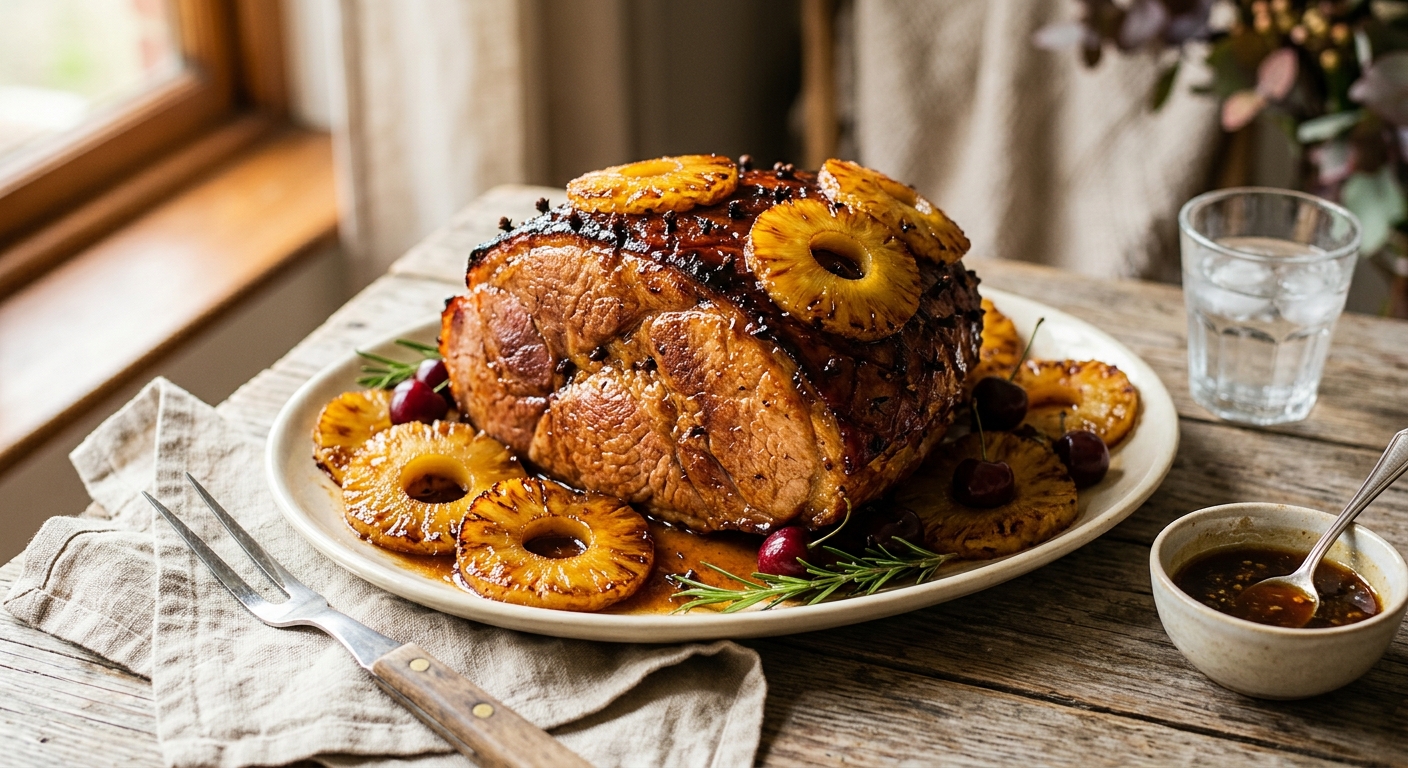
Glazed ham with pineapple is one of those rare dishes where crowd-pleasing indulgence and serious nutritional science happen to occupy the same plate. The combination of cured pork and fresh pineapple has deep roots in Polynesian-influenced American cooking, but at Calibrated Cuisine we are here to tell you that the pairing is more than tradition: pork is one of the single richest dietary sources of thiamine (vitamin B1) on the planet, while also delivering outstanding selenium, zinc, and phosphorus in a single serving. The pineapple is not just decoration either. It contributes bromelain, a proteolytic enzyme that pre-digests surface proteins in the ham, tenderising the meat naturally while adding vitamin C that enhances non-haem iron absorption from the pork.
Selenium is a trace mineral that sits at the heart of your antioxidant defence system. It is the cofactor for glutathione peroxidase, your body’s primary free-radical-quenching enzyme, and it is critical for thyroid hormone synthesis and immune surveillance. Pork is one of the most bioavailable sources of selenium in the human diet, with organic selenium in the form of selenomethionine showing absorption rates of 90% or higher. Thiamine, meanwhile, is the spark plug of carbohydrate metabolism: every molecule of glucose your cells burn requires thiamine-dependent enzymes at the gateway step. A thiamine shortfall manifests quickly as fatigue, brain fog, and impaired nerve conduction, and yet surveys consistently show that a significant portion of adults fall short of their 1.2 mg daily target.
This recipe is built around a bone-in or boneless gammon joint glazed with a reduction of pineapple juice, Dijon mustard, brown sugar, and warming spices. We provide four genuinely distinct cooking methods, each optimised for texture, colour, and nutrient retention. Whether you are roasting for a holiday crowd, slow-cooking for a weeknight dinner, or pressing the Instant Pot button on a Tuesday, every method is calibrated to deliver the same exceptional nutritional profile with flavour that stands entirely on its own merits.
6
servings
Ingredients
- 1500 gboneless gammon or cooked ham joint, rinsed and patted dry
- 400 gfresh pineapple, cored and sliced into 1cm rings (or tinned in juice, drained)
- 240 ml100% pineapple juice (from fresh or tinned, no added sugar)
- 60 gdark brown sugar
- 2 tbspDijon mustard
- 2 tbspapple cider vinegar
- 1 tbspunsalted butter
- 1 tspground cinnamon
- 0.5 tspground ginger
- 0.25 tspground cloves
- 0.25 tspsmoked paprika
- 4 clovesgarlic, minced
- 1 mediumyellow onion, roughly chopped
- 240 mllow-sodium chicken or vegetable stock
- 12 wholewhole cloves, for studding (optional)
- —Colima Sea SaltMicroplastic Free Salt and black pepper to taste
- —Fresh flat-leaf parsley or mint leaves, to garnish
Instructions
Click on an item below to shop for the recommended items for this recipe on Amazon.
As an Amazon Associate, we earn from qualifying purchases.
- Make the glaze: combine the pineapple juice, brown sugar, Dijon mustard, apple cider vinegar, cinnamon, ground ginger, ground cloves, and smoked paprika in a small saucepan. Bring to a gentle boil over medium heat, stirring to dissolve the sugar. Reduce the heat to medium-low and simmer, stirring occasionally, for 12 to 15 minutes until the glaze is reduced by half and coats the back of a spoon. Remove from heat and stir in the butter. Set aside.
- Place the ham joint in a large, deep, lidded pot or Dutch oven. Add the chopped onion, garlic, and stock. Pour in half of the prepared glaze. Add enough cold water to bring the liquid level to one-third of the way up the ham. Bring to a boil over high heat, then immediately reduce the heat to low, cover tightly, and simmer gently for 35 minutes, turning the ham once at the halfway point. The ham is ready when an instant-read thermometer reads at least 68 degrees C (155 degrees F) in the thickest part.
- Lift the ham from the braising liquid using two large forks or tongs and set it on a carving board. Pat the surface dry with kitchen paper. Score the top surface in a 3 cm crosshatch pattern, cutting about 5 mm deep. If using whole cloves, press one into each crosshatch intersection.
- Heat a large, heavy-based frying pan or skillet over medium-high heat until very hot. Add a thin film of oil and carefully place the ham scored-side down. Sear for 2 to 3 minutes until golden. Brush generously with the remaining glaze, then turn and sear each side for 1 to 2 minutes, continuing to baste with glaze. The surface should develop a sticky, lacquered, mahogany-coloured crust.
- Arrange the fresh pineapple rings in the same pan alongside the ham. Cook for 2 minutes per side until caramelised and golden. Remove the ham and allow it to rest uncovered for 8 minutes before slicing. Serve draped with pineapple rings and any pan juices, garnished with fresh herbs.
- Whisk together the pineapple juice, brown sugar, Dijon mustard, apple cider vinegar, cinnamon, ground ginger, ground cloves, and smoked paprika directly in the slow cooker insert. Add the stock, chopped onion, and minced garlic and stir to combine. This liquid will act as both cooking medium and the base for your finishing glaze.
- Score the ham joint in a 3 cm crosshatch pattern on all sides, cutting about 5 mm deep. If using whole cloves, press one into each crosshatch intersection. Lower the ham into the slow cooker, nestling it into the liquid. Tuck the pineapple rings around and on top of the ham, pressing some into the scores. Cover with the lid.
- Cook on Low for 6 to 8 hours, or on High for 3 to 4 hours, until the ham is deeply tender and registers at least 68 degrees C (155 degrees F) on an instant-read thermometer. The meat should give easily when pressed with a fork but still hold its shape for slicing.
- About 20 minutes before serving, preheat your oven grill (broiler) to high. Carefully lift the ham from the slow cooker and place it on a foil-lined baking sheet. Strain 180 ml of the cooking liquid into a small saucepan. Bring to a boil over high heat and reduce for 6 to 8 minutes, stirring in the butter, until syrupy. This is your finishing glaze.
- Arrange the pineapple rings from the slow cooker around the ham on the baking sheet. Brush the ham and pineapple generously with the reduced glaze. Grill (broil) 15 cm from the heat source for 4 to 6 minutes, brushing with additional glaze every 2 minutes, until the surface is bubbling, caramelised, and deeply coloured. Watch closely to prevent burning. Rest for 8 minutes before slicing and serving.
- Set your pressure cooker or Instant Pot to Saute mode on High. Add a thin film of oil and sear the ham joint on all sides for 2 to 3 minutes per side until lightly browned. This Maillard reaction creates deeper flavour than the slow cooker method can produce before the pressure stage. Remove the ham and set aside. Cancel Saute mode.
- Add the chopped onion and garlic to the insert and stir for 30 seconds using the residual heat. Pour in the stock and pineapple juice, scraping up any browned bits from the bottom with a wooden spoon. This deglazing step prevents a burn warning. Whisk in the brown sugar, Dijon mustard, apple cider vinegar, cinnamon, ground ginger, ground cloves, and smoked paprika.
- Score the seared ham in a 3 cm crosshatch pattern, cutting about 5 mm deep. If using whole cloves, press one into each intersection. Lower the trivet into the pot and place the ham on the trivet so it sits above the liquid. Arrange pineapple rings over and around the ham. Secure the lid and set the pressure release valve to Sealing.
- Cook on High Pressure for 35 minutes. Allow a natural pressure release for 15 minutes, then carefully switch to Quick Release to vent any remaining steam. Open the lid away from you. The ham should read at least 68 degrees C (155 degrees F) in the thickest part.
- Transfer the ham to a foil-lined baking sheet. Remove the pineapple rings and set aside. Switch the Instant Pot back to Saute mode on High and reduce the cooking liquid for 5 to 7 minutes with the butter added, until it forms a thick, syrupy glaze. Brush the ham and pineapple rings with the glaze and finish under a preheated high grill (broiler) for 3 to 5 minutes until caramelised and glossy. Rest 8 minutes before slicing.
- Preheat the oven to 180 degrees C (350 degrees F / Gas Mark 4). Make the glaze by combining the pineapple juice, brown sugar, Dijon mustard, apple cider vinegar, cinnamon, ground ginger, ground cloves, and smoked paprika in a small saucepan over medium heat. Stir to dissolve the sugar, then simmer for 12 to 15 minutes until reduced by half and syrupy. Remove from heat and stir in the butter. Reserve one-third of the glaze separately to serve alongside.
- Place the chopped onion, garlic, and stock in the bottom of a deep roasting tin or large casserole dish. This aromatic braising base keeps the oven environment moist and prevents the drippings from scorching. Score the ham in a 3 cm crosshatch pattern on all sides, cutting 5 mm deep. Press a whole clove into each crosshatch intersection if using. Set the ham on a roasting rack above the liquid.
- Brush the ham all over with a generous coating of glaze. Loosely tent the tin with foil, sealing the edges to trap steam. Roast in the centre of the oven for 45 minutes, then remove the foil and brush with another coat of glaze. Continue roasting uncovered, basting with glaze every 15 to 20 minutes, for a further 30 to 35 minutes. The ham is ready when an instant-read thermometer reads 68 degrees C (155 degrees F) at the thickest point and the surface is deeply caramelised.
- While the ham rests, increase the oven temperature to 220 degrees C (425 degrees F). Arrange the pineapple rings on the roasting rack or a separate lined baking sheet. Brush with the remaining glaze and roast for 8 to 10 minutes, turning once, until golden and caramelised at the edges.
- Transfer the ham to a carving board and rest uncovered for 10 to 12 minutes. Meanwhile, pour the pan drippings through a fine sieve into a small saucepan, skim any excess fat, and warm gently to serve as a jus. Slice the ham, arrange on a platter with the roasted pineapple rings, drizzle with the reserved glaze, and garnish with fresh herbs.
Nutrition Breakdown
Per 1 serving (makes 6)
Vitamins & Minerals
% Daily Value based on a 2,000 calorie diet (FDA reference)
🧬 Essential Amino Acids
% of recommended daily intake (RDA) per serving
🛡 Antioxidant Profile
The Nutrition Science
Pork is the pre-eminent dietary source of thiamine in Western diets, containing approximately 0.5 to 0.9 mg per 100 g of lean meat depending on cut and processing. Thiamine pyrophosphate (the active coenzyme form) is indispensable at three critical enzymatic steps in energy metabolism: pyruvate dehydrogenase, which gates entry of glucose carbons into the citric acid cycle; alpha-ketoglutarate dehydrogenase, a rate-limiting step within the cycle itself; and transketolase in the pentose phosphate pathway, which generates the NADPH needed for antioxidant recycling. Because thiamine is water-soluble and the body stores only 30 mg at most, with a biological half-life of roughly 18 days, consistent dietary intake is non-negotiable for sustained cognitive and metabolic function.
Selenium in pork exists predominantly as selenomethionine, an organoselenium compound with documented absorption efficiency of 85 to 95%, substantially higher than inorganic selenite or selenate found in supplements. Once absorbed, selenomethionine is incorporated non-specifically into body proteins wherever methionine is used, creating a metabolically accessible selenium reserve. The most nutritionally critical use is the co-translational insertion of selenocysteine into the active site of the selenoprotein family, which includes five glutathione peroxidase isoforms, three thioredoxin reductases, and iodothyronine deiodinases responsible for converting thyroxine (T4) to the metabolically active triiodothyronine (T3). Selenium adequacy is therefore directly linked to thyroid health and whole-body metabolic rate.
The pineapple in this recipe contributes more than sweetness. Fresh pineapple contains 40 to 100 mg of bromelain per 100 g, a mixture of cysteine proteases that remain enzymatically active at the acidic pH of the stomach. Clinical trials have demonstrated bromelain’s capacity to reduce post-exercise muscle soreness and modulate prostaglandin synthesis, reducing inflammatory mediators including thromboxane B2 and prostaglandin E2. Vitamin C from the pineapple, at approximately 47 mg per 100 g in fresh fruit, enhances the absorption of non-haem iron from the pork by reducing ferric iron (Fe3+) to the more soluble ferrous form (Fe2+) in the intestinal lumen, an effect that can increase iron bioavailability by two to four-fold in the same meal.
Pro Tips
- Remove the ham from the refrigerator 30 minutes before cooking. Starting with a room-temperature joint ensures even cooking from edge to centre and prevents the outer layers from overcooking before the interior reaches a safe temperature.
- If your ham is particularly salty (common with commercially cured gammon), soak it in cold water for 2 to 4 hours before cooking, changing the water once. This leaches excess sodium without significantly affecting selenium or thiamine content, as both are more tightly bound within the muscle tissue than surface salt.
- Reserve the strained braising liquid from any method: it is rich in water-soluble B vitamins including thiamine and niacin that have leached from the meat during cooking. Use it as a flavourful stock base for lentil soup, pea soup, or braised greens within 3 days to recover those nutrients rather than discarding them.
What a beautiful way to highlight the micronutrient density in something so celebratory! I’m curious whether you’re incorporating any turmeric or ginger into the glaze itself, since the selenium and thiamine would pair so well with anti-inflammatory spices that support their absorption. I’ve found that adding a touch of turmeric and black pepper to glazes (especially with that caramelized pineapple’s natural sweetness) creates this grounding warmth while also helping your body actually utilize all those B vitamins you’re delivering, plus the pineapple’s bromelain becomes even more bioavailable. Do you have thoughts on how spice choices might amplify the nutritional strategy here
ooh i love this for a special occasion meal, but im really curious how the pineapple timing works here? like are you adding it partway through so it caramelizes without losing all those thiamine gains, or going full roast from the start? ive been experimenting with different carb sources around my long runs and a glazed ham situation sounds amazing for refueling – the selenium for recovery inflammation is clutch, but im wondering if the sugar content in the glaze spikes fast enough to actually be useful post-race or if its more of a steady fuel thing?
ooh the selenium + thiamine combo is so good, but honestly im now wondering if theres any fermented element you could work into the glaze – like a miso or tamari base would add umami depth AND give you those beneficial microbes that support selenium absorption in the gut! i’ve been experimenting with fermented pineapple juice as a glaze base lately and it’s been a game changer for both flavor and digestion, plus the probiotics seem to really maximize nutrient bioavailability