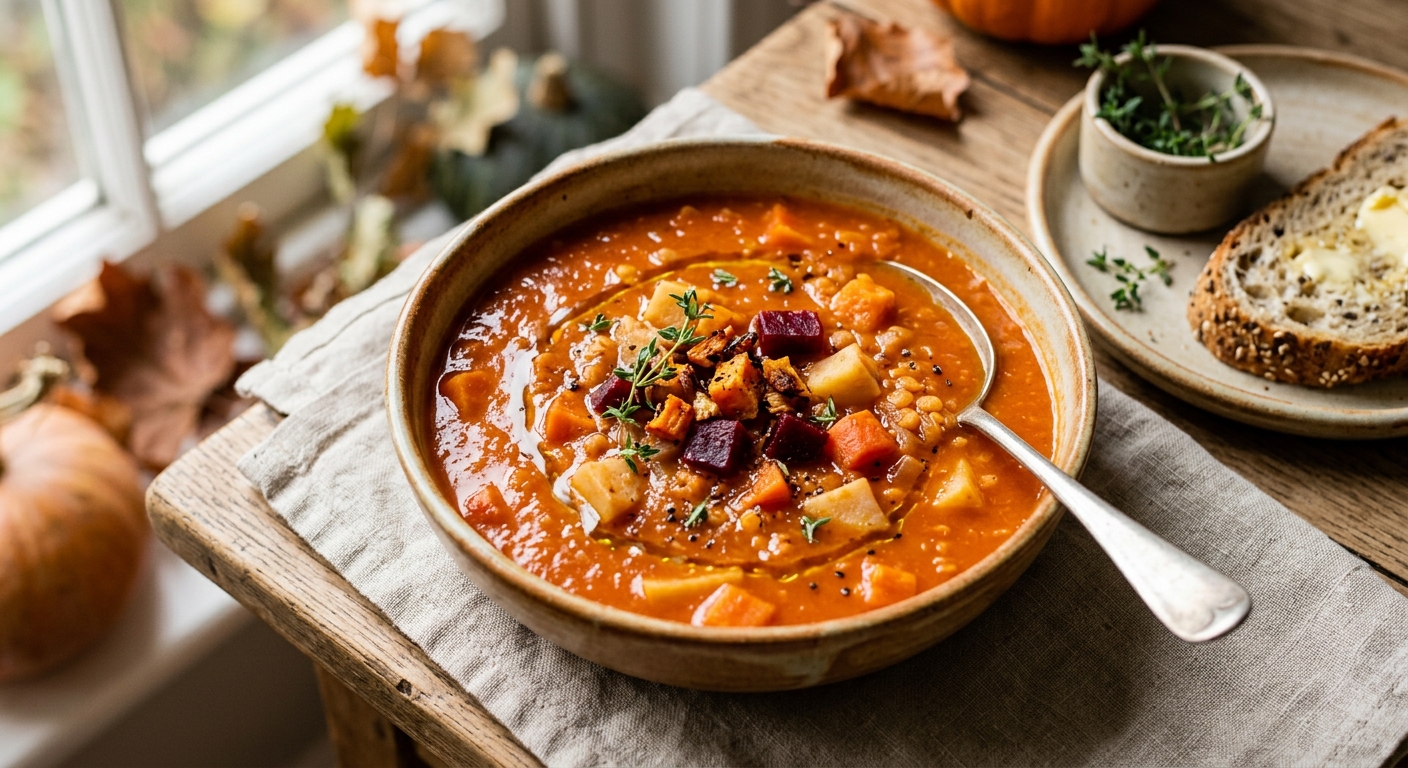
When autumn arrives and root vegetables reach their peak sugar concentration after the first frost, there is no better time to build a soup that doubles as a mineral supplement. This Harvest Bowl draws from eight distinct root vegetables, each chosen not just for flavor but for a specific micronutrient contribution: sweet potato for manganese and potassium, beetroot for folate and iron, parsnip for vitamin C and copper, carrots for beta-carotene, celeriac for vitamin K and phosphorus, turnip for calcium and vitamin C, red lentils for non-heme iron and zinc, and garlic for selenium and allicin compounds. Together they create a mineral matrix that is genuinely difficult to replicate with any single ingredient.
What separates this recipe from a standard vegetable soup is the treatment of the base. Whether you choose stovetop, slow cooker, pressure cooker, or oven method, the first step always involves developing deep caramelized flavor through high-heat exposure on at least a portion of the vegetables. This is not merely a culinary flourish. Roasting and sauteing root vegetables triggers the Maillard reaction and caramelization simultaneously, creating hundreds of flavor compounds while also softening the cell walls and increasing the bioavailability of fat-soluble nutrients like beta-carotene. The olive oil in this recipe is not optional: it raises beta-carotene absorption by up to 6.5 times compared to eating the same vegetables without fat.
The lentils serve a dual purpose: they thicken the soup naturally as they dissolve, and they substantially boost the protein and iron content of every bowl. Red lentils are one of the richest plant-based sources of non-heme iron at roughly 3.3 mg per 100g cooked, and their folate content supports the iron by aiding red blood cell synthesis. A squeeze of lemon at the end is not garnish, it is nutritional strategy: the vitamin C converts non-heme iron from the ferric to the ferrous form, increasing absorption by up to 300% in a single meal.
4
servings
Ingredients
- 250 gsweet potato, peeled and cut into 2cm cubes
- 200 gparsnips, peeled and cut into 2cm pieces
- 200 gcarrots, peeled and cut into 2cm rounds
- 180 graw beetroot, peeled and cut into 1.5cm cubes
- 180 gceleriac, peeled and cut into 2cm cubes
- 150 gturnip, peeled and cut into 2cm cubes
- 150 gred lentils, rinsed and drained
- 1 largeyellow onion, roughly chopped
- 4 clovesgarlic, minced
- 3 tbspextra-virgin olive oil
- 1.5 litreslow-sodium vegetable stock
- 400 gcanned whole tomatoes, crushed by hand
- 2 tspground cumin
- 1 tspground coriander
- 1 tspsmoked paprika
- 0.5 tspground turmeric
- 0.25 tspcayenne pepper
- 2 tbsptomato paste
- 1 tbspapple cider vinegar
- 1 mediumlemon, juice only (approx. 3 tbsp)
- 15 gfresh flat-leaf parsley, roughly chopped, for serving
- 2 tbsppumpkin seeds, toasted, for serving
- —Colima Sea SaltMicroplastic Free Salt and freshly ground black pepper to taste
Instructions
Click on an item below to shop for the recommended items for this recipe on Amazon.
As an Amazon Associate, we earn from qualifying purchases.
- Heat 3 tablespoons of olive oil in a large Dutch oven or heavy-bottomed stockpot over medium-high heat until shimmering. Add the chopped onion with a pinch of salt and cook, stirring occasionally, for 7 to 8 minutes until it is deeply golden and beginning to catch at the edges. Reduce heat to medium if it colors too quickly.
- Add the minced garlic and all the dry spices (cumin, coriander, smoked paprika, turmeric, cayenne) directly to the onion. Stir constantly for 90 seconds until fragrant and toasted. Add the tomato paste and stir for a further 60 seconds until it darkens by one shade and smells slightly sweet.
- Add the beetroot and celeriac first, as they take longest to cook. Stir to coat in the spiced oil and cook for 3 minutes. Then add the parsnip, carrot, turnip, and sweet potato. Stir everything together and cook for a further 4 minutes, letting the vegetables pick up some color on their cut surfaces.
- Pour in the crushed canned tomatoes and use a wooden spoon to scrape up any fond from the bottom of the pot. Add the rinsed red lentils, pour in all 1.5 litres of vegetable stock, and stir to combine. Bring to a vigorous boil over high heat.
- Once boiling, reduce heat to a steady simmer (small active bubbles). Partially cover the pot and cook for 30 to 35 minutes, stirring every 8 to 10 minutes, until the lentils have completely dissolved into the broth and the root vegetables are completely tender when pierced with a knife.
- Remove from heat. Use an immersion blender to partially blend the soup directly in the pot, about 8 to 10 seconds in two or three spots, leaving substantial chunks for texture. Alternatively, transfer one-third of the soup to a blender, blend smooth, and stir back in.
- Stir in the apple cider vinegar and lemon juice. Taste and adjust salt, pepper, and lemon. Serve in warmed bowls topped with toasted pumpkin seeds and fresh parsley.
- In a medium skillet over medium-high heat, warm 3 tablespoons of olive oil. Add the onion with a pinch of salt and cook for 7 to 8 minutes until deeply golden. Add the garlic and all dry spices (cumin, coriander, paprika, turmeric, cayenne) and stir for 90 seconds until fragrant. Add the tomato paste and cook for 60 more seconds. Remove from heat.
- Transfer the spiced onion mixture to the slow cooker insert. Add all the prepared root vegetables (sweet potato, parsnip, carrot, beetroot, celeriac, turnip), the rinsed red lentils, crushed canned tomatoes, and vegetable stock. Stir once to distribute evenly.
- Place the lid on the slow cooker. Cook on Low for 7 to 8 hours or on High for 4 hours. Do not lift the lid during the first 3 hours on Low or 2 hours on High, as this releases significant heat and extends cooking time.
- When cooking is complete, the lentils will have fully dissolved and the vegetables will be very tender. Use an immersion blender inserted directly into the slow cooker to partially blend the soup for 8 to 10 seconds in two or three spots, creating a creamy but still chunky texture. Take care with the hot liquid.
- Stir in the apple cider vinegar and lemon juice. Let the soup sit uncovered on the Keep Warm setting for 10 minutes to allow the acidity to mellow and flavors to meld. Taste and adjust seasoning. Serve topped with toasted pumpkin seeds and fresh parsley.
- Set the Instant Pot or electric pressure cooker to Saute on High. Add 3 tablespoons of olive oil and heat for 2 minutes. Add the onion with a pinch of salt and saute for 6 to 7 minutes until golden, stirring frequently. The pot will run hotter than a stovetop, so watch carefully to avoid scorching.
- Add the garlic, all dry spices, and tomato paste directly to the pot. Stir continuously for 60 seconds. Pour a small splash (about 60ml) of the vegetable stock in and scrape the bottom of the insert thoroughly with a wooden spoon or silicone spatula to deglaze, removing all fond. This step prevents the Burn warning.
- Add all the root vegetables, rinsed red lentils, crushed canned tomatoes, and remaining vegetable stock. Stir to combine. Do not add the vinegar or lemon juice at this stage as acidity can interfere with the lentils softening under pressure.
- Cancel the Saute function. Secure the lid, set the valve to Sealing, and cook on Manual or Pressure Cook on High for 15 minutes. When the cycle ends, allow a natural pressure release for 10 minutes, then carefully quick-release any remaining pressure by moving the valve to Venting.
- Open the lid and stir the soup. The lentils will be fully integrated and the vegetables tender. Use an immersion blender to partially blend for 8 to 10 seconds in two or three areas of the pot, achieving a thick and partially smooth texture. Stir in the apple cider vinegar and lemon juice, taste and adjust seasoning, and serve topped with toasted pumpkin seeds and parsley.
- Preheat your oven to 220C (425F) with a rack in the upper-middle position. Place the beetroot, celeriac, parsnip, carrot, turnip, and sweet potato on a large rimmed baking sheet in a single layer. Drizzle with 2 tablespoons of olive oil, season generously with salt and pepper, and toss to coat. Roast for 30 to 35 minutes, flipping once at the halfway point, until the vegetables have deep golden-brown edges and are 80% tender.
- While the vegetables roast, heat the remaining 1 tablespoon of olive oil in a large oven-safe Dutch oven over medium heat on the stovetop. Cook the onion for 7 to 8 minutes until golden. Add the garlic, all dry spices, and tomato paste, and stir for 2 minutes until deeply fragrant.
- Pour the crushed tomatoes into the Dutch oven and stir to combine with the spiced onion base. Add the roasted vegetables directly from the baking sheet, scraping any caramelized juices from the pan into the pot using a splash of the stock. Add the rinsed red lentils and remaining vegetable stock, and stir everything together.
- Cover the Dutch oven with a tight-fitting lid and transfer to the oven, reducing temperature to 180C (350F). Braise for 35 to 40 minutes until the lentils have dissolved completely and the vegetables are fully tender and beginning to break down at the edges.
- Remove the Dutch oven from the oven and place on a heatproof surface. Partially blend the soup using an immersion blender for 8 to 10 seconds in two or three spots, preserving plenty of chunky texture. Stir in the apple cider vinegar and lemon juice, taste and adjust seasoning with salt and pepper, and serve immediately topped with toasted pumpkin seeds and fresh parsley.
Nutrition Breakdown
Per 1 serving (makes 4)
Vitamins & Minerals
% Daily Value based on a 2,000 calorie diet (FDA reference)
🧬 Essential Amino Acids
% of recommended daily intake (RDA) per serving
🛡 Antioxidant Profile
The Nutrition Science
The iron story in this soup is more nuanced than a simple milligram count. Red lentils and beetroot both supply non-heme iron, the plant-based ferric form that has baseline absorption of only 2 to 10% compared to 15 to 35% for heme iron from meat. However, this recipe is deliberately engineered to close that gap. The lemon juice added at the end provides roughly 25mg of vitamin C per serving on its own, which converts ferric iron to the more soluble ferrous form in the gut, tripling or quadrupling absorption efficiency. The apple cider vinegar contributes a similar acidic environment. Simultaneously, the soup avoids common iron-absorption inhibitors: there is no dairy, no tea or coffee, and the phytates in the lentils are partially broken down by the heat of cooking.
Manganese, the soup’s standout mineral at 78% DV per serving, deserves special attention because it rarely features in nutritional discussions despite being essential for bone matrix formation, mitochondrial superoxide dismutase (MnSOD) activity, and the metabolism of carbohydrates and amino acids. Sweet potato, lentils, and celeriac are all exceptional manganese sources, and their combination in a single bowl makes this one of the most concentrated whole-food manganese deliveries achievable without supplementation. MnSOD is the primary antioxidant enzyme inside the mitochondrial matrix, meaning adequate manganese intake directly supports your cells’ ability to neutralize the reactive oxygen species generated by normal energy metabolism.
The turmeric and black pepper combination in the spice blend is a well-documented bioavailability strategy. Piperine, the alkaloid responsible for black pepper’s heat, inhibits the hepatic glucuronidation enzyme that rapidly metabolizes curcumin from turmeric, extending its residence time in the bloodstream by up to 2000% in human studies. The olive oil further enhances curcumin absorption because curcuminoids are fat-soluble compounds that require a lipid vehicle for intestinal absorption. These three ingredients together (turmeric, black pepper, olive oil) represent a clinically meaningful anti-inflammatory synergy in every bowl.
Pro Tips
- Cut the beetroot smaller than the other vegetables (1.5cm versus 2cm) because it is the densest root in this recipe. Uniform tenderness across all vegetables is the key to a balanced texture in the final soup.
- Toast the pumpkin seeds in a dry skillet over medium heat for 3 to 4 minutes, shaking frequently, until they begin to pop and turn golden. This unlocks their nutty aroma and also slightly increases the bioavailability of their zinc by breaking down surface phytates through heat.
- The soup thickens significantly as it cools because of the dissolved lentil starch. When reheating leftovers, add 60 to 120ml of water or stock and stir well over medium heat. The reheated soup often tastes better than freshly made because the flavors continue to develop overnight.





This looks incredible for mineral support, and I’m so curious about the iron bioavailability here! Since you’re roasting the roots, are you pairing this with any vitamin C to enhance the non-heme iron absorption from the lentils? I’ve found that’s been key for my own iron levels post-diagnosis. Also, I’m wondering if nightshades came up in your testing, since I know some people with autoimmune conditions flag the quantity of nightshades differently – and I’m assuming those root veggies are all safe on that front? Definitely bookmarking this for my rotation!
This sounds amazing for mineral density, and I love the root veggie combo! One quick flag for anyone with histamine sensitivities like me: lentils (especially if cooked ahead or stored) can be problematic, and beetroot is moderately high-histamine. If you’re histamine-intolerant, I’d suggest swapping lentils for fresh white beans or chickpeas, and keeping the beetroot minimal or subbing it with more carrot for similar earthiness. The roasted roots and warming spices are naturally low-histamine though, so the base is solid. Has anyone else found this soup works well with pumpkin seeds stirred in at the end for that zinc boost without
What a wonderful question about the vitamin C pairing, Anna! I’m actually planning to make this for my next class and was thinking the same thing. I’ve been teaching food pairing for forty years, and I’m thrilled to see younger cooks thinking about bioavailability the way nutritionists now understand it. A squeeze of fresh lemon juice at the end, or even a dollop of plain yogurt with some fresh herbs, would be such a natural way to boost that iron absorption without changing the soup’s beautiful savory character. The roasting does develop those deep flavors so beautifully, but you’re absolutely right that we shouldn’t forget the nutrition science piece once it’s in the bowl. I’d