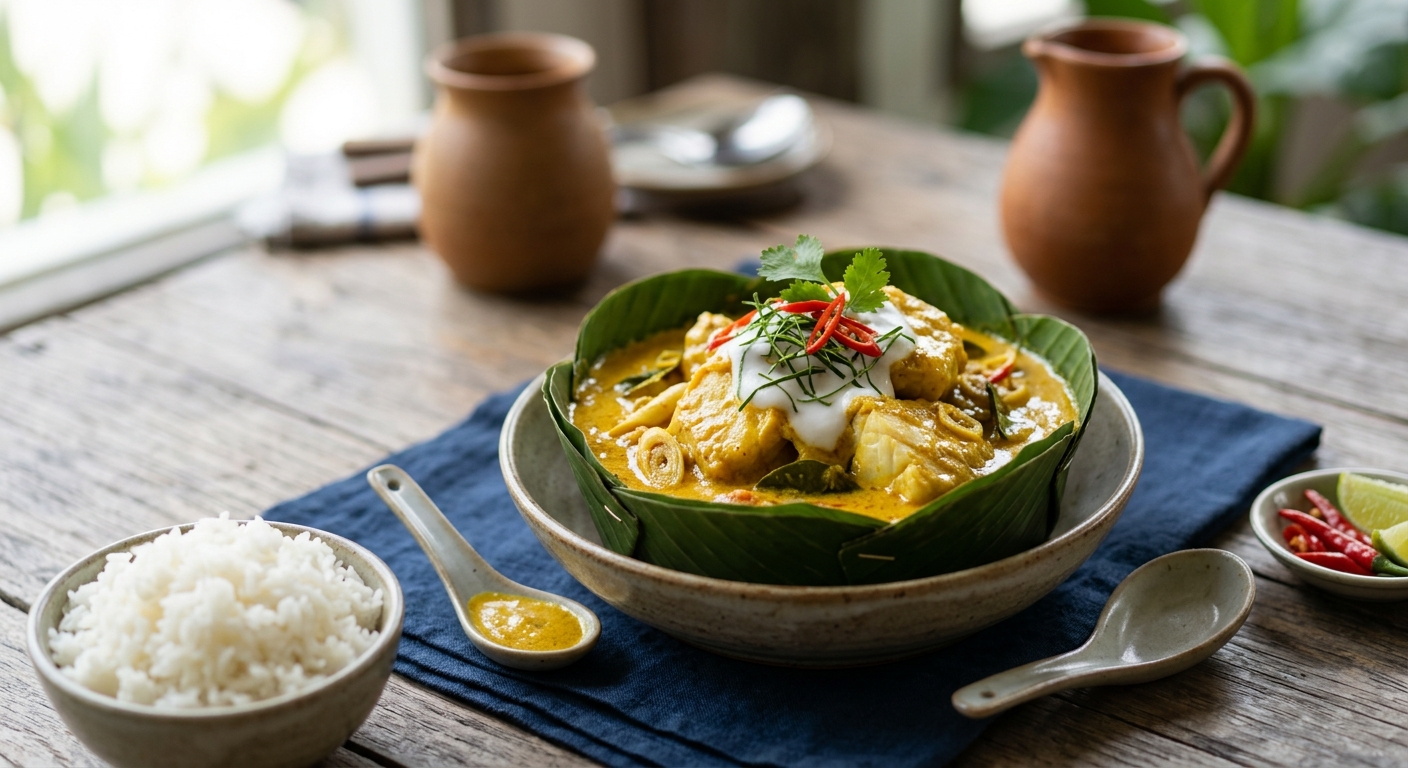
Fish Amok is not simply a curry. It is Cambodia’s culinary crown jewel, a dish that has graced royal banquet tables for centuries and now earns its place on the Calibrated Cuisine table for an equally compelling reason: its nutritional architecture is almost suspiciously perfect for combating chronic inflammation. The marriage of fresh white fish with a kroeung paste built from turmeric, galangal, lemongrass, and kaffir lime creates a flavor profile that is simultaneously earthy, citrusy, and silkily rich from coconut milk.
What separates Amok from most South-East Asian curries is the traditional technique of folding beaten egg and thick coconut cream into the spiced fish, then steaming the mixture inside banana leaf cups until it sets into a delicate, custard-like texture. For home cooks without banana leaves, a shallow baking dish or ramekins replicate the texture beautifully. This recipe honours the authentic kroeung paste while calibrating portion sizes and ingredient ratios to ensure each serving delivers a meaningful percentage of your daily requirements for omega-3 fatty acids, vitamin D, folate, selenium, and the anti-inflammatory compound curcumin.
Every ingredient earns its place here on both culinary and biochemical grounds. Barramundi or cod provides long-chain EPA and DHA omega-3s alongside heme-adjacent selenium. Fresh turmeric root contributes curcumin at a concentration roughly 20% higher than dried powder. The coconut milk fat is not merely indulgence: its medium-chain triglycerides aid fat-soluble nutrient absorption, and the fat itself dramatically increases the bioavailability of curcumin. Together, these elements form one of the most nutrient-dense, anti-inflammatory one-pot meals in the South-East Asian canon.
4
servings
Ingredients
- 700 gbarramundi or cod fillets, skinless, cut into 4 cm chunks
- 400 mlfull-fat coconut milk (1 can), divided
- 120 mlthick coconut cream (from the top of a second can or a separate carton)
- 2 largeeggs, lightly beaten
- 2 tbspfish sauce
- 1 tbsppalm sugar or light brown sugar
- 30 gfresh turmeric root, peeled and roughly chopped (or 2 tsp ground turmeric)
- 3 stalkslemongrass, white and pale-green parts only, thinly sliced
- 4 clovesgarlic, peeled
- 4 wholekaffir lime leaves, stems removed, thinly sliced (plus 4 extra for garnish)
- 30 ggalangal or fresh ginger, peeled and roughly chopped
- 3 wholedried red chilies, soaked in warm water for 10 minutes, drained
- 2 wholeshallots, peeled and roughly chopped
- 1 tspshrimp paste (kapi)
- 1 tspground coriander
- 0.5 tspground white pepper
- 2 tbspAvocado Oil100% Pure Avocado Oil (such as avocado or Avocado Oil100% Pure Avocado Oil)
- 40 gfresh spinach or sliced snake beans, for the base layer
- 1 wholefresh red chili, thinly sliced, for garnish
- 10 gfresh Thai basil or holy basil leaves, for garnish
- —Colima Sea SaltMicroplastic Free Salt to taste
- —Steamed jasmine rice, to serve
Instructions
Click on an item below to shop for the recommended items for this recipe on Amazon.
As an Amazon Associate, we earn from qualifying purchases.
- Make the kroeung paste: combine the lemongrass, garlic, shallots, fresh turmeric, galangal, soaked dried chilies, kaffir lime leaves, shrimp paste, ground coriander, and white pepper in a food processor or blender. Add 3 tablespoons of the coconut milk to help it blend. Process for 2 to 3 minutes, scraping down the sides, until you have a smooth, bright-orange paste. Taste and adjust salt if needed.
- Heat the neutral oil in a wide, heavy-bottomed skillet or wok over medium heat. Add the kroeung paste and cook, stirring constantly, for 4 to 5 minutes until the paste darkens slightly, smells intensely fragrant, and the oil begins to separate around the edges. This blooming step is essential for depth of flavor.
- Pour in the remaining coconut milk (reserving the thick coconut cream for later) and stir to combine with the paste. Add the fish sauce and palm sugar. Bring the sauce to a gentle simmer over medium-low heat. Taste and balance: it should be savory, faintly sweet, and gently spiced.
- Scatter the fresh spinach or snake beans across the bottom of the skillet in an even layer. Lay the fish chunks on top in a single layer, gently pressing them into the sauce. Cover the pan with a tight-fitting lid and cook for 6 to 8 minutes over medium-low heat, until the fish is just opaque throughout and flakes easily. Do not stir or the fish will break apart.
- While the fish cooks, whisk the beaten eggs into the thick coconut cream in a small bowl until combined. Once the fish is cooked, pour this egg-coconut cream mixture evenly over the top of the fish. Replace the lid and cook for a further 2 to 3 minutes until the cream layer is just set and slightly wobbly at the center, like a soft custard. Remove from heat immediately to prevent overcooking.
- Garnish with sliced fresh chili, reserved kaffir lime leaf chiffonade, and fresh basil leaves. Serve immediately in the pan or ladle into bowls over steamed jasmine rice.
- Make the kroeung paste as directed: blend lemongrass, garlic, shallots, turmeric, galangal, drained chilies, kaffir lime leaves, shrimp paste, coriander, and white pepper with 3 tablespoons of coconut milk until completely smooth. Transfer to the slow cooker insert.
- Add the remaining coconut milk, fish sauce, and palm sugar directly to the slow cooker with the paste. Stir well to combine everything into a uniform sauce. Layer the spinach or snake beans across the bottom of the insert.
- Nestle the fish chunks on top of the greens in a single layer, pressing them gently into the sauce. The fish should be mostly submerged. Place the lid on the slow cooker and set to Low. Cook for 1 hour 45 minutes to 2 hours. Check at 1 hour 45 minutes: the fish is done when it is opaque and just beginning to flake at the thickest part. Because slow cookers vary, begin checking early to avoid overcooking.
- About 10 minutes before serving, whisk the beaten eggs into the thick coconut cream. Pour this mixture into a small saucepan and place over medium-low heat on the stovetop, stirring gently for 3 to 4 minutes until the cream thickens to a pourable custard consistency but does not scramble. Season with a small pinch of salt.
- Carefully ladle the fish and sauce into serving bowls over jasmine rice. Spoon the warm egg-coconut cream generously over each portion. Finish with sliced fresh chili, kaffir lime leaf chiffonade, and fresh basil leaves. Serve immediately.
- Set the Instant Pot or electric pressure cooker to Saute mode on Medium heat. Add the neutral oil, then the freshly blended kroeung paste (prepared exactly as in the stovetop method). Saute for 3 to 4 minutes, stirring constantly, until the paste is fragrant and the oil separates slightly. Press Cancel to end Saute mode.
- Add the remaining coconut milk, fish sauce, and palm sugar to the pot. Stir to deglaze the bottom and lift any paste that has stuck, which prevents a burn warning. Scatter the spinach or snake beans across the base. Arrange the fish chunks on top in a single, even layer.
- Seal the lid and set the valve to Sealing. Select Pressure Cook (High Pressure) and set the timer for 3 minutes. The pot will take approximately 5 to 6 minutes to reach pressure before the countdown begins.
- When the timer sounds, immediately perform a Quick Release by carefully turning the valve to Venting. Remove the lid as soon as the float pin drops. The fish will be perfectly cooked: opaque, tender, and intact. If any pieces are translucent at the very center, replace the lid (do not re-seal) and let residual heat finish them for 1 minute.
- Whisk the beaten eggs into the thick coconut cream and pour the mixture evenly over the fish directly in the pot. Replace the lid loosely (not sealed) and let the residual heat of the pot set the cream for 2 to 3 minutes. The cream will become silky and just-set. Garnish with sliced chili, kaffir lime leaf, and basil, then serve immediately over jasmine rice.
- Preheat your oven to 170C (340F) with the fan off if possible (still oven heat is gentler and prevents the custard from curdling). Prepare the kroeung paste as directed and set aside. Grease four 300 ml oven-safe ramekins or one 22 cm square ceramic baking dish with a thin layer of neutral oil.
- In a large mixing bowl, combine the blended kroeung paste, the full-fat coconut milk, fish sauce, and palm sugar. Whisk until smooth. Now whisk in the beaten eggs and half of the thick coconut cream (60 ml) to form the Amok custard base. Season with a small pinch of salt if needed.
- Divide the spinach or snake beans evenly among the ramekins, covering the base of each. Add the fish chunks on top of the greens, distributing them equally. Pour the coconut-egg custard mixture over the fish in each ramekin, filling to about 1 cm below the rim. The fish will be partially submerged in the custard.
- Place the ramekins in a deep roasting pan. Pour hot water into the roasting pan to come halfway up the sides of the ramekins, creating a bain-marie (water bath). This is the key technique: the water bath regulates temperature and prevents the custard from overcooking at the edges before the center sets.
- Carefully transfer the roasting pan to the oven. Bake for 22 to 25 minutes, until the custard is just set with a very slight wobble in the center when gently shaken, and the edges are fully firm. The internal temperature of the fish should reach 63C (145F). Remove from the oven and lift the ramekins out of the water bath.
- Spoon the remaining thick coconut cream over the top of each ramekin and return to the oven (without the water bath) for 3 to 4 minutes until the cream is just warmed and slightly glossy. Garnish with fresh chili, kaffir lime leaf chiffonade, and basil leaves. Serve the ramekins directly on plates alongside steamed jasmine rice.
Nutrition Breakdown
Per 1 serving (makes 4)
Vitamins & Minerals
% Daily Value based on a 2,000 calorie diet (FDA reference)
🧬 Essential Amino Acids
% of recommended daily intake (RDA) per serving
🛡 Antioxidant Profile
The Nutrition Science
The anti-inflammatory potency of Fish Amok is the product of several synergistic mechanisms. The long-chain omega-3 fatty acids EPA (eicosapentaenoic acid) and DHA (docosahexaenoic acid) from the barramundi or cod are precursors to specialized pro-resolving mediators called resolvins and protectins. These lipid-derived molecules actively switch off inflammatory signaling rather than simply blocking it, a mechanistic distinction from non-steroidal anti-inflammatory drugs. A single serving provides approximately 1.8 g of combined EPA and DHA, exceeding the 1.6 g daily Adequate Intake recommended by the National Academies for adult males.
Curcumin, the primary bioactive polyphenol in fresh turmeric, operates through a complementary but distinct pathway. It suppresses the nuclear factor kappa-B (NF-kB) transcription factor, which controls the expression of over 400 pro-inflammatory genes. Critically, curcumin’s bioavailability from dietary sources is normally poor due to rapid glucuronidation in the gut and liver. The coconut milk fat in this recipe substantially increases curcumin absorption: studies have demonstrated that consuming curcumin with lipids can raise plasma curcumin concentrations by up to 7-fold compared with aqueous preparations. This is why Amok’s traditional formulation is, unintentionally, pharmacologically optimal for curcumin delivery.
Selenium deserves particular attention in this dish. Each serving provides approximately 52 mcg, covering 94% of the daily value. Selenium is an obligate cofactor for the glutathione peroxidase family of enzymes, which are the body’s primary defense against lipid peroxidation, the oxidative degradation of polyunsaturated fatty acids in cell membranes. Given that this recipe is rich in omega-3 PUFAs, the high selenium content provides direct biochemical protection for those same fatty acids within the body’s tissues, creating an elegant nutritional pairing with genuine mechanistic support.
Pro Tips
- For the smoothest kroeung paste, slice the lemongrass very thinly before blending and always soak dried chilies for at least 10 minutes. Fibrous lemongrass is the most common source of a grainy paste texture, and pre-soaking the chilies ensures they blend without leaving tough skin fragments.
- Fresh turmeric root stains everything intensely, including cutting boards, hands, and blender jars. Work on a dedicated plastic cutting board, wear gloves, and rinse your blender immediately after use. A paste made with fresh turmeric has a floral, slightly peppery warmth that ground turmeric simply cannot replicate.
- The fish-to-custard ratio is critical for authentic Amok texture. If the coconut milk you buy is very thin or watered down, refrigerate the can overnight and scoop the thick cream off the top before opening fully. Using dilute coconut milk results in a soupy rather than custardy final dish.
- For a visually stunning and traditional presentation, fashion cups from banana leaves by forming them into cylinders and securing with toothpicks, then lining them with a whole kaffir lime leaf before filling. They can be steamed in a bamboo steamer basket or baked in the oven method as described.
Love where you’re going with the sleep angle, Sam, though I’d gently push back on one thing: white fish actually has pretty modest tryptophan compared to other proteins like poultry or dairy, so I wouldn’t lean too heavily on that mechanism. That said, you’re spot on about the omega-3s and curcumin reducing neuroinflammation, which absolutely matters for sleep quality – and here’s what really gets me excited: that coconut milk base means you’ve got fat-soluble absorption happening simultaneously, which dramatically increases curcumin bioavailability compared to turmeric alone. The lemongrass actually brings citral compounds too, which some emerging research suggests might have
ooh this sounds perfect for my post long run recovery window actually – that combo of omega 3s to fight the inflammation spike from hard training plus the turmeric for added anti inflammatory punch is exactly what ive been experimenting with. the b vitamins are huge too since endurance work depletes them like crazy. my question though is how does the coconut milk factor in? like i know its higher in saturated fat but im curious if thats actually a concern post workout or if the whole food matrix makes it less inflammatory than isolated fat would be, because ive been nervous about timing heavier curries close to runs
oh man this is hitting all my sleep optimization buttons – omega-3s for reducing inflammation that tanks sleep quality, turmeric’s curcumin for the same reason, plus white fish is packed with tryptophan and b6 which your body needs to convert it to serotonin before melatonin. did you specifically choose white fish over salmon here or was it more about staying true to the traditional preparation? im genuinely curious because im wondering if the lower fat white fish plays better with the coconut milk’s saturation profile for nighttime digestion, or if im just sleep deprived and overthinking this lol. my tracker definitely showed better sleep scores the week i was cooking amok variants every