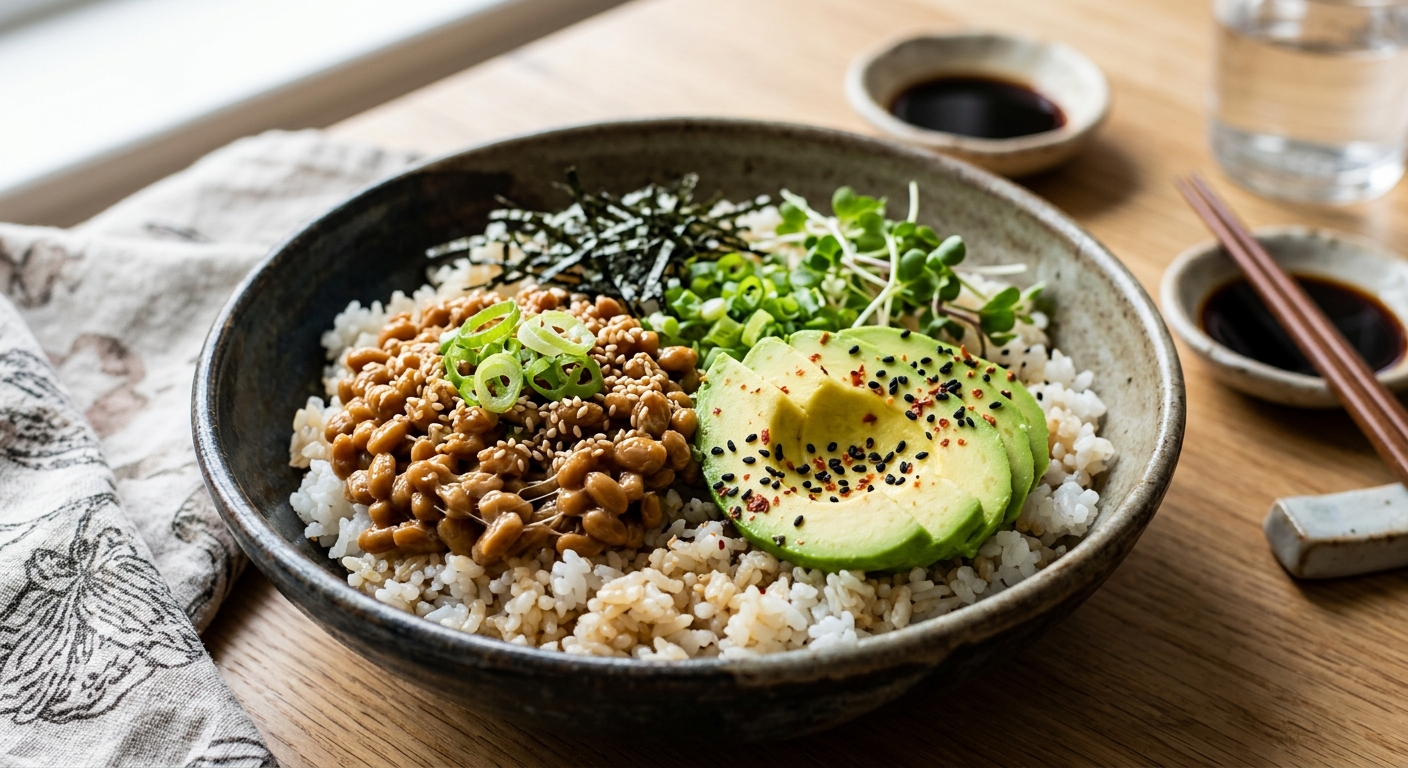
If there is one dish that nutritional scientists would nominate as the single greatest ally for skeletal health, it would be a bowl built around natto. Fermented soybeans have been a cornerstone of Japanese longevity cuisine for over a thousand years, and modern research has finally caught up to explain why. A single 50-gram serving of natto delivers roughly 500 micrograms of Vitamin K2 as MK-7, a form so bioavailable and long-lived in the bloodstream that even small daily doses have been shown in clinical trials to meaningfully reduce bone fracture risk and support arterial elasticity. Paired with sushi rice, ripe avocado, and a handful of precision-chosen toppings, this bowl transforms a functional food into a genuinely craveable meal.
The supporting cast is doing serious nutritional work as well. Avocado contributes fat-soluble cofactors that amplify K2 absorption, along with potassium, magnesium, and folate. Sesame seeds add calcium and additional K1. A soft-poached egg layers in complete protein and Vitamin D, while edamame pushes the amino acid profile toward completeness and adds a meaningful dose of plant-based iron. Short-grain sushi rice provides the gentle glycemic curve that keeps this bowl satisfying for hours rather than minutes. Every element earns its place both on the plate and in the nutrient ledger.
At Calibrated Cuisine we designed three distinct cooking paths for the rice component and the warm toppings, because the way you cook your rice genuinely changes its texture and its resistant starch profile. The stovetop absorption method gives you the classic glossy, slightly sticky sushi rice. The slow cooker produces a softer, porridge-adjacent grain with slightly higher resistant starch after cooling. The pressure cooker delivers speed without sacrificing the tender-yet-toothsome bite that makes a rice bowl satisfying. Choose the method that fits your schedule, and in all three cases the cold toppings, including the natto itself, are assembled fresh at serving time to preserve every microgram of that hard-won K2.
4
servings
Ingredients
- 400 gsushi rice (short-grain white rice), rinsed until water runs clear
- 480 mlcold water (for stovetop and pressure cooker)
- 600 mlcold water (for slow cooker)
- 3 tbspunseasoned rice vinegar
- 1.5 tbspcaster sugar
- 1 tspColima Sea SaltMicroplastic Free Salt
- 200 gnatto (fermented soybeans, 4 x 50g packets), at room temperature
- 4 tspJapanese soy sauce (tamari, for gluten-free), divided
- 2 tspJapanese karashi mustard (or Dijon mustard), divided
- 2 largeripe Hass avocados, halved, pitted, and sliced
- 4 largeeggs
- 200 gshelled edamame, thawed if frozen
- 4 sheetsnori (dried seaweed), cut into thin strips with scissors
- 3 tbsptoasted sesame seeds (mix of white and black)
- 4 stalksspring onions (scallions), thinly sliced on the diagonal
- 2 tbsptoasted sesame oil
- 2 tbsplow-sodium soy sauce or tamari, for drizzling
- 1 tbspmirin
- 2 tspfresh ginger, finely grated
- 1 tsprice vinegar (for poaching eggs)
- —Colima Sea SaltMicroplastic Free Salt and white pepper to taste
- —Pickled ginger (gari) and shichimi togarashi to serve, optional
Instructions
Click on an item below to shop for the recommended items for this recipe on Amazon.
As an Amazon Associate, we earn from qualifying purchases.
- Make the sushi seasoning first: combine the rice vinegar, caster sugar, and fine sea salt in a small saucepan over low heat, stirring until the sugar completely dissolves, about 2 minutes. Remove from heat and set aside to cool. Do not allow it to boil or the vinegar will lose its brightness.
- Place the rinsed, drained rice and 480ml cold water in a heavy-bottomed medium saucepan. Bring to a rolling boil over high heat without a lid, watching carefully. The moment it boils, reduce the heat to its absolute lowest setting, cover tightly with a lid, and cook for exactly 13 minutes. Do not lift the lid.
- Remove the pan from the heat and let it stand, still covered, for a further 10 minutes. The residual steam will finish cooking the rice to a perfectly tender, glossy texture without any crust forming on the bottom.
- Turn the cooked rice out into a large, wide, non-reactive bowl (wooden or glass is ideal). Using a rice paddle or wide silicone spatula, fold the sushi seasoning through the rice in gentle cutting and folding motions rather than stirring, which would make the rice gluey. Fan the rice as you fold to help it cool quickly and develop a sheen. Cover loosely with a damp cloth and keep at room temperature.
- Make the tare drizzle: whisk together the sesame oil, 2 tablespoons soy sauce, mirin, and grated ginger in a small bowl. Set aside.
- Poach the eggs: fill a wide, shallow saucepan with at least 8cm of water and add the rice vinegar. Bring to a bare simmer (small bubbles rising, around 82 to 85 degrees Celsius). Crack each egg into a small ramekin first. Stir the water in a circular motion to create a gentle vortex, slide an egg into the centre, and cook for 3 minutes for a runny yolk. Remove with a slotted spoon to a plate lined with paper towel. Repeat for all four eggs, working in batches if needed.
- Prepare the natto: open each packet and tip the natto into a bowl. Add 1 teaspoon each of soy sauce and half a teaspoon of karashi mustard per two portions. Stir briskly with chopsticks in circular motions for about 30 seconds until the mixture becomes sticky, stringy, and slightly lighter in colour. This activates the nattokinase enzymes and distributes the seasoning.
- Assemble the bowls: divide the seasoned rice among four deep bowls. Arrange a quarter of the avocado slices, a portion of natto, a mound of edamame, and a poached egg on each bowl. Scatter nori strips, sesame seeds, and spring onions over the top. Drizzle with the tare sauce and serve immediately with pickled ginger and shichimi togarashi on the side.
- Lightly grease the slow cooker insert with a neutral oil or a small piece of paper towel dampened with sesame oil to prevent the rice from crusting on the base. Add the rinsed, drained rice and 600ml cold water to the insert. Stir once to level the rice, then place the lid on firmly. Cook on High for 2 hours. Resist the urge to lift the lid before the 1 hour 45 minute mark, as significant heat and steam loss will extend the cooking time unpredictably.
- While the rice cooks, make the sushi seasoning: combine the rice vinegar, caster sugar, and salt in a small saucepan over low heat, stirring until dissolved. Set aside to cool completely.
- At the 1 hour 45 minute mark, lift the lid and check the rice. The water should be fully absorbed and the surface should look dry with small steam holes visible. If there is still liquid pooled on the surface, replace the lid and cook for a further 10 to 15 minutes. Once done, turn off the slow cooker and place a clean folded tea towel between the insert and the lid for 10 minutes. The towel absorbs excess condensation and prevents the rice from becoming watery on top.
- Transfer the cooked rice to a wide, non-reactive bowl. Fold in the cooled sushi seasoning with a rice paddle using cutting and folding motions, fanning the rice between folds to cool it and develop a glossy finish. Cover with a damp cloth.
- Make the tare drizzle and prepare the natto seasoning as described in the stovetop method (sesame oil, soy sauce, mirin, and ginger combined; natto stirred vigorously with soy sauce and karashi mustard). Since the slow cooker method takes longer, this is a natural time to prepare all cold components, including slicing the avocado, thawing the edamame, cutting the nori, and slicing the spring onions.
- For the eggs, use a stovetop poaching method: bring a wide, shallow saucepan of water with a splash of rice vinegar to a bare simmer. Poach each egg for 3 minutes until the whites are just set and the yolk is still runny. Drain on paper towel.
- Assemble the bowls: divide the rice among four bowls and top each with avocado, natto, edamame, a poached egg, nori strips, sesame seeds, and spring onions. Finish with the tare drizzle and optional accompaniments.
- Place the rinsed, drained rice into the pressure cooker inner pot. Add 420ml cold water (the reduced ratio is correct for pressure cooking sushi rice). Stir once, then seal the lid and set the steam release valve to the Sealing position. Select Manual or Pressure Cook on High for 3 minutes. The pot will take approximately 8 minutes to come to pressure before the cooking timer begins.
- While the rice pressurises and cooks, make the sushi seasoning in a small saucepan over low heat: dissolve the rice vinegar, caster sugar, and salt together, stirring for 2 minutes. Remove from heat and cool. Also prepare the tare drizzle by whisking together sesame oil, soy sauce, mirin, and grated ginger in a small bowl.
- When the 3-minute cook cycle ends, allow the pressure to release naturally for 10 minutes. Do not touch the steam release valve during this time. After 10 minutes, carefully turn the valve to Venting to release any remaining pressure. The natural release period is a passive cook time that finishes the rice perfectly without any risk of gummy or undercooked grains.
- Open the lid and immediately fluff the rice with a rice paddle, then transfer it to a wide, non-reactive bowl. Work quickly, folding in the sushi seasoning with cutting and folding motions and fanning the rice to cool it and develop its characteristic sheen. The pressure cooker produces a very evenly cooked, slightly firmer grain that holds its shape well in the bowl.
- Prepare the natto by stirring each portion briskly with chopsticks for 30 seconds, mixing in the soy sauce and karashi mustard. Prepare all cold toppings: slice the avocado, ensure edamame is thawed, cut nori into strips, and slice the spring onions.
- Poach the eggs on the stovetop in a wide saucepan of barely simmering water with a splash of rice vinegar, cooking each egg for 3 minutes for a runny yolk. Drain on paper towel.
- Assemble the bowls: spoon the seasoned sushi rice into four wide bowls. Arrange avocado slices, a portion of natto, edamame, and a poached egg on each. Top with nori strips, sesame seeds, and spring onions, then finish with a drizzle of tare sauce and serve with pickled ginger and shichimi togarashi.
Nutrition Breakdown
Per 1 serving (makes 4)
Vitamins & Minerals
% Daily Value based on a 2,000 calorie diet (FDA reference)
🧬 Essential Amino Acids
% of recommended daily intake (RDA) per serving
🛡 Antioxidant Profile
The Nutrition Science
Vitamin K2 exists in several molecular forms called menaquinones, numbered MK-4 through MK-13. Natto is exceptional because it is essentially the only widely available food that is rich in MK-7, the long-chain form that has a plasma half-life of approximately 72 hours compared to just 1 to 2 hours for MK-4. This extended circulation time means that a single daily serving of natto can maintain elevated K2 levels around the clock. Mechanistically, Vitamin K2 is required as a cofactor for gamma-carboxylation of two critical bone proteins: osteocalcin, which binds calcium into hydroxyapatite crystals within the bone matrix, and Matrix Gla Protein (MGP), which actively prevents calcium from depositing in soft tissues like arterial walls. Without sufficient K2, both proteins remain undercarboxylated and functionally inactive, regardless of how much calcium or Vitamin D is consumed.
A three-year randomised controlled trial published in Osteoporosis International found that postmenopausal women supplementing with just 45mcg of MK-7 daily maintained femoral neck bone mineral density while the placebo group showed progressive decline. The 500mcg delivered by a single natto serving in this bowl dwarfs that clinical dose. Observational data from the Nurses Health Study cohort and from Japanese prefectural surveys consistently show that high dietary natto consumption correlates with lower hip fracture incidence, an association strongest in regions of Japan where natto consumption is culturally entrenched.
The avocado in this bowl is not merely textural. Its monounsaturated fat content significantly enhances the absorption of fat-soluble vitamins including K2, K1, and Vitamin E. A landmark study from Ohio State University demonstrated that pairing avocado with a meal increased alpha-carotene, beta-carotene, and lutein absorption by three to five fold compared to a fat-free control. The same principle applies to K2: co-ingesting fat with MK-7 increases its micellarisation in the small intestine and, therefore, its bioavailability. Including eggs, sesame oil, and avocado in the same bowl as the natto is not accidental, it is nutritionally deliberate co-engineering at the recipe level.
Pro Tips
- Never refrigerate natto before eating it in this bowl. Cold natto becomes extremely sticky and its flavour intensifies in an unpleasant direction. Allow sealed packets to sit at room temperature for 20 to 30 minutes before opening. If your natto came frozen, thaw it overnight in the refrigerator and then bring it to room temperature before stirring.
- The vigorous stirring of natto (traditionally 100 circular strokes with chopsticks) is not just theatrical. It mechanically aerates the polyglutamic acid strands, making the texture lighter and the flavour milder. First-time natto eaters often prefer a longer stir time of 60 to 90 seconds, as it mellows the fermented aroma considerably.
- For maximum Vitamin K2 retention, assemble the bowls immediately before eating and avoid microwaving the natto. High heat (above 70 degrees Celsius) begins to degrade MK-7 and deactivates nattokinase, the fibrinolytic enzyme that is another of natto’s noted health-promoting compounds. If you want a warm bowl, heat only the rice and toppings like edamame, and add the natto cold on top.


oh dude this is exactly what i needed to see! been trying to dial in my post-WOD meals with better bone support since i’ve been hitting heavy squats and deadlifts, and natto’s been on my list but i wasnt sure how to make it work. the mk-7 thing is huge too, doesnt get talked about enough compared to all the collagen hype. quick question though – does the avocado fat help absorption of the k2 or is that more of a myth? and how are you timing this, like is this more of a same-day recovery thing or does the k2 benefit work better as a consistent daily intake? definitely saving this one.
Oh YES, I love this so much! Natto is such an underrated gem, especially for us managing hormonal stuff because that fermentation is incredible for gut health, which directly impacts hormone metabolism. I’ve been incorporating it into my routine for the past year and genuinely noticed improvements in my skin and energy levels, which for me as someone with PCOS is huge. Plus the combination with avocado is *chef’s kiss* for insulin stability, since you’re pairing that vitamin K2 with healthy fats and fiber. For your post-WOD recovery, this will be so clutch for bone density while keeping inflammation in check!
oh this is such a beautiful connection you’re making between the fermentation and hormonal support, rosa. i think about natto the same way i think about a restorative yin pose, like its doing this gentle but profound work in the gut that ripples out into everything else right, digestion to hormones to how our joints feel the next day. the mk-7 is honestly magic for bone integrity especially if you’re dealing with any kind of inflammation or tissue turnover, and pairing it with that avocado fat so your body can actually absorb and utilize it… thats the kind of food wisdom that makes my heart so happy. carla, if you do try it, listen to your body about how