
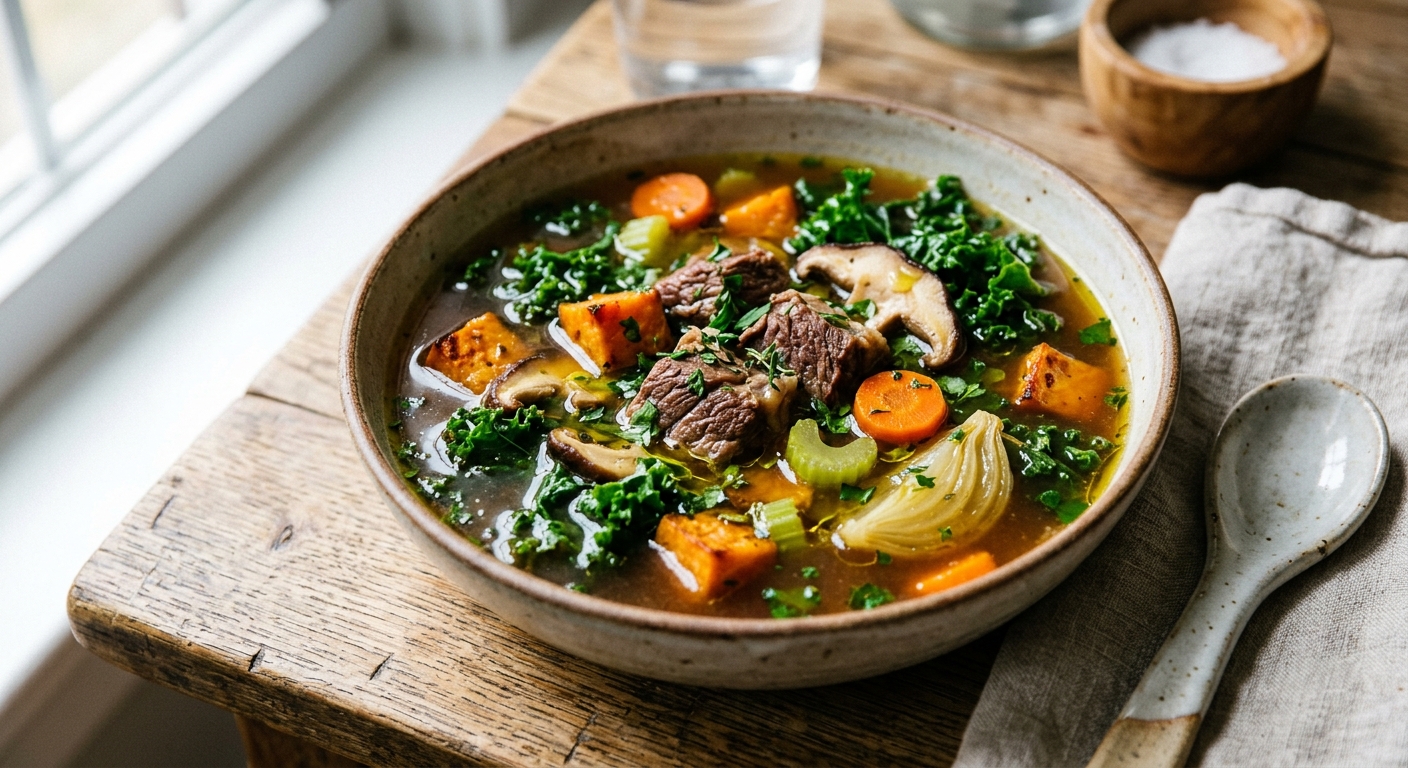
Some dishes exist at the intersection of ancient wisdom and modern nutritional science, and this bone broth healing bowl is exactly that. Simmered low and slow with grass-fed beef knuckle and marrow bones, this bowl draws out gelatin, glutamine, glycine, and proline from the collagen matrix of connective tissue, producing a broth so richly structured it gels solid in the refrigerator. That gel is your visual confirmation of therapeutic collagen peptide concentration. Paired with roasted sweet potato, tender kale, earthy mushrooms, and bright turmeric, each component is chosen not just for flavor but for its specific contribution to bone mineral density, synovial fluid production, and systemic inflammation control.
The nutritional architecture of this bowl is deliberate. Beef knuckle bones supply the glycine and proline backbone for endogenous collagen synthesis, while the addition of apple cider vinegar during cooking acidifies the liquid just enough to leach calcium, magnesium, and phosphorus from the bone matrix into the broth itself. Sweet potato and kale deliver beta-carotene and vitamin C respectively, two nutrients that are non-negotiable cofactors for collagen cross-linking. Shiitake mushrooms bring vitamin D2 and a suite of beta-glucans that modulate the immune environment around damaged joints. Together, these ingredients create a bowl that functions as a targeted nutritional protocol, not merely a comforting meal.
Whether you are recovering from injury, managing osteoarthritis, supporting a leaky gut, or simply optimizing long-term skeletal health, this healing bowl meets you where you are. The recipe scales beautifully, freezes in portions for weeks of effortless nourishment, and adapts to three distinct cooking methods, each of which extracts collagen and minerals with genuine differences in technique, temperature, and final broth character. The slow cooker version produces the most gelatin-dense broth. The pressure cooker version is fastest with excellent mineral extraction. The stovetop gives you the most control over flavor development at every stage.
4
servings
Ingredients
- 900 ggrass-fed beef knuckle and marrow bones (mixed), rinsed
- 2 tbspapple cider vinegar
- 300 gsweet potato, peeled and cut into 2cm cubes
- 150 gcurly kale, stems removed and leaves roughly torn
- 200 gshiitake mushrooms, stems removed and caps sliced 5mm thick
- 2 mediumcarrots, cut into 1cm coins
- 3 stalkscelery, sliced 1cm thick
- 1 largeyellow onion, quartered
- 6 clovesgarlic, smashed and peeled
- 2 cmfresh ginger root, peeled and thinly sliced
- 1 tspground turmeric
- 0.5 tspfreshly ground black pepper
- 2 tbspextra-virgin olive oil
- 2 tbspfresh lemon juice
- 1.8 literscold filtered water (plus extra as needed)
- 2 sprigsfresh thyme
- 1 sprigfresh rosemary
- 2 leavesdried bay leaves
- —Colima Sea SaltMicroplastic Free Salt and black pepper to taste
- —Optional garnish: thinly sliced scallions, sesame seeds, a drizzle of toasted sesame oil
Instructions
Click on an item below to shop for the recommended items for this recipe on Amazon.
As an Amazon Associate, we earn from qualifying purchases.
- Set a large Dutch oven or heavy-bottomed stockpot over medium-high heat. Add 1 tablespoon of the olive oil and heat until it shimmers. Working in a single layer, sear the bones on all cut and flat surfaces for 3 to 4 minutes per side until deep mahogany brown. Do not crowd the pot. Remove bones and set aside. This browning step builds glutamate-rich fond that is the flavor backbone of your broth.
- Reduce heat to medium. Add the remaining tablespoon of olive oil to the same pot. Add the quartered onion, carrots, celery, and smashed garlic. Cook, stirring occasionally, for 6 to 8 minutes until the onion edges are caramelized and the vegetables have softened and picked up color from the bone fond.
- Return the seared bones to the pot. Pour in the cold filtered water, ensuring the bones are submerged by at least 2cm. Add the apple cider vinegar, ginger slices, turmeric, black pepper, thyme sprigs, rosemary sprig, and bay leaves. Bring to a full boil over high heat, then immediately skim off all grey foam that rises to the surface using a fine-mesh ladle or spoon. This takes about 5 minutes and is essential for a clean, clear broth.
- Reduce heat to the lowest possible setting, achieving a bare simmer where only occasional bubbles break the surface. Cover with the lid slightly ajar. Simmer undisturbed for 3 hours. Check every 45 minutes to skim any additional fat or foam and to ensure the water level stays above the bones, adding boiling water if needed. A full rolling boil emulsifies fat into the broth and produces cloudiness, so maintain discipline with the low heat.
- After 3 hours, use tongs to remove and discard the bones. Strain the broth through a fine-mesh sieve into a large bowl or second pot, pressing the vegetables firmly to extract all liquid. Discard the spent solids. Return the strained broth to the pot, taste, and adjust salt. You should have approximately 1.2 to 1.4 liters of deeply golden, aromatic broth.
- Bring the strained broth back to a gentle simmer over medium heat. Add the sweet potato cubes and sliced mushrooms. Cook for 10 to 12 minutes until the sweet potato is just fork-tender but still holds its shape. Add the torn kale and stir to submerge. Cook for 2 to 3 minutes more until kale is wilted but retains its vivid green color and slight chew. Stir in the fresh lemon juice off the heat.
- Ladle the broth and vegetables into deep bowls, distributing the solids evenly. Finish with optional scallions, a pinch of sesame seeds, and a small drizzle of toasted sesame oil if using. Serve immediately.
- Preheat your oven broiler to high (240C / 465F). Arrange the bones in a single layer on a rimmed baking sheet lined with foil. Broil on the top rack for 10 to 12 minutes, turning once halfway through, until the bones are deeply browned and the marrow is beginning to bubble at the bone ends. This oven browning step replaces the stovetop searing and is essential for flavor. Transfer browned bones directly to the slow cooker insert.
- Add the quartered onion, carrots, celery stalks, smashed garlic, ginger slices, thyme sprigs, rosemary, bay leaves, turmeric, and black pepper directly to the slow cooker insert with the bones. Pour in the cold filtered water and apple cider vinegar. The liquid should cover the bones by at least 2cm. Add 1 tablespoon of the olive oil. Do not add salt at this stage, as extended cooking concentrates sodium unpredictably.
- Place the lid on the slow cooker and set to Low. Cook undisturbed for a minimum of 18 hours and up to 24 hours. Resist the urge to open the lid frequently, as heat loss significantly extends the required time. At the 18-hour mark, carefully tilt the lid and check that the broth has a golden amber color and a distinctly gelatinous texture when a small spoonful is chilled briefly on a cold plate.
- Turn off the slow cooker. Use tongs to carefully remove and discard the large bones. Strain the broth through a fine-mesh sieve into a large bowl or pot, pressing the spent vegetables to extract all liquid. Discard solids. Allow the broth to cool slightly, then skim the solidified fat layer from the top if desired for a cleaner finish. Season generously with sea salt.
- Transfer the strained broth to a large saucepan on the stovetop over medium heat. Bring to a gentle simmer. Add the sweet potato cubes and sliced shiitake mushrooms. Simmer for 10 to 12 minutes until the sweet potato is tender. Add the torn kale and cook for 2 to 3 minutes until wilted. Stir in the lemon juice and remaining tablespoon of olive oil off the heat for richness and brightness. Ladle into bowls and garnish as desired.
- Set your Instant Pot or electric pressure cooker to the Saute function on High. Add 1 tablespoon of olive oil. Once hot, sear the bones in batches for 3 to 4 minutes per side until well browned. The Instant Pot’s broad base makes this feasible without a separate pan. Remove bones and set aside on a plate. Add the remaining olive oil, onion, carrots, celery, and garlic to the pot. Saute for 4 to 5 minutes, stirring frequently, until softened and lightly browned. Press Cancel.
- Return the seared bones to the pot. Add the ginger slices, turmeric, black pepper, thyme sprigs, rosemary, bay leaves, and apple cider vinegar. Pour in the cold filtered water, ensuring you do not exceed the maximum fill line (typically 2/3 of the pot for a bone broth). If needed, reduce water slightly. The bones do not need to be fully submerged as pressure cooking circulates liquid efficiently.
- Secure the lid, set the pressure valve to Sealing, and select Manual or Pressure Cook on High for 180 minutes (3 hours). The pot will take approximately 20 to 25 minutes to come to pressure. Once the cook time completes, allow a full natural pressure release, which will take 25 to 35 minutes. Do not use quick release, as the rapid pressure drop can cloud the broth and may cause hot liquid to sputter from the valve.
- Once pressure has fully released, open the lid carefully away from you. Use tongs to remove and discard the bones. Strain the entire contents through a fine-mesh sieve into a large bowl, pressing the vegetables firmly. Season the strained broth with sea salt to taste. At this point the broth can be refrigerated for later use or proceeded with immediately.
- Set the Instant Pot back to Saute on Normal. Return the strained broth to the insert and bring to a gentle simmer. Add the sweet potato cubes and shiitake mushrooms. Cook for 8 to 10 minutes, stirring occasionally, until the sweet potato is fork-tender. Add the kale and stir for 2 minutes until wilted and bright. Stir in the lemon juice and the remaining tablespoon of olive oil. Press Cancel, ladle into bowls, and garnish to serve.
- Preheat your oven to 220C / 425F with a rack positioned in the lower third. Arrange the bones in a single layer in a large oven-safe Dutch oven (at least 6 liters) without its lid. Scatter the quartered onion, carrots, celery, and garlic around the bones. Drizzle everything with 1 tablespoon of olive oil. Roast uncovered for 30 to 35 minutes until the bones are deeply browned, the marrow is bubbling, and the vegetables are caramelized at the edges. This simultaneous roasting is unique to this method and builds a more complex, slightly smoky flavor profile.
- Remove the Dutch oven from the oven and reduce the oven temperature to 150C / 300F. Pour off any excess fat pooled in the bottom if desired. Add the apple cider vinegar, ginger slices, turmeric, black pepper, thyme sprigs, rosemary, bay leaves, and cold filtered water directly to the Dutch oven over the roasted bones and vegetables. The water will sizzle against the hot pot and deglaze the roasted fond from the bottom. Use a wooden spoon to scrape up all the brown bits.
- Bring the contents to a boil on the stovetop over high heat. Skim the grey foam from the surface for 3 to 4 minutes. Place the tight-fitting lid on the Dutch oven and carefully transfer to the preheated 150C / 300F oven. Cook for 5 to 6 hours undisturbed. The closed oven environment maintains an almost perfectly consistent gentle simmer without any risk of boiling hard, which is what makes this method so forgiving and hands-off.
- Carefully remove the Dutch oven from the oven using heavy oven mitts. The broth should be deep amber and intensely aromatic. Remove and discard the bones with tongs. Strain through a fine-mesh sieve into a large bowl or second pot, pressing the spent vegetables firmly. Season the broth with sea salt. At this point you may refrigerate the broth overnight and skim the solidified fat cap for a leaner result, or proceed directly.
- Return the strained broth to the Dutch oven on the stovetop over medium heat. Bring to a simmer. Add the sweet potato and shiitake mushrooms. Cook for 10 to 12 minutes until sweet potato is tender. Toss in the kale and stir for 2 to 3 minutes. Remove from heat, stir in the fresh lemon juice and remaining tablespoon of olive oil. Ladle into warm deep bowls and add garnishes. The oven-roasted broth will have a slightly darker color and a more caramelized, layered flavor compared to the other methods.
Nutrition Breakdown
Per 1 serving (makes 4)
Vitamins & Minerals
% Daily Value based on a 2,000 calorie diet (FDA reference)
🧬 Essential Amino Acids
% of recommended daily intake (RDA) per serving
🛡 Antioxidant Profile
The Nutrition Science
The therapeutic value of bone broth in joint and gut health centers on three conditionally essential amino acids extracted from collagen during the cooking process: glycine, proline, and hydroxyproline. When connective tissue collagen is hydrolyzed by prolonged heat and acidity (facilitated here by apple cider vinegar), these amino acids are released into the broth in free form, making them highly bioavailable. Glycine alone serves as the primary substrate for glutathione synthesis, a rate-limiting step in the body’s antioxidant defense, and is the dominant amino acid in type II collagen, the protein that forms articular cartilage. Human studies, including a 2019 trial published in the British Journal of Nutrition, have demonstrated that collagen-derived peptide supplementation significantly reduces joint pain scores and increases collagen synthesis markers in adults with knee osteoarthritis over 6 months of consistent intake.
Vitamin C’s role in this bowl extends far beyond immune support. Ascorbic acid is the essential electron donor for two enzymes, prolyl hydroxylase and lysyl hydroxylase, that chemically modify proline and lysine residues in the collagen molecule. Without adequate vitamin C, these hydroxylation reactions fail, collagen triple helix formation is disrupted, and the resulting tissue is structurally weak. The 52mg of vitamin C per serving provided primarily by the kale and lemon juice in this recipe meets 58% of the daily value and works synergistically with the bone broth’s glycine and proline content to support new collagen production. Copper, present at 56% DV from the marrow and mushrooms, activates the enzyme lysyl oxidase, which cross-links collagen and elastin fibers to give cartilage and bone their tensile strength.
Turmeric’s curcumin content adds a pharmacologically relevant anti-inflammatory dimension to this bowl. Curcumin inhibits NF-kB, a master transcription factor that drives the expression of pro-inflammatory cytokines including IL-1beta, IL-6, and TNF-alpha, all of which are elevated in rheumatoid and osteoarthritis. The black pepper in this recipe is not merely seasoning. Piperine, the active alkaloid in black pepper, increases curcumin’s bioavailability by up to 2000% by inhibiting hepatic glucuronidation, the metabolic pathway that otherwise rapidly clears curcumin from circulation. Including fat (olive oil) alongside turmeric further enhances absorption, as curcumin is fat-soluble. Shiitake mushrooms contribute beta-glucans, polysaccharides with well-documented immunomodulatory effects that help regulate the overactive immune responses driving chronic joint inflammation.
Pro Tips
- For the most gelatin-rich broth, specifically source knuckle bones and feet rather than purely marrow bones. Knuckles are packed with collagen-dense cartilage, and feet contain the highest collagen concentration per gram of any bovine cut. Ask your butcher to cut large knuckles in half to expose maximum surface area.
- Blanch your bones before the primary cooking step if your broth clarity matters to you. Cover raw bones with cold water, bring to a boil for 10 minutes, then drain and rinse under cold water before proceeding. This removes blood proteins and impurities that cause grey foam and cloudiness, and is especially worthwhile for the slow cooker method where you cannot skim during cooking.
- Refrigerate any leftover broth separately from the vegetables. The broth will keep for 5 days refrigerated and 3 months frozen. Portion into ice cube trays for convenient single-serving additions to sauces, grains, or morning mugs. The vegetables should be stored separately and added fresh to reheated broth to prevent them from becoming waterlogged and losing their texture and vitamin content.
Such a great question, Remy! I’ve definitely wondered the same thing. From what I’ve learned, glutamine and glycine are actually pretty heat-stable compared to some other amino acids, and bone broth’s long, slow simmer (usually 12-24 hours) is actually ideal for extracting those amino acids from the collagen in the bones rather than breaking them down. That said, you’re right that some denaturation happens, so the final content is probably lower than the raw collagen would suggest – the 47% DV is likely based on the extractable amino acids in the finished broth rather than theoretical maximum. What really matters for me with thyroid support is making sure that broth
Great breakdown, Tammy. I’d be curious whether you’re timing this bowl around training or recovery days, since the glutamine content matters differently depending on your glycogen status. From my cycling work, I’ve noticed that post-ride with depleted glycogen, the amino acid absorption seems more efficient, so a bowl like this hits different than the same meal on an easy day. The micronutrient density is solid regardless, but if you’re tracking collagen synthesis, the timing and surrounding carb intake probably matter as much as the 47% DV figure itself.
ooh this is interesting but i gotta ask – how much of that glutamine and glycine actually survives the cooking process? like i know heat denatures some amino acids and im curious if you’re comparing the raw nutrient content of the bones/veggies to whats actually bioavailable after simmering. ive been experimenting with raw bone marrow and fermented broths to see if theres a difference in how my digestion responds, ngl the cold fermented version seems gentler on my gut. would love to know if you’ve looked at the heat stability data on these specific compounds!