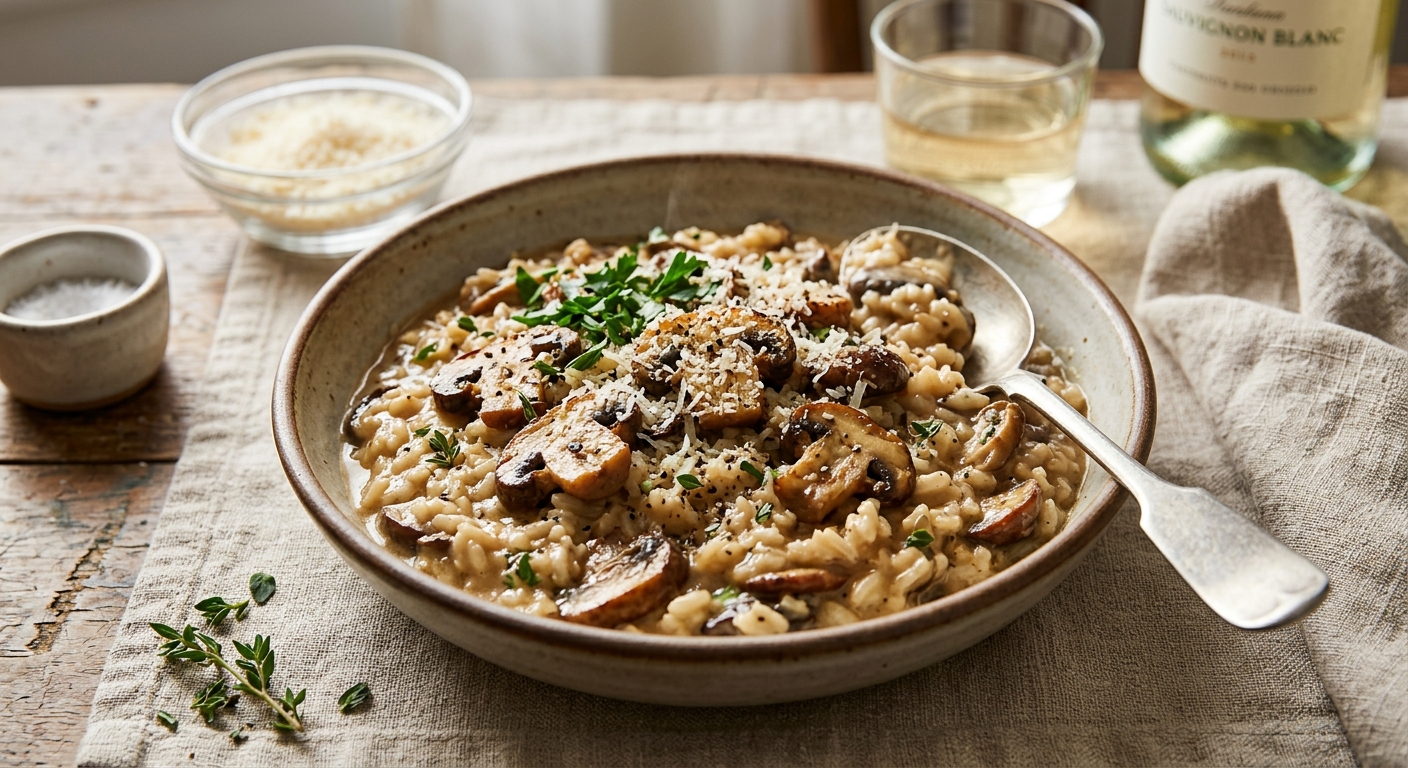
Riboflavin, or vitamin B2, is one of the most underappreciated B vitamins in the modern diet. It sits at the crossroads of every major energy-producing pathway in your body, acting as a coenzyme in the conversion of fats, carbohydrates, and proteins into usable ATP. Without adequate riboflavin, mitochondrial function falters, skin integrity declines, and fatigue sets in, yet surveys consistently show that a significant portion of the population falls short of the 1.3 mg daily reference intake for adults. This risotto was built from the ground up to fix that, drawing on three of the most riboflavin-dense food categories available: dairy, fungi, and enriched grains.
Cremini and shiitake mushrooms are nutritional workhorses that are often reduced to mere flavor contributors, but a 100 g serving of cooked shiitake mushrooms contains approximately 0.22 mg of riboflavin, while cremini mushrooms contribute around 0.27 mg per 100 g cooked weight. Combine those with whole milk (0.17 mg per 100 ml), aged Parmesan (0.11 mg per 30 g), and a rich chicken or vegetable stock fortified with a splash of cream, and you have a single dish that easily clears 1.0 mg of riboflavin per serving. Arborio rice itself, being an enriched grain, adds a modest but meaningful additional contribution. This is not nutritional coincidence. It is culinary architecture.
Beyond riboflavin, this dish delivers meaningful amounts of selenium, phosphorus, niacin, and vitamin D from the mushrooms, along with calcium and vitamin B12 from the dairy. The technique is classical Italian, relying on the slow, progressive addition of warm liquid to coax the starch from Arborio grains into that signature silky, flowing consistency the Italians call all’onda, meaning wave-like. Three cooking methods are included so that every kitchen, from a professional stovetop to a weeknight slow cooker, can produce this dish with confidence.
4
servings
Ingredients
- 320 gArborio rice
- 250 gcremini mushrooms, cleaned and sliced 5mm thick
- 200 gshiitake mushrooms, stems removed, caps sliced 5mm thick
- 1200 mlgood-quality chicken or vegetable stock, warmed
- 240 mlwhole milk, at room temperature
- 120 mldry white wine (such as Pinot Grigio or Sauvignon Blanc)
- 80 mlheavy cream
- 90 gfinely grated Parmigiano-Reggiano, plus extra to serve
- 2 tbspunsalted butter, divided
- 2 tbspextra-virgin olive oil
- 1 mediumyellow onion, finely diced (about 150g)
- 4 clovesgarlic, minced
- 2 tspfresh thyme leaves (or 3/4 tsp dried thyme)
- 1 tspfine lemon zest
- 15 gflat-leaf parsley, finely chopped
- —Colima Sea SaltMicroplastic Free Salt and freshly cracked black pepper to taste
- —A pinch of freshly grated nutmeg
Instructions
Click on an item below to shop for the recommended items for this recipe on Amazon.
As an Amazon Associate, we earn from qualifying purchases.
- Pour the warm stock and whole milk into a medium saucepan and keep it at a bare simmer over low heat. Having warm liquid is non-negotiable: cold stock shocks the rice and halts starch gelatinisation, producing a gluey rather than creamy result.
- Heat 1 tablespoon of olive oil and 1 tablespoon of butter in a wide, heavy-bottomed Dutch oven or high-sided skillet over medium-high heat. Once the butter foams and subsides, add the cremini and shiitake mushrooms in a single layer without stirring for 2 to 3 minutes, allowing them to develop a deep golden-brown sear. Season with salt and pepper, then stir and cook for a further 2 minutes until all moisture has evaporated. Transfer the mushrooms to a plate and set aside.
- Reduce the heat to medium. Add the remaining olive oil to the same pan. Add the diced onion and cook, stirring frequently, for 5 to 6 minutes until completely softened and translucent but not browned. Add the minced garlic and thyme and cook for 60 seconds until fragrant.
- Add the Arborio rice and stir it through the aromatics, toasting the grains for 2 minutes until the edges of each grain turn translucent and the center remains opaque white. You should hear a faint crackling sound. This toasting step waterproofs the exterior starch slightly, ensuring the rice absorbs liquid gradually rather than all at once.
- Pour in the white wine and stir constantly until it has been fully absorbed, about 1 to 2 minutes. The raw alcohol will cook off, leaving behind acidity that balances the richness of the finished dish.
- Begin adding the warm stock-and-milk mixture one ladleful (approximately 120 ml) at a time, stirring frequently but not frantically after each addition. Wait until each ladleful is almost fully absorbed before adding the next. Maintain a steady medium simmer throughout. This process will take approximately 20 to 22 minutes and require 8 to 10 additions of liquid.
- After about 18 minutes, taste a grain of rice. It should be nearly cooked through with just the faintest resistance at the very center. Return the seared mushrooms to the pan, stir to incorporate, and add one final ladle of liquid. The consistency at this stage should be slightly looser than you want the finished dish to be, as the rice will continue to absorb liquid.
- Remove the pan from the heat. Add the remaining tablespoon of cold butter in small pieces, the heavy cream, and all of the grated Parmigiano-Reggiano. Stir vigorously in a figure-eight motion for 60 to 90 seconds. This technique, known as mantecatura, emulsifies the butter and cheese into the starchy cooking liquid, creating a unified, glossy, wave-like sauce. Add the lemon zest and nutmeg, taste, and adjust seasoning.
- Spoon immediately into warm, shallow bowls. The risotto should flow and spread slightly when the bowl is tilted. Finish with extra Parmesan, freshly cracked black pepper, and a scattering of chopped parsley. Serve within 5 minutes of finishing.
- The mushrooms must be pre-seared for flavor before the slow cooker does its work. Heat 1 tablespoon of olive oil and 1 tablespoon of butter in a skillet over medium-high heat. Sear the cremini and shiitake mushrooms in a single layer without stirring for 3 minutes until deeply browned, then stir and cook for 2 more minutes. Season with salt and pepper. Set aside.
- In the same skillet, reduce heat to medium, add the remaining olive oil, and soften the diced onion for 5 minutes until translucent. Add the garlic and thyme and stir for 60 seconds. Add the Arborio rice and toast for 2 minutes, stirring constantly, until the grain edges are translucent. Pour in the white wine and stir until absorbed, about 1 minute. This stovetop prep step is essential: slow cookers cannot develop the toasted, aromatic base that defines risotto quality.
- Transfer the toasted rice and aromatics to the slow cooker insert. Add 950 ml of the warm stock (not all of it), all of the whole milk, and the seared mushrooms. Stir to combine. Do not add the cream or Parmesan yet. Place the lid on and cook on High for 1 hour and 45 minutes without lifting the lid. Resist the urge to check: every time the lid is removed, significant heat and steam are lost, which disrupts the even swelling of the rice.
- After 1 hour and 45 minutes, remove the lid and stir the risotto thoroughly. The rice should be nearly cooked but still slightly underdone in the center. If it looks dry, add up to 120 ml of the reserved warm stock. Stir well, replace the lid, and cook on High for a further 15 to 20 minutes until the rice is tender with a slight bite and the mixture is thick and creamy.
- Turn off the slow cooker. Add the remaining tablespoon of cold butter in small pieces, the heavy cream, and all of the grated Parmigiano-Reggiano. Stir vigorously for 60 to 90 seconds to emulsify. The residual heat of the slow cooker insert will melt everything without the risk of overcooking. Stir in the lemon zest, nutmeg, and parsley. Taste and adjust seasoning with salt and pepper.
- Serve immediately from the slow cooker insert, ladling into warm shallow bowls. Finish with extra Parmesan and freshly cracked black pepper. Note that slow cooker risotto will thicken quickly as it rests, so serve promptly.
- Set your Instant Pot or electric pressure cooker to Saute on the High setting. Add 1 tablespoon of olive oil and 1 tablespoon of butter. Once the butter foams, add the cremini and shiitake mushrooms. Sear without stirring for 2 to 3 minutes until golden, then stir and cook for 2 more minutes until any released moisture has evaporated. Season with salt and pepper. Remove the mushrooms and set aside.
- Without cleaning the pot, add the remaining olive oil. Add the diced onion and cook on Saute High for 4 minutes until softened. Add the garlic and thyme and stir for 30 seconds. Add the Arborio rice and stir for 90 seconds to toast the grains. Pour in the white wine and stir until fully absorbed, about 1 minute. These Saute steps build the aromatic flavor base that high-pressure steam cooking cannot create on its own.
- Pour in 900 ml of the warm stock and all of the whole milk. Stir well to ensure no rice is stuck to the bottom of the pot, as stuck rice will cause a burn warning. Add the seared mushrooms back in. Do not add the cream or Parmesan at this stage, as dairy can scorch under pressure and milk proteins can partially block the steam valve. Cancel the Saute function.
- Secure the lid and set the pressure release valve to the Sealing position. Cook on Manual High Pressure for 6 minutes. While the pot comes to pressure (approximately 8 to 10 minutes), warm the remaining 150 ml of stock in a small pan on the stovetop to have it ready for the finishing step.
- When the cook time ends, perform a Quick Release by carefully turning the valve to Venting. Stand back from the steam. Once the float valve drops, open the lid carefully. The risotto will look quite wet and soupy at first, which is exactly correct for this method.
- Set the Instant Pot back to Saute on Low. Stir the risotto vigorously for 2 to 3 minutes, adding splashes of the reserved warm stock as needed to achieve a flowing consistency. The starch released during pressure cooking will thicken the liquid rapidly as you stir. Once the texture is right, cancel the Saute function. Add the remaining tablespoon of cold butter, the heavy cream, and all of the Parmigiano-Reggiano. Stir energetically for 60 seconds to emulsify. Stir in the lemon zest, nutmeg, and parsley. Taste, season, and serve immediately in warm bowls with extra Parmesan and black pepper.
- Preheat your oven to 180C (350F) with a rack positioned in the center. Warm the stock and whole milk together in a saucepan over low heat until steaming but not boiling. Keep warm on the lowest possible heat setting.
- Heat a large, oven-safe Dutch oven (at least 4-litre capacity) over medium-high heat on the stovetop. Add 1 tablespoon of olive oil and 1 tablespoon of butter. Sear the cremini and shiitake mushrooms in a single layer for 3 minutes without stirring, then stir and cook for 2 more minutes. Season with salt and pepper and remove to a plate.
- In the same Dutch oven over medium heat, add the remaining olive oil. Cook the onion for 5 minutes until softened. Add the garlic and thyme and stir for 60 seconds. Add the Arborio rice and stir to toast for 2 minutes until the grain edges are translucent. Pour in the white wine and stir until absorbed. These stovetop steps are critical even for the oven method: the toasted grain foundation and aromatic base cannot be developed in a static oven environment.
- Add 1050 ml of the warm stock-and-milk mixture to the Dutch oven and stir well. Return the seared mushrooms to the pot and stir to distribute evenly. Bring the mixture to a gentle simmer on the stovetop, stirring once or twice, then cover tightly with the lid and transfer to the preheated oven.
- Bake undisturbed for 25 minutes. Remove the lid and check the rice: it should be nearly tender with a small amount of creamy liquid still visible around the grains. If the rice is still very firm or the liquid is fully absorbed, add the remaining 150 ml of warm stock, stir briefly, replace the lid, and return to the oven for a further 8 to 10 minutes.
- Remove the Dutch oven from the oven. Place it back on the stovetop over low heat. Add the remaining tablespoon of cold butter, the heavy cream, and all of the grated Parmigiano-Reggiano. Stir vigorously for 60 to 90 seconds until the butter and cheese are fully emulsified into the risotto. The baked risotto will be slightly thicker than the stovetop version; add a small splash of warm stock if needed to reach a flowing consistency. Stir in the lemon zest, nutmeg, and parsley. Taste and adjust seasoning, then serve immediately in warm bowls with extra Parmesan and freshly cracked black pepper.
Nutrition Breakdown
Per 1 serving (makes 4)
Vitamins & Minerals
% Daily Value based on a 2,000 calorie diet (FDA reference)
🧬 Essential Amino Acids
% of recommended daily intake (RDA) per serving
🛡 Antioxidant Profile
The Nutrition Science
Riboflavin is the prosthetic group of two critical coenzymes: flavin mononucleotide (FMN) and flavin adenine dinucleotide (FAD). Both are indispensable to the electron transport chain in mitochondria, where they shuttle electrons between complex I and complex II during oxidative phosphorylation. Without adequate FAD, acetyl-CoA cannot enter the citric acid cycle efficiently, meaning that every macronutrient you eat, whether fat, carbohydrate, or protein, is partially blocked from yielding its full ATP output. In practical terms, subclinical riboflavin deficiency manifests as fatigue, reduced exercise tolerance, and impaired recovery long before any clinical signs appear, making dietary adequacy important even for people who do not exhibit classical deficiency symptoms such as angular cheilitis or glossitis.
The riboflavin content of this dish is particularly noteworthy because it comes from multiple, nutritionally distinct sources. Cremini and shiitake mushrooms are among the plant kingdom’s best riboflavin sources, providing approximately 0.27 mg and 0.22 mg per 100 g cooked weight respectively, amounts that rival many fortified breakfast cereals on a per-calorie basis. Importantly, riboflavin in mushrooms is present primarily as free riboflavin rather than as FAD bound to proteins, which means it survives cooking with minimal degradation. Dairy products contribute a second, highly bioavailable riboflavin pool: milk riboflavin is approximately 95% bioavailable in humans, and Parmesan cheese, despite its concentrated nature, retains nearly all of the riboflavin present in the original milk. The combination of these two sources in a single dish creates a synergistic riboflavin density that is difficult to achieve with either ingredient category alone.
The selenium content of this dish deserves equal attention. Shiitake mushrooms are one of the most selenium-dense fungi available, and selenium’s biological role is intimately linked to riboflavin’s: glutathione peroxidase, the selenium-dependent antioxidant enzyme, relies on the NADPH generated by the riboflavin-dependent enzyme glutathione reductase to regenerate reduced glutathione. In other words, riboflavin and selenium are metabolically coupled antioxidant partners, and a dish that provides meaningful amounts of both simultaneously provides a compounded protective effect against oxidative stress beyond what either nutrient could achieve in isolation.
Pro Tips
- Never wash mushrooms under running water as they absorb moisture like sponges, which causes them to steam rather than sear. Instead, wipe them clean with a slightly damp paper towel or a dry pastry brush.
- The mantecatura finishing step, adding cold butter off the heat and stirring vigorously, is the single most important technique in risotto. The cold butter creates an emulsion with the starchy, hot cooking liquid. Using butter that is too warm results in a greasy, broken sauce rather than a glossy, unified one.
- For maximum riboflavin yield, do not overcook the mushrooms into a dark, crispy state. A golden-brown sear retains the riboflavin content; prolonged high heat and repeated flipping drives off moisture and can degrade heat-sensitive water-soluble vitamins including B2.
omg YES the mushroom combo is SO smart bc theyre literally packed with riboflavin AND theyre already what makes risotto taste amazing anyway, like youre not forcing nutrition in, its just… there. my kids will actually eat mushrooms when theyre cooked into risotto like this (normally they pick them out of everything lol) and honestly i love that the dairy amp B2 absorption too, win win! are the mushroom quantities flexible if someone has a kid thats extra picky, or is the riboflavin calculation pretty dependent on hitting those specific amounts?
This is such a grounding approach to risotto, and I love how you’re highlighting riboflavin without losing the soul of the dish. I’ve been thinking a lot lately about how mushrooms are these incredible nutrient carriers, and pairing them with dairy for that B2 synergy feels both traditional and really intentional. One thing I always add to risottos like this is a pinch of turmeric and black pepper near the end of cooking, not just for the anti-inflammatory lift but because it seems to deepen the earthiness of the mushrooms while aiding absorption of fat-soluble nutrients alongside the B vitamins. Have you experimented with any spice integration, or do you prefer to
love this approach, but wanted to flag something that might be relevant depending on where those mushrooms are sourced – ive found that conventional mushrooms can carry pretty high mycotoxin loads, especially if theyre stored improperly or come from humid growing conditions, and since im managing mold illness myself i’ve gotten really careful about sourcing mine from trusted suppliers or growing my own. riboflavin is such a critical nutrient for energy metabolism (something i desperately needed when my symptoms were worst), so its awesome that youre highlighting it, but id hate for someone to unknowingly load up on contaminated mushrooms thinking theyre doing themselves a favor. maybe a sourcing note would be worth adding?