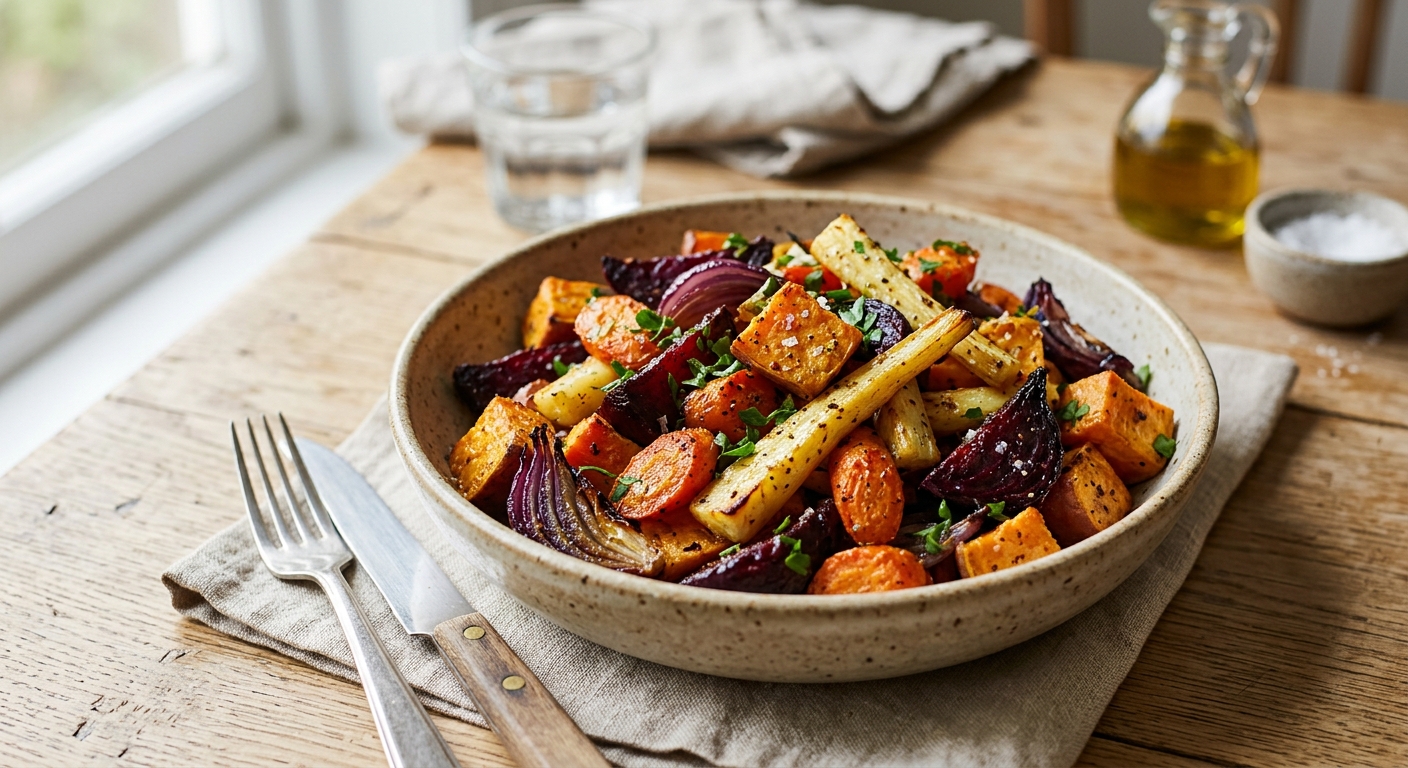
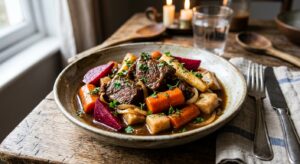
Root vegetables have anchored human diets for millennia, but this recipe transforms humble pantry staples into a metabolic catalyst. Sweet potato, parsnip, carrot, and beetroot form the foundation, each chosen not only for their earthy sweetness and satisfying texture but for their dense cargo of beta-carotene, folate, manganese, and potassium. Roasted at high heat, their natural sugars caramelise into a complex, almost candy-like depth that makes every forkful genuinely addictive.
What separates this bowl from an ordinary vegetable side is the thermogenic spice matrix. Cayenne pepper supplies capsaicin, a compound shown in multiple peer-reviewed studies to increase diet-induced thermogenesis by 4 to 8% in the hours following consumption. Black pepper contributes piperine, which simultaneously enhances bioavailability of fat-soluble nutrients like beta-carotene by up to 30%. Ground ginger and cumin round out the blend, both linked to improved insulin sensitivity and reduced post-meal blood glucose spikes, making this dish a genuine metabolic ally.
The recipe is built for real weeknight cooking, with four distinct cooking methods so you can choose the technique that fits your schedule. Oven roasting delivers the deepest caramelisation and crispest edges. The stovetop method gives you speed and intimate control over colour and texture. The slow cooker produces meltingly tender, deeply infused vegetables perfect for meal prep. The pressure cooker collapses the timeline dramatically without sacrificing the flavour saturation the spice blend demands. Whichever method you choose, this bowl is a complete, colourful, scientifically calibrated meal.
4
servings
Ingredients
- 400 gsweet potato, peeled and cut into 2cm cubes
- 300 gparsnips, peeled and cut into 2cm batons
- 300 gcarrots, peeled and cut into 2cm diagonal rounds
- 250 graw beetroot, peeled and cut into 2cm wedges
- 1 mediumred onion, cut into 8 wedges
- 4 clovesgarlic, minced
- 3 tbspextra-virgin olive oil
- 1.5 tspground cumin
- 1 tspsmoked paprika
- 0.75 tspcayenne pepper
- 1 tspground ginger
- 0.5 tspground black pepper, freshly cracked
- 1 tspground coriander
- 0.5 tspground turmeric
- 1 tbspapple cider vinegar
- 1 tbsppure maple syrup
- 240 mllow-sodium vegetable broth
- 400 gcanned chickpeas, drained and rinsed
- 60 gbaby spinach leaves
- 2 tbspfresh flat-leaf parsley, roughly chopped
- 1 tbsptoasted pumpkin seeds (pepitas), per serving
- —Colima Sea SaltMicroplastic Free Salt to taste
- —Lemon wedges to serve
Instructions
Click on an item below to shop for the recommended items for this recipe on Amazon.
As an Amazon Associate, we earn from qualifying purchases.
- Preheat your oven to 220C (425F) with two large rimmed baking sheets inside on separate racks. Heating the pans in advance creates an immediate sear on the vegetables, driving caramelisation from the moment they hit the surface.
- In a large mixing bowl, combine the olive oil, cumin, smoked paprika, cayenne, ground ginger, black pepper, ground coriander, turmeric, apple cider vinegar, and maple syrup. Whisk together until a uniform spice paste forms. Add the sweet potato, parsnip, carrot, beetroot, red onion wedges, and garlic. Toss thoroughly until every piece is coated. Season generously with sea salt.
- Carefully remove the hot baking sheets from the oven. Divide the coated vegetables evenly between the two sheets, spreading them into a single layer with at least 1cm of space between pieces. Keep the beetroot on one side of a sheet to prevent its colour bleeding onto other vegetables.
- Roast for 20 minutes on the upper and lower racks. Then rotate the pans between racks, flip the vegetables with a wide spatula, and add the drained chickpeas evenly across both sheets. Return to the oven for a further 18 to 22 minutes until the vegetables are fork-tender with deeply caramelised, slightly charred edges and the chickpeas are crisp.
- While the vegetables finish roasting, place the baby spinach in your serving bowls. Remove the hot roasted vegetables and chickpeas from the oven and allow to rest on the pans for 2 minutes. Pile them over the spinach, which will gently wilt under the heat. Finish with fresh parsley, pumpkin seeds, and a squeeze of lemon. Drizzle any caramelised pan juices over the top.
- In a small bowl, combine the cumin, smoked paprika, cayenne, ground ginger, black pepper, ground coriander, and turmeric. Set the dry spice blend aside. Separately, whisk together the apple cider vinegar and maple syrup in a small cup.
- Place a large (30cm) cast iron skillet or heavy-based frying pan over high heat. Once the pan is smoking hot, add 2 tablespoons of the olive oil. Working in two batches to avoid crowding, add the carrot and parsnip first. Press them into the pan and leave undisturbed for 3 minutes to build a proper sear. Toss and sear for another 2 minutes. Transfer to a plate. Repeat with the sweet potato and beetroot, adding another half tablespoon of oil if needed.
- Reduce the heat to medium-high. Add the remaining oil, then the red onion wedges and garlic. Cook for 3 minutes, stirring occasionally, until fragrant and beginning to soften. Add the entire dry spice blend and stir constantly for 90 seconds, toasting the spices directly in the oil until darkened and intensely aromatic.
- Return all seared vegetables to the pan. Pour in the vegetable broth and the vinegar-maple mixture. Stir to coat everything, scraping up any fond from the pan base. Cover with a lid, reduce heat to medium-low, and cook for 12 to 15 minutes until all vegetables are tender when pierced with a knife.
- Remove the lid, increase heat to medium-high, and add the chickpeas. Cook uncovered for 5 to 6 minutes, stirring occasionally, until most of the liquid has reduced to a thick, glossy glaze clinging to the vegetables. Taste and adjust salt. Serve immediately over baby spinach with parsley, pumpkin seeds, and lemon wedges.
- In a dry skillet over medium heat, toast the cumin, smoked paprika, cayenne, ground ginger, black pepper, ground coriander, and turmeric for 60 to 90 seconds, stirring constantly, until fragrant. This dry-toast step is essential for slow cooker recipes because the low heat cannot bloom spices properly during cooking. Remove from heat and whisk the toasted spices into the olive oil, apple cider vinegar, and maple syrup to form a spice paste.
- Place the carrot, parsnip, and sweet potato cubes in the base of a 5- to 6-litre slow cooker insert. These denser vegetables go on the bottom where heat is most intense. Nestle the beetroot wedges and red onion on top. Scatter the garlic over everything. Pour the vegetable broth around the sides of the insert, not directly over the vegetables, to avoid washing off the spice coating you will apply next.
- Spoon and spread the spice paste evenly over the top layer of vegetables. Gently turn the top layer with a spoon to partially coat. Do not fully mix, as you want the paste to slowly melt down through the vegetables during cooking, creating layers of flavour rather than a uniform slurry.
- Place the lid on and cook on Low for 6 to 7 hours or High for 3 to 3.5 hours, until all vegetables yield easily to a fork but hold their shape. In the final 20 minutes of cooking on either setting, add the drained chickpeas, stir gently to combine, and replace the lid to allow them to warm through and absorb the braising liquid.
- To serve, place baby spinach in bowls. Using a slotted spoon, transfer the vegetables and chickpeas over the spinach. Ladle 2 to 3 tablespoons of the rich braising liquid over each bowl as a sauce. The spinach will wilt under the warmth. Finish with fresh parsley, pumpkin seeds, and a squeeze of lemon.
- Set your Instant Pot or electric pressure cooker to the Saute function on High. Once hot, add 2 tablespoons of the olive oil. Add the red onion wedges and cook for 3 minutes until softened at the edges. Add the garlic and all dry spices (cumin, paprika, cayenne, ginger, black pepper, coriander, turmeric) and stir constantly for 60 seconds until the spices coat the onion and become intensely fragrant. This saute step is non-negotiable: pressure cooking cannot develop the toasted-spice flavour that defines this dish.
- Add the apple cider vinegar and maple syrup directly into the pot. Stir and scrape up any spice bits stuck to the bottom of the insert, as these will trigger a burn warning during pressurisation if left. This deglazing step is specific to pressure cooking and critical for safe operation.
- Add the carrot, parsnip, sweet potato, and beetroot to the pot. Pour in the vegetable broth. Stir once to roughly combine, ensuring the broth is distributed through the vegetables and no dry ingredients are stuck to the bottom. Do not overstir, as you want the vegetables to remain in distinct pieces.
- Secure the lid and set the pressure release valve to Sealing. Select Manual or Pressure Cook on High for 8 minutes. When the cycle completes, allow the pressure to release naturally for a full 10 to 12 minutes before carefully turning the valve to Venting to release any residual steam.
- Open the lid and switch back to Saute on Normal heat. Stir in the drained chickpeas and cook uncovered for 4 to 5 minutes, stirring gently, until the liquid reduces slightly into a sauce and the chickpeas are heated through. Taste and correct seasoning. Spoon over baby spinach in bowls, top with parsley, pumpkin seeds, and lemon.
Nutrition Breakdown
Per 1 serving (makes 4)
Vitamins & Minerals
% Daily Value based on a 2,000 calorie diet (FDA reference)
🧬 Essential Amino Acids
% of recommended daily intake (RDA) per serving
🛡 Antioxidant Profile
The Nutrition Science
The thermogenic claim in this recipe is not marketing language; it is grounded in reproducible clinical data. Capsaicin from cayenne pepper activates the transient receptor potential vanilloid 1 (TRPV1) channel in the gut and peripheral nervous system, triggering sympathetic nervous system activity and elevating norepinephrine. A 2012 meta-analysis published in Chemical Senses confirmed a mean increase in diet-induced thermogenesis of 4.3% following capsaicin consumption, with effects sustained for up to two hours post-meal. When combined with piperine from black pepper, which inhibits P-glycoprotein efflux transporters, the bioavailability of co-ingested fat-soluble compounds including beta-carotene, curcumin, and the fat-soluble vitamins A and K is meaningfully increased, often by 20 to 30% in controlled studies.
Sweet potato is arguably the most nutritionally dense root vegetable available at a standard grocery store. A single 100g serving provides over 100% of the daily vitamin A requirement as beta-carotene, and its moderate glycemic index of approximately 63 is further blunted by its fibre content and the presence of acetic acid from apple cider vinegar. Research published in Bioscience, Biotechnology, and Biochemistry demonstrated that acetic acid suppresses disaccharidase activity in the small intestine, slowing carbohydrate absorption and reducing peak postprandial glucose by 20 to 35% compared to the same meal without vinegar. Beetroot adds a distinct dimension through its betalain pigments and naturally occurring nitrates, which vasodilate peripheral blood vessels, improving oxygen delivery to working muscles and supporting cardiovascular efficiency during activity.
Chickpeas anchor the protein and fibre contribution of this bowl. Their resistant starch resists digestion in the small intestine and reaches the colon intact, where it is fermented by Bifidobacterium and Lactobacillus species into short-chain fatty acids including butyrate, which fuels colonocyte health and is inversely associated with colorectal cancer risk. The combination of resistant starch, soluble fibre from parsnip, and insoluble fibre from carrot produces a composite fibre matrix that extends satiety signalling from gut peptides including PYY and GLP-1, making this bowl genuinely filling despite its moderate caloric density of 385 calories per serving.
Pro Tips
- Cut all root vegetables to a consistent 2cm size. This single step is the most important factor in even cooking across all four methods. Uneven cuts result in some pieces being raw while others are overcooked, regardless of the method used.
- Do not skip the spice blooming step. Whether you are toasting dry in a skillet for the slow cooker method or sauteing in oil for the pressure cooker, raw spice powder lacks the volatilised aromatic compounds that define the dish’s flavour. Ground spices need direct heat contact with fat or a dry surface to fully develop.
- For meal prep, store the cooked vegetable and chickpea mixture separately from the spinach and pumpkin seeds. The base keeps refrigerated for up to 4 days and reheats well in a skillet with a splash of water. Add fresh spinach and seeds only when serving to preserve texture and preserve the heat-sensitive vitamin C in the greens.
Oh I’m SO intrigued by this one – the ginger and cayenne combo is actually a game-changer for my IBS flare-ups! I’ve been tracking how thermogenic spices affect my inflammation markers for months now, and I’ve noticed that when I roast my root veggies with black pepper and ginger (instead of eating them raw), my digestion feels so much smoother the next day. Quick question though – are you cooking these at high heat to get that caramelization? I’m curious if that affects the thermogenic properties or if the spices do most of the heavy lifting either way, since I’m always experimenting with preparation methods to see what my gut tolerates best
That’s excellent self-tracking, Greta – the roasting is doing real work here beyond just flavor, since heat can increase capsaicin bioavailability while the maillard reaction on those root veggies creates compounds that support gut barrier function. The thermogenic effect comes primarily from the spices themselves (capsaicin, piperine, and gingerol are doing the metabolic lifting), but roasting over raw gives you both better digestive tolerance and potentially enhanced polyphenol absorption, which is why you’re likely seeing that smoothness the next day. I’d be curious whether you’ve noticed any difference between when you add the spices pre-roast versus post-roast, since
Oh Greta, I’m so glad you’re tracking this connection – that’s exactly the kind of personalized observation that bridges our lived experience with the science! I’d just gently add that if you’re working with the ginger and cayenne, you might explore adding a pinch of black pepper and turmeric to that combo, since black pepper dramatically increases turmeric’s curcumin absorption and they work beautifully together for gut inflammation in Ayurvedic tradition. I’ve seen this pairing settle digestion in my yoga students in ways that either spice alone doesn’t quite achieve. Have you noticed any difference when you toggle the ratios, or are you keeping it consistent for your tracking?