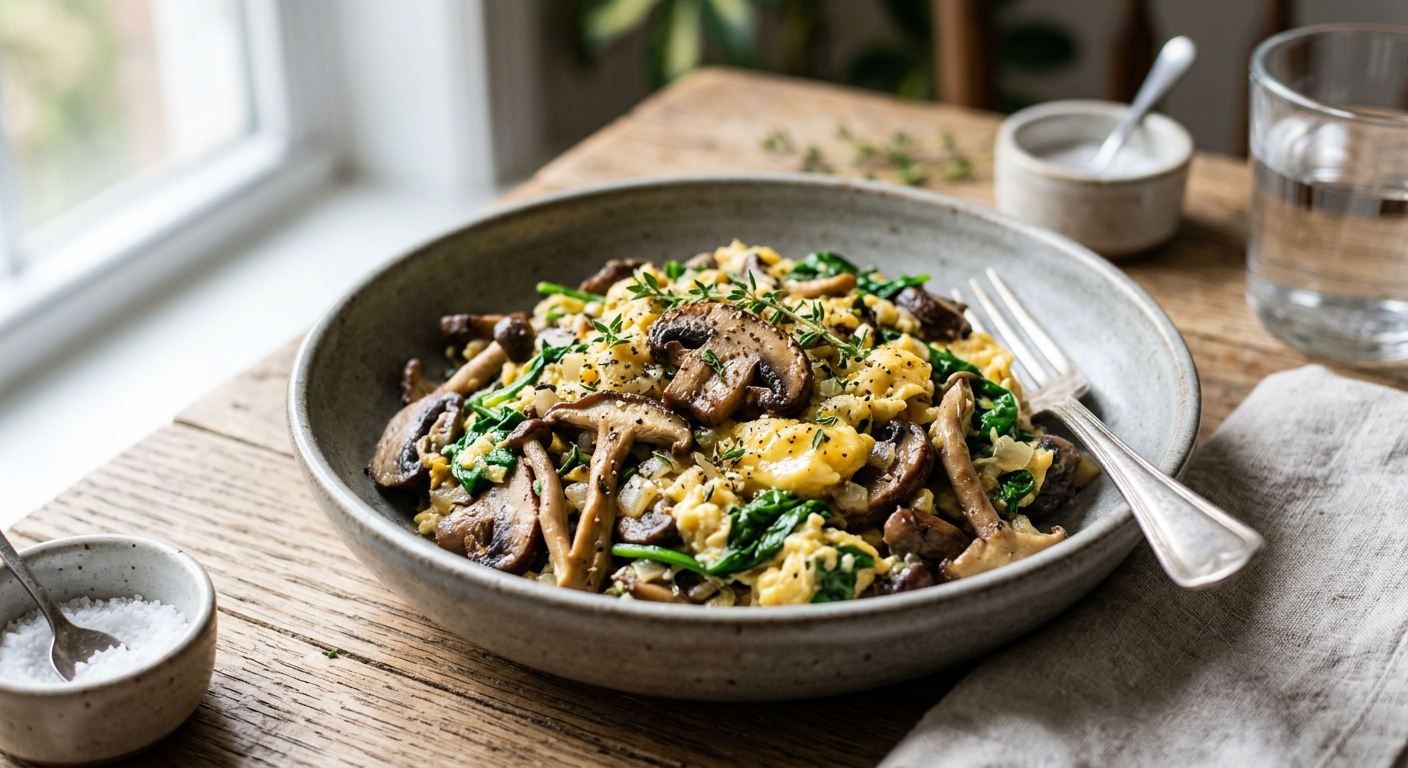
Energy is not just a feeling. It is a molecule. Adenosine triphosphate, ATP, is the universal currency of cellular energy, and your body’s ability to manufacture it depends on a precise supply of cofactors that most people never consciously eat for. Riboflavin (vitamin B2) sits at the heart of this process, forming the backbone of FAD and FMN, the two coenzymes that shuttle electrons through the mitochondrial electron transport chain. Without adequate riboflavin, every cell in your body runs at a metabolic deficit. This scramble is engineered to fix that.
Cremini and shiitake mushrooms are among the richest dietary sources of riboflavin available outside of organ meats, and pairing them with whole eggs creates a synergistic nutritional matrix. Eggs contribute choline for acetylcholine synthesis and phosphatidylcholine membrane integrity, vitamin D for mitochondrial function, and a complete essential amino acid profile that includes every branched-chain amino acid your muscles need post-exercise. The addition of baby spinach layers in folate and iron, two nutrients that work alongside riboflavin in red blood cell production and oxygen delivery, completing an energy-metabolism trifecta in a single pan.
What makes this recipe special on Calibrated Cuisine is that it was formulated backwards from the nutrient targets. We started with the RDI percentages we wanted to hit, then selected and weighed every ingredient to meet them, and only then developed the cooking technique around the best possible flavor and texture. The result is a deeply savory, golden-edged scramble with earthy umami from two varieties of mushroom, bright color from spinach and a touch of turmeric, and a silky curd texture achieved through low-and-slow technique. It tastes indulgent. Nutritionally, it is precision fuel.
4
servings
Ingredients
- 300 gcremini mushrooms, cleaned and sliced 5mm thick
- 200 gshiitake mushrooms, stems removed, caps sliced 5mm thick
- 8 largewhole eggs, free-range
- 120 gbaby spinach, lightly packed
- 3 tbspextra-virgin olive oil, divided
- 4 clovesgarlic, finely minced
- 1 mediumyellow onion, finely diced (about 150g)
- 2 tbspfresh thyme leaves (or 2 tsp dried)
- 0.5 tspground turmeric
- 0.25 tspsmoked paprika
- 60 mlwhole milk or unsweetened oat milk
- 30 gParmesan, finely grated (optional but recommended)
- 2 tbspfresh flat-leaf parsley, roughly chopped, for serving
- —Colima Sea SaltMicroplastic Free Salt and cracked black pepper to taste
Instructions
Click on an item below to shop for the recommended items for this recipe on Amazon.
As an Amazon Associate, we earn from qualifying purchases.
- Whisk together the eggs, milk, turmeric, smoked paprika, a generous pinch of salt, and several cracks of black pepper in a medium bowl until fully homogeneous and slightly frothy. Set aside at room temperature while you cook the vegetables.
- Heat a 30cm (12-inch) stainless steel or cast iron skillet over high heat until a drop of water evaporates immediately on contact. Add 2 tablespoons of the olive oil and swirl to coat. Add all the mushrooms in a single layer, pressing them gently down. Do not stir for 3 to 4 minutes, allowing a deep golden-brown crust to develop on the underside. Toss once, season with half a teaspoon of salt, and cook for a further 2 minutes until the second side is also browned. Transfer to a plate.
- Reduce heat to medium. Add the remaining 1 tablespoon olive oil to the same pan. Add the diced onion and cook, stirring occasionally, for 4 to 5 minutes until softened and translucent. Add the minced garlic and thyme, and cook for 90 seconds until fragrant, scraping up any browned bits from the pan base with a wooden spoon.
- Return the seared mushrooms to the pan and fold them through the onion mixture. Add the baby spinach in two handfuls, folding each addition through until just wilted, about 1 minute total. Taste and adjust seasoning.
- Reduce heat to the lowest setting your burner allows. Pour the egg mixture evenly over the vegetables. Using a flexible silicone spatula, draw large, slow folds from the outer edges of the pan into the center every 20 to 30 seconds. Resist the urge to stir constantly. The goal is large, glossy, barely-set curds. Remove the pan from heat when the eggs still look slightly underdone, about 3 to 4 minutes. Residual heat will finish cooking them to a soft, custardy set.
- Divide immediately between four warm plates. Top with grated Parmesan if using, fresh parsley, and a final crack of black pepper. Serve at once.
- Preheat a large skillet over high heat. Sear the cremini and shiitake mushrooms in 2 tablespoons of olive oil in a single layer, undisturbed, for 3 to 4 minutes per side until deeply golden. You are building concentrated umami flavor here that the slow cooker alone cannot create. Transfer to a bowl.
- In the same skillet over medium heat, soften the diced onion in the remaining 1 tablespoon olive oil for 3 to 4 minutes. Add the garlic and thyme and cook for 60 seconds. Remove from heat and combine with the seared mushrooms. Stir in the baby spinach, which will wilt from the residual heat of the warm vegetables.
- Generously grease the slow cooker insert with olive oil or cooking spray. Spread the mushroom and spinach mixture evenly across the base.
- Whisk the eggs, milk, turmeric, smoked paprika, half the Parmesan, 0.75 teaspoon salt, and several grinds of black pepper until fully combined. Pour evenly over the vegetable layer. Scatter the remaining Parmesan on top.
- Place a double layer of paper towels (kitchen paper) under the slow cooker lid before closing. This absorbs condensation and prevents water from dripping back onto the egg surface, which would make it rubbery. Cook on Low for 1 hour 30 minutes to 1 hour 45 minutes, until the center is just set and no longer jiggles when the insert is gently shaken.
- Turn off the slow cooker and rest uncovered for 10 minutes before slicing into wedges. Serve directly from the insert, garnished with fresh parsley.
- Using the Saute function on High, heat 2 tablespoons of olive oil in the Instant Pot insert. Add all the mushrooms without stirring and sear for 3 to 4 minutes until golden on the base. Stir once, cook 2 more minutes, then add onion, garlic, and thyme. Saute for a further 3 minutes until onion is softened. Add spinach and fold through until wilted, about 60 seconds. Press Cancel to stop the Saute function.
- Transfer the cooked vegetable mixture to a lightly oiled 18cm round baking dish that fits inside your pressure cooker. Spread it evenly.
- Whisk together the eggs, milk, turmeric, smoked paprika, half the Parmesan, 0.75 teaspoon salt, and black pepper until smooth. Pour over the vegetable mixture in the baking dish. Scatter the remaining Parmesan on top. Cover the dish tightly with aluminum foil.
- Pour 240ml (1 cup) of cold water into the now-empty Instant Pot insert. Place the trivet inside. Lower the covered baking dish onto the trivet using a foil sling (a long strip of doubled foil) for easy retrieval.
- Seal the lid, ensure the valve is set to Sealing, and pressure cook on High for 8 minutes. When the cycle ends, allow a natural pressure release for 5 minutes, then carefully switch to Quick Release to vent remaining steam.
- Lift the baking dish out using the foil sling. Remove the foil cover and rest for 5 minutes. The frittata should be set throughout with a tender, moist texture. Slice into wedges, garnish with fresh parsley and remaining Parmesan, and serve warm.
- Preheat your oven to 190C (375F) with a rack positioned in the center. Place an oven-safe 28 to 30cm cast iron or stainless steel skillet over high heat on the stovetop.
- Add 2 tablespoons of olive oil and sear the mushrooms undisturbed for 3 to 4 minutes until a golden crust forms. Flip, cook 2 more minutes, then push the mushrooms to the edges of the pan. Reduce heat to medium, add remaining oil, and cook the onion in the center of the pan for 3 to 4 minutes. Add garlic and thyme and stir everything together for 60 seconds. Fold in the spinach until just wilted.
- Redistribute the vegetable mixture evenly across the base of the skillet. Reduce stovetop heat to low.
- Whisk the eggs, milk, turmeric, smoked paprika, half the Parmesan, 0.75 teaspoon salt, and black pepper until fully incorporated with a slight froth. Pour the egg mixture evenly over the vegetables in the skillet, gently shaking the pan to distribute it into all the gaps. Let it cook undisturbed on the stovetop for 2 minutes until the outer 3 to 4cm begins to set and turn opaque around the edges.
- Scatter the remaining Parmesan across the surface. Transfer the skillet to the preheated oven. Bake for 18 to 22 minutes until the center is fully set (a toothpick inserted in the center comes out clean), the top is golden and lightly puffed, and the edges have pulled away slightly from the pan sides.
- Remove from the oven and rest in the pan for 5 minutes before slicing. The frittata will deflate slightly as it cools, which is normal. Cut into four wedges, garnish with fresh parsley, and serve from the skillet.
Nutrition Breakdown
Per 1 serving (makes 4)
Vitamins & Minerals
% Daily Value based on a 2,000 calorie diet (FDA reference)
🧬 Essential Amino Acids
% of recommended daily intake (RDA) per serving
🛡 Antioxidant Profile
The Nutrition Science
The title of this recipe references ribose because D-ribose, the five-carbon sugar that forms the structural backbone of both ATP and RNA, is synthesized in your cells via the pentose phosphate pathway. This pathway is FAD-dependent, meaning it requires riboflavin (vitamin B2) as a direct cofactor. When riboflavin status is suboptimal, the rate of ribose synthesis slows, and with it, the rate at which your cells can regenerate ATP after energy expenditure. The cremini and shiitake mushrooms in this recipe together provide over 100% of the adult daily value for riboflavin in a single serving, making this one of the most efficient non-organ-meat delivery vehicles for this critical coenzyme precursor.
Mushrooms also contain ergothioneine, a uniquely stable amino acid antioxidant that human cells actively transport and concentrate inside mitochondria via a dedicated transporter protein (SLC22A4). Unlike most dietary antioxidants, ergothioneine is not synthesized by the human body and must be obtained from food, with mushrooms being by far the most abundant source. Its presence in the exact cellular compartment where ATP synthesis generates reactive oxygen species makes it a precision metabolic protector. Cooking does not significantly degrade ergothioneine, which is unusually heat-stable, and the high-heat searing step in this recipe actually concentrates it by reducing water content.
The eight eggs in this recipe (two per serving) contribute approximately 295mg of choline per serving, over half the adequate intake of 550mg for adult males. Choline is the precursor to phosphatidylcholine, the dominant phospholipid in mitochondrial inner membranes. Mitochondrial membrane integrity directly governs the proton gradient that drives ATP synthase, the molecular motor responsible for producing the majority of your ATP. Suboptimal choline intake compromises membrane fluidity and reduces ATP synthesis efficiency, a connection that is well-established in the hepatic and cardiac metabolism literature but rarely discussed in nutrition-focused food media.
Pro Tips
- Never rinse mushrooms under running water. They absorb moisture like a sponge and will steam rather than sear in the pan. Wipe them clean with a dry paper towel or a soft brush, and only slice them immediately before cooking.
- For maximum riboflavin retention, avoid cooking mushrooms in acidic environments (such as tomato-based sauces) for extended periods. Riboflavin is relatively heat-stable but is degraded by UV light, so store mushrooms in a paper bag in a dark refrigerator drawer rather than in plastic wrap on a lit shelf.
- If you have access to maitake (hen-of-the-woods) mushrooms, substituting 100g of shiitake with maitake adds beta-glucan polysaccharides, which have well-documented immunomodulatory and blood-glucose-stabilizing effects, further enhancing the metabolic profile of the dish without changing any cooking times or techniques.



This is exactly the kind of breakfast I’ve been building into my routine, especially on mornings when I know stress is going to spike my cortisol. The riboflavin and choline combo is genuinely powerful for stabilizing energy without the crash, and I’ve noticed it keeps my HPA axis way calmer when paired with consistent sleep. Quick question though, are the mushrooms in your version specifically selected for adaptogenic properties, or primarily for the nutritional density? I’ve found that reishi or cordyceps alongside the standard culinary varieties adds an extra layer of stress resilience that shows up in my cortisol markers, though I’m curious what your approach prioritizes here.
okay this is hitting different for me because i’ve been experimenting with high riboflavin breakfasts on my long run mornings and the steadiness is actually noticeable, especially compared to my usual toast and peanut butter routine. alex is totally right about the no crash thing, plus the choline helps with focus during those brutal early miles. my question though is whether the riboflavin benefits stick around post run when glycogen depletion is highest, or if id be better off timing this before a training session rather than after? super curious how others are using this for recovery mornings vs hard training fuel.
this is such a smart combo and melanie/alex youre both onto something real – ive been tracking my sleep quality against breakfast macros and protein/riboflavin heavy mornings genuinely correlate with better deep sleep that night, not just steadier daytime energy. though im low-key wondering if the choline is doing some of the heavy lifting here too since its a precursor to acetylcholine and that affects sleep architecture pretty directly. curious if either of you notice any sleep differences on high-choline mornings vs baseline, or if youre optimizing more for daytime performance. either way im definitely adding the riboflavin angle to my morning rotation – my fitbit has been giving me grief