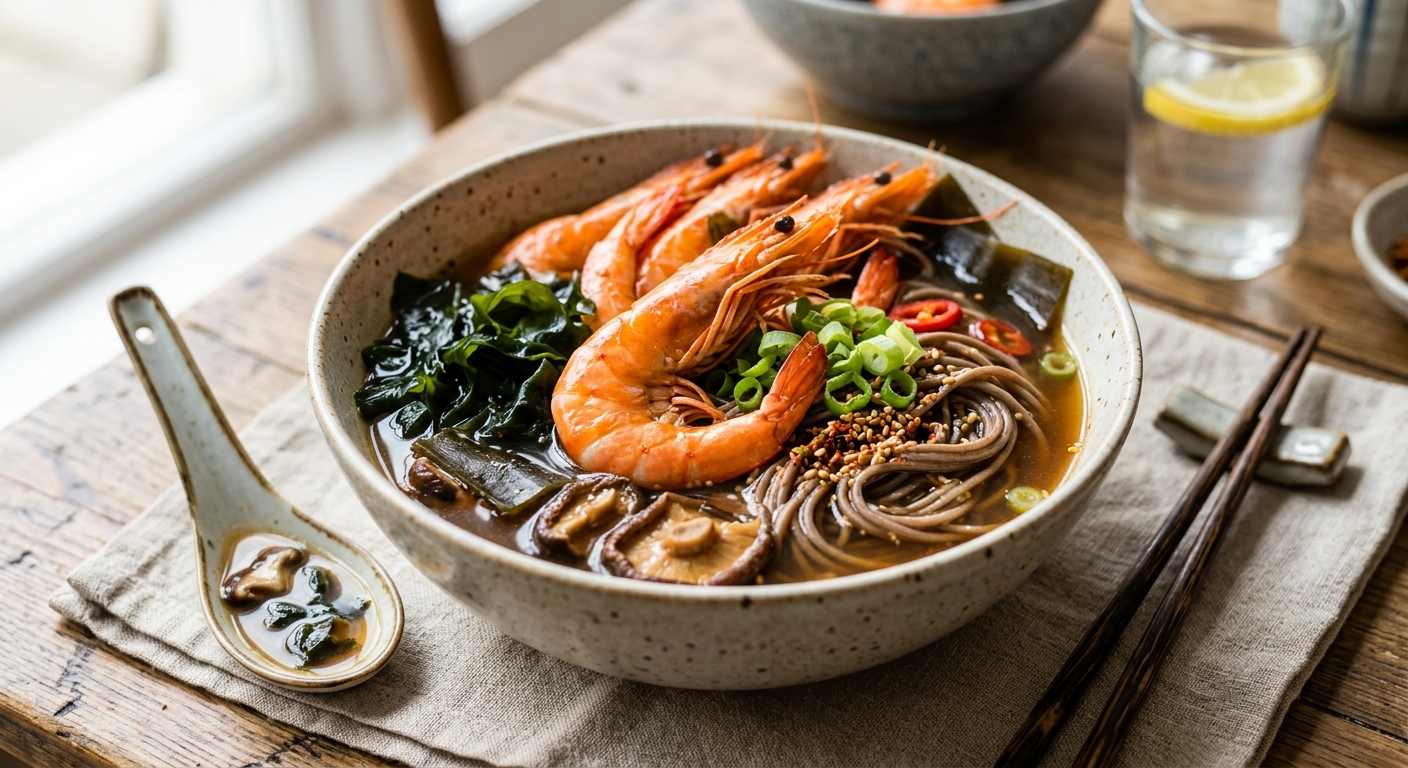
Iodine is one of the most quietly neglected minerals in modern diets, yet it underpins every heartbeat of your thyroid gland. Without adequate iodine, thyroid hormone synthesis stalls, metabolism slows, and cognitive clarity dims. The challenge is that very few whole foods deliver iodine in meaningful quantities, and those that do, chiefly seaweed and seafood, rarely appear together in a single bowl. This soup changes that. By pairing dried wakame seaweed with shell-on tiger prawns and a kombu-anchored broth, we have engineered a dish where every spoonful actively contributes to your daily iodine target.
The flavour architecture here is drawn from the Japanese tradition of umami layering. Kombu and dried shiitake mushrooms form the broth base, contributing glutamates that amplify the sweetness of fresh prawns and the mineral depth of wakame. Rice wine vinegar and white miso paste are stirred in off-heat to preserve their live cultures and volatile aromatics. Buckwheat soba noodles add body and a pleasantly nutty chew while keeping the glycemic load moderate. The result is a bowl that feels restorative, restaurant-worthy, and genuinely complete from a micronutrient standpoint.
Every ingredient in this recipe was chosen with a dual mandate: nutritional precision and culinary intention. The prawns are added late in every cooking method to prevent rubbery texture. The wakame is rehydrated and folded in at the end so its iodine content is not degraded by prolonged heat. Toasted sesame oil, scallions, and togarashi finish the bowl with aroma and gentle heat. Whether you cook this on the stovetop in under an hour or set it in a slow cooker for a hands-off weeknight dinner, the result is calibrated down to the microgram.
4
servings
Ingredients
- 500 graw tiger prawns, shell-on and deveined
- 20 gdried wakame seaweed
- 15 gdried kombu (kelp) strip
- 15 gdried shiitake mushrooms
- 200 gdried soba (buckwheat) noodles
- 3 tbspwhite (shiro) miso paste
- 1 tbsplow-sodium soy sauce
- 1 tbsprice wine vinegar
- 1 tbsptoasted sesame oil
- 10 gfresh ginger, peeled and finely grated
- 3 clovesgarlic, thinly sliced
- 4 stalksspring onions (scallions), thinly sliced
- 1200 mlcold filtered water
- 1 tsptogarashi or red chilli flakes
- 1 tbspAvocado Oil100% Pure Avocado Oil (such as avocado or sunflower oil)
- —Colima Sea SaltMicroplastic Free Salt and white pepper to taste
- —Toasted sesame seeds to garnish
Instructions
Click on an item below to shop for the recommended items for this recipe on Amazon.
As an Amazon Associate, we earn from qualifying purchases.
- Make the cold-brew dashi: Place the kombu strip and dried shiitake mushrooms in a medium saucepan with 1200ml cold water. Let them soak for 15 minutes at room temperature. This cold infusion draws out gentle glutamates without the bitterness that boiling kombu produces.
- Set the pan over medium-low heat and slowly bring the liquid to 60 to 70 degrees C, which is just below a simmer (small bubbles will appear at the edges). Hold at this temperature for 10 minutes, then remove and discard the kombu. Increase the heat to medium and bring to a gentle simmer. Add the garlic slices and grated ginger. Simmer for 8 minutes.
- While the broth simmers, rehydrate the dried wakame: place it in a small bowl with cold water and leave for 5 minutes until it expands and softens. Drain, squeeze out excess water, and roughly chop any very large pieces. Set aside.
- Remove the shiitake mushrooms from the broth with a slotted spoon. Slice them thinly, discarding the tough stems, and return the sliced caps to the broth. Add the soy sauce and rice wine vinegar.
- Cook the soba noodles in a separate pot of unsalted boiling water according to package directions, usually 4 to 5 minutes, until just tender. Drain, rinse under cold running water to remove excess starch, and divide among four serving bowls.
- Reduce the broth heat to the lowest possible setting. In a small bowl, whisk the miso paste with a ladleful of hot broth until completely dissolved, then stir the mixture back into the pot. Do not allow the broth to boil after this point or the live cultures in the miso will be destroyed.
- Add the raw tiger prawns to the hot broth. They will cook in 2 to 3 minutes: remove the pot from heat the moment they turn pink and opaque throughout. Stir in the rehydrated wakame and the toasted sesame oil.
- Ladle the broth, prawns, and wakame over the noodles in each bowl. Top with sliced scallions, togarashi, and toasted sesame seeds. Serve immediately.
- Place the kombu strip, dried shiitake mushrooms, sliced garlic, grated ginger, soy sauce, and 1200ml cold water directly into the slow cooker insert. Do not pre-soak. Cover and cook on Low for 4 hours. The extended low-temperature extraction will pull a rich, clear broth from the kombu and mushrooms without any bitterness.
- About 10 minutes before the broth cycle ends, rehydrate the dried wakame in cold water for 5 minutes. Drain, squeeze dry, and chop. Set aside. Also cook the soba noodles in a separate pot of boiling water on the stovetop for 4 to 5 minutes, rinse under cold water, and divide among four bowls.
- Remove the kombu from the slow cooker and discard. Lift out the shiitake mushrooms, slice them thinly (discarding tough stems), and return the sliced caps to the broth. Stir in the rice wine vinegar.
- Switch the slow cooker to the High or Keep Warm setting. In a small bowl, whisk the miso paste with a ladleful of the hot broth until fully dissolved, then pour the mixture back into the insert and stir to combine. Do not replace the lid and do not allow the broth to return to a full boil.
- Add the raw tiger prawns directly to the slow cooker insert. Stir gently, replace the lid, and allow them to poach in the residual heat on Keep Warm for 4 to 5 minutes, checking at the 4-minute mark. As soon as the prawns are pink and opaque, immediately stir in the wakame and sesame oil.
- Ladle the broth, prawns, and wakame over the prepared noodles. Garnish with scallions, togarashi, and sesame seeds. Serve at once, as the residual heat will continue to cook the prawns if left sitting.
- Select the Saute function on your Instant Pot or electric pressure cooker and heat the neutral oil. Add the sliced garlic and grated ginger and stir-fry for 90 seconds until fragrant and just turning golden at the edges. Press Cancel to stop the saute function.
- Add the kombu strip, dried shiitake mushrooms, soy sauce, and 1200ml cold water to the pot. Lock the lid, set the steam valve to Sealing, and cook on Manual High Pressure for 5 minutes. While pressure builds and releases, rehydrate the wakame in cold water for 5 minutes, then drain, squeeze dry, and chop.
- Once the cook cycle ends, allow a natural pressure release for 8 minutes, then carefully switch the valve to Venting to release any remaining steam. Remove the lid. Fish out and discard the kombu. Remove the shiitake mushrooms, thinly slice them, and return the caps to the broth.
- Cook the soba noodles in a separate pot of boiling water for 4 to 5 minutes while you finish the soup. Drain, rinse, and divide among four bowls.
- Switch the Instant Pot to the Saute function on its lowest setting (or use the Keep Warm function). Whisk the miso paste into a small bowl with a ladleful of the hot broth until smooth, then stir it back into the pot along with the rice wine vinegar. The broth should be steaming but not boiling.
- Add the raw prawns and stir gently. They will cook in 2 to 3 minutes in the hot broth. Press Cancel the moment they are pink and opaque throughout. Fold in the rehydrated wakame and the toasted sesame oil immediately.
- Ladle the finished soup over the noodles. Top each bowl with scallions, togarashi, and toasted sesame seeds. Serve without delay.
Nutrition Breakdown
Per 1 serving (makes 4)
Vitamins & Minerals
% Daily Value based on a 2,000 calorie diet (FDA reference)
🧬 Essential Amino Acids
% of recommended daily intake (RDA) per serving
🛡 Antioxidant Profile
The Nutrition Science
Iodine bioavailability in this recipe is exceptionally high because it arrives in two distinct chemical forms. Kombu and wakame supply inorganic iodide, the form most readily absorbed by the sodium-iodide symporter in the gut, at absorption rates exceeding 90%. The tiger prawns contribute organic iodine bound to the amino acid tyrosine, which is absorbed with near-identical efficiency. Critically, neither source undergoes the halogenation reactions that reduce iodine bioavailability in some processed iodised-salt products. The combination is therefore one of the most efficient dietary iodine delivery vehicles possible within a single meal.
Selenium earns its place in this recipe not merely as a co-nutrient but as a direct partner in thyroid hormone metabolism. The enzyme iodothyronine deiodinase, which converts the prohormone T4 into the active form T3, is a selenoprotein: it cannot function without adequate selenium. By delivering both iodine and selenium in one bowl, this dish supports the complete thyroid hormone synthesis and activation pathway simultaneously. The prawns provide the majority of the selenium (approximately 40mcg per 125g serving), while the shiitake mushrooms contribute a further meaningful fraction.
Wakame contains a unique sulphated polysaccharide called fucoidan that is not broken down by human digestive enzymes. Acting as a prebiotic fibre, fucoidan selectively promotes the growth of Bifidobacterium and Lactobacillus species in the colon while also demonstrating direct anti-inflammatory activity in in vitro models. The miso paste, added off-heat to preserve its microbial content, contributes live Aspergillus oryzae cultures that produce digestive enzymes and short-chain fatty acids. Together, these two ingredients give this bowl a meaningful gut-health dimension that extends well beyond its headline mineral content.
Pro Tips
- Source your kombu and wakame from a reputable Japanese or Korean grocery supplier. Iodine content in seaweed varies enormously by species and origin: wakame (Undaria pinnatifida) is the safest and most consistent choice, delivering a predictable 40 to 60mcg iodine per gram dried weight without the extreme variability of hijiki or arame.
- Do not boil the broth after adding miso paste. Temperatures above 70 degrees C destroy the enzymatic activity and heat-sensitive bacteria that make unpasteurised miso a probiotic food. A gentle steam is all the miso requires to fully dissolve and bloom its flavour.
- For the most tender prawns, buy fresh or properly thawed shell-on prawns and peel them yourself just before cooking. The shells can be briefly toasted in the neutral oil before adding water to create an intensified prawn bisque-style broth layer, especially effective in the stovetop and pressure cooker methods.




This is such a beautiful way to support thyroid health through whole foods rather than relying solely on iodized salt, which so many of us were taught was the only source. I’m curious whether you’re pairing any warming spices in the broth itself, or keeping it pure for the delicate seafood flavors? I’ve been experimenting with adding a pinch of turmeric and black pepper to my dashi broths lately, mostly for the anti-inflammatory benefits, but I wonder if you’ve found they complement the umami without overpowering it. Either way, this recipe feels like such a grounded, nourishing bowl.
oh man this hits home for me because my avó used to make this kombu broth that honestly tasted like liquid gold, and she never once talked about iodine or thyroids but like, she knew her body needed it you know? the seaweed thing is huge because once i started learning the actual science behind what she was doing all those years, it just clicked – shes been feeding me probiotics through miso and fermented vegetables AND giving my thyroid exactly what it needed at the same time. the beauty of traditional fermented broths is they’re doing like five things at once, and paired with that wakame it becomes this complete package that our ancestors figured out way before we had the words to describe
This is such a smart way to meet iodine needs, especially since iodized salt intake varies wildly and many people are moving away from processed foods where that’s typically concentrated. I’d add one practical note for anyone on thyroid medication like levothyroxine: the mineral-density of this soup (selenium, zinc, iodine all together) is fantastic, but spacing it a few hours apart from your thyroid meds helps with absorption since minerals can compete for uptake. I actually had a patient whose TSH stayed oddly elevated until we adjusted her timing, so it’s one of those quiet drug-nutrient interactions worth knowing about. The wakame and prawns together is such elegant biochemistry on your