Boron rarely earns a headline on a nutrition label, yet researchers at the USDA Grand Forks Human Nutrition Research Center demonstrated decades ago that even marginal boron deficiency impairs calcium absorption, elevates urinary calcium loss, and blunts the activity of both vitamin D and estrogen in bone metabolism. The good news is that boron is not scarce in whole foods. Dried figs deliver approximately 1.1mg per 40g serving, walnuts add another 0.7mg per 30g handful, and whole grains like farro contribute meaningfully to the total. Build a meal around all three and you can realistically reach or exceed the suggested adequate intake of 1 to 3mg per day from a single bowl.
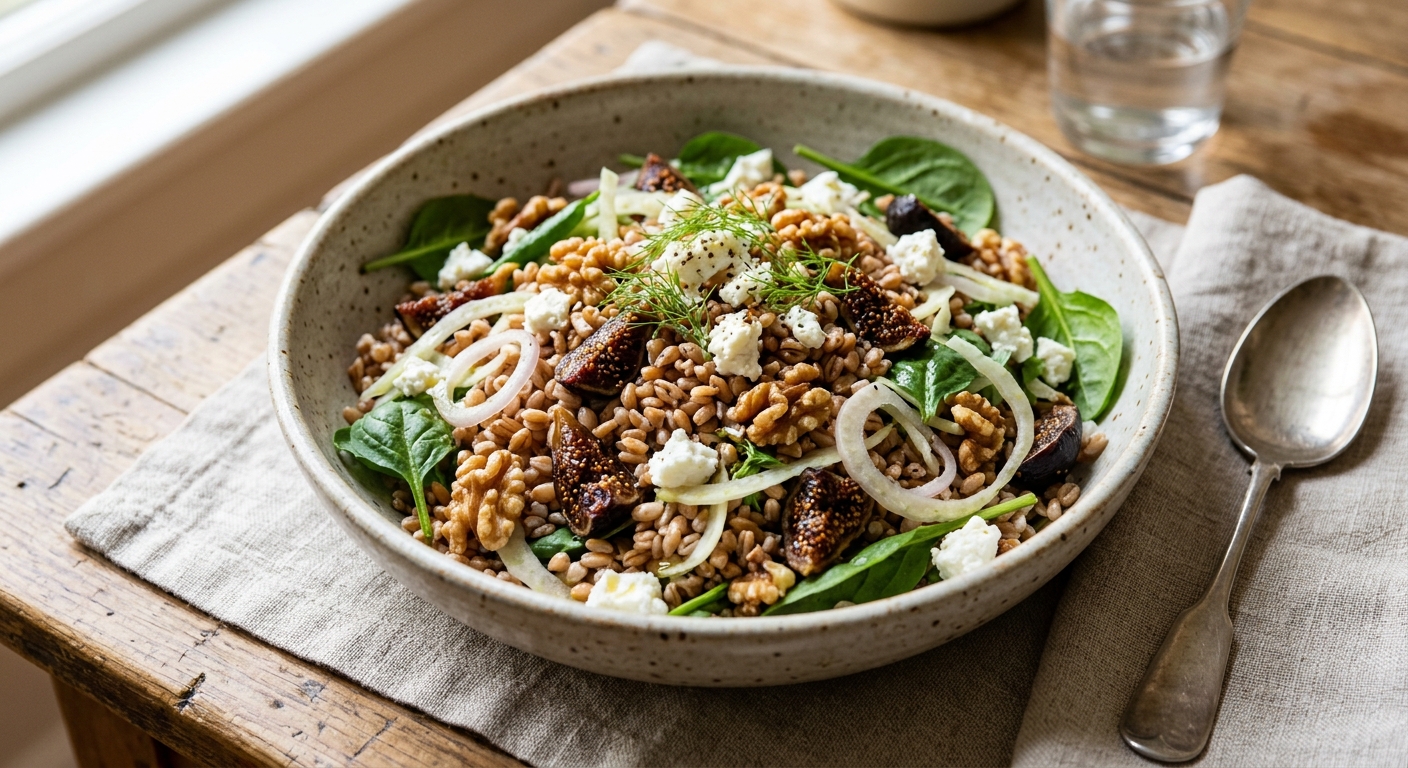
This salad layers toasted, nutty farro with caramelized shallots, earthy dried figs, crunchy walnuts, shaved fennel, and a bright lemon and thyme vinaigrette. It sits at the intersection of ancient-grain heartiness and modern nutritional precision. Farro is a whole-grain emmer wheat that brings manganese, magnesium, and zinc to the matrix, all of which are co-factors in the enzymatic processes that build collagen and mineralise bone. The walnuts add omega-3 alpha-linolenic acid, which is associated with reduced bone resorption in observational studies, and the figs contribute natural sugars that are buffered by 3.7g of fiber per 40g serving, keeping the glycemic impact moderate.
Whether you cook the farro on the stovetop with careful absorption, low-and-slow in a slow cooker for a hands-off approach, or under pressure in an Instant Pot for a weeknight speed run, the mineral payload is identical. Each method produces a slightly different texture, and the instructions below are tailored specifically to each technique rather than copy-pasted with different clock times. Choose your method, follow the finishing steps, and you will have a deeply satisfying, bone-fortifying grain salad on the table in under an hour, or with almost zero active effort if you choose the slow cooker route.
4
servings
Ingredients
- 280 gpearled farro, rinsed under cold water
- 120 gdried Calimyrna or Black Mission figs, stems removed and quartered
- 90 graw walnut halves
- 2 mediumshallots, thinly sliced into rings
- 1 smallfennel bulb, cored and very thinly shaved, fronds reserved
- 80 gbaby spinach leaves
- 60 gcrumbled aged sheep’s milk feta (optional, omit for dairy-free)
- 3 tbspextra-virgin olive oil, divided
- 2 tbspfresh lemon juice (about 1 large lemon)
- 1 tsplemon zest
- 1 tbspraw honey or pure maple syrup
- 2 tspfresh thyme leaves (or 3/4 tsp dried)
- 1 tspDijon mustard
- 700 mllow-sodium vegetable broth
- 1 clovegarlic, minced
- —Colima Sea SaltMicroplastic Free Salt and freshly cracked black pepper to taste
Instructions
Click on an item below to shop for the recommended items for this recipe on Amazon.
As an Amazon Associate, we earn from qualifying purchases.
- Toast the farro first for maximum nuttiness: place a dry medium saucepan over medium heat and add the rinsed, well-drained farro. Stir constantly for 3 to 4 minutes until the grains smell toasty and a few begin to crackle. This step drives off surface moisture and develops Maillard flavour compounds that deepen the final salad.
- Pour in the vegetable broth and add a generous pinch of salt. Raise the heat to bring the broth to a full boil, then immediately reduce to a gentle simmer. Cover with a tight-fitting lid and cook for 25 to 28 minutes, checking at the 25-minute mark. The farro is ready when it is tender but still has a pleasant chew and all (or nearly all) of the broth has been absorbed. If liquid remains, uncover and cook for 2 to 3 minutes more.
- While the farro simmers, caramelise the shallots: heat 1 tablespoon of olive oil in a wide skillet over medium-low heat. Add the shallot rings and a pinch of salt and cook, stirring occasionally, for 12 to 15 minutes until they are deep golden and jammy. Do not rush this step over high heat as the shallots will burn rather than caramelise. Add the minced garlic in the last 90 seconds and stir until fragrant.
- In the same dry skillet (or a separate small pan), toast the walnut halves over medium heat for 4 to 5 minutes, tossing frequently, until fragrant and lightly browned. Tip them onto a cutting board, let them cool for 2 minutes, then roughly chop into chunky pieces. Set aside.
- Whisk together the vinaigrette in a small bowl: combine the remaining 2 tablespoons of olive oil, lemon juice, lemon zest, honey, Dijon mustard, thyme leaves, and a pinch each of salt and pepper. Whisk vigorously until emulsified.
- Drain any residual liquid from the farro and transfer to a large mixing bowl. While the farro is still warm, pour half the vinaigrette over it and toss to coat so the grains absorb the dressing as they cool slightly. Fold in the caramelised shallots, quartered figs, shaved fennel, and chopped walnuts. Add the baby spinach and toss gently so it wilts slightly from the residual heat of the farro. Drizzle with the remaining vinaigrette, scatter the reserved fennel fronds and optional feta over the top, and serve warm or at room temperature.
- Add the rinsed farro, quartered figs, sliced shallots, minced garlic, and all 700ml of vegetable broth to the slow cooker insert. Stir to combine and season with half a teaspoon of salt. The figs and shallots will cook together with the farro here rather than being caramelised separately, creating an entirely different but equally delicious flavour profile: sweeter, more cohesive, and deeply savoury.
- Place the lid on the slow cooker and cook on High for 3 to 3.5 hours or on Low for 5 to 6 hours. Check at the lower end of each time range. The farro is ready when it is fully tender and the liquid is mostly absorbed. Pearled farro can become quite soft in a slow cooker, which is intentional here; it gives the salad a more porridge-adjacent, risotto-like base that contrasts beautifully with the crunchy walnuts added at the end.
- About 10 minutes before the farro finishes, prepare the remaining components. Toast the walnut halves in a dry skillet over medium heat for 4 to 5 minutes until fragrant, then chop roughly. Shave the fennel bulb very thinly using a mandoline or a sharp knife.
- Whisk together the vinaigrette in a small bowl: combine the 3 tablespoons of olive oil, lemon juice, lemon zest, honey, Dijon mustard, thyme leaves, and salt and pepper to taste. The acid from the lemon will brighten the soft, slow-cooked grain mixture considerably.
- Remove the insert from the slow cooker and let it rest uncovered for 5 minutes to allow any remaining steam to escape. Transfer the farro mixture to a large bowl, pour the vinaigrette over while still warm, and toss gently. Fold in the shaved fennel, baby spinach, and chopped walnuts. The spinach will wilt slightly from the residual heat. Scatter the optional feta and reserved fennel fronds over the top. Serve warm directly from the bowl.
- Select the Saute function on your Instant Pot or electric pressure cooker and allow it to heat for 1 minute. Add 1 tablespoon of the olive oil, then add the sliced shallots and a pinch of salt. Saute for 5 to 6 minutes, stirring occasionally, until the shallots are softened and beginning to turn golden at the edges. Add the minced garlic and cook for 1 minute more. Press Cancel to turn off the Saute function.
- Add the rinsed and well-drained farro directly to the shallot mixture in the insert. Stir for about 1 minute using the residual heat of the pot to lightly toast the grains. Pour in the vegetable broth and stir to combine, scraping up any browned bits from the bottom of the insert to prevent a burn warning. Add half a teaspoon of salt.
- Secure the lid and set the pressure release valve to Sealing. Select Manual or Pressure Cook on High Pressure and set the timer for 10 minutes. The pot will take approximately 8 to 10 minutes to come to full pressure before the cooking cycle begins.
- When the cycle completes, allow the pressure to release naturally for 10 minutes (do not touch the valve). After 10 minutes, carefully quick-release any remaining pressure by turning the valve to Venting. Open the lid away from you. The farro should be tender with a slight bite and the liquid mostly absorbed. If the mixture looks wet, select Saute and stir for 1 to 2 minutes until the excess moisture evaporates.
- While the pressure is releasing, toast the walnuts in a dry skillet over medium heat for 4 to 5 minutes until golden and fragrant. Chop roughly. Whisk together the remaining 2 tablespoons of olive oil, lemon juice, lemon zest, honey, Dijon mustard, thyme, and salt and pepper into a vinaigrette.
- Transfer the hot farro to a large mixing bowl. Immediately add half the vinaigrette and toss well so the grains absorb the dressing while warm. Fold in the quartered figs (they remain uncooked in this version, giving a chewier, more textured contrast than the slow cooker method), shaved fennel, baby spinach, and toasted walnuts. Drizzle with the remaining vinaigrette, top with optional feta and fennel fronds, and serve.
- Preheat your oven to 190C (375F) with a rack positioned in the middle. While the oven heats, place your Dutch oven or a deep oven-safe pot with a tight-fitting lid over medium heat on the stovetop. Add 1 tablespoon of olive oil and heat until shimmering. Add the shallot rings and saute for 6 to 7 minutes until softened and lightly golden. Add the minced garlic and stir for 1 minute.
- Add the rinsed farro to the Dutch oven and stir to coat the grains with the oil and shallot mixture. Toast on the stovetop for 2 minutes, stirring, until the grains smell nutty. Pour in the warm vegetable broth (warming it slightly speeds the process but cold broth works too), season with half a teaspoon of salt, and stir to combine. Bring to a simmer on the stovetop.
- Once the liquid is simmering, cover the Dutch oven with its lid and transfer to the preheated oven. Bake for 35 to 40 minutes without lifting the lid for the first 30 minutes, as releasing steam will slow absorption. Check at 35 minutes: the farro should be tender and the broth fully absorbed. If liquid remains, return to the oven uncovered for 5 minutes.
- While the farro bakes, spread the walnut halves on a small rimmed baking sheet. Place in the oven for the last 8 to 10 minutes of the farro’s cooking time, checking at 8 minutes to prevent burning. Remove and let cool, then chop roughly. This oven-toasting brings out a deeper roasted flavour compared to stovetop toasting.
- Whisk together the vinaigrette: 2 tablespoons olive oil, lemon juice, lemon zest, honey, Dijon mustard, thyme, salt, and pepper. Remove the Dutch oven from the oven, uncover carefully (hot steam will escape), and fluff the farro with a fork. Transfer to a large mixing bowl, pour half the vinaigrette over the warm grains, and toss to coat. Fold in the quartered figs, shaved fennel, chopped oven-toasted walnuts, and baby spinach. Finish with the remaining vinaigrette, scatter the optional feta and fennel fronds over the top, and serve warm.
Nutrition Breakdown
Per 1 serving (makes 4)
Vitamins & Minerals
% Daily Value based on a 2,000 calorie diet (FDA reference)
🧬 Essential Amino Acids
% of recommended daily intake (RDA) per serving
🛡 Antioxidant Profile
The Nutrition Science
Boron occupies a uniquely underappreciated position in bone mineral metabolism. Unlike calcium or vitamin D, it has no established RDA in most national guidelines, yet controlled depletion studies (Nielsen et al., FASEB Journal, 1987) showed that removing boron from the diet raised urinary calcium excretion by 44% and reduced serum 25-hydroxyvitamin D by roughly 39% within just 63 days. The proposed mechanism involves boron’s role as an enzymatic co-factor in hydroxylation reactions that convert inactive vitamin D precursors into the biologically active 1,25-dihydroxyvitamin D3 form. In plain terms, without adequate boron, your body is less efficient at activating the vitamin D it already has, and it excretes significantly more calcium in urine rather than depositing it in bone.
The three main boron contributors in this recipe work synergistically with its other minerals. Farro provides manganese (3.4mg, 148% DV), which is the essential metalloenzyme cofactor for glycosyltransferases that construct the proteoglycan matrix of cartilage and bone. Without manganese, the structural scaffold onto which calcium hydroxyapatite crystallises is incomplete. The walnuts deliver copper (contributes to the 0.7mg total), which activates lysyl oxidase, the enzyme that cross-links collagen fibres to give bone its tensile strength and resistance to fracture. Vitamin K1 from the spinach and fresh herbs (72mcg, 60% DV) is the final piece of the puzzle: it carboxylates osteocalcin, a bone protein that would otherwise be unable to bind calcium ions. Together, these nutrients form an integrated bone mineralisation system rather than a list of isolated compounds.
The glycemic design of this salad also matters for bone health in a way that is often overlooked. Diets with a chronically high glycemic load generate more advanced glycation end-products (AGEs), which have been shown to impair osteoblast function and increase collagen degradation in bone tissue. By anchoring this recipe in farro (GI approximately 40, one of the lowest among grains), balancing the natural sugars of the dried figs with 11g of dietary fiber per serving, and using a lemon-and-olive-oil vinaigrette rather than a sugary dressing, the glycemic load is kept at a moderate 16, protecting the very bone-building processes the minerals are working to support.
Pro Tips
- Do not skip toasting the farro before adding liquid, whether on the stovetop, in the Instant Pot’s saute mode, or briefly in the Dutch oven on the hob. Even 2 to 3 minutes of dry heat creates nutty, aromatic compounds and helps the grains maintain a pleasant chew rather than turning mushy during cooking.
- For maximum boron density, choose Calimyrna figs (the pale golden variety) over standard dried figs when available: they have a slightly higher boron content per gram and a richer, honey-like sweetness that pairs beautifully with the lemony vinaigrette. If using very dry or hard figs, soak them in warm water for 10 minutes before quartering.
- Dress the farro while it is still warm, not after it has cooled completely. Warm starch granules are more porous and absorb the vinaigrette deeply, whereas cold farro tends to sit in a pool of dressing rather than integrating with it. This single step is the difference between a grain salad that tastes alive and one that tastes flat.
- This salad keeps well for up to 3 days refrigerated, but store the toasted walnuts separately and add them just before serving to preserve their crunch. The dressing also firms up in the fridge; simply let the salad sit at room temperature for 15 minutes and toss with a small splash of lemon juice before serving leftovers.

Love that you’re highlighting boron, this is such an underrated mineral in bone health conversations! I’ve been recommending fig and walnut combos to clients for years but never quantified the boron content so precisely, so this is super helpful. Quick question though, are you accounting for any mineral loss in the cooking water when you prepared the farro? I’m curious if you tested the final dish or if that 3mg is calculated from raw ingredient databases. Either way, the fact that figs bring both boron AND calcium plus those walnuts add in the omega-3s and magnesium makes this genuinely whole-food bone support, not supplement-dependent.
This is exactly the kind of micronutrient tracking I geek out over, so major props for quantifying the boron load here. I’m curious about the farro choice though, from a carb periodization angle – on recovery or base-building days when I’m loading carbs, farro’s definitely my go-to grain for that 70g carb per cooked cup, but I’m wondering if you’ve tested this against something lower glycemic like barley or spelt for athletes wanting bone support without the insulin spike on harder training days? Either way, the mineral density from the fig and walnut combo is solid and would fit nicely into my post-ride window.
okay so i havent specifically tracked glycemic response with a cgm during different training phases but now youre making me want to, which is dangerous for my sleep schedule lol. that said, barley would honestly be a killer swap here since its got similar boron density to farro (maybe slightly lower) but way more beta-glucans which might actually give you better satiety without the blood sugar roller coaster. the fig and walnut pairing is whats doing the heavy boron lifting anyway, so the grain is almost secondary. my sleep tracker actually shows better sleep consistency on nights after lower-gi carb meals even when total calories are the same, so theres probably something to timing your carbs around training intensity