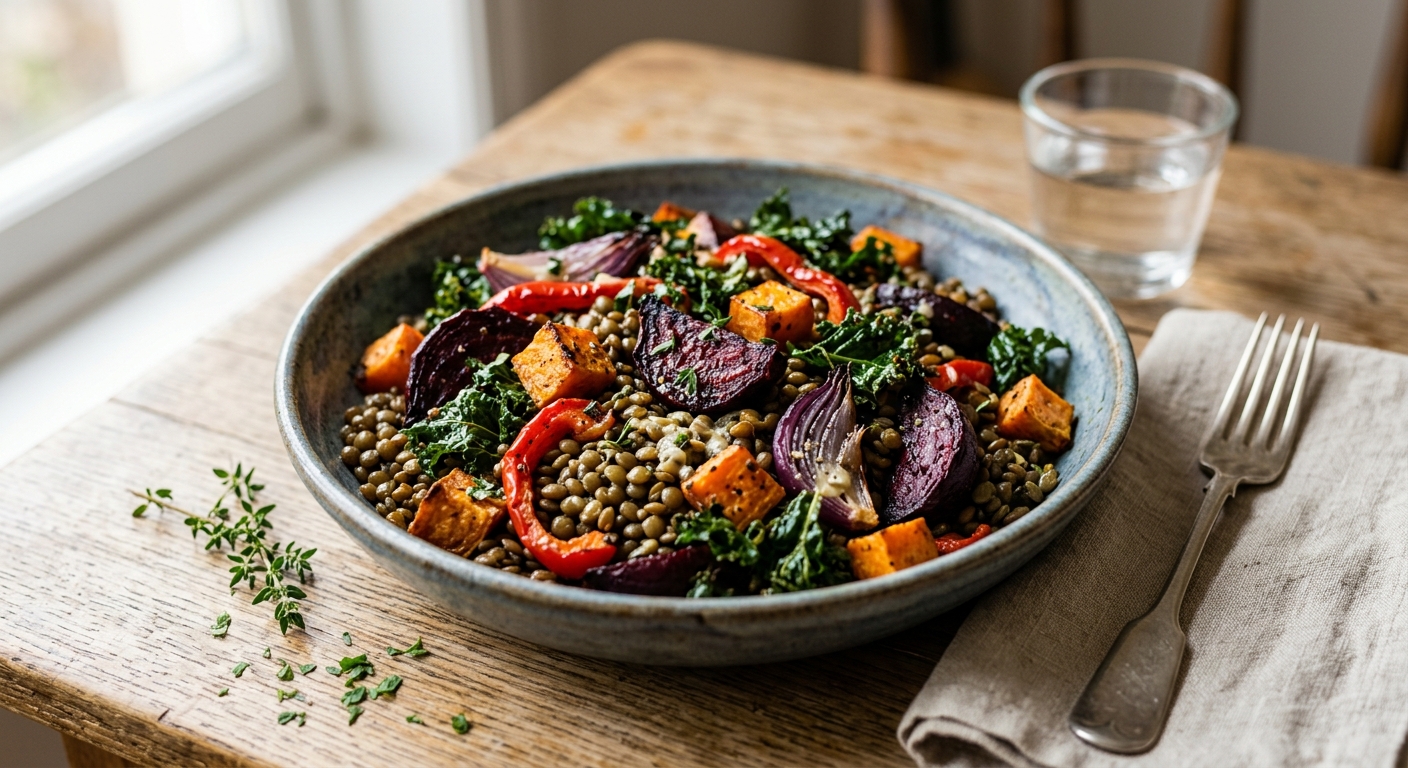
Most people associate minerals like iron, zinc, and magnesium with meat-heavy meals, but this roasted vegetable and lentil sheet pan dinner quietly dismantles that assumption. French green lentils anchor the dish with a firm bite and an extraordinary mineral profile, while beets, sweet potato, red onion, and lacinato kale layer in complementary micronutrients, polyphenols, and fiber. The result is a one-pan dinner that is simultaneously weeknight-simple and nutritionally formidable.
The secret to unlocking maximum mineral absorption here is threefold. First, pairing lentils and beets with lemon juice and roasted red peppers introduces vitamin C, which converts non-heme iron from plant sources into a form two to three times more bioavailable to your gut. Second, the spice blend, built on cumin, smoked paprika, and coriander, is not merely decorative. Cumin is one of the richest spice sources of iron on earth, and it contributes meaningfully to the recipe totals. Third, using extra-virgin olive oil to coat the vegetables before roasting helps dissolve fat-soluble antioxidants like beta-carotene from the sweet potato and supports overall cellular uptake.
This recipe is engineered for flexibility. Whether you prefer the blistered char of a high-heat oven, the slow building of flavors in a slow cooker, the weeknight speed of a pressure cooker, or the stovetop control of a deep skillet, every method produces a dish that is genuinely delicious and nutritionally complete. The macros stay consistent across methods, and the mineral delivery is virtually identical regardless of how you cook it. Dinner, sorted.
4
servings
Ingredients
- 300 gFrench green lentils (Puy lentils), rinsed and drained
- 300 graw beets (about 2 medium), peeled and cut into 2cm wedges
- 300 gsweet potato (about 1 large), peeled and cut into 2cm cubes
- 200 gred bell peppers (about 2 medium), seeded and cut into strips
- 180 glacinato (Tuscan) kale, stems removed, leaves roughly torn
- 150 gred onion (about 1 medium), cut into 2cm wedges
- 4 clovesgarlic, minced
- 3 tbspextra-virgin olive oil, divided
- 2 tspground cumin
- 2 tspsmoked paprika
- 1 tspground coriander
- 0.5 tspground turmeric
- 0.25 tspcayenne pepper
- 750 mllow-sodium vegetable broth
- 2 tbsptomato paste
- 2 tbspfresh lemon juice (about 1 lemon)
- 1 tbspapple cider vinegar
- 30 gfresh flat-leaf parsley, roughly chopped, for serving
- 2 tbsptoasted pumpkin seeds (pepitas), for serving
- —Colima Sea SaltMicroplastic Free Salt and freshly ground black pepper to taste
Instructions
Click on an item below to shop for the recommended items for this recipe on Amazon.
As an Amazon Associate, we earn from qualifying purchases.
- In a small bowl, combine the cumin, smoked paprika, coriander, turmeric, and cayenne. Set the spice blend aside. Bring a medium saucepan of lightly salted water to a boil over high heat. Add the lentils, reduce heat to a steady simmer, and cook for 20 to 22 minutes until just tender but still holding their shape. Drain and set aside.
- While the lentils cook, heat 2 tablespoons of olive oil in a large (30cm) heavy-based skillet or Dutch oven over medium-high heat until shimmering. Add the beet wedges in a single layer. Cook undisturbed for 4 minutes until a deep brown crust develops on the cut side. Flip, add the sweet potato cubes, season with a generous pinch of salt, and cook for another 4 minutes, tossing the sweet potato occasionally. You want real caramelization here, not just warmth.
- Push the vegetables to the edge of the pan and add the remaining 1 tablespoon of olive oil to the center. Add the red onion and red bell pepper strips. Cook over medium-high heat for 3 to 4 minutes, stirring occasionally, until the onion edges begin to char and the peppers soften. Stir in the garlic and the spice blend. Cook for 60 seconds, stirring constantly, until the spices bloom and become intensely fragrant.
- Add the tomato paste and stir it into the vegetables. Cook for 2 minutes, allowing the paste to caramelize slightly against the bottom of the pan. Pour in the vegetable broth, scraping up any browned bits from the bottom with a wooden spoon. Bring to a gentle boil, then reduce heat to medium-low.
- Stir in the drained lentils and apple cider vinegar. Simmer uncovered for 8 to 10 minutes until the broth reduces to a glossy, sauce-like consistency that clings to the vegetables. Fold in the torn kale in two batches, pressing each batch down into the liquid and covering the pan for 2 minutes between additions to wilt. Remove from heat, stir in the lemon juice, and taste for seasoning. Serve in wide bowls topped with fresh parsley and toasted pumpkin seeds.
- In a small bowl, whisk together the tomato paste, apple cider vinegar, minced garlic, cumin, smoked paprika, coriander, turmeric, cayenne, and 1 teaspoon fine sea salt until a smooth paste forms. This front-loading of aromatics into a paste is the slow cooker technique for building flavor without sauteing.
- Layer the ingredients into the slow cooker insert in the following order to manage cooking rates: place the beet wedges on the bottom (they need the most time), followed by the sweet potato cubes and red onion wedges. Scatter the rinsed lentils evenly over the vegetables. Lay the red bell pepper strips on top of the lentils.
- Spoon the spice paste evenly over the layered ingredients. Pour the vegetable broth down the inside wall of the insert, do not pour directly onto the spice paste or you will wash it off. Drizzle 2 tablespoons of the olive oil over everything. Do not stir. Place the lid on and cook on Low for 6 to 7 hours or on High for 3 to 3.5 hours, until the beets are completely tender when pierced with a knife and the lentils are cooked through.
- Remove the lid and gently stir the contents together, which will naturally blend the spice paste into the braising liquid. Taste and adjust salt and pepper. Lay the torn kale over the surface in an even layer. Replace the lid and cook on High for 25 to 30 minutes, until the kale is fully wilted and tender.
- Stir the kale into the dish. Add the lemon juice, drizzle with the remaining 1 tablespoon of olive oil, and stir gently. The lentils should be tender but intact, and the liquid should have reduced to a loose, brothy consistency. Ladle into wide bowls and finish with fresh parsley and toasted pumpkin seeds.
- Set the Instant Pot or electric pressure cooker to Saute mode on High. Heat 2 tablespoons of olive oil until shimmering. Add the beet wedges and sweet potato cubes in a single, mostly even layer. Saute for 4 to 5 minutes without stirring too frequently, until lightly browned on one or two sides. Add the red onion and red bell pepper and saute for 2 minutes more.
- Add the garlic, cumin, smoked paprika, coriander, turmeric, and cayenne to the pot. Stir for 60 seconds until the spices coat the vegetables and become fragrant. Add the tomato paste and stir for another 60 seconds. Pour in the apple cider vinegar and use a wooden spoon to scrape up any browned bits from the bottom of the pot, this step is critical to prevent the burn warning on electric pressure cookers.
- Add the rinsed lentils and pour in the vegetable broth. Stir briefly to distribute the lentils. Do not add the kale yet. Secure the lid and set the pressure release valve to Sealing. Select Pressure Cook (Manual) on High pressure and set the timer for 15 minutes.
- Once the cook time is complete, perform a controlled quick release by carefully moving the valve to Venting in short bursts to prevent liquid from spraying. When pressure has fully released, open the lid. The lentils should be tender and the vegetables cooked through.
- Switch back to Saute mode on Low. Fold in the torn kale and cook for 3 to 4 minutes, stirring, until completely wilted. Cancel Saute mode. Stir in the lemon juice and the remaining 1 tablespoon of olive oil. Season generously with salt and pepper. The dish will be brothier than the stovetop version; this is intentional. Ladle into bowls and top with parsley and pumpkin seeds.
- Preheat your oven to 220C (425F) with two large rimmed sheet pans (each approximately 46 x 33 cm) inside. Preheating the pans is the single most important technique for achieving caramelization rather than steaming. While the oven heats, cook the lentils: place them in a medium saucepan with the vegetable broth and bring to a boil over high heat. Reduce to a steady simmer and cook for 20 to 22 minutes until just tender. Drain, reserving 4 tablespoons of the cooking liquid, and set both aside.
- In a large mixing bowl, combine the beet wedges, sweet potato cubes, and red onion wedges with 2 tablespoons of olive oil, half of the cumin, half of the smoked paprika, half of the coriander, all of the turmeric, and a generous pinch of salt. Toss thoroughly to coat every surface. In a separate bowl, toss the red bell pepper strips with 1 teaspoon of olive oil and a pinch of salt.
- Carefully remove the hot sheet pans from the oven using oven mitts. Working quickly, spread the root vegetable mixture across one hot pan in a single layer, ensuring pieces are not touching. Spread the pepper strips on the second hot pan. Roast both pans for 20 minutes, then use a thin metal spatula to flip the root vegetables and rotate both pans between oven racks. Roast for a further 15 to 20 minutes until the beets are tender and all vegetables have deep, caramelized edges.
- While the vegetables finish roasting, prepare the dressing: in a small bowl whisk together the tomato paste, garlic, apple cider vinegar, lemon juice, the remaining half of the cumin and paprika, the remaining coriander, cayenne, and the reserved 4 tablespoons of lentil cooking liquid to form a pourable dressing. Season with salt and pepper.
- Remove the sheet pans from the oven. Scatter the torn kale across the root vegetable pan and drizzle with the remaining olive oil and a pinch of salt. Return only this pan to the oven for 3 to 4 minutes until the kale is crisped and wilted at the edges. Remove from the oven. Combine the roasted vegetables, crisped kale, roasted peppers, and cooked lentils in one of the sheet pans or a large wide serving bowl. Pour the dressing over everything and toss gently to coat. Taste for seasoning, then serve immediately topped with parsley and toasted pumpkin seeds.
Nutrition Breakdown
Per 1 serving (makes 4)
Vitamins & Minerals
% Daily Value based on a 2,000 calorie diet (FDA reference)
🧬 Essential Amino Acids
% of recommended daily intake (RDA) per serving
🛡 Antioxidant Profile
The Nutrition Science
The mineral density of this dish is not accidental. French green lentils are among the most iron-rich plant foods available, providing approximately 3.3mg of non-heme iron per 100g dry weight, compared to 0.9mg in a standard chicken breast. The challenge with non-heme iron has historically been absorption efficiency, which sits at 2 to 20% depending on dietary context versus 15 to 35% for heme iron from meat. This recipe addresses that limitation directly. The red bell peppers and lemon juice provide approximately 74mg of vitamin C per serving, and mechanistic studies confirm that ascorbic acid at doses above 50mg consumed simultaneously with non-heme iron can increase its absorption two to three-fold by reducing ferric Fe(III) to the more soluble ferrous Fe(II) form in the stomach. Cumin contributes an additional 1.4mg of iron per teaspoon, and at 2 teaspoons across four servings, its contribution is nutritionally significant rather than cosmetic.
Magnesium in this dish comes from a coalition of sources: lentils (36mg per 100g cooked), kale (47mg per 100g), pumpkin seeds used as garnish (37mg per tablespoon), and sweet potato (27mg per 100g). Magnesium is the fourth most abundant mineral in the human body and serves as a cofactor in over 300 enzymatic reactions, including ATP synthesis, protein translation, and DNA repair. Yet surveys consistently show that 48 to 68% of adults in Western countries consume below the RDA of 310 to 420mg per day. A single serving of this dish provides 118mg, meaning that adding this to an otherwise average diet can meaningfully close that gap. The zinc in lentils and pumpkin seeds, combined with the betalain-mediated anti-inflammatory activity of the beets, creates additional synergistic effects on immune regulation at the cellular level.
The folate content warrants special attention: at 280mcg per serving (70% DV), this dish rivals fortified breakfast cereals as a folate source. Folate (vitamin B9) is essential for one-carbon metabolism, which underpins DNA methylation, nucleotide synthesis, and homocysteine clearance. Unlike synthetic folic acid in fortified foods, the folate in lentils and kale is in the naturally occurring polyglutamate form, which must be converted by the enzyme MTHFR before use. For individuals carrying the common MTHFR C677T polymorphism, increasing dietary folate from whole food sources (as opposed to supplemental folic acid) is specifically recommended by nutrition geneticists to ensure adequate metabolic conversion.
Pro Tips
- Do not substitute red lentils in the slow cooker or pressure cooker methods. Red lentils disintegrate under prolonged heat. French green lentils or brown lentils are the only varieties that hold their texture in a slow cooker over 6 to 7 hours.
- Roast beets cut-side down on a screaming-hot pan for maximum caramelization in the oven method. Beets have a high sugar content (approximately 7g per 100g) that cooks to deep, bitter-sweet fond on direct contact with a preheated metal surface.
- Add the lemon juice only after removing the dish from heat. Vitamin C degrades rapidly above 70C (160F), and adding the lemon juice at the end preserves both its iron-enhancing bioavailability benefit and its bright flavor.
- Massage the kale with a pinch of salt for 60 seconds before adding it if you want it to wilt faster in the stovetop or pressure cooker methods. Breaking down the tough cell walls reduces wilting time by about half and improves texture.
- Store leftovers in an airtight container in the refrigerator for up to 4 days. The mineral content does not degrade significantly during refrigeration, and the flavors intensify overnight as the spices continue to bloom into the lentils.


Oh this is right up my alley, honestly. I’ve been tracking how magnesium affects my sleep quality through perimenopause and this amount in one meal is game-changing, especially since I’m trying to dial back how much I rely on my evening magnesium supplement. The iron and zinc combo is also clutch because my ferritin levels dipped during the transition and adding more plant-based iron sources with vitamin C (assuming there’s something acidic in that dressing?) has actually made a noticeable difference in my energy. Definitely making this tonight!
Love that you’re both thinking about bioavailability, Francesca! That lemon squeeze is absolutely the move, and I’m glad you mentioned it because French lentils especially pair beautifully with citrus. I’d add though that the kale in this recipe is also doing heavy lifting for vitamin C absorption of that iron, so this sheet pan is already thoughtfully stacked. Miranda, the magnesium piece resonates so much with me too, and what’s wild is that lentils, root veggies, and leafy greens together create this synergistic mineral profile that our ancestors understood intuitively before we had the lab work to back it up – think how foundational these foods are across
omg the iron content is what got me – lentils are such a game changer for my ferritin levels, but i’m curious if youre pairing this with anything vitamin c rich? i usually squeeze lemon over my lentil bowls because the absorption difference is actually wild, especially with plant based iron. and kale is amazing but just wanted to flag that cruciferous veggies can be a bit binding if youre iron conscious, though honestly the benefit usually outweighs it for me. would love to know if you tested your ferritin before and after adding mineral dense meals like this into rotation