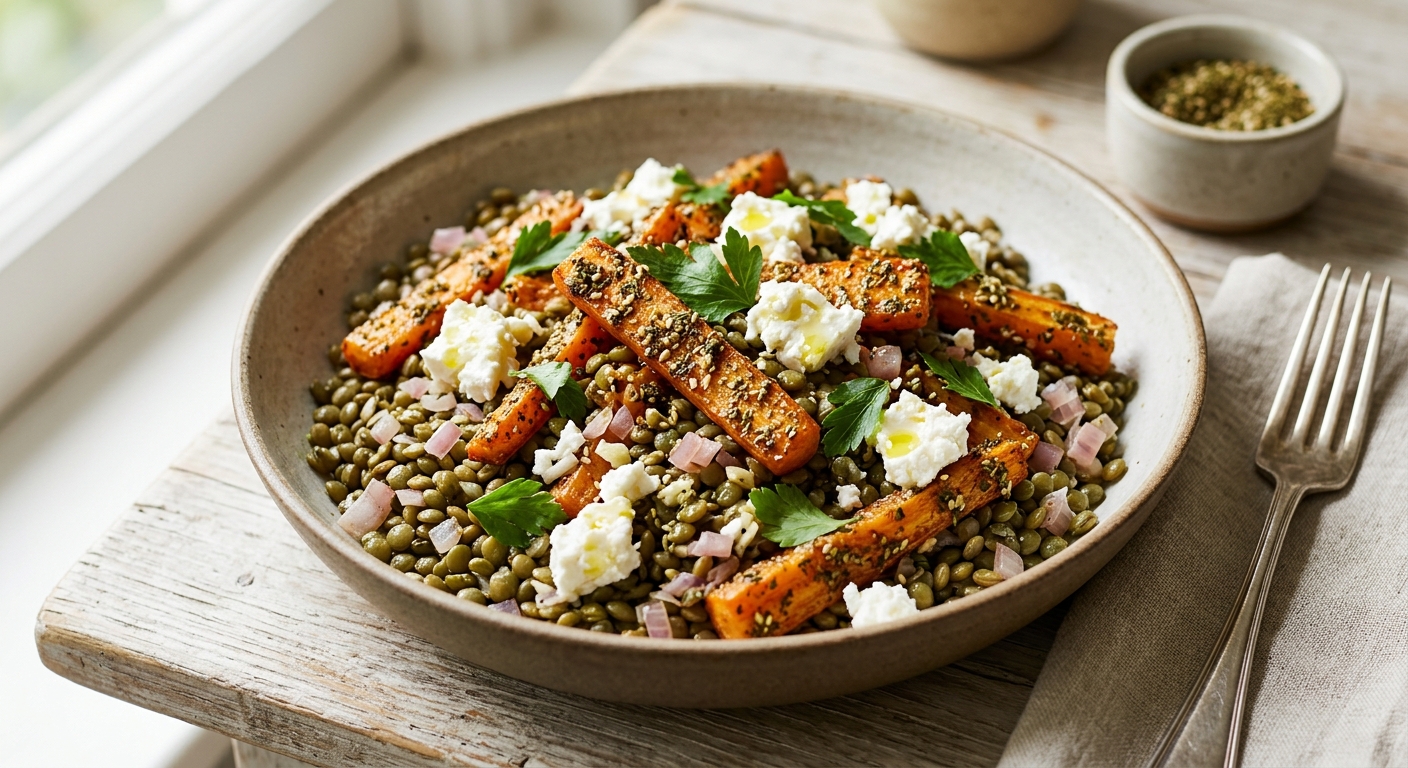
Some dishes earn their place on a nutrition-focused table by excelling in one area. This one refuses to specialise. Za’atar Roasted Carrots with Lentils and Feta is a full-spectrum mineral delivery system dressed up as a deeply satisfying Middle Eastern-inspired bowl. The combination of green lentils, heirloom carrots, sesame-rich za’atar, and briny sheep’s milk feta hits iron, zinc, manganese, calcium, magnesium, phosphorus, and potassium all in a single serving, many of them clearing 20 to 35 percent of your daily recommended intake.
The flavour architecture is equally deliberate. Za’atar, the ancient Levantine spice blend of dried thyme, sumac, oregano, and toasted sesame seeds, does far more than season. Sumac contributes a bright, lemony tartness that lifts the earthy lentils, while the sesame seeds add a toasty nuttiness and a meaningful dose of calcium and zinc all on their own. Roasting the carrots at high heat caramelises their natural sugars and concentrates their mineral content per gram, turning a humble root vegetable into something genuinely luxurious. Feta finishes the bowl with creamy salinity and a calcium boost that no other soft cheese matches gram for gram.
On Calibrated Cuisine, we build recipes around the question: what does your body actually need, and how do we make eating it feel like a treat rather than a chore? This bowl answers that question with confidence. Whether you cook it in a single oven roast, build it slowly in a slow cooker, or get it on the table in under 30 minutes in a pressure cooker, the mineral payoff is the same. Choose your method, choose your mood, and let the za’atar do the rest.
4
servings
Ingredients
- 600 gcarrots, peeled and cut into 4cm batons
- 300 ggreen or Puy lentils, rinsed and drained
- 750 mlvegetable stock, low-sodium
- 150 gfeta cheese, crumbled
- 3 tbspza’atar spice blend
- 3 tbspextra-virgin olive oil
- 1 mediumred onion, finely diced
- 4 clovesgarlic, minced
- 1 tbsplemon juice, freshly squeezed
- 1 tspground cumin
- 0.5 tspsmoked paprika
- 30 gflat-leaf parsley, roughly chopped
- 2 tbsptahini
- —Colima Sea SaltMicroplastic Free Salt and black pepper to taste
Instructions
Click on an item below to shop for the recommended items for this recipe on Amazon.
As an Amazon Associate, we earn from qualifying purchases.
- Bring a medium saucepan of lightly salted water to a boil. Add the rinsed green lentils and cook at a steady simmer for 22 to 25 minutes, until just tender with a slight bite remaining. Drain thoroughly and set aside. Do not overcook, as the lentils will continue warming when combined.
- While lentils cook, heat 2 tablespoons of olive oil in a wide, heavy-bottomed skillet or saute pan over medium-high heat. Add the carrot batons in a single layer, working in two batches if needed to avoid crowding. Sear undisturbed for 3 to 4 minutes per side until deeply golden and caramelised on the cut edges.
- Reduce heat to medium. Add the diced red onion to the pan with the carrots and cook, stirring occasionally, for 4 minutes until softened. Add the minced garlic, ground cumin, and smoked paprika, stirring for 60 seconds until fragrant. Pour in 120ml of the vegetable stock and scrape up any browned bits from the pan base.
- Sprinkle 2 tablespoons of the za’atar over the carrots and stir to coat evenly. Allow the stock to reduce almost completely over medium heat, about 3 to 4 minutes, so the carrots are glazed and coated. Remove from heat and season generously with salt and black pepper.
- In a small bowl, whisk together the tahini, lemon juice, remaining tablespoon of olive oil, and 2 to 3 tablespoons of warm water until a pourable dressing forms. Season with salt.
- Fold the drained lentils gently into the carrot pan over low heat for 1 to 2 minutes to combine and warm through. Transfer to a serving platter or individual bowls. Drizzle generously with the tahini dressing, scatter crumbled feta and chopped parsley over the top, and dust with the remaining tablespoon of za’atar before serving.
- Place the rinsed lentils in the base of the slow cooker insert. Scatter the diced red onion and minced garlic directly over the lentils. Add the ground cumin, smoked paprika, and 2 tablespoons of za’atar, then pour over all 750ml of vegetable stock. Stir once to distribute the spices evenly through the liquid.
- Toss the carrot batons in a bowl with 1 tablespoon of olive oil, a pinch of salt, and a few grinds of black pepper. Lay the seasoned carrots in a single layer on top of the lentil mixture. Do not stir them in; keeping them elevated allows the carrots to steam-braise rather than fully submerge, preserving more bite.
- Place the lid on the slow cooker and cook on Low for 6 to 7 hours, or on High for 3 to 3.5 hours, until lentils are fully tender and have absorbed most of the stock and the carrots are soft but not falling apart.
- If you want caramelised carrot edges, preheat your grill to high. Transfer the cooked carrots to a foil-lined baking tray using tongs, drizzle with 1 tablespoon of olive oil, and grill for 4 to 5 minutes until the edges colour and blister. Return them to the slow cooker insert or arrange over the lentils on a platter.
- Stir the lemon juice through the lentils and taste for seasoning, adjusting salt as needed. Whisk together the tahini with 2 tablespoons of warm water and a pinch of salt to make a loose drizzling sauce. Spoon the lentils into bowls, top with the carrots, and finish with crumbled feta, chopped parsley, the tahini drizzle, and the remaining tablespoon of za’atar.
- Set your Instant Pot or electric pressure cooker to Saute mode on medium-high heat. Add 2 tablespoons of olive oil. Once shimmering, add the diced red onion and cook for 3 minutes, stirring frequently, until softened and lightly golden at the edges. Add the minced garlic, ground cumin, smoked paprika, and 2 tablespoons of za’atar and stir for 45 seconds until the spices are fragrant and toasted.
- Add the carrot batons to the pot and toss to coat in the spiced oil for 1 to 2 minutes. Pour in the rinsed lentils and all 750ml of vegetable stock. Stir once to combine, then scrape the bottom of the pot with a wooden spoon to ensure nothing is stuck, which could trigger a burn warning.
- Cancel Saute mode. Secure the pressure cooker lid and set the valve to Sealing. Cook on Manual High Pressure for 10 minutes. Allow natural pressure release for 5 minutes, then carefully switch the valve to Venting to release remaining steam.
- Open the lid and stir the contents gently. If the mixture looks too liquid, switch back to Saute mode and simmer uncovered for 3 to 5 minutes, stirring occasionally, until the excess stock reduces to a glossy, coating consistency. Stir in the lemon juice and season thoroughly with salt and black pepper.
- Whisk the tahini with the remaining tablespoon of olive oil and 2 to 3 tablespoons of warm water until smooth and pourable. Ladle the lentil and carrot mixture into bowls, drizzle generously with tahini dressing, top with crumbled feta and fresh parsley, and finish with the remaining tablespoon of za’atar and a crack of black pepper.
- Preheat your oven to 220 degrees Celsius (200 degrees Celsius fan, Gas Mark 7). In a large mixing bowl, toss the carrot batons with 2 tablespoons of olive oil, 2 tablespoons of za’atar, the smoked paprika, and a generous pinch of salt and black pepper until every piece is thoroughly coated. Spread in a single layer on a large rimmed baking sheet lined with parchment paper. Do not crowd the pan; use two sheets if necessary.
- Roast the carrots on the top oven rack for 22 to 25 minutes, flipping once at the halfway point with a spatula, until the edges are deeply caramelised and the za’atar crust is fragrant and slightly charred at the tips. Remove from the oven and set aside.
- While the carrots roast, prepare the lentil base. In a large oven-safe braising dish or Dutch oven, heat the remaining tablespoon of olive oil over medium heat on the stovetop. Saute the diced red onion for 4 minutes until soft, then add the minced garlic and ground cumin and cook for 1 minute more. Add the rinsed lentils and all 750ml of vegetable stock, season with salt, and bring to a simmer.
- Transfer the braising dish to the oven, uncovered, on the middle rack. Reduce oven temperature to 190 degrees Celsius (170 degrees Celsius fan). Bake for 25 to 28 minutes, until the lentils are tender and have absorbed most of the stock, with a small amount of thickened liquid remaining. Check at 20 minutes and add a splash of stock or water if the lentils look dry.
- Arrange the roasted carrot batons over the top of the baked lentils directly in the braising dish. Return to the oven for a final 5 minutes to meld the flavours and warm everything through together.
- Remove from the oven and rest for 3 minutes. Whisk together the tahini, lemon juice, and 2 tablespoons of warm water to form a light dressing. Drizzle over the dish, scatter the crumbled feta and flat-leaf parsley across the top, and dust with the final tablespoon of za’atar. Serve directly from the braising dish for a dramatic presentation.
Nutrition Breakdown
Per 1 serving (makes 4)
Vitamins & Minerals
% Daily Value based on a 2,000 calorie diet (FDA reference)
🧬 Essential Amino Acids
% of recommended daily intake (RDA) per serving
🛡 Antioxidant Profile
The Nutrition Science
Green lentils are one of the most nutritionally dense legumes available, and their mineral profile is the backbone of this dish. A 75g dry serving of green lentils provides approximately 6mg of iron, predominantly non-haem iron, the plant-based form that is absorbed at a lower baseline rate than haem iron from meat. However, this dish is strategically constructed to maximise non-haem iron bioavailability. The lemon juice in the tahini dressing provides ascorbic acid, which reduces ferric iron (Fe3+) to the more absorbable ferrous form (Fe2+) in the gut lumen. Meanwhile, the absence of calcium-rich dairy consumed simultaneously, apart from the feta which is added cold at the end, means there is minimal competitive inhibition at intestinal iron transporters during the main eating window.
The manganese content of this dish is exceptional and often overlooked. Green lentils, sesame seeds in the za’atar, and tahini collectively push this dish to over 90 percent of the daily adequate intake for manganese, a trace mineral that is a required cofactor for manganese superoxide dismutase (MnSOD), the primary antioxidant enzyme in mitochondria. Manganese is also essential for the enzyme arginase in the urea cycle and for the synthesis of proteoglycans needed in cartilage and bone matrix, making this dish genuinely relevant for joint and bone health alongside its headline iron contribution. Zinc from lentils, feta, and sesame supports over 300 enzymatic reactions including DNA synthesis and immune cell activation, and its co-delivery with protein in this dish improves its relative bioavailability compared to zinc consumed in isolation.
The carotenoid story in this dish is equally compelling. The 600g of carrots provides approximately 25 to 30mg of beta-carotene across the whole recipe, translating to roughly 7 to 8mg per serving, which the intestinal mucosa cleaves into retinal and then retinol (vitamin A) as needed. This conversion is upregulated when vitamin A stores are low and downregulated when replete, making beta-carotene from whole food a physiologically self-regulating source of vitamin A without the toxicity risk associated with preformed retinol supplements. The olive oil and tahini in this recipe are critical here: beta-carotene is a fat-soluble compound and its micellarisation and absorption in the small intestine is directly dependent on co-ingested dietary fat. Cooking the carrots also ruptures cell walls and increases beta-carotene bioaccessibility by 30 to 40 percent compared to raw carrots.
Pro Tips
- For maximum iron absorption, avoid drinking tea or coffee within one hour of this meal. Tannins in both beverages bind non-haem iron in the gut and can reduce absorption by up to 60 percent, effectively cancelling out a significant portion of this dish’s mineral benefit.
- Za’atar blends vary significantly by brand and region. Look for a blend that lists sesame seeds, sumac, and thyme or oregano as the first three ingredients, and avoid blends with heavy filler salts or starch. For the highest mineral contribution from the blend itself, toast a fresh batch in a dry pan for 90 seconds just before use.
- To make this dish vegan, simply omit the feta or replace it with a cashew-based feta alternative. Note that doing so will reduce the calcium content by approximately 120mg per serving, so consider adding an extra tablespoon of tahini to partially compensate.
- Puy lentils hold their shape better than standard green lentils under longer cooking times, making them the preferred choice for the slow cooker method where texture preservation is harder to control.
- Leftover lentil and carrot mixture keeps refrigerated for up to 4 days and actually improves in flavour as the za’atar spices continue to infuse. Store the tahini dressing and feta separately and add fresh at serving to maintain textural contrast.
Love this approach, Nick! You’re highlighting something so important that often gets lost in the “superfoods” conversation, which is that it’s not just about having minerals present, it’s about whether our bodies can actually absorb and use them, right? The lentil-feta pairing is chef’s kiss from a bioavailability standpoint, and I’m reminded of how traditional African and Mediterranean cuisines figured this out centuries ago without the lab tests to prove it, you know? Both cultures paired plant proteins with fermented or dairy components intuitively, which is exactly what modern functional nutrition is trying to “rediscover” now.
This is exactly the kind of dish I wish more of my cardiac patients would actually eat, honestly. The mineral density here is solid, but what really catches my eye is the lentil-feta combo for bioavailability, the za’atar for polyphenol load, and the fact that carrots don’t spike blood glucose the way most “grain bowls” do. One small note from the nursing side, though: if anyone reading this has hemochromatosis or iron overload issues, go easy on the lentil quantity since you’re stacking iron sources. For everyone else, this is the kind of real food that actually moves the needle on metabolic markers, not just Instagram engagement.
spot on about the bioavailability piece, nick. the vitamin c in those carrots paired with the lentil iron is legit chemistry, not just marketing. ive actually seen clients’ ferritin and hemoglobin shift noticeably when they dial in the zinc to iron ratio instead of just chasing iron content alone. the feta adds the calcium that helps with absorption too, which most people totally miss. your hemochromatosis callout is the real move though, thats the kind of nuance that separates actual nutrition coaching from just posting pretty bowls.