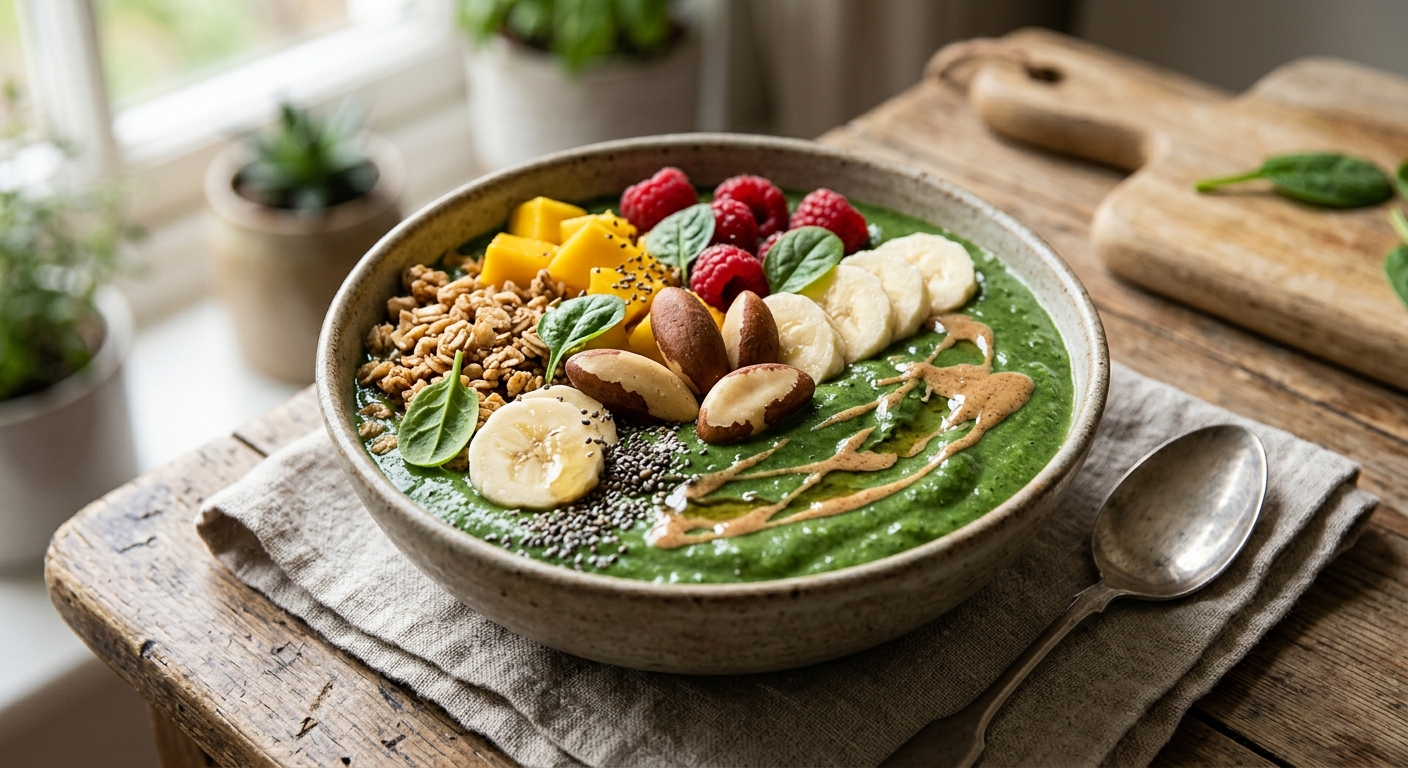
Selenium is one of nutrition’s most underappreciated minerals. It sits at the centre of a family of selenoprotein enzymes that regulate thyroid hormone metabolism, protect DNA from oxidative damage, and coordinate a surprisingly large portion of your immune response. Yet surveys consistently show that a significant portion of the population falls short of the 55 mcg daily requirement, largely because selenium content in plant foods is so dependent on soil quality. Brazil nuts sidestep that problem entirely: they accumulate selenium from the deep Amazon soil with almost aggressive efficiency, delivering 68 to 91 mcg per single nut. Two nuts per serving in this bowl puts you firmly in optimal territory without any risk of toxicity from whole food sources at this dose.
The supporting cast here is anything but a nutritional afterthought. Baby spinach brings a remarkable load of folate, iron, magnesium, and vitamin K alongside lutein and zeaxanthin, two carotenoids that protect the macula of the eye. Frozen mango supplies a generous dose of beta-carotene and vitamin C, which simultaneously boosts non-haem iron absorption from the spinach and contributes to the vibrant golden-orange swirl that makes this bowl genuinely beautiful. Banana adds potassium, a touch of prebiotic resistant starch when used slightly underripe, and the body that gives the bowl its signature thick, spoonable texture.
Because smoothie bowls are not cooked, the three method variations here reimagine what a cooking method can mean for this format: a stovetop-toasted nut and seed granola topping, a slow cooker warm spiced compote topping, and a pressure cooker option that produces an intensely concentrated mango and ginger coulis to swirl through the bowl. Each method adds a genuinely different dimension of flavour, texture, and additional nutrients, turning a simple blended bowl into a complete, calibrated breakfast or post-workout meal.
4
servings
Ingredients
- 8 wholeBrazil nuts (approximately 56g total), plus 4 extra halved for garnish
- 120 gbaby spinach, tightly packed
- 400 gfrozen banana chunks (about 3 medium bananas, sliced and frozen)
- 300 gfrozen mango chunks
- 180 mlunsweetened oat milk (or other plant milk)
- 2 tbspnatural almond butter
- 1 tbspraw honey or pure maple syrup
- 1 tsppure vanilla extract
- 1 tspfreshly grated ginger
- 2 tbspchia seeds
- 3 tbsprolled oats (certified gluten-free if required)
- 2 tbspraw pumpkin seeds (pepitas)
- 2 tbspraw sunflower seeds
- 1 tbspcoconut flakes, unsweetened
- 150 gfresh mango, diced (for topping)
- 80 gfresh blueberries (for topping)
- 1 tbspextra-virgin coconut oil
- 0.5 tspground cinnamon
- 0.25 tspground turmeric
- —Pinch of Colima Sea SaltMicroplastic Free Salt
Instructions
Click on an item below to shop for the recommended items for this recipe on Amazon.
As an Amazon Associate, we earn from qualifying purchases.
- Place a dry, wide skillet or frying pan over medium heat. Add the rolled oats, pumpkin seeds, sunflower seeds, and coconut flakes in a single layer. Toast, stirring frequently with a wooden spoon, for 3 to 4 minutes until the oats are golden and the seeds smell nutty. Watch closely as seeds can burn quickly once hot.
- Push the toasted mixture to the edges of the pan and add the coconut oil to the centre. Once melted, add the cinnamon, turmeric, and a pinch of sea salt, stirring the spices into the oil for 20 seconds to bloom them. Then toss everything together and cook for 1 more minute until evenly coated and fragrant. Transfer immediately to a plate or tray and spread into a thin layer to cool and crisp. Set aside.
- While the topping cools, make the smoothie bowl base. Place the Brazil nuts (the 8 whole ones for blending) into a high-speed blender. Add the baby spinach, followed by the frozen banana chunks, frozen mango, almond butter, honey, vanilla extract, and fresh ginger. Pour in the oat milk last so the liquid sits near the blade.
- Blend on high for 45 to 60 seconds, stopping once to scrape down the sides with a spatula. The target consistency is very thick, like soft-serve ice cream. It should hold its shape when dropped from the spatula. If the blender struggles, add oat milk one tablespoon at a time, never more than 2 additional tablespoons total, to keep the bowl thick and spoonable.
- Divide the smoothie base evenly among 4 wide, chilled bowls. Working quickly before the base softens, arrange the toppings: scatter the warm toasted granola across the centre, add a small pile of fresh mango cubes and fresh blueberries to one side, sprinkle the chia seeds over everything, and place one halved Brazil nut on top of each bowl. Serve immediately.
- Place the fresh mango cubes, blueberries, grated ginger, cinnamon, turmeric, honey, and a pinch of sea salt directly into the slow cooker insert. Stir briefly to combine. Do not add any liquid, as the fruit will release its own juice during cooking. Set the slow cooker to Low, place the lid on slightly ajar to allow steam to escape and the compote to thicken rather than stew, and cook for 2 hours.
- After 2 hours the fruit should be soft and jammy, with a syrupy liquid pooling at the bottom. Stir gently once, being careful not to completely break down the mango chunks as you want some texture. Taste and adjust sweetness. If the compote seems too liquid, remove the lid fully and cook on Low for a further 15 minutes to reduce. Turn off the slow cooker and allow the compote to rest uncovered for 10 minutes; it will thicken further as it cools slightly.
- While the compote is in its final resting stage, toast the rolled oats, pumpkin seeds, and sunflower seeds in a dry pan over medium heat for 3 to 4 minutes until golden, then set aside. This adds essential crunch since there is no oven step in this method.
- Prepare the smoothie bowl base. Into a high-speed blender, add the Brazil nuts, baby spinach, frozen banana chunks, frozen mango, almond butter, vanilla extract, and oat milk. Blend on high for 45 to 60 seconds until the texture is thick and creamy like soft-serve. Scrape down the sides as needed. The base must be blended just before serving since the frozen fruit base softens quickly.
- Spoon the smoothie base into 4 wide chilled bowls. Ladle a generous portion of the warm spiced compote directly over the centre of each bowl, creating a striking temperature contrast between the warm jammy fruit and cold frozen base. Scatter the dry-toasted seeds and oats around the compote, sprinkle chia seeds across the top, and finish each bowl with one halved Brazil nut and a dusting of coconut flakes. Serve within 3 minutes.
- Add the fresh mango cubes, blueberries, grated ginger, cinnamon, turmeric, honey, coconut oil, and 3 tablespoons of water to the pressure cooker or Instant Pot inner pot. Stir briefly. Secure the lid and set the steam valve to Sealing. Select Manual or Pressure Cook on High and set the timer to 4 minutes.
- Once cooking is complete, allow the pressure to release naturally for 5 minutes, then carefully switch the valve to Venting for a quick release of any remaining pressure. Open the lid away from you. The fruit will have completely broken down into a vibrant, deeply coloured sauce with intensely concentrated flavour.
- Use an immersion blender directly in the pot, or transfer the cooked fruit carefully to a blender, and process until completely smooth and glossy. If the coulis seems thicker than a pourable sauce, stir in one tablespoon of warm water at a time until it reaches a consistency that flows slowly from a spoon. Taste and adjust with a pinch of sea salt or a few extra drops of honey. Set aside and keep warm.
- While the coulis rests, toast the rolled oats, pumpkin seeds, sunflower seeds, and coconut flakes in a dry skillet over medium heat for 3 to 4 minutes until golden and fragrant. Toss with a pinch of cinnamon and sea salt, spread onto a plate to cool.
- Blend the smoothie base: combine Brazil nuts, baby spinach, frozen banana chunks, frozen mango, almond butter, vanilla extract, and oat milk in a high-speed blender. Process on high for 45 to 60 seconds until thick and smooth. Divide evenly among 4 chilled bowls. Drizzle the warm mango ginger coulis in a swirling spiral over the top of each bowl, allowing it to pool in the centre. Scatter the toasted seed and oat crumble around the coulis, add chia seeds, and top with a halved Brazil nut. Serve immediately.
Nutrition Breakdown
Per 1 serving (makes 4)
Vitamins & Minerals
% Daily Value based on a 2,000 calorie diet (FDA reference)
🧬 Essential Amino Acids
% of recommended daily intake (RDA) per serving
🛡 Antioxidant Profile
The Nutrition Science
Brazil nuts occupy a uniquely privileged position in nutritional science because their selenium content is both extraordinarily high and almost entirely bioavailable. The selenium is stored in the nut as selenomethionine, an organic form that research consistently shows is absorbed at 90% or higher efficiency, compared to inorganic selenate or selenite found in supplements. Once absorbed, selenomethionine is incorporated into a family of at least 25 known selenoproteins, the most studied of which are the glutathione peroxidases (GPx1 through GPx4). These enzymes catalyse the reduction of harmful hydrogen peroxide and lipid hydroperoxides, neutralising them before they can damage DNA strands, mitochondrial membranes, or circulating lipoproteins. Two Brazil nuts in this recipe deliver approximately 175 mcg of selenium, placing each serving at roughly 318% of the daily value, well within the tolerable upper intake level of 400 mcg for adults and far above the threshold needed to fully saturate all selenoprotein synthesis.
Spinach’s iron content is frequently misunderstood. While spinach is genuinely rich in non-haem iron (approximately 2.7 mg per 100g raw), its oxalic acid content binds a portion of that iron and reduces absorption in isolation. This recipe is deliberately engineered to overcome that limitation. The 52 mg of vitamin C per serving, sourced from mango and blueberries, converts ferric iron (Fe3+) to the more soluble ferrous form (Fe2+) directly in the gut lumen, increasing non-haem iron absorption by two to three times compared to consuming spinach alone. The absence of competing calcium-rich dairy foods in this bowl further protects iron absorption, making the bioavailable iron delivery from this meal considerably higher than the raw iron figure alone would suggest.
The chia seeds, almond butter, and Brazil nuts collectively contribute a meaningful spectrum of magnesium (98 mg, 23% DV) and zinc (2.2 mg, 20% DV), two minerals that work synergistically with selenium in the body’s antioxidant enzyme systems. Magnesium is a required cofactor for over 300 enzymatic reactions, including ATP synthesis and DNA repair processes that are directly downstream of the oxidative damage that selenium-dependent enzymes prevent. The manganese contribution (1.4 mg, 61% DV) from spinach, oats, and pumpkin seeds is equally important: manganese is the specific cofactor for mitochondrial superoxide dismutase (MnSOD), the enzyme responsible for dismutating the superoxide radicals generated as a natural byproduct of cellular respiration. This bowl, in other words, simultaneously fuels and protects your mitochondria in a single meal.
Pro Tips
- Freeze your bowls for 10 minutes before serving: a frozen bowl dramatically slows the melting of the smoothie base, giving you time to arrange toppings neatly and photograph the bowl before it softens.
- Do not exceed 2 Brazil nuts per serving on a daily basis. While this recipe is calibrated safely, consuming 6 or more Brazil nuts every day for extended periods can push selenium intake toward the tolerable upper limit. Enjoy this bowl three to four times per week rather than every day for optimal long-term balance.
- For the thickest possible smoothie base, freeze your bananas when they are just ripe (yellow with minimal spotting): overripe frozen bananas are sweeter but release more liquid during blending, resulting in a thinner bowl.



Oh wow, the selenium angle is so smart, especially paired with spinach! I’m actually looking at magnesium-bound chlorophyll in my thesis research right now, and baby spinach has such a beautiful chlorophyll profile, around 23mg per 100g raw. What I’m curious about is whether you tested the bioavailability of those minerals together, because the vitamin C from the mango should really enhance iron absorption from the spinach, but I’m wondering if the selenium uptake interacts with the folate or magnesium in any way? I’ve been experimenting with smoothie bowl ratios myself and found that even slight differences in the greens (like subbing spinach for waterc
This is a really thoughtful question, and honestly it’s the kind of thing I wish more people thought about in nutrition. The vitamin C / iron pairing you’re mentioning is textbook stuff – that’s real synergy we see in practice – but selenium bioavailability is trickier because it’s largely dependent on selenium speciation in the source food rather than mineral-mineral interactions in the bowl itself. What I mean is, Brazil nuts contain selenomethionine which absorbs pretty independently of the folate or magnesium present, though the overall nutrient density of this combination definitely doesn’t hurt. The chlorophyll work sounds fascinating though, because I’ve seen patients with better micronutrient status on high
this looks amazing, and i love that youre focusing on the selenium pairing with the other micronutrients. quick question though – whats the total carb count on this including the banana and mango? im always looking for ways to get those nutrient-dense foods in without spiking blood sugar, and i wonder if theres a lower carb version with maybe berries instead that could still hit that selenium target with the brazil nuts. the spinach and chlorophyll angle is really cool btw, thats the kind of micronutrient layering that actually moves the needle on metabolic health.