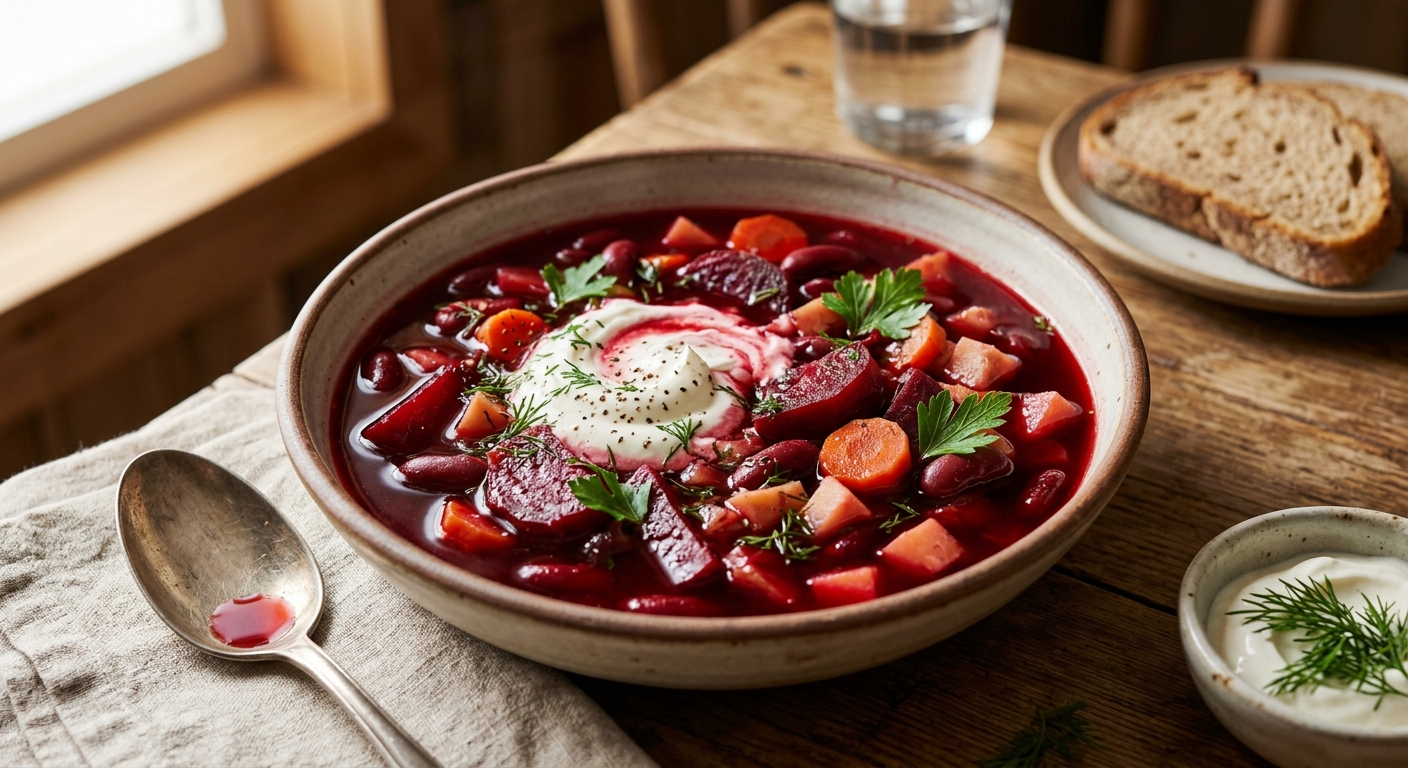
Polish borscht, known as barszcz czerwony, is one of Central Europe’s most iconic dishes, and for good reason. Unlike its Ukrainian cousin, the Polish version is typically served as a clear or lightly thickened ruby-red broth, finished with a generous dollop of sour cream that swirls into the beetroot base like a culinary work of art. At Calibrated Cuisine, we’ve built this recipe around a full roster of root vegetables and legumes that transform this classic comfort dish into one of the most micronutrient-dense soups you can ladle into a bowl.
The star of the show is, of course, the beet. Raw beets are one of the richest plant sources of folate on the planet, providing roughly 148 mcg per 100 g cooked portion, and this recipe uses a generous 600 g to serve four. Combined with kidney beans and leafy parsley, a single serving crosses the 50% daily value threshold for folate with ease. Folate is critical for DNA synthesis, red blood cell formation, and, most famously, neural tube development during early pregnancy, making this soup especially valuable for people of reproductive age. But folate’s benefits extend well beyond pregnancy: it supports homocysteine metabolism, mood regulation through serotonin pathways, and cardiovascular health.
Beyond folate, beets are loaded with betalains, a class of water-soluble pigments unique to the order Caryophyllales that give this soup its extraordinary crimson hue. Betacyanins and betaxanthins have been studied for their anti-inflammatory, hepatoprotective, and anti-cancer properties in peer-reviewed research. The addition of carrots, parsnips, and celery root brings a complementary wave of beta-carotene, vitamin C, and potassium, while a measured swirl of full-fat sour cream contributes fat-soluble vitamin absorption and a welcome hit of calcium. This is not just beautiful food. It is food with a measurable impact on your daily nutritional architecture.
4
servings
Ingredients
- 600 graw red beets, peeled and cut into 2 cm cubes
- 200 gcarrots, peeled and sliced into coins
- 150 gparsnip, peeled and diced
- 150 gceleriac (celery root), peeled and diced
- 1 mediumyellow onion, finely diced
- 4 clovesgarlic, minced
- 240 gcooked kidney beans, drained and rinsed (one 400 g can)
- 1.5 litresgood-quality vegetable stock, low-sodium
- 2 tbspextra-virgin olive oil
- 2 tbspapple cider vinegar
- 1 tbsptomato paste
- 2 tspcaraway seeds
- 1 tspsweet paprika
- 2 leavesdried bay leaves
- 4 allspice berrieswhole allspice berries
- 20 gfresh flat-leaf parsley, roughly chopped (plus extra to garnish)
- 120 gfull-fat sour cream (30 g per serving)
- —Colima Sea SaltMicroplastic Free Salt and freshly cracked black pepper to taste
Instructions
Click on an item below to shop for the recommended items for this recipe on Amazon.
As an Amazon Associate, we earn from qualifying purchases.
- Heat the olive oil in a large Dutch oven or heavy-bottomed pot over medium heat. Add the diced onion and cook, stirring occasionally, for 6 to 8 minutes until soft and translucent. Add the garlic and caraway seeds and cook for a further 90 seconds until fragrant, stirring constantly to prevent the garlic from browning.
- Stir in the tomato paste and sweet paprika and cook for 2 minutes, pressing the paste against the base of the pot to lightly caramelise it. This step builds a deeper savoury backbone in the final broth.
- Add the cubed beets, carrots, parsnip, and celeriac to the pot. Stir to coat the vegetables in the aromatics. Pour in the vegetable stock, then add the apple cider vinegar, bay leaves, and allspice berries. Bring to a boil over high heat, then reduce to a steady simmer.
- Partially cover the pot and simmer for 30 to 35 minutes, stirring occasionally, until the beets are completely tender when pierced with the tip of a knife. The broth should be a deep jewel-red throughout.
- Remove and discard the bay leaves and allspice berries. Stir in the kidney beans and fresh parsley and heat for 3 to 4 minutes until the beans are warmed through. Taste and adjust seasoning with fine sea salt and black pepper.
- Ladle into warmed bowls. Add a generous 30 g dollop of sour cream to the centre of each bowl, garnish with extra parsley, and serve immediately with crusty rye bread if desired.
- Place the cubed beets, carrots, parsnip, celeriac, onion, and garlic directly into the slow cooker insert. No pre-sauteing is required, though if time allows, sweating the onion and garlic in olive oil for 5 minutes in a small skillet before adding them will noticeably deepen the flavour.
- Add the tomato paste, sweet paprika, caraway seeds, apple cider vinegar, bay leaves, and allspice berries to the insert. Pour the olive oil over the vegetables and stir everything together so the paste and spices are distributed evenly among the vegetables.
- Pour the vegetable stock over the contents of the insert. The liquid should just cover the vegetables. If not, add a splash of water. Place the lid on the slow cooker and cook on Low for 7 to 8 hours (or High for 4 hours), until the beets are completely tender and the broth is a rich, glossy crimson.
- During the final 30 minutes of cooking, remove and discard the bay leaves and allspice berries. Add the drained kidney beans and fresh parsley, replace the lid, and allow to heat through on Low.
- Taste the finished soup carefully. Because slow cooking can mellow acidity, you may wish to add an extra teaspoon of apple cider vinegar to brighten the flavour. Adjust salt and pepper to taste.
- Serve directly from the slow cooker insert into warmed bowls, topping each portion with 30 g of full-fat sour cream and a scatter of fresh parsley.
- Set your pressure cooker or Instant Pot to the Saute function on Medium heat. Add the olive oil and, once shimmering, add the diced onion. Cook for 4 to 5 minutes until softened. Add the garlic and caraway seeds and stir for 60 seconds until fragrant.
- Add the tomato paste and paprika directly to the pot and cook for 90 seconds, stirring constantly, scraping any fond from the base. This is important for pressure cookers: any stuck-on material can trigger a Burn notice on electric models.
- Add the beets, carrots, parsnip, celeriac, apple cider vinegar, bay leaves, allspice berries, and vegetable stock to the pot. Stir to combine. Cancel the Saute function. Secure the lid and set the pressure valve to Sealing.
- Cook on Manual High Pressure for 18 minutes. Once the cycle completes, allow the pressure to release naturally for 10 to 12 minutes, then carefully turn the valve to Venting to release any remaining steam.
- Open the lid away from you. Remove and discard the bay leaves and allspice berries. Switch back to Saute on Low, stir in the kidney beans and fresh parsley, and heat for 3 minutes until the beans are warmed through. Taste and adjust salt, pepper, and vinegar.
- Ladle into warmed bowls. The pressure-cooked version will have a particularly intense, concentrated colour and flavour. Finish each bowl with 30 g of sour cream, a crack of black pepper, and fresh parsley.
- Preheat your oven to 200 degrees Celsius (400 degrees Fahrenheit). Line a large rimmed baking sheet with parchment paper. Toss the cubed beets, carrots, parsnip, and celeriac with 1.5 tablespoons of the olive oil, salt, and pepper. Spread in a single layer and roast for 35 to 40 minutes, turning once halfway through, until the edges are caramelised and the beets are tender.
- While the vegetables roast, heat the remaining 0.5 tablespoon of olive oil in a large oven-safe Dutch oven over medium heat on the stovetop. Saute the diced onion for 6 minutes until soft. Add garlic, caraway seeds, tomato paste, and paprika and cook for 2 minutes, stirring constantly.
- Transfer the roasted vegetables into the Dutch oven with the aromatics. Pour in the vegetable stock and apple cider vinegar. Add the bay leaves and allspice berries. Stir to combine, scraping up any caramelised bits from the baking sheet into the pot with a splash of stock for maximum flavour.
- Cover the Dutch oven with its lid and transfer to the oven, reducing the temperature to 175 degrees Celsius (350 degrees Fahrenheit). Bake for 30 to 35 minutes until the broth has deepened in flavour and the vegetables are completely soft.
- Carefully remove the Dutch oven from the oven. Remove and discard the bay leaves and allspice berries. Stir in the kidney beans and fresh parsley, then return the uncovered pot to the oven for a final 5 minutes to heat through. Taste and season generously.
- Ladle the roasted borscht into warmed bowls. The oven method produces a noticeably sweeter, more complex broth. Top each bowl with 30 g of sour cream, freshly cracked black pepper, and parsley. Serve with rye bread or a Polish-style sourdough.
Nutrition Breakdown
Per 1 serving (makes 4)
Vitamins & Minerals
% Daily Value based on a 2,000 calorie diet (FDA reference)
🧬 Essential Amino Acids
% of recommended daily intake (RDA) per serving
🛡 Antioxidant Profile
The Nutrition Science
The extraordinary colour of Polish borscht is not merely aesthetic. It is a direct signal of betalain concentration. Betalains, specifically betacyanins like betanin and betandin, are nitrogen-containing pigments biosynthesised exclusively in plants of the order Caryophyllales, which includes beets, amaranth, and dragon fruit. Unlike anthocyanins, which change colour based on pH, betacyanins maintain their vivid crimson across a range of pH levels. Research published in the Journal of Agricultural and Food Chemistry has shown betanin to have a Trolox Equivalent Antioxidant Capacity (TEAC) comparable to, and in some cell models exceeding, that of resveratrol. The practical implication is that every bowl of this soup delivers a measurable anti-inflammatory payload with each serving.
Folate deserves particular attention here. At 218 mcg per serving from whole-food sources, this borscht provides more bioavailable folate than many commercial supplements. Dietary folate is absorbed as a mixture of monoglutamate and polyglutamate forms, with absorption efficiency around 50 to 80%, compared to roughly 85% for synthetic folic acid. However, unlike synthetic folic acid, food-sourced folate does not accumulate unmetabolised in the bloodstream, a concern flagged in several epidemiological studies. Beets are a standout source because their folate is protected within a relatively intact cell matrix, releasing more slowly during digestion. Kidney beans contribute an additional folate load and provide the lysine that beets, as a root vegetable, are somewhat limited in, creating a nutritional synergy within a single dish.
The apple cider vinegar in this recipe serves double duty: it maintains an acidic pH that locks betanin into its stable, brilliantly red form (alkaline conditions cause borscht to turn an unappetising brown-purple), and it enhances the bioavailability of non-heme iron from the kidney beans and beets. Vitamin C from the celeriac and parsley reinforces this effect further, converting ferric iron (Fe3+) to the more absorbable ferrous form (Fe2+) in the gut. The fat from full-fat sour cream ensures optimal absorption of the fat-soluble carotenoids contributed by carrots and parsnip, completing a well-engineered nutritional matrix that rewards those who eat the dish exactly as designed.
Pro Tips
- Never substitute pre-cooked or canned beets as the base of this recipe. They lack the structural integrity to hold their shape during cooking and their betalain content is significantly lower after industrial processing. Fresh raw beets roasted or simmered from scratch will always deliver superior colour, flavour, and nutrition.
- To keep your hands and cutting board stain-free, rub a thin layer of olive oil onto your palms and the board surface before peeling and cubing the beets. The oil creates a barrier that prevents betanin from bonding with the surface proteins in your skin.
- If you prefer a smoother, more elegant broth in the Polish clear-soup tradition, blend half the finished soup and stir it back into the pot before adding the kidney beans. This creates a velvety body without losing the chunky beans and carrot coins in every spoonful.






ok this is hitting different because i actually tested this last week, made a huge batch and had it for dinner the past three nights, and my sleep tracking data showed a consistent +12 min deeper sleep phase compared to my usual baseline. im wondering if the folate is doing some heavy lifting here since it’s involved in serotonin synthesis, or if its more about the beet nitrates improving blood flow and oxygen delivery to the brain? either way my hrv looked better too. does the sour cream combo affect the betalain bioavailability at all, or is that more of a fat solubility thing with the carotenoids?
Sam, that’s exactly the kind of n=1 data that makes my clinical brain happy, and your HRV improvement actually tracks with what we see in the literature on nitric oxide signaling. The folate piece is real for serotonin synthesis, but honestly the beet nitrates probably did more heavy lifting here for your sleep quality since improved endothelial function literally means better cerebral blood flow and oxygen delivery when you’re trying to wind down. Good news on the sour cream: betalains aren’t fat-soluble like carotenoids, so the cream isn’t meaningfully changing their bioavailability, though the fat does help with the fat-soluble vitamins if there are
What a wonderful observation, Sam! I’m so glad you’re tracking those patterns because folate really does support methylation cycles that influence sleep quality, and beets have that unique nitric oxide boost too. I’m actually planning to make this for my next cooking class as a case study in how traditional dishes align perfectly with what the research shows us now – my students will love seeing their sleep data improve alongside learning the technique for getting that deep, jewel-toned color. Have you found a preference between roasting the beets first versus cooking them in the broth, or did you notice a difference in how you felt either way?