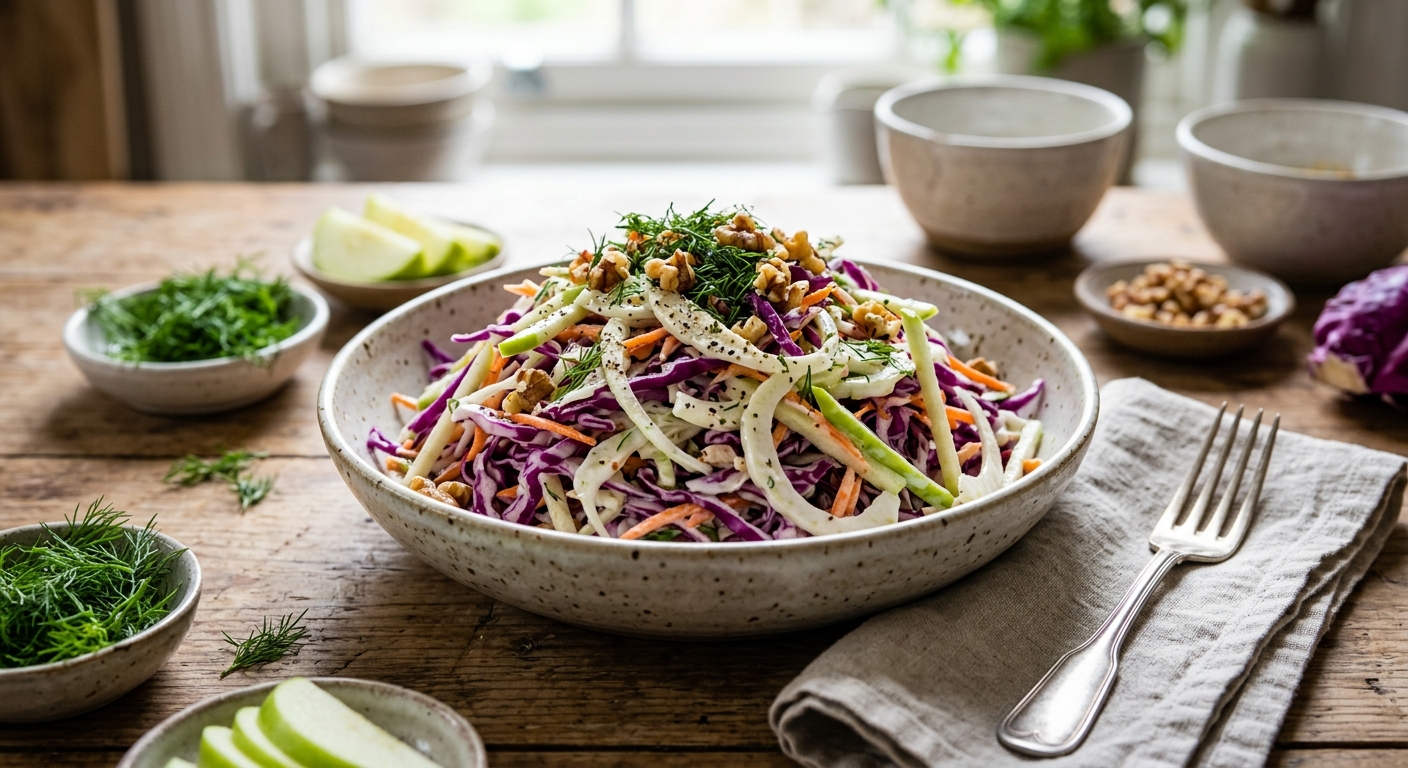
Coleslaw has a reputation problem. Too often it arrives as a pale, mayo-drenched afterthought alongside barbecue, soggy and nutritionally vacant. This Apple and Fennel Coleslaw with Kefir Dressing is a complete reimagining of that dish, built from the ground up around a single powerful nutritional concept: the gut microbiome. Every ingredient here was chosen either for its probiotic content (live beneficial bacteria) or its prebiotic content (the fermentable fibres those bacteria eat). The result is a dish that is simultaneously one of the most science-backed things you can put on your plate and one of the most genuinely satisfying salads you will ever eat.
Fennel is the architectural centrepiece, contributing an anise-forward crunch and a remarkable concentration of prebiotic inulin fibre. Purple cabbage layers in glucosinolates and anthocyanins alongside its own prebiotic fibre supply. Tart Granny Smith apple adds pectin, a soluble fibre that ferments slowly in the colon and selectively nourishes Bifidobacterium and Lactobacillus strains. The dressing is where the probiotic magic lives: full-fat kefir delivers upward of 12 distinct live bacterial and yeast cultures per serving, including Lactobacillus acidophilus, Lactobacillus kefiri, and Streptococcus thermophilus, at a CFU count that rivals many supplement capsules. A touch of raw apple cider vinegar amplifies the acidity, helping the live cultures survive transit to the gut.
From a culinary standpoint, the dish succeeds because of contrast: the sweet-tart apple against the slightly bitter fennel frond, the cooling kefir against warm toasted fennel seed, the silky dressing against shattering raw vegetable. A short maceration step, which you will see in the stovetop and pressure cooker preparation methods, draws moisture from the vegetables and seasons them from within, producing a coleslaw that stays crisp for two days in the refrigerator without becoming waterlogged. This is Calibrated Cuisine at its most practical: a recipe that is genuinely good for you, genuinely delicious, and genuinely easy to make work in a busy week.
4
servings
Ingredients
- 300 gfennel bulb (about 1 large), cored and very thinly sliced, fronds reserved
- 250 gpurple cabbage, very thinly shredded
- 200 gGranny Smith apple (about 1 large), unpeeled, julienned or coarsely grated
- 80 gcarrots (about 1 medium), coarsely grated
- 240 mlfull-fat plain kefir
- 2 tbspraw apple cider vinegar (with the mother)
- 1 tbspextra-virgin olive oil
- 1 tbspraw honey or pure maple syrup
- 1 tspDijon mustard
- 1 tspfennel seeds, lightly toasted
- 30 gfresh flat-leaf parsley, roughly chopped
- 30 gwalnuts, roughly chopped (optional, for serving)
- 0.5 tspColima Sea SaltMicroplastic Free Salt, plus more for macerating
- —Freshly ground black pepper to taste
Instructions
Click on an item below to shop for the recommended items for this recipe on Amazon.
As an Amazon Associate, we earn from qualifying purchases.
- Toast the fennel seeds: place them in a small dry skillet over medium-low heat and shake the pan continuously for 90 seconds until fragrant and lightly golden. Tip immediately onto a cold plate so they do not continue cooking in residual heat. Set aside to cool completely.
- Prepare the vegetables: using a mandoline or a very sharp chef’s knife, slice the fennel bulb as thinly as possible (2mm or less). Shred the purple cabbage to similar thickness. Julienne the apple into matchsticks roughly 5cm long, or grate it on the coarse side of a box grater. Grate the carrot on the same side. Combine all four in a large mixing bowl.
- Macerate the vegetables: sprinkle 1 teaspoon of fine sea salt evenly over the vegetable mixture and toss thoroughly with your hands, working the salt into the cabbage and fennel. Let stand uncovered at room temperature for 15 minutes. The salt will draw out excess moisture, season the vegetables internally, and soften the raw fibres just enough to make them pleasant to chew without losing crunch.
- While the vegetables macerate, make the kefir dressing: in a medium bowl or jar, whisk together the kefir, apple cider vinegar, olive oil, honey, Dijon mustard, and the cooled toasted fennel seeds. Season with the 0.5 tsp salt and several grinds of black pepper. Taste and adjust the balance of sweet and acid to your preference.
- Drain the macerated vegetables: tip the vegetable mixture into a colander and rinse briefly under cold water to remove excess salt. Shake firmly, then spread on a clean kitchen towel and pat dry. This step is important; residual surface moisture will dilute the dressing.
- Dress and finish: return the dried vegetables to the mixing bowl. Add the julienned apple if you held it back (it can be added post-maceration to preserve its texture), then pour the kefir dressing over and toss thoroughly until every strand is coated. Fold in the chopped parsley and reserved fennel fronds. Taste for seasoning.
- Serve immediately for maximum crunch, or refrigerate uncovered for 10 minutes to allow the dressing to penetrate slightly. Scatter chopped walnuts over the top just before serving if using.
- Prepare the braised base: slice the fennel bulb into thin wedges (about 8 wedges per bulb, keeping the core partially intact so they hold together). Roughly shred the purple cabbage into wider ribbons than you would for a raw slaw. Place both in the slow cooker insert. Add the grated carrot, the olive oil, apple cider vinegar, Dijon mustard, toasted fennel seeds, and 3 tablespoons of water. Season with salt and pepper. Stir to combine.
- Set the slow cooker to Low. Lay a double sheet of paper towel directly on top of the vegetable mixture before fitting the lid; this absorbs condensation and prevents the vegetables from stewing in excess liquid, which would make them mushy rather than gently wilted.
- Cook on Low for 2 hours until the fennel is tender and translucent at the edges but still holds its shape and retains a slight bite at the core. Check at the 90-minute mark; fennel sliced thinly may be done sooner depending on your slow cooker model.
- Transfer the braised vegetables to a wide shallow bowl or baking sheet and spread them out in a single layer. Allow to cool until the mixture reads below 40C (104F) on an instant-read thermometer, approximately 15 to 20 minutes. This temperature threshold is critical: adding kefir to hot food kills the live cultures you are cooking for.
- While the vegetables cool, prepare the fresh apple: julienne the Granny Smith apple into matchsticks and toss immediately in 1 teaspoon of the apple cider vinegar to prevent browning.
- Make the kefir dressing as described in the stovetop method (whisk kefir, remaining vinegar, honey, mustard, and cooled fennel seeds together). Once the vegetables are at safe temperature, combine them with the fresh apple in a serving bowl, pour over the kefir dressing, and fold in the parsley and fennel fronds.
- Serve warm or at room temperature. The contrast of the slightly soft braised fennel against the crisp fresh apple makes this version texturally distinct from the raw method. Top with walnuts if using.
- Prepare the fennel only: slice the fennel bulb into thin half-moons approximately 3mm thick. Place in the pressure cooker insert with 120ml water, a pinch of salt, and 1 teaspoon of the apple cider vinegar. Do not add the cabbage, carrot, or apple at this stage; they will be used raw.
- Seal the lid and set the pressure cooker to High Pressure for 1 minute. It will take approximately 5 to 7 minutes to come to pressure. When the cook time ends, perform an immediate quick release by carefully turning the valve to venting.
- Open the lid and check the fennel: it should be tender-crisp with a slight translucency but no mushiness. If it is still quite firm and you prefer a softer texture, reseal and cook for 1 additional minute at High Pressure. Drain the fennel through a fine-mesh sieve and spread on a plate to cool rapidly; you can place it in the freezer for 3 to 4 minutes to accelerate this step.
- While the fennel cools, prepare the raw components: shred the purple cabbage, julienne the apple, and grate the carrot. Toss these together in a large bowl. Toast the fennel seeds in a small dry skillet over medium-low heat for 90 seconds and allow to cool.
- Make the kefir dressing: whisk together the kefir, remaining apple cider vinegar, olive oil, honey, mustard, and toasted fennel seeds. Season with salt and pepper.
- Combine the cooled pressure-cooked fennel with the raw vegetables in the large bowl. Pour over the kefir dressing and toss well. Fold in the parsley and fennel fronds. Because the fennel has already released some of its moisture during pressure cooking, no additional maceration step is needed.
- Plate immediately and finish with walnuts if desired. This version has the most complex texture of the three methods, with the soft-yielding fennel providing a contrast to the crisp cabbage and apple that many people find the most satisfying.
Nutrition Breakdown
Per 1 serving (makes 4)
Vitamins & Minerals
% Daily Value based on a 2,000 calorie diet (FDA reference)
🧬 Essential Amino Acids
% of recommended daily intake (RDA) per serving
🛡 Antioxidant Profile
The Nutrition Science
The central nutritional concept here is synbiotic nutrition, the simultaneous delivery of probiotics (live microorganisms) and prebiotics (their preferred food substrates) in a single meal. Most probiotic foods, such as yogurt or kombucha, deliver live cultures but little fermentable fibre. Most high-fibre vegetables provide prebiotic substrates but no live cultures. This coleslaw unites both in a single bowl. Full-fat kefir, when made from a traditional grain culture, contains between 10 and 34 distinct microbial species including Lactobacillus kefiri, Lactobacillus acidophilus, Lactobacillus brevis, Bifidobacterium lactis, and the yeast Saccharomyces cerevisiae, at viable counts typically exceeding 1 billion CFU per 100ml. The apple pectin and fennel inulin then act as selective carbon sources for these same species once they reach the colon, dramatically improving their colonisation efficiency compared to taking a probiotic supplement on an empty stomach.
Inulin, the dominant prebiotic fibre in fennel (present at approximately 2 to 7g per 100g raw fennel), is a fructooligosaccharide that resists digestion in the small intestine and arrives largely intact in the colon, where it undergoes anaerobic fermentation by Bifidobacterium and Faecalibacterium prausnitzii. This fermentation produces short-chain fatty acids (SCFAs), particularly butyrate, propionate, and acetate. Butyrate is the primary energy source for colonocytes (colon lining cells) and is one of the most potent natural downregulators of intestinal inflammation, partly through inhibiting histone deacetylase (HDAC) and reducing NF-kB activity. Apple pectin similarly ferments to produce SCFAs, and a 2019 randomised controlled trial in Nutrients found that daily apple pectin supplementation significantly increased populations of Akkermansia muciniphila, a keystone gut species associated with reduced intestinal permeability.
The raw apple cider vinegar in the dressing contributes acetic acid, which transiently lowers the gastric pH of the dressing, creating a more hospitable acidic environment for Lactobacillus species during the brief transit through the stomach. Dijon mustard contributes allyl isothiocyanate, a glucosinolate breakdown product with its own anti-inflammatory activity. Purple cabbage contributes indole-3-carbinol precursors (from glucobrassicin) that support phase II liver detoxification enzymes, adding a hepatoprotective dimension to the dish’s anti-inflammatory profile.
Pro Tips
- Never add the kefir dressing to vegetables that are above 40C (104F): heat above this threshold rapidly denatures the live bacterial cultures that are the entire point of using kefir over regular yogurt.
- For the crispest raw version, prepare the kefir dressing up to 3 days in advance and refrigerate it separately; dress the vegetables no more than 2 hours before serving.
- To boost the probiotic count further, stir 1 tablespoon of white miso paste into the kefir dressing in place of some of the salt, adding a second fermented food source with a complementary bacterial profile.
This is exactly the kind of synergy I’ve been seeing play out in my own methylation experiments, honestly. The purple cabbage alone is loaded with anthocyanins and sulforaphane precursors that can upregulate detox pathways, but pair that with the kefir’s lactobacillus strains and you’re basically creating an environment where your gut bacteria can actually *produce* the B vitamins and folate your methylation cycle desperately needs. I started doing something similar with fermented foods about six months ago and tracked my energy levels and focus, and the difference was noticeable by week three. Have you noticed whether the type of kefir (cow vs goat vs coconut
oh man greta, fennel is such a sleeper for digestion – my avó used to make this simple fennel tea after big meals and id always roll my eyes until i learned it actually increases stomach acid and helps break down food better. the kefir pairing is genius though because youre right, the probiotics in there are literally feeding on the prebiotics in the fennel and cabbage, so your gut bacteria actually have fuel to work with instead of just passing through. ive been doing similar combos in my workshops and people are always shocked how much their digestion shifts when they stop thinking of these ingredients separately and start thinking of them as a whole ecosystem, like theyre all talking to each other in your
Oh wow, this is literally the combination I’ve been testing for the past month! – The fennel specifically has been a game changer for my bloating, and I noticed it works SO much better when paired with the kefir’s live cultures rather than just eating them separately. I’m tracking my symptom scores in my food diary and this exact recipe ratio knocked down my inflammation markers noticeably by day three – would love to hear if anyone else is seeing similar results with the prebiotic/probiotic timing, since that synergy really does seem to matter!