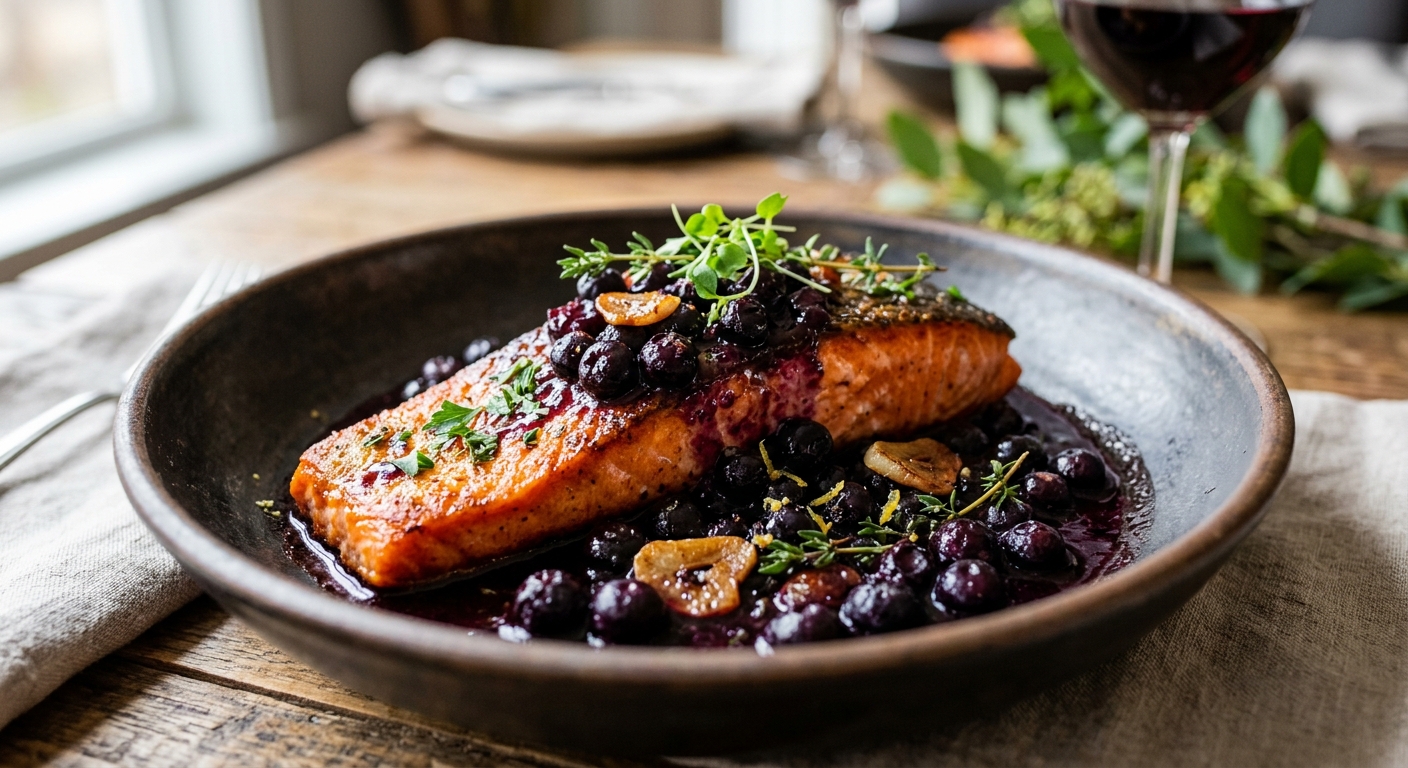
Sockeye salmon earns its deep crimson colour from astaxanthin, a ketocarotenoid synthesised by the microalgae the fish consumes throughout its life in cold Pacific waters. Unlike beta-carotene or lycopene, astaxanthin is never converted to vitamin A in the body, meaning its full antioxidant capacity remains intact to quench singlet oxygen and neutralise lipid peroxidation in cell membranes. Studies published in Marine Drugs consistently place astaxanthin’s antioxidant potency at 6,000 times that of vitamin C on a molar singlet-oxygen-quenching basis, making wild sockeye one of the most genuinely functional ingredients available at a grocery counter.
Wild blueberries, not their cultivated cousins, are the co-star here. Wild (lowbush) blueberries grow in challenging, acidic soils and respond by producing dramatically higher concentrations of anthocyanins, particularly delphinidin-3-glucoside and cyanidin-3-glucoside, compared to farmed highbush varieties. When reduced into a pan sauce with a splash of dry red wine and a whisper of fresh thyme, these pigments concentrate further, creating a glossy, jewel-toned sauce that pairs beautifully with the rich umami of the salmon while contributing measurable anti-inflammatory polyphenols to every bite.
Together, this pairing is a nutritional force multiplier. The fat-soluble astaxanthin in the salmon is absorbed dramatically better in the presence of dietary fat, and the olive oil used to sear the fish provides exactly that vehicle. Meanwhile, the organic acids in the blueberry sauce slightly acidify the digestive environment, which research suggests enhances non-heme iron absorption from the fish. Every element of this recipe has been calibrated not just for flavour but for bioavailability, so what you eat is genuinely what your body receives.
4
servings
Ingredients
- 680 gwild sockeye salmon fillets (4 x 170g portions, skin-on, pin bones removed)
- 2 tbspextra-virgin olive oil, divided
- 240 gwild (lowbush) blueberries, fresh or frozen
- 80 mldry red wine (such as Pinot Noir)
- 120 mllow-sodium chicken or fish stock
- 1 tbspraw honey
- 1 tbspaged balsamic vinegar
- 3 clovesgarlic, thinly sliced
- 1 smallshallot, finely minced
- 4 sprigsfresh thyme
- 1 tspfresh lemon zest
- 1 tbspfresh lemon juice
- 1 tbspcold unsalted butter, cut into small cubes
- 1 tspsmoked paprika
- 0.5 tspground black pepper, plus more to taste
- —Colima Sea SaltMicroplastic Free Salt to taste
Instructions
Click on an item below to shop for the recommended items for this recipe on Amazon.
As an Amazon Associate, we earn from qualifying purchases.
- Remove the salmon fillets from the refrigerator 15 minutes before cooking to allow them to come toward room temperature. This promotes even cooking and prevents the albumin (white protein) from seizing and squeezing out of the flesh prematurely. Pat each fillet completely dry with paper towels on both sides, as surface moisture is the single biggest enemy of a proper sear. Season generously with fine sea salt, the smoked paprika, and black pepper, pressing the spices lightly into the flesh.
- Heat a 30cm (12-inch) stainless steel or cast iron skillet over medium-high heat for 2 full minutes until the pan is uniformly hot. Add 1 tablespoon of the olive oil and swirl to coat. The oil should shimmer immediately and begin to show faint wisps of smoke at the edges. Lay the salmon fillets skin-side down in the pan, pressing each one gently with a fish spatula for the first 30 seconds to prevent the skin from curling. Cook undisturbed for 4 to 5 minutes until the skin is deeply golden and releases cleanly from the pan. Flip and cook flesh-side down for 2 to 3 minutes more until an internal temperature of 52 to 54 degrees Celsius (125 to 130 degrees Fahrenheit) is reached for medium. Transfer to a warm plate and tent loosely with foil.
- Reduce heat to medium. Add the remaining 1 tablespoon of olive oil to the same skillet, preserving all the browned fond. Add the minced shallot and cook, stirring frequently, for 90 seconds until softened and translucent. Add the sliced garlic and thyme sprigs and cook for a further 45 seconds, stirring constantly, until fragrant but not browned.
- Pour in the red wine and use a wooden spoon or silicone spatula to scrape up every bit of caramelised fond from the pan bottom. This deglazing step is critical: those browned bits carry deep savoury flavour and will dissolve completely into the sauce. Allow the wine to reduce by half, about 2 minutes, then add the blueberries, stock, honey, and balsamic vinegar. Increase heat to medium-high and cook the sauce, stirring occasionally and gently pressing some of the blueberries with the back of a spoon to release their juices, for 5 to 6 minutes until the sauce has reduced to a glossy, lightly syrupy consistency that coats the spoon.
- Remove the thyme sprigs. Remove the pan from the heat and stir in the lemon zest, lemon juice, and the cold butter cubes one at a time, swirling the pan between each addition. This technique, called mounting with butter (monter au beurre), emulsifies the fat into the sauce, giving it a velvety sheen without breaking. Taste and adjust seasoning. Return the salmon to the pan, skin-side up, and spoon the warm sauce over the top. Serve immediately.
- Build the blueberry braising base directly in the slow cooker insert without any pre-cooking. Combine the blueberries, red wine, stock, honey, balsamic vinegar, sliced garlic, minced shallot, thyme sprigs, smoked paprika, and black pepper in the insert. Stir to combine. The liquid components should just barely cover the bottom of the insert in a shallow layer; you want the salmon to rest above a bath of sauce, not submerge in it. Season the mixture lightly with sea salt.
- Pat the salmon fillets dry with paper towels and season all over with sea salt and a small additional pinch of smoked paprika. Place the fillets skin-side down in a single layer on top of the blueberry mixture, spacing them so they are not overlapping. Drizzle the olive oil evenly over the tops of the fillets. This fat layer protects the surface from drying out and helps carry the astaxanthin into the sauce as it renders slightly.
- Place the lid on the slow cooker and cook on Low for 1.5 to 2 hours. Begin checking at the 1.5-hour mark. The salmon is ready when the flesh has turned from translucent to opaque throughout, flakes gently when pressed with a fork at the thickest point, and reaches an internal temperature of 52 to 54 degrees Celsius (125 to 130 degrees Fahrenheit) for medium. If you prefer well-done, cook to 60 degrees Celsius (140 degrees Fahrenheit), noting the texture will be firmer.
- Using a wide fish spatula, carefully transfer the salmon fillets to a warm serving platter. Turn the slow cooker to High and cook the blueberry sauce uncovered for 15 to 20 minutes, stirring occasionally, until it reduces and thickens to a glossy consistency. Alternatively, pour the sauce into a small saucepan and reduce it over medium-high heat on the stovetop for 5 to 7 minutes for faster results.
- Remove and discard the thyme sprigs. Remove the finished sauce from the heat, stir in the lemon zest, lemon juice, and cold butter cubes one at a time, swirling until fully emulsified. Taste and correct seasoning. Spoon the sauce generously over the poached salmon fillets and serve immediately alongside a leafy green or steamed vegetable.
- Add the red wine, stock, blueberries, honey, balsamic vinegar, sliced garlic, minced shallot, thyme sprigs, smoked paprika, and black pepper to the Instant Pot inner pot. Stir briefly to combine. The liquid is used both to create steam for cooking and to form the base of your sauce. Place the trivet (steam rack) into the pot, ensuring its legs rest on the bottom and it sits above the liquid.
- Pat the salmon fillets completely dry and season all sides with sea salt and a pinch of smoked paprika. Lightly brush or drizzle 1 tablespoon of olive oil over each fillet. Place the seasoned fillets skin-side down on the trivet in a single layer. If your pot is smaller and two fillets must be stacked, place a small sheet of parchment paper between layers. Lock the lid and set the steam release valve to Sealing.
- Select Manual or Pressure Cook and set to High Pressure for 3 minutes. The pot will take approximately 8 to 10 minutes to come to pressure before the countdown begins. When the 3 minutes of cooking time are complete, immediately perform a Quick Release (move the valve to Venting) to stop the cooking process at once. Waiting for natural release will result in overcooked, dry salmon. The internal temperature of the fillets should read 52 to 57 degrees Celsius (125 to 135 degrees Fahrenheit) at the thickest point.
- Carefully remove the trivet with the salmon fillets and set aside on a warm plate, tented with foil. Remove the thyme sprigs from the pot. Select the Saute function on High and cook the blueberry liquid, stirring frequently and pressing the blueberries with the back of a spoon, for 6 to 8 minutes until the sauce reduces by roughly one-third and reaches a glossy, lightly thickened consistency.
- Turn off the Saute function and allow the bubbling to subside for 30 seconds. Stir in the lemon zest, lemon juice, and cold butter cubes, adding them one at a time and stirring vigorously after each addition to create a smooth, emulsified sauce. Taste and adjust salt and pepper. Plate the salmon, spoon the vivid blueberry sauce over each fillet, and serve immediately.
- Preheat your oven to 200 degrees Celsius (400 degrees Fahrenheit) with a rack positioned in the upper-middle position. While the oven heats, place a 30cm (12-inch) oven-safe skillet (cast iron or stainless steel) on the stovetop over medium heat. Add 1 tablespoon of olive oil and saute the minced shallot for 2 minutes until soft. Add the sliced garlic and cook for 45 seconds. Pour in the red wine and let it sizzle and reduce by half, about 90 seconds, then add the blueberries, stock, honey, balsamic vinegar, and thyme sprigs. Stir and cook for 3 to 4 minutes until the blueberries begin to burst and the liquid is heated through. Remove from heat.
- Pat the salmon fillets dry and season generously on all sides with sea salt, smoked paprika, and black pepper. Nestle the fillets skin-side down into the blueberry sauce in the skillet, spacing them evenly. The sauce should come up around the sides of the fish but not cover the tops. Drizzle the remaining tablespoon of olive oil evenly over the exposed flesh of each fillet to encourage surface caramelisation in the oven.
- Transfer the skillet to the preheated oven and roast for 14 to 16 minutes. The exact time depends on the thickness of your fillets; a 170g fillet that is 2.5cm (1 inch) thick at its thickest point will be perfectly cooked at 14 minutes. Look for the flesh to have changed colour from translucent to opaque throughout, a light browning on the top surface, and an internal temperature of 52 to 57 degrees Celsius (125 to 135 degrees Fahrenheit). The blueberry sauce will have reduced and deepened in colour around the fish.
- Remove the skillet from the oven using heavy oven mitts; the handle will be extremely hot. Place the skillet on a heatproof surface and allow it to rest for 2 minutes. The residual heat will continue cooking the fish slightly. Using a fish spatula, transfer the salmon fillets to serving plates. Return the skillet to medium heat on the stovetop, discard the thyme sprigs, and reduce the sauce for a further 2 minutes if it needs more body.
- Take the skillet off the heat, then stir in the lemon zest, lemon juice, and cold butter cubes one at a time, swirling vigorously to mount the sauce into a glossy emulsion. Taste and adjust seasoning. Spoon the finished blueberry pan sauce generously over each roasted salmon fillet and garnish with an extra pinch of lemon zest if desired.
Nutrition Breakdown
Per 1 serving (makes 4)
Vitamins & Minerals
% Daily Value based on a 2,000 calorie diet (FDA reference)
🧬 Essential Amino Acids
% of recommended daily intake (RDA) per serving
🛡 Antioxidant Profile
The Nutrition Science
Astaxanthin belongs to the xanthophyll subclass of carotenoids and carries both polar end groups and a long conjugated polyene chain, a molecular geometry that allows it to span the full width of a phospholipid bilayer and protect both the interior and exterior faces of the membrane simultaneously. This is a structural capability that beta-carotene and lycopene cannot match, as those carotenoids anchor only within the hydrophobic core. Research in the Journal of Nutritional Science and Vitaminology has demonstrated that dietary astaxanthin significantly reduces plasma levels of malondialdehyde (MDA), a key biomarker of lipid peroxidation, at doses as low as 2 to 4mg per day, a quantity provided by a single 170g serving of wild sockeye salmon.
Wild blueberry anthocyanins operate through a complementary mechanism. Rather than directly scavenging reactive oxygen species at the cellular level, the dominant anthocyanins in lowbush varieties, particularly delphinidin-3-galactoside and cyanidin-3-glucoside, modulate inflammatory gene expression by inhibiting the translocation of nuclear factor kappa B (NF-kB), a master transcription factor that governs the production of pro-inflammatory cytokines including TNF-alpha, IL-1beta, and IL-6. This upstream gene-regulatory action means blueberry polyphenols address inflammation at a fundamental level rather than simply mopping up its downstream consequences. Cooking the blueberries into a reduction concentrates these pigments and increases the proportion of free aglycone forms, which some research suggests exhibit higher bioavailability due to passive diffusion across intestinal epithelial cells.
The omega-3 fatty acids EPA and DHA in sockeye salmon are the substrate from which the body enzymatically produces specialised pro-resolving mediators (SPMs), a family of molecules including resolvins, protectins, and maresins that actively resolve established inflammation rather than merely suppressing its onset. This is a critical distinction from non-steroidal anti-inflammatory drugs, which inhibit prostaglandin synthesis but do not promote resolution. At the 2,100mg EPA+DHA dose delivered by this recipe, clinical evidence supports measurable reductions in circulating triglycerides and modest improvements in endothelial function with regular consumption, reinforcing the dish’s classification as a genuine functional food rather than a marketing construct.
Pro Tips
- Always buy wild-caught Alaskan sockeye (Oncorhynchus nerka) rather than farmed Atlantic salmon for this recipe. Farmed salmon contains dramatically lower astaxanthin (which is synthetically supplemented, not diet-derived) and significantly fewer omega-3s relative to its omega-6 content, which can actually increase net inflammatory burden.
- Frozen wild blueberries are nutritionally equivalent to fresh and often superior in polyphenol content, as they are harvested and frozen at peak ripeness. If using frozen, do not thaw before adding to the sauce; add them directly from frozen and extend the reduction time by 2 to 3 minutes.
- The cold butter mounting step (monter au beurre) is non-negotiable for sauce quality. The butter must be cold and added off the heat to form a stable emulsion. If the sauce breaks (appears greasy and separated), add a teaspoon of cold water and whisk vigorously to bring it back together.
hey diane thats awesome your trying to get them more d3 honestly! have you checked out the net carb count on that blueberry sauce? im asking because i’ve found when people are deficient in vitamins like d it usually correlates with some metabolic stuff, and getting them on lower carb whole foods like the salmon base here can actually help their bodies absorb and utilize the d better. the salmon itself is perfect zero carb protein, and even kids tend to go for it if you just pan sear it with butter and salt. might be worth trying the salmon part without the sauce first to see if they’ll eat it, then you can always drizzle the blueberry reduction on your portion
Love this practical breakdown, Kurt! You’re touching on something really important about nutrient absorption, and I’d gently add that the bioavailability piece goes even deeper, especially for vitamin D. Since it’s fat-soluble, pairing that salmon with healthy fats (like the butter you mentioned, or even a drizzle of quality oil) actually helps their bodies absorb and utilize that D3 way better than D alone would. That said, I’m also thinking about Diane’s family specifically, since fish resistance is so real, especially in households where ancestral diets don’t center seafood, and that’s completely valid! Have you considered other vitamin D and B12 powerhouses like mushrooms (
omg YES this is exactly what im looking for!! okay so real talk, my family wont touch fish like ever, but ive been trying to get more vitamin d into them since we all tested deficient last year and this might actually work because blueberries are like the ONE fruit my kids will eat. quick question though – would this work with regular salmon instead of sockeye or would i lose a lot of that astaxanthin punch? and do you think i could sneak some cooked spinach into the pan sauce without making it look weird lol im always trying to layer the nutrition without making it obvious. sounds absolutely delicious either way!