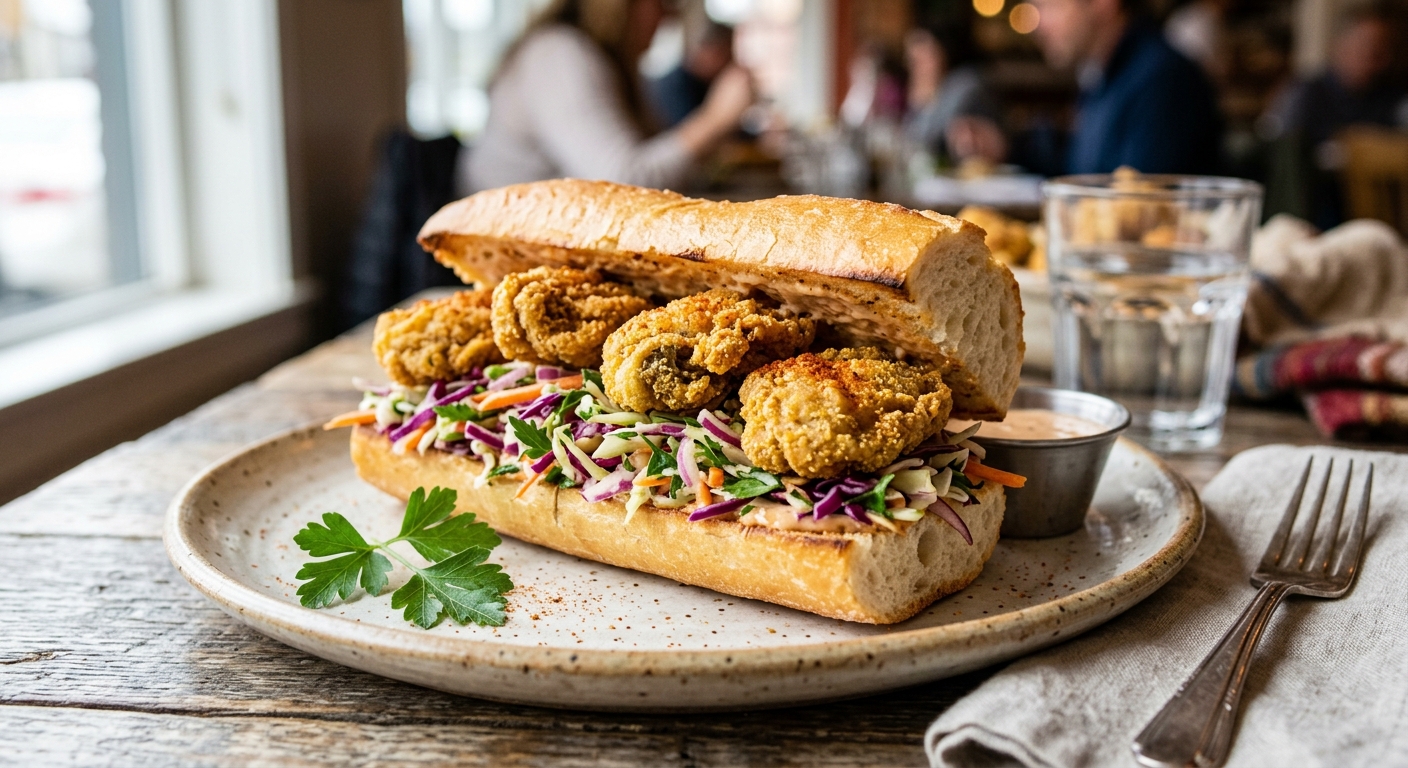
Few ingredients in the entire food kingdom rival the oyster when it comes to raw mineral density. A single serving of oysters provides more zinc than almost any other food on earth, and zinc is the mineral that quietly runs your immune system, wound healing, protein synthesis, and hormonal balance. We’ve taken this Gulf Coast icon and built a po’ boy around it that doesn’t just taste extraordinary, it genuinely moves the needle on your nutritional status in a single meal.
The slaw is no afterthought. Shredded purple cabbage, julienned carrots, and thinly sliced radishes bring a trifecta of vitamin C (which dramatically boosts iron absorption from the oysters), folate, and sulforaphane-producing glucosinolates. The dressing layers apple cider vinegar and a touch of raw honey over a base of Greek yogurt, keeping the fat profile lean while adding calcium and probiotics. Together, the slaw and the oyster filling create a meal with genuine cross-nutrient synergy, where each component makes the others more bioavailable.
We’ve developed four cooking methods for the oysters themselves, each yielding a different texture and flavor profile while preserving the mineral payload. The stovetop pan-fry delivers the classic shatteringly crispy crust. The oven-bake method gives you a lighter, hands-off result perfect for feeding a crowd. The pressure cooker and slow cooker methods are adapted for a warm, sauced oyster filling more akin to a dressed, smoky remoulade-braised sandwich than a fried one, ideal when you want all the flavor and mineral density without the frying step entirely. Choose your adventure, the zinc is waiting.
4
servings
Ingredients
- 480 gshucked oysters (about 24 medium oysters), drained and patted dry
- 4 wholehoagie rolls or French po’ boy rolls, split
- 120 gfine yellow cornmeal
- 60 gall-purpose flour
- 1 tspsmoked paprika
- 1 tspgarlic powder
- 0.5 tspcayenne pepper
- 2 largeeggs, beaten
- 60 mlbuttermilk
- 200 mlAvocado Oil100% Pure Avocado Oil (avocado or refined sunflower) for frying
- 200 gpurple cabbage, finely shredded
- 100 gcarrots, julienned or coarsely grated
- 80 gradishes, thinly sliced into rounds
- 30 gflat-leaf parsley, roughly chopped
- 120 gfull-fat Greek yogurt
- 2 tbspapple cider vinegar
- 1 tspraw honey
- 1 tspDijon mustard
- 2 tbspextra-virgin olive oil
- 2 clovesgarlic, minced
- 1 tbsphot sauce (such as Crystal or Tabasco), plus more to serve
- 1 tbspWorcestershire sauce
- 2 tbspunsalted butter
- 1 wholelemon, cut into wedges
- —Colima Sea SaltMicroplastic Free Salt and freshly ground black pepper to taste
Instructions
Click on an item below to shop for the recommended items for this recipe on Amazon.
As an Amazon Associate, we earn from qualifying purchases.
- Make the slaw first so it can macerate while you cook. Whisk together the Greek yogurt, apple cider vinegar, raw honey, Dijon mustard, and olive oil in a large bowl until smooth. Season generously with salt and pepper. Add the shredded purple cabbage, julienned carrots, sliced radishes, and chopped parsley. Toss thoroughly until every strand is coated. Cover and refrigerate for at least 15 minutes to allow the cabbage to soften slightly and the flavors to meld.
- Set up your dredging station. In one shallow bowl, whisk together the beaten eggs and buttermilk. In a second shallow bowl, combine the cornmeal, flour, smoked paprika, garlic powder, cayenne, 1 teaspoon of fine sea salt, and a generous grind of black pepper. Mix well.
- Pat the drained oysters completely dry with paper towels. This is critical: surface moisture will cause violent oil splattering and prevent crust formation. Working in batches, dip each oyster in the egg-buttermilk mixture, let the excess drip off, then press firmly into the cornmeal mixture, turning to coat all sides. Set coated oysters on a wire rack while you finish the batch.
- Pour the neutral oil into a large, heavy-bottomed skillet (cast iron is ideal) to a depth of about 1.5 cm. Heat over medium-high until the oil reaches 180 degrees C (350 degrees F), or until a pinch of cornmeal dropped in sizzles immediately. Carefully add the oysters in a single layer, leaving space between each one. Fry for 2 to 3 minutes until the underside is deep golden brown, then flip and fry for another 1 to 2 minutes. Internal texture should be firm at the edges but still slightly creamy in the centre.
- Transfer the fried oysters to a clean wire rack set over a baking sheet. Never drain on paper towels, as the steam will soften your crust. Season immediately with a pinch of flaky salt. Repeat with remaining oysters, monitoring oil temperature between batches and adjusting heat as needed.
- While the final batch fries, lightly toast the split rolls in a dry pan or under the broiler for 1 to 2 minutes until the cut sides are golden. To assemble, spoon a generous mound of slaw onto the base of each roll, pile 5 to 6 fried oysters on top, add a dash of hot sauce, and finish with a squeeze of lemon. Serve immediately.
- Preheat your oven to 230 degrees C (450 degrees F) with a wire rack set inside a rimmed baking sheet on the centre rail. Allowing the rack and pan to preheat with the oven is key: the instant heat from below helps set the crust on contact. Make the slaw as described in Step 1 of the Stovetop method and refrigerate.
- Prepare the dredging station as in the Stovetop method: egg-buttermilk wash in one bowl, the seasoned cornmeal-flour mixture in another. Pat the oysters completely dry. Dredge each oyster through the egg wash, then press into the cornmeal mixture to coat all sides thoroughly. Place coated oysters on a plate as you work.
- Remove the preheated rack and pan from the oven carefully. Working quickly, spray or brush the rack generously with avocado oil. Arrange the dredged oysters in a single layer on the hot rack with at least 2 cm of space between them. Spray or drizzle a little additional oil over the tops of the oysters to encourage browning.
- Return the pan to the oven and bake for 10 minutes without opening the door. After 10 minutes, carefully flip each oyster using tongs and bake for a further 6 to 8 minutes until the crust is deep golden and audibly crisp when tapped with a fork. The higher heat and preheated rack replicate the effect of shallow frying.
- While the oysters finish, toast the rolls cut-side up under the broiler for 1 to 2 minutes. Remove the oysters from the oven, season lightly with flaky salt, and assemble immediately: slaw on the base, oysters on top, hot sauce, and a firm squeeze of lemon wedge. Serve at once, as oven-baked coatings lose their crunch faster than pan-fried ones.
- Make the slaw first and refrigerate as described in Step 1 of the Stovetop method. The cold, crunchy slaw is especially important as a textural counterpoint to the soft, sauced oysters in this version.
- In a small bowl, build the slow cooker sauce: whisk together the minced garlic, hot sauce, Worcestershire sauce, smoked paprika, garlic powder, cayenne, 2 tablespoons of olive oil, the butter (cut into small pieces), and a good pinch of salt and pepper. This concentrated sauce will loosen and coat the oysters as they release their liquor during cooking.
- Pour half the sauce into the base of the slow cooker insert and spread evenly. Add the drained oysters in a mostly single layer, then pour the remaining sauce over the top, turning the oysters gently to coat. Do not add any additional water or stock: oysters hold significant liquid that will release and create a naturally briny, mineral-rich braising liquid.
- Set the slow cooker to High and cook for 1.5 hours. The oysters are done when they are plump, opaque, and coated in a glossy, reduced sauce. If any oysters appear to be curling significantly at the edges before the time is up, switch to the Keep Warm setting immediately to avoid overcooking.
- To serve, lightly toast the rolls. Spoon a generous mound of cold slaw onto each roll base. Using a slotted spoon, pile 5 to 6 sauced oysters on top, then drizzle a little of the concentrated cooking sauce over the filling. Add extra hot sauce and a squeeze of lemon. The contrast of warm, sauced oysters against cold, acidic slaw is the defining characteristic of this version.
- Prepare the slaw and refrigerate as directed. Make sure the slaw is fully assembled and chilled before you start the pressure cooker, since the oyster cook cycle is very short and you will want to assemble and serve immediately.
- Select the Saute function on your Instant Pot or electric pressure cooker (or use the stovetop version over medium heat). Add the butter and olive oil to the insert. Once the butter foams, add the minced garlic and cook, stirring constantly, for 60 seconds until fragrant but not browned. Add the hot sauce, Worcestershire sauce, smoked paprika, garlic powder, cayenne, and a pinch of salt. Stir to combine into a thick aromatic base.
- Add 60 ml of water to the insert and stir to deglaze, scraping up any garlic from the bottom (this prevents the burn notice on electric models). Add the drained oysters and toss gently in the sauce to coat. The oysters should be in a mostly single layer if possible.
- Secure the lid and set the pressure release valve to Sealing. Cook on High Pressure for 2 minutes. The moment the cook time ends, perform an immediate Quick Release by carefully turning the valve to Venting. Do not use Natural Release, as the residual heat will continue cooking the oysters and they will toughen.
- Open the lid and assess the oysters: they should be plump, opaque, and swimming in a rich, garlic-scented butter sauce. If the sauce looks very thin, switch back to Saute mode and simmer for 1 to 2 minutes, stirring gently, until it reduces slightly and clings to the oysters. Toast the rolls, layer cold slaw on the base, spoon the garlic butter oysters on top with a generous drizzle of pan sauce, and finish with a squeeze of lemon and extra hot sauce.
Nutrition Breakdown
Per 1 serving (makes 4)
Vitamins & Minerals
% Daily Value based on a 2,000 calorie diet (FDA reference)
🧬 Essential Amino Acids
% of recommended daily intake (RDA) per serving
🛡 Antioxidant Profile
The Nutrition Science
Oysters are the undisputed champion of dietary zinc, providing more of this essential mineral per gram than any other food, including red meat. Zinc is a cofactor for over 300 enzymatic reactions in the human body, regulating DNA synthesis, immune cell proliferation (particularly natural killer cells and T-lymphocytes), wound healing, taste and smell perception, and testosterone synthesis. The 33 mg of zinc per serving in this recipe represents 300% of the daily value, which is important context: zinc is not efficiently stored in the body, and mild deficiency is far more common than most people realize, particularly among athletes, vegans, and older adults whose absorption capacity declines with age.
The slaw is a masterclass in nutritional synergism. Purple cabbage and carrots deliver a substantial dose of vitamin C (52 mg per serving), and vitamin C is one of the most potent natural enhancers of non-heme iron absorption. By consuming it alongside the 9.8 mg of iron in the oysters, you are converting more of that iron from its less bioavailable form into a form your gut can efficiently absorb. Simultaneously, the apple cider vinegar in the dressing lowers the pH of the meal, which further enhances the solubility of mineral ions, including zinc and iron, in the digestive tract. This is nutritional architecture, not accident.
Selenium in oysters exists largely as selenocysteine, the organic form that is integrated directly into glutathione peroxidase (GPx) enzymes, your body’s primary antioxidant defense system. Unlike supplemental selenium, which must be converted before use, the selenocysteine in oysters is immediately bioavailable and is incorporated into GPx with remarkable efficiency. The 68 mcg per serving represents 124% of the daily value and provides meaningful protection against lipid peroxidation in cell membranes, a process implicated in cardiovascular disease, neurodegeneration, and accelerated cellular aging. Combined with vitamin B12 at 583% DV (critical for myelin sheath integrity and red blood cell formation), this dish delivers a level of micronutrient density that very few single meals can match.
Pro Tips
- Always pat oysters completely dry before dredging: surface moisture is the enemy of crust formation in both pan-frying and oven-baking, and it causes dangerous oil splatter on the stovetop.
- Make the slaw at least 15 to 30 minutes ahead regardless of cooking method. The salt and acid in the dressing begin to break down the tough cell walls of the purple cabbage, transforming it from raw and astringent to tender and lightly pickled.
- For the slow cooker and pressure cooker versions, do not discard the cooking liquid. It is an extraordinarily mineral-rich broth: drizzle it over the assembled sandwich or save it as a base for a seafood soup. A single tablespoon contains a meaningful concentration of zinc, B12, and copper released from the oysters during cooking.
- Source your oysters from a reputable fishmonger and use them within 24 hours of purchase. Freshness is not only a food safety issue but a flavor one: older oysters develop a flat, metallic quality that no amount of seasoning can mask.
- To make this dish gluten-free, substitute a certified gluten-free 1-to-1 flour blend for the all-purpose flour in the dredge, and use gluten-free rolls. All other ingredients, including the cornmeal, are naturally gluten-free. Ensure your Worcestershire sauce is also labeled gluten-free, as some brands contain malt vinegar.
oh wow the oyster and mineral combo is absolutely *chef’s kiss* but ive been thinking about what you mentioned about histamine – have you ever tried fermenting your slaw components separately before mixing them? i make a killer fermented cabbage situation that honestly seems to help my own histamine sensitivity, plus the live cultures might give you extra gut support on top of all those minerals youre getting! the fermentation process actually breaks down some of those histamines naturally so it could be a game changer for your oyster tolerance
This looks amazing, but I wanted to flag that oysters, while nutritionally incredible, can be pretty high in histamine depending on freshness and storage. I’ve had to get very selective about which seafood I can tolerate, and I’ve found that only the freshest oysters (ideally shucked same-day) work for me. A couple questions: what’s in the slaw? If it includes vinegar, fermented ingredients, or aged cheeses, those could be histamine bombs for folks like me. Would love to know if you have any low-histamine slaw swap suggestions, like using fresh lemon juice instead of vinegar!
Oh Lorraine, I totally get this – histamine sensitivity has been such a game changer in understanding my IBS flares, and I’ve noticed oysters are definitely a trigger for me unless they’re super fresh too! The slaw ingredient list is crucial here, because I’ve learned the hard way that fermented cabbage, vinegar, and aged anything can wreck my digestion for days / I’m curious if the blog used any of those since they weren’t listed in the excerpt. Fresh lemon juice is such a smart swap – I started doing that about two years ago and it completely changed how I can tolerate raw slaws now, plus the vitamin C helps with iron absorption which is a win-win!