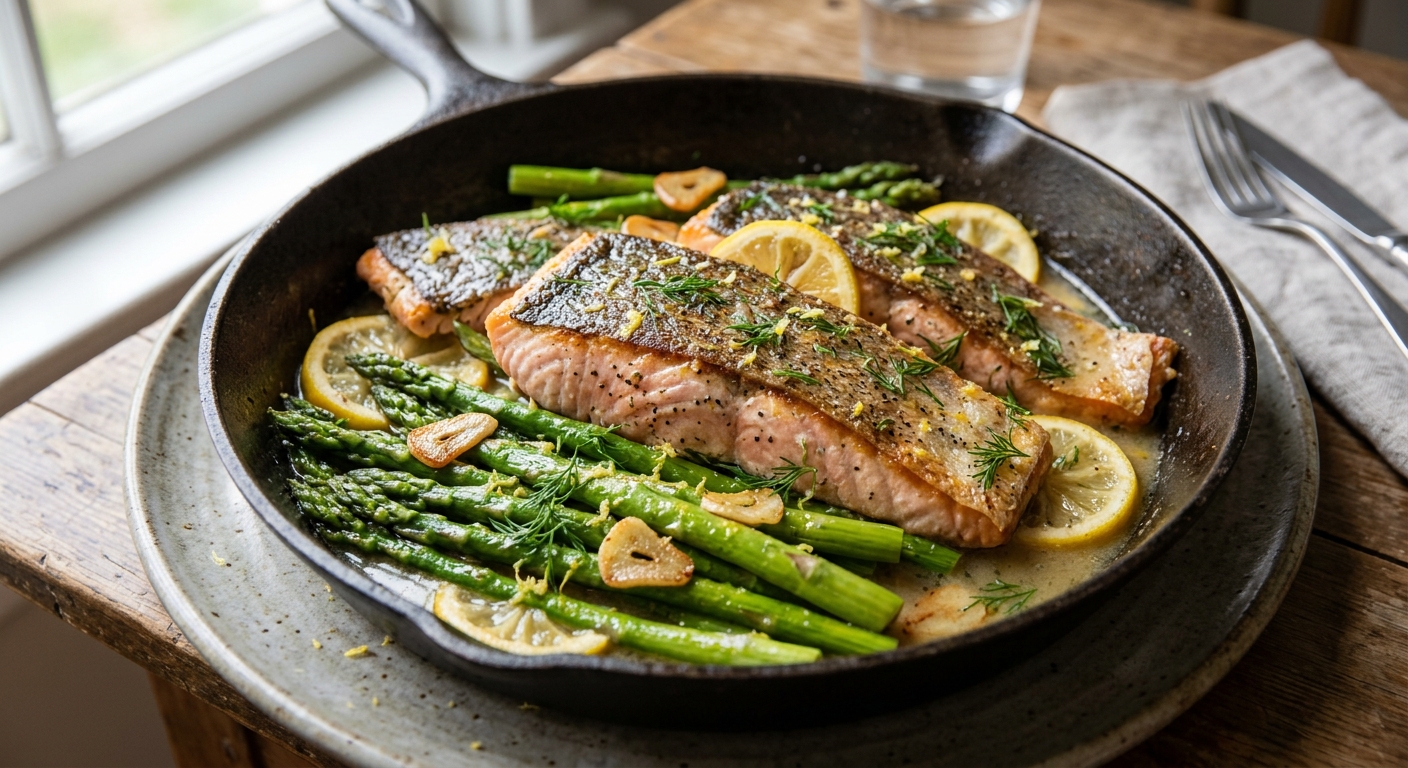
Rainbow trout is one of the most nutritionally dense freshwater fish you can put on your plate, yet it flies quietly under the radar compared to its more famous cousin, salmon. A single 150g fillet provides well over 100% of your daily vitamin D requirement and a remarkable 130% of vitamin B12, two nutrients that are chronically under-consumed in modern diets and almost exclusively found in animal products. Pair it with asparagus, one of the plant kingdom’s richest sources of folate, and you have a dish that reads like a multivitamin label but tastes like something from a bistro menu.
The combination here is also strategically clever from a culinary standpoint. Asparagus contains natural glutamates that amplify the savory depth of the fish, while the lemon does double duty: it brightens the flavors on the palate and its vitamin C content enhances the absorption of the non-heme iron present in both the asparagus and the fish. A touch of extra-virgin olive oil carries the fat-soluble vitamins D and A across the gut lining, making this not just a nutritious dish but a nutritionally optimized one.
Whether you are managing a vitamin D deficiency, supporting neurological health through adequate B12 intake, or simply trying to eat with more intention, this recipe gives you a measurable, science-backed return on every bite. We have developed four distinct cooking methods, each with its own character: the stovetop version delivers a golden, crispy-skinned fillet; the oven method produces a gently roasted, herb-perfumed result; the pressure cooker keeps the fish impossibly moist; and the slow cooker creates a poached, almost silken texture that suits meal-prep beautifully.
4
servings
Ingredients
- 680 grainbow trout fillets (4 fillets, skin-on, about 170g each)
- 500 gfresh asparagus, tough ends snapped off
- 3 tbspextra-virgin olive oil
- 4 clovesgarlic, thinly sliced
- 2 wholelemons (1 zested and juiced, 1 sliced into rounds)
- 30 gunsalted butter
- 120 mldry white wine (such as Pinot Grigio or Sauvignon Blanc)
- 120 mllow-sodium vegetable or fish stock
- 2 tbspcapers, drained and rinsed
- 15 gfresh flat-leaf parsley, roughly chopped
- 10 gfresh dill, fronds picked
- 1 tspsmoked paprika
- 0.5 tspred pepper flakes
- —Colima Sea SaltMicroplastic Free Salt and freshly cracked black pepper to taste
Instructions
Click on an item below to shop for the recommended items for this recipe on Amazon.
As an Amazon Associate, we earn from qualifying purchases.
- Remove the trout fillets from the refrigerator 10 minutes before cooking. Pat them completely dry on both sides with paper towels, including the skin. Season generously with salt, pepper, and smoked paprika on the flesh side only. Drying and seasoning ahead of time is the single most important step for a crispy skin.
- Heat 2 tablespoons of olive oil in a large (30cm) cast iron or stainless steel skillet over medium-high heat until the oil shimmers and just begins to smoke at the edges. Lay the fillets skin-side down away from you into the pan. Immediately press each fillet firmly with a fish spatula for 15 seconds to prevent curling and ensure full skin contact with the pan. Cook, undisturbed, for 5 to 6 minutes until the skin is deeply golden and releases cleanly from the pan. The flesh will appear opaque about two-thirds of the way up.
- Flip the fillets carefully and cook flesh-side down for just 90 seconds. The residual heat will finish the interior. Transfer the fillets to a warm plate, skin-side up to preserve the crispness, and tent loosely with foil.
- Reduce the heat to medium. Add the remaining 1 tablespoon of olive oil to the same pan. Add the asparagus spears in a single layer and cook, turning occasionally, for 3 to 4 minutes until bright green and just tender with a slight snap. Season with salt and pepper. Transfer asparagus to the plate with the trout.
- With the pan still over medium heat, add the sliced garlic and red pepper flakes. Saute for 45 seconds until fragrant but not browned. Pour in the white wine and let it bubble vigorously, scraping up all the brown bits from the bottom of the pan with a wooden spoon. Add the stock, lemon zest, and lemon juice. Simmer for 2 to 3 minutes until reduced by about half.
- Remove the pan from heat. Add the butter and swirl the pan until it melts into the sauce and creates a glossy, slightly thickened emulsion. Stir in the capers and half the parsley. Taste and adjust salt and pepper.
- Return the asparagus to the pan and toss briefly to coat. Plate the asparagus first, lay a trout fillet on top skin-side up, and spoon the pan sauce generously over everything. Finish with fresh dill, the remaining parsley, and lemon rounds on the side.
- Preheat your oven to 220 degrees Celsius (425 degrees Fahrenheit) with a rimmed baking sheet inside on the middle rack. Preheating the pan is essential: it acts like a hot skillet and begins crisping the underside of the fish immediately on contact, mimicking the stovetop sear.
- While the oven heats, prepare the asparagus: toss the spears with 1.5 tablespoons of olive oil, half the sliced garlic, salt, pepper, and red pepper flakes in a large bowl. In a separate bowl, combine the remaining olive oil, lemon zest, smoked paprika, salt, and pepper. Pat the trout fillets dry and coat the flesh side with the lemon-paprika oil mixture.
- Carefully remove the hot baking sheet from the oven using heavy oven mitts. Working quickly, arrange the asparagus spears in a single layer on one side of the hot pan. Place the trout fillets skin-side down on the other side. Lay 2 to 3 lemon rounds on top of each fillet and scatter the remaining garlic slices across both the fish and asparagus.
- Return the pan to the oven. Roast for 14 to 16 minutes. The trout is done when the flesh flakes easily at the thickest point and the internal temperature reads 63 degrees Celsius (145 degrees Fahrenheit) on an instant-read thermometer. The asparagus should have lightly caramelized tips.
- While the fish roasts, make the finishing sauce on the stovetop: combine the white wine, stock, lemon juice, and capers in a small saucepan over medium heat. Simmer for 4 to 5 minutes until reduced by half, then remove from heat and whisk in the butter until glossy. Stir in half the parsley.
- Remove the pan from the oven. Drizzle the butter-caper sauce over the fish and asparagus directly on the baking sheet, or plate individually. Finish with fresh dill, remaining parsley, and roasted lemon rounds squeezed over the top just before serving.
- Build an aromatic base directly in the slow cooker insert: pour in the white wine and stock. Add the lemon zest, lemon juice, sliced garlic, capers, red pepper flakes, and half the dill fronds. Stir briefly to combine. This liquid becomes both the poaching medium and the serving broth, so taste it and adjust salt before adding the fish.
- Lay the lemon rounds in a single layer across the bottom of the slow cooker. This creates a rack that prevents the fish from sitting directly in the liquid and sticking to the insert, and it perfumes the underside of the fillets as they cook.
- Pat the trout fillets completely dry and season both sides with salt, pepper, and smoked paprika. Place the fillets skin-side down on top of the lemon rounds in a single layer. If your slow cooker is not wide enough for all four, slightly overlap the thinner tail ends rather than stacking.
- Arrange the asparagus spears around and slightly under the edges of the fish fillets. The asparagus will take longer to soften than the trout, so placing it in direct contact with the hot liquid is important. Drizzle the olive oil over everything.
- Cover and cook on Low for 1 hour and 30 minutes to 2 hours. Check at the 90-minute mark: the trout is done when the flesh is opaque throughout and separates easily along the natural flake lines when pressed gently with a spoon. The asparagus should be fully tender. Because slow cooker temperatures vary, check 15 minutes early the first time you make this.
- Using a wide spatula, carefully lift each fillet out of the poaching liquid and transfer to warmed shallow bowls. Remove the asparagus with tongs. Ladle the aromatic poaching broth generously over each portion. Whisk the butter into the remaining broth in the insert (the residual heat will melt it) for a richer finish. Finish with fresh parsley, remaining dill, and a lemon round on the side.
- Pour the stock, white wine, lemon juice, and lemon zest into the Instant Pot insert. Add the sliced garlic, capers, red pepper flakes, half the parsley, and half the dill. Stir to combine. Select the Saute function on Normal heat and bring the liquid to a simmer. Cook for 2 minutes to bloom the aromatics and drive off some of the raw alcohol from the wine. Cancel the Saute function.
- Place the metal steam trivet or a silicone steamer basket into the pot above the liquid. Pat the trout fillets dry, season both sides with salt, pepper, and smoked paprika, and drizzle with the olive oil. Lay the fillets skin-side down on the trivet in a single layer. Tuck the asparagus spears in around and between the fillets. Lay lemon rounds over the fish.
- Secure the lid and set the pressure release valve to Sealing. Select Pressure Cook (or Manual) on High Pressure and set the timer for 3 minutes. The pot will take approximately 5 to 7 minutes to come to pressure before the countdown begins.
- The moment the 3-minute timer beeps, immediately perform a Quick Release by carefully turning the pressure release valve to Venting. Keep your hand and face away from the steam. Once the float valve drops and all pressure is released, open the lid away from you.
- Check the trout for doneness: the flesh should be fully opaque and should flake easily at the thickest part. If any part looks translucent, replace the lid (without locking) and let it sit on the Keep Warm setting for 2 minutes. Carefully lift the trivet and transfer the fillets and asparagus to warmed plates.
- Select Saute on Normal heat and bring the cooking liquid to a boil. Simmer for 2 to 3 minutes until slightly reduced. Remove from heat, add the butter, and whisk to emulsify into a glossy finishing sauce. Spoon over the plated fish and asparagus. Garnish with the remaining parsley and dill, and serve with fresh lemon rounds.
Nutrition Breakdown
Per 1 serving (makes 4)
Vitamins & Minerals
% Daily Value based on a 2,000 calorie diet (FDA reference)
🧬 Essential Amino Acids
% of recommended daily intake (RDA) per serving
🛡 Antioxidant Profile
The Nutrition Science
Vitamin D from food exists almost exclusively in animal products, and fatty fish like rainbow trout are among the very few foods that provide it in clinically meaningful amounts. The form found in fish, vitamin D3 (cholecalciferol), is significantly more effective at raising serum 25-hydroxyvitamin D levels than the plant-derived D2 (ergocalciferol). A single 170g trout fillet provides roughly 16 to 17 micrograms of D3, which translates to over 100% of the recommended dietary allowance for adults up to age 70. This vitamin is essential not just for calcium absorption and bone density, but for immune modulation, insulin sensitivity, and neuromuscular function. Deficiency is associated with increased risk of multiple sclerosis, seasonal depression, and impaired immune response, making dietary sources critically important, especially in populations with limited sun exposure.
Vitamin B12 and folate work in a tightly coupled metabolic partnership: together they are essential for the methylation cycle, a biochemical process that regulates DNA synthesis, red blood cell formation, and the conversion of homocysteine to methionine. Elevated homocysteine is an independent risk factor for cardiovascular disease, and both B12 and folate are required to keep it in check. Rainbow trout is exceptional for B12, providing over 200% of the daily value per serving, while the asparagus contributes approximately 40 to 45% of the daily folate requirement. This pairing is particularly valuable for pregnant individuals, where adequate folate is critical for neural tube development, and for older adults, who absorb crystalline and food-bound B12 with decreasing efficiency as gastric acid secretion declines with age.
The omega-3 fatty acids (EPA and DHA) in trout do more than support cardiovascular health; they also have a meaningful impact on the bioavailability of the fat-soluble vitamins D and A present in this dish. Dietary fat triggers bile secretion in the small intestine, which emulsifies fat-soluble nutrients and packages them into micelles for absorption across the intestinal epithelium. This is why consuming vitamin D with a meal containing healthy fats, as this recipe is designed to do, can increase its absorption by up to 32% compared to consuming it in a fat-free context. The extra-virgin olive oil and natural fish fats in this recipe create an optimal absorption environment for every fat-soluble nutrient on the plate.
Pro Tips
- For the crispiest skin on the stovetop method, score the skin side of each fillet with 3 to 4 shallow diagonal cuts using a sharp knife. This prevents the fillet from bowing in the hot pan and ensures even skin-to-surface contact throughout cooking.
- To maximize folate retention in asparagus, cook it to just tender-crisp rather than soft. Folate is a water-soluble B vitamin that leaches into cooking water and degrades with prolonged heat; a 3 to 4 minute saute or a short roast retains significantly more than boiling for 8 or more minutes.
- Store any leftover trout separately from the asparagus and sauce in an airtight container for up to 2 days. To reheat without drying out the fish, place it in a covered skillet with a tablespoon of stock over low heat for 3 to 4 minutes, or serve it cold over salad greens with the sauce used as a dressing.

ok this is so legit! trout is seriously underrated as a post-WOD meal, the complete amino acid profile plus those omega-3s for inflammation management is *chef’s kiss*. and three days of vitamin D is no joke, especially if youre training hard and need that recovery support. the B12 and folate combo also hits differently when youre trying to optimize nutrient timing between sessions, definitely adding this to my meal prep rotation!
Oh this is literally my kind of meal, the vitamin D alone is such a game changer for hormone balance especially when managing insulin resistance. I’ve been upping my fatty fish intake since my PCOS diagnosis and I noticed my androgen levels actually started shifting in a good way, plus the lemon and asparagus combo is so smart for keeping blood sugar stable throughout digestion. Do you have any thoughts on how the cooking method impacts nutrient bioavailability here, or is pan-searing basically the sweet spot for keeping that D intact?
This sounds like such a nourishing meal for my thyroid health, especially with the selenium in trout supporting thyroid peroxidase function! I’m curious about the iodine content though – is the sea salt in the pan sauce iodized, or would you recommend adding a pinch of iodized salt separately? I’ve found that trout pairs beautifully with asparagus for me, and I’m wondering if this recipe would work well with ghee instead of butter if you’re using any, since I follow AIP most of the time. The lemon-herb sauce sounds perfect as is though!