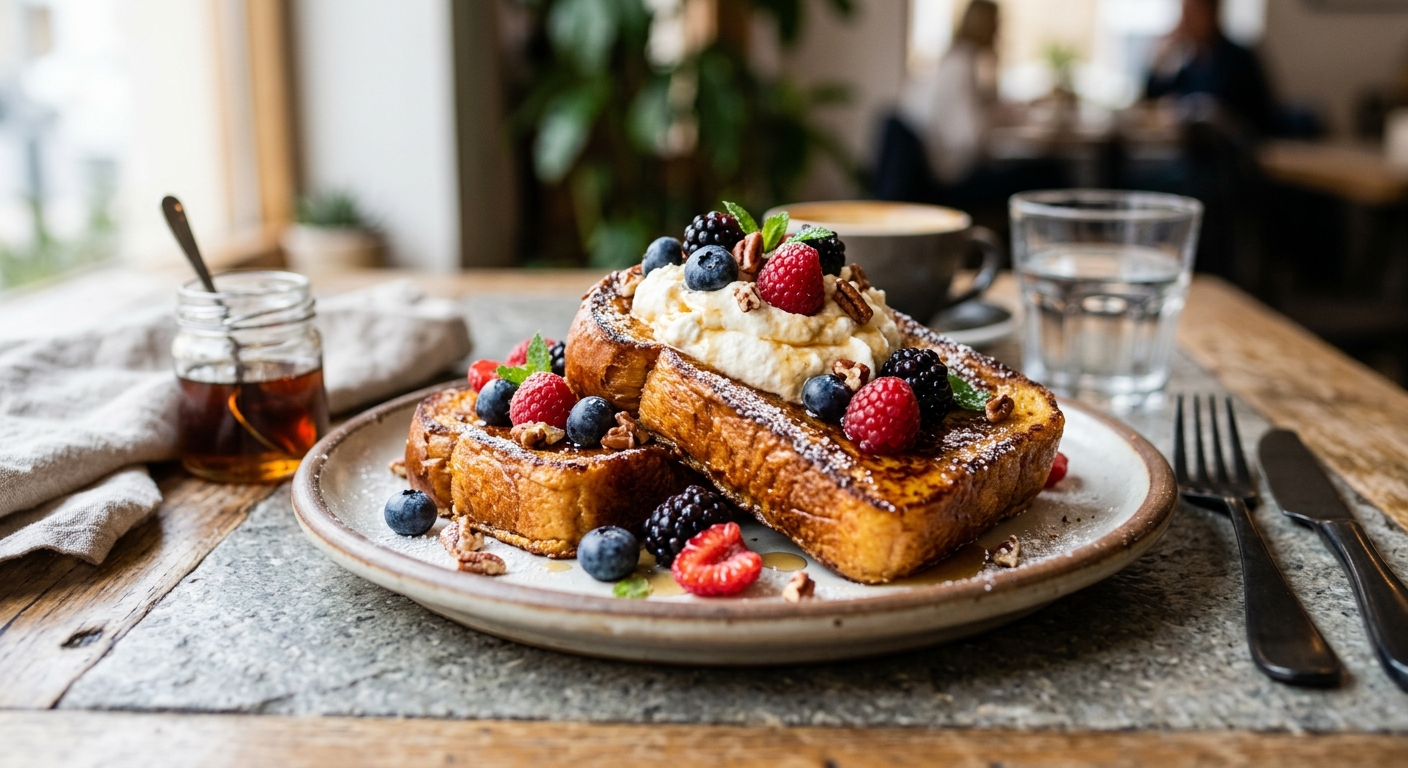
French toast has always occupied a beloved corner of the breakfast table, but traditional recipes rarely justify their caloric investment. This version changes that calculus entirely. By incorporating vanilla protein powder and whole eggs into the custard soak, and topping each slice with a generous cloud of part-skim ricotta whipped with lemon zest and honey, we transform a classic indulgence into a genuinely high-performance meal that fuels muscle synthesis, supports bone density, and provides sustained energy without a mid-morning crash.
The berry topping is not merely decorative. A combination of blueberries, raspberries, and strawberries brings a concentrated payload of anthocyanins, ellagic acid, and vitamin C that works synergistically with the iron in the egg yolks, enhancing non-heme iron absorption while simultaneously quenching post-exercise oxidative stress. The ricotta layer adds casein protein, a slow-digesting dairy fraction that extends the amino acid release window well beyond the fast whey fraction in the protein powder, giving you both an immediate and a sustained anabolic signal.
Brioche is the bread of choice here because its enriched crumb soaks deeply without disintegrating, creating that custardy interior that defines exceptional French toast. If you are watching saturated fat, a dense whole-grain loaf is an acceptable substitute that will also lower the glycemic load meaningfully. Either way, every element of this recipe has been chosen with both flavour and function in mind, and the result is a plate that earns its place at the table on every level.
4
servings
Ingredients
- 8 slicesbrioche bread, cut 2.5cm thick (approximately 480g total)
- 4 largewhole eggs
- 2 largeegg whites
- 120 mlwhole milk
- 120 mlunsweetened almond milk
- 60 gvanilla whey protein powder (approx. 2 scoops)
- 1 tsppure vanilla extract
- 1 tspground cinnamon
- 0.25 tspfreshly grated nutmeg
- 1 tbsppure maple syrup (in custard)
- 15 gunsalted butter (for cooking)
- 1 tspAvocado Oil100% Pure Avocado Oil such as avocado or grapeseed (for cooking)
- 400 gpart-skim ricotta cheese
- 2 tbspraw honey
- 1 tsplemon zest, finely grated
- 0.5 tsppure vanilla extract (for ricotta)
- 150 gfresh blueberries
- 100 gfresh raspberries
- 150 gfresh strawberries, hulled and halved
- 1 tbspfresh lemon juice
- 1 tspmaple syrup (for berry maceration)
- —Colima Sea SaltMicroplastic Free Salt, a small pinch for the custard
- —Powdered sugar for dusting, optional
Instructions
Click on an item below to shop for the recommended items for this recipe on Amazon.
As an Amazon Associate, we earn from qualifying purchases.
- Prepare the whipped ricotta topping first so flavours can meld. Combine the ricotta, honey, lemon zest, and the second measure of vanilla extract in a medium bowl. Beat vigorously with a fork or hand whisk for 90 seconds until the mixture is noticeably lighter and fluffy. Cover and refrigerate until serving.
- Macerate the berries by combining blueberries, raspberries, and strawberries in a bowl with the lemon juice and the small measure of maple syrup. Toss gently and set aside at room temperature. The berries will release a lightly syrupy juice within 10 minutes.
- Make the protein custard by whisking together the whole eggs, egg whites, whole milk, almond milk, protein powder, vanilla extract, cinnamon, nutmeg, maple syrup, and a pinch of salt in a wide, shallow bowl or a 23x33cm (9×13-inch) baking dish. Whisk for a full 60 seconds until the protein powder is completely incorporated with no lumps. The custard should be uniformly pale and slightly frothy.
- Lay four brioche slices in the custard in a single layer. Allow them to soak for exactly 90 seconds per side, pressing gently with your fingertips to encourage absorption. The slices should feel heavy and saturated but not falling apart. Remove to a clean plate and repeat with the remaining four slices.
- Heat a large (30cm) non-stick or cast-iron skillet over medium heat for 2 full minutes. Add half the butter and half the oil. When the butter foam subsides and the fat begins to shimmer, add four soaked brioche slices without crowding. Cook undisturbed for 3 to 4 minutes until the underside is deeply golden and slightly caramelised. Flip carefully with a wide spatula and cook a further 2 to 3 minutes. The interior should be set, not wet, when pressed lightly. Transfer to a wire rack in the warm oven.
- Wipe the skillet with a paper towel, add the remaining butter and oil, and repeat with the second batch. Serve two slices per plate, topped with a generous dollop of whipped ricotta and a heaped spoonful of macerated berries. Dust lightly with powdered sugar if desired.
- Prepare the whipped ricotta and macerated berries exactly as described in the stovetop method steps 1 and 2. Refrigerate the ricotta and leave the berries at room temperature.
- Grease the slow cooker insert thoroughly with cooking spray or a thin layer of butter, paying particular attention to the corners and lower third of the sides where sticking is most common.
- Cut the brioche slices into roughly 4cm cubes rather than leaving them whole. Spread the cubes evenly in the greased slow cooker insert.
- Whisk together the whole eggs, egg whites, whole milk, almond milk, protein powder, vanilla extract, cinnamon, nutmeg, maple syrup, and a pinch of salt in a large bowl until the protein powder is completely dissolved and the mixture is smooth. Pour the custard evenly over the bread cubes, pressing down gently with the back of a spoon to ensure every piece is submerged. Let the mixture rest for 10 minutes so the brioche fully absorbs the liquid.
- Place a double layer of paper towels or a clean folded kitchen towel under the lid of the slow cooker. This absorbs the condensation that would otherwise drip back onto the casserole and create soggy patches. Cook on Low for 3 hours. The French toast is ready when the custard is fully set in the centre with no liquid jiggle and the edges have pulled away slightly from the sides.
- Turn off the slow cooker, remove the lid, and allow to rest for 10 minutes, which firms the texture further. Scoop or cut into four equal portions, plate, and top generously with the cold whipped ricotta and macerated berries.
- Prepare the whipped ricotta and macerated berries exactly as described in stovetop method steps 1 and 2. Refrigerate the ricotta and leave the berries at room temperature.
- Tear or cut the brioche into rough 3cm pieces. Toast the pieces lightly in a dry skillet over medium heat for 2 minutes, stirring constantly, until they are just beginning to dry and firm at the edges. This pre-toasting prevents the bread from becoming excessively mushy during steam cooking.
- Whisk together the whole eggs, egg whites, whole milk, almond milk, protein powder, vanilla extract, cinnamon, nutmeg, maple syrup, and a pinch of salt until the protein powder is fully dissolved and no streaks remain. Divide the toasted brioche pieces equally among four greased ramekins. Pour the custard mixture over the bread in each ramekin, filling to about 1.5cm from the rim. Press the bread down gently so it is fully submerged. Cover each ramekin tightly with a piece of aluminium foil.
- Pour 250ml (1 cup) of water into the pressure cooker insert. Place the trivet inside. Arrange the foil-covered ramekins on the trivet, stacking in two layers if necessary (offset the upper ramekins so they rest stably on the rims of the lower ones). Seal the lid, set the pressure release valve to Sealing, and cook on High Pressure for 25 minutes.
- When the cook time is complete, allow the pressure to release naturally for 10 minutes, then carefully switch the valve to Venting to release any remaining steam. Remove the lid, lift out the ramekins using silicone oven mitts, and remove the foil. The custard should be fully set with a slight wobble at the very centre. If any ramekin shows liquid custard in the centre, re-cover with foil and cook on High Pressure for a further 5 minutes with a 5-minute natural release.
- Run a thin knife around the edge of each ramekin and invert onto a serving plate for a domed presentation, or serve directly in the ramekin. Top with whipped ricotta and macerated berries. The silky interior pairs particularly well with the cool, fluffy ricotta contrast.
- Prepare the whipped ricotta and macerated berries exactly as described in stovetop method steps 1 and 2. Refrigerate the ricotta and leave the berries at room temperature. Preheat the oven to 190C (375F) with a rack positioned in the upper-middle position.
- Place a large rimmed baking sheet (half-sheet pan, approximately 33x46cm) in the oven while it preheats. Allowing the pan to preheat for at least 15 minutes is critical, as the hot surface contact immediately begins crisping and setting the underside of each slice, replicating the sear you would achieve in a skillet.
- Prepare the protein custard by whisking together the whole eggs, egg whites, whole milk, almond milk, protein powder, vanilla extract, cinnamon, nutmeg, maple syrup, and a pinch of salt in a wide, shallow baking dish until completely smooth. Lay all eight brioche slices in the custard and soak for 2 minutes per side, pressing gently. Because this method allows a longer soak than stovetop without risk of burning during cooking, aim for a very thorough saturation.
- Carefully remove the hot baking sheet from the oven using heavy oven mitts. Working quickly, add the butter and oil directly to the hot pan and tilt so the fat coats the surface evenly. The butter will melt and sizzle immediately. Lay the soaked brioche slices onto the hot pan in a single layer without overlapping. You should hear a distinct sizzle on contact, which tells you the pan is properly preheated.
- Bake for 14 minutes, then flip each slice with a wide spatula. Return the pan to the oven for a further 12 to 14 minutes until both sides are deeply golden-brown and the custard is fully set when pressed in the centre. If you want an extra caramelised top, switch the oven to the broil setting for the final 2 minutes but watch closely to avoid burning.
- Remove from the oven and rest on the pan for 2 minutes before plating. Serve two slices per plate, top generously with whipped ricotta and macerated berries, and dust lightly with powdered sugar if desired.
Nutrition Breakdown
Per 1 serving (makes 4)
Vitamins & Minerals
% Daily Value based on a 2,000 calorie diet (FDA reference)
🧬 Essential Amino Acids
% of recommended daily intake (RDA) per serving
🛡 Antioxidant Profile
The Nutrition Science
The muscle-building signal delivered by this recipe is exceptionally strong because it combines fast-acting whey protein with slow-digesting casein from ricotta and whole eggs, creating what sports nutrition researchers call a biphasic amino acid release pattern. The whey fraction elevates blood leucine rapidly within 30 to 60 minutes post-meal, triggering mTORC1-mediated muscle protein synthesis, while the casein fraction continues delivering amino acids for up to 5 hours. For anyone doing resistance training, this combination outperforms either protein source alone, and the 38g total protein per serving surpasses the 25 to 40g leucine-threshold dose confirmed effective for maximal muscle protein synthesis in most studies of healthy adults.
The berry topping contributes far more than flavour. The anthocyanins in blueberries have been shown in controlled trials to reduce exercise-induced oxidative stress and accelerate muscle recovery when consumed in the hours around a training session. The vitamin C from strawberries and raspberries is mechanistically important in this recipe because it directly enhances the absorption of the non-haem iron present in the egg yolks by reducing ferric iron (Fe3+) to the more absorbable ferrous form (Fe2+). Given that iron-deficiency anaemia is the most prevalent micronutrient deficiency globally, this combination is nutritionally meaningful beyond a merely additive effect.
Choline, provided abundantly by the four whole eggs in this recipe, is the biosynthetic precursor to acetylcholine, the primary neurotransmitter governing memory formation and muscle contraction, and to phosphatidylcholine, a structural phospholipid critical for cell membrane integrity. Despite its importance, choline remains chronically under-consumed across most Western diets, and a single serving of this recipe delivers 34% of the adequate intake. The selenium content, largely derived from the eggs and whey protein, is equally noteworthy: at 69% of the daily value per serving, this recipe meaningfully supports thyroid hormone synthesis, immune competence, and the glutathione peroxidase antioxidant system.
Pro Tips
- Use day-old brioche if possible. Fresh brioche has too much moisture and can become paste-like when soaked. Leaving slices uncovered on a wire rack overnight dries them sufficiently to soak deeply without disintegrating.
- Whisk the protein powder into the milk first before adding the eggs. Protein powders, especially whey isolates, can clump when introduced directly to eggs. Pre-hydrating in liquid guarantees a perfectly smooth custard with no powdery pockets.
- For the stovetop and oven methods, resist the urge to flip the slices too early. French toast releases naturally from the pan when it is ready. Forcing an early flip tears the crust and exposes the wet interior. Wait until the underside moves freely when you gently shake the pan.




Love this take on protein french toast, especially the ricotta choice for that calcium hit. Quick question though, what’s the glycemic load looking like on the brioche base? I’ve found that even with the protein density, thicker brioche can still spike me pretty hard, so I usually swap in sprouted grain or sourdough and honestly the texture holds way better when it’s not absorbing as much custard. The ricotta, eggs, and berries combo is chef’s kiss though, that’s such a solid low-glycemic protein pairing that I could see eating this regularly without worrying about blood sugar chaos.
oof this looks amazing but im wondering about the brioche texture – does it get mushy on you or does the thicker cut help it hold up? im always nervous about bread based stuff during flares since i need that gentle fiber situation, but the ricotta base is calling to me. did you do anything to make it easier on the digestive system, or is this more of a remission recipe for you?
honestly the ricotta move here is smart, thats where youre getting your calcium density without needing milk powder. but im curious about the egg yolk ratio in that custard – if youre using whole eggs youre already sitting on solid choline and selenium, so thats doing heavy lifting for hormone synthesis. whats the actual breakdown on magnesium per serving? thats the mineral i notice people sleep on with breakfast and it tanks their afternoon performance. still hitting this for sure though.