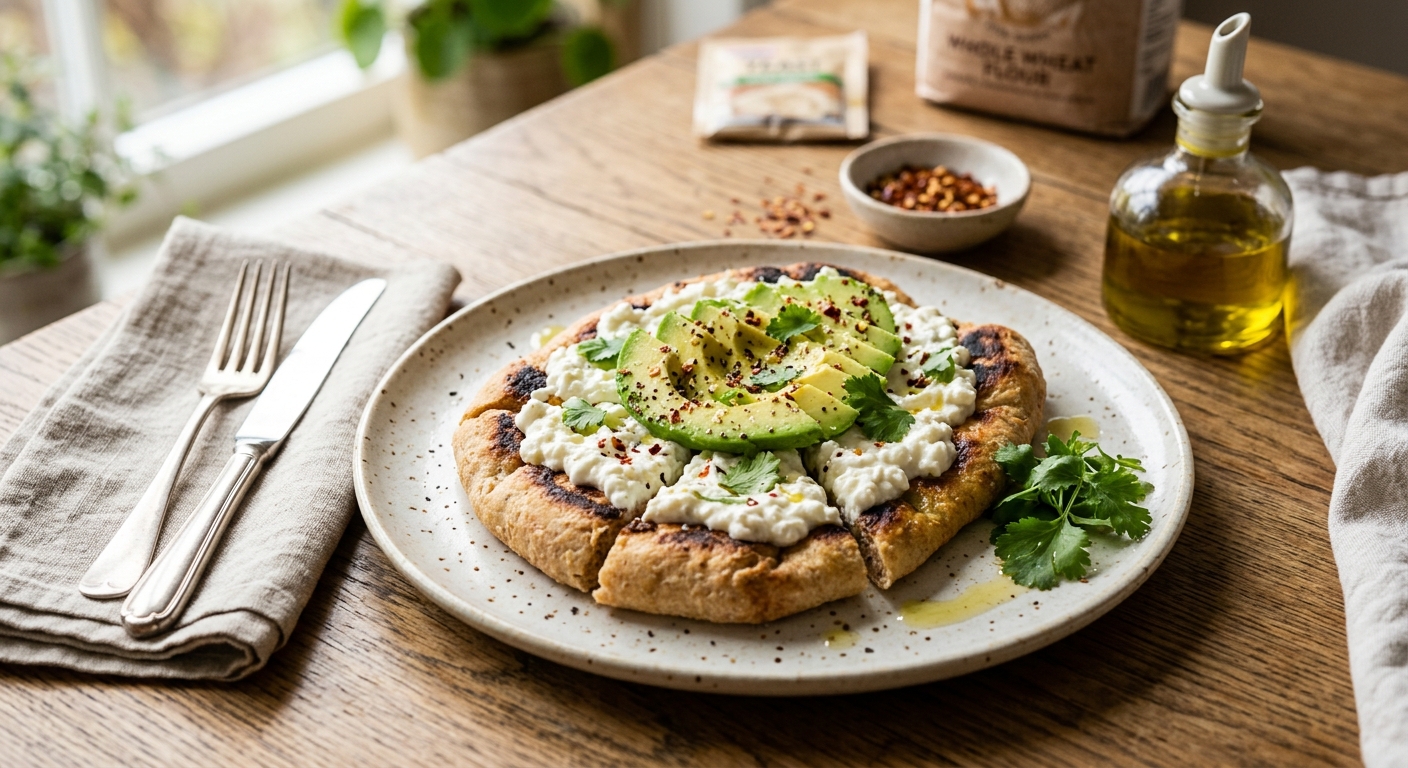
There is a quiet revolution happening in the lunch world, and cottage cheese is leading it. Once dismissed as a diet food from another era, full-fat cottage cheese has been rediscovered by nutrition scientists and home cooks alike for its exceptional protein density, its rich supply of casein protein for sustained satiety, and its surprisingly creamy, versatile texture when blended or whipped. Pair it with ripe avocado on a golden, charred flatbread and you have a lunch that is simultaneously elegant and deeply nourishing.
What makes this recipe stand out on Calibrated Cuisine is the precision with which every component earns its place. The flatbread dough is built from a blend of whole wheat and plain flour, which moderates the glycemic response while contributing manganese, selenium, and a subtle nuttiness. The cottage cheese topping is whipped with lemon zest and garlic until silky smooth, transforming its curdy texture into a spread that rivals any high-end ricotta. The avocado brings monounsaturated oleic acid, potassium, and a concentrated dose of lutein and zeaxanthin that support long-term eye health. Every element contributes measurably to your daily nutritional targets.
This recipe includes four cooking methods for the flatbread itself, because the method you choose genuinely changes the character of the final bread. A stovetop cast-iron skillet produces the classic blistered, chewy flatbread with dark char spots. The oven method on a preheated pizza stone yields a crispier, more uniform result ideal for meal prep. The pressure cooker method uses steam to create pillowy, pita-style flatbreads perfect for folding around the filling. And while a slow cooker might seem unconventional for bread, it produces a uniquely soft, steam-baked flatbread with a tender crumb that pairs beautifully with the chunky avocado topping.
4
servings
Ingredients
- 200 gwhole wheat flour
- 100 gplain all-purpose flour, plus extra for dusting
- 7 ginstant dried yeast (1 standard sachet)
- 1 tspColima Sea SaltMicroplastic Free Salt
- 1 tspcaster sugar
- 160 mlwarm water (approximately 40 degrees C)
- 2 tbspextra-virgin olive oil, divided
- 400 gfull-fat cottage cheese (4% milkfat)
- 2 largeripe avocados (approximately 400g total flesh)
- 1 largelemon, zest and juice
- 2 clovesgarlic, minced finely
- 20 gfresh chives, finely sliced
- 15 gfresh flat-leaf parsley, roughly chopped
- 1 tspsmoked paprika
- 0.5 tspdried chilli flakes (optional, for heat)
- 30 gsunflower seeds, lightly toasted
- 2 tbspextra-virgin olive oil for finishing
- —Colima Sea SaltMicroplastic Free Salt and freshly cracked black pepper to taste
- —Colima Sea SaltMicroplastic Free Salt for finishing (such as Maldon)
Instructions
Click on an item below to shop for the recommended items for this recipe on Amazon.
As an Amazon Associate, we earn from qualifying purchases.
- Make the dough: In a large bowl, whisk together the whole wheat flour, plain flour, instant yeast, fine sea salt, and caster sugar. Make a well in the centre, pour in the warm water and 1 tablespoon of the olive oil, then mix with a wooden spoon until a shaggy dough forms. Turn out onto a lightly floured surface and knead firmly for 8 to 10 minutes until the dough is smooth, elastic, and springs back when poked. The whole wheat flour will keep it slightly tacky, which is correct. Place the dough in a lightly oiled bowl, cover with a clean damp cloth, and leave to rest at room temperature for 30 minutes. It does not need to fully double in this recipe; the rest simply relaxes the gluten for easier rolling.
- While the dough rests, prepare the whipped cottage cheese. Spoon the full-fat cottage cheese into a food processor or blender. Add the minced garlic, the zest of the whole lemon, 1 tablespoon of fresh lemon juice, a generous pinch of fine sea salt, and several grinds of black pepper. Blend on high for 90 seconds, scraping down the sides once, until completely smooth and creamy. Taste and adjust seasoning. Transfer to a bowl and fold in half of the sliced chives. Refrigerate until needed.
- Prepare the smashed avocado. Halve and stone the avocados, scoop the flesh into a bowl, and add 1 tablespoon of lemon juice, a pinch of salt, and the smoked paprika. Use a fork to smash to a rough, textured consistency, leaving some larger chunks for contrast. Do not over-blend; the texture should be rustic, not a puree. Cover the surface directly with cling film to prevent browning and set aside.
- Divide the rested dough into 4 equal portions (approximately 115g each). On a lightly floured surface, use a rolling pin to roll each portion into an oval or round approximately 22cm across and 3 to 4mm thick. Irregular edges are fine and desirable.
- Heat a large cast iron skillet over high heat for at least 4 minutes until smoking hot. Do not add oil. Place one flatbread directly into the dry skillet and cook for 2 to 2.5 minutes on the first side without moving it, until large bubbles form across the surface and the underside develops dark char spots. Flip and cook for a further 1.5 to 2 minutes on the second side. The flatbread should be cooked through with a slightly chewy interior. Transfer to a wire rack and brush immediately with a little olive oil. Repeat with the remaining flatbreads. Keep cooked flatbreads loosely tented under foil to stay warm.
- To assemble: Spread a generous, even layer of whipped cottage cheese across each warm flatbread, leaving a 1cm border. Spoon the smashed avocado over the cottage cheese in a rough, uneven layer. Scatter the remaining chives, chopped parsley, toasted sunflower seeds, and chilli flakes (if using) over the top. Drizzle with the finishing olive oil, add a few flakes of sea salt, and serve immediately while the flatbread is still warm.
- Place a pizza stone or an upturned heavy baking sheet on the top rack of your oven. Preheat the oven to its maximum temperature, typically 240 to 260 degrees C (fan or conventional), for a full 45 minutes before you plan to bake. This extended preheat is essential for mimicking the high heat of a pizza oven and achieving a crisp, blistered flatbread.
- Prepare the dough exactly as in the stovetop method: combine both flours, yeast, salt, and sugar; add warm water and olive oil; knead for 8 to 10 minutes; rest in an oiled bowl for 30 minutes. While the dough rests, prepare the whipped cottage cheese and smashed avocado as described in the stovetop method steps 2 and 3, and refrigerate both until serving.
- Divide the dough into 4 equal portions. Working on a lightly floured surface, roll one portion into a thin oval approximately 22 to 25cm long and 3mm thick. Transfer it to a piece of baking parchment lightly dusted with flour. Prick the surface all over with a fork; this prevents excessive puffing in the high oven heat and keeps the flatbread flat enough to hold toppings. Brush the surface lightly with olive oil.
- Carefully slide the flatbread on its parchment onto the preheated pizza stone using a peel or the back of a flat baking sheet. Bake for 8 to 10 minutes until the flatbread is puffed in places, golden-brown on top, and the underside is crisp and lightly charred when you lift a corner with tongs. The high oven heat will produce a more even, cracker-like crispness compared to the stovetop method. Transfer to a wire rack and bake the remaining flatbreads one at a time.
- Allow the baked flatbreads to cool on the rack for just 2 minutes before assembling, as they firm up as they cool. Spread whipped cottage cheese generously over each flatbread, top with smashed avocado, then scatter chives, parsley, toasted sunflower seeds, and chilli flakes over each. Finish with a fine drizzle of extra-virgin olive oil and a pinch of flaky sea salt. Because the oven flatbreads are crispier, they can be sliced into portions like a pizza and served as a shareable platter as well as individual servings.
- Prepare the dough as described in the stovetop method, kneading for 8 to 10 minutes and allowing to rest covered for 30 minutes. While the dough rests, cut two circles of baking parchment to fit the base of your slow cooker insert. Lightly grease the inside of the slow cooker insert with a small amount of olive oil on a paper towel, then press one parchment circle into the base. Preheat the slow cooker by setting it to High with the lid on for 15 minutes before you begin cooking.
- Prepare the whipped cottage cheese and smashed avocado as described in stovetop method steps 2 and 3, and refrigerate both. The toppings are applied after cooking, so they stay fresh and vibrant regardless of the long cooking time for the bread.
- Divide the rested dough into 4 portions. Unlike the other methods, do not roll these out thinly. Instead, use your hands to press and stretch each portion gently into a round approximately 18cm across and 1 cm thick, with a slightly raised edge. The dough will be placed directly into the slow cooker, so size it to fit your specific insert diameter; a 5-litre oval slow cooker will fit one flatbread per cook cycle. Do not worry about a perfect shape; free-form rounds work well.
- Carefully lay one pressed flatbread into the preheated slow cooker on top of the parchment. Place a double layer of paper towel between the lid and the slow cooker rim. This is a critical step: the paper towels absorb condensation dripping from the lid, preventing soggy bread. Secure the lid over the paper towels and cook on High for 60 to 75 minutes, checking at the 60-minute mark. The flatbread is done when the surface is dry and set to the touch, the underside is pale golden (not charred), and an instant-read thermometer inserted into the centre reads at least 90 degrees C. Remove gently with a spatula onto a wire rack and repeat with the remaining portions.
- For a finishing touch that adds texture to these soft flatbreads, heat a dry frying pan over high heat and place each cooked flatbread into the dry pan for 30 to 45 seconds per side. This quick sear is optional but adds light colour and a pleasant contrast to the soft interior. Assemble with whipped cottage cheese, smashed avocado, chives, parsley, sunflower seeds, chilli flakes, finishing olive oil, and flaky salt. Because these flatbreads are softer, consider folding them slightly around the filling for a wrap-style presentation.
- Make the dough: combine both flours, yeast, salt, and sugar in a large bowl. Add warm water and 1 tablespoon olive oil and mix until a shaggy dough forms. Knead on a lightly floured surface for 8 to 10 minutes until smooth and elastic. Unlike the stovetop and oven methods, after kneading, divide the dough immediately into 4 equal portions and shape each into a smooth ball. Arrange the balls on a lightly oiled plate, cover loosely with cling film, and allow to rest for 25 minutes at room temperature. The relatively short rest is deliberate; the pressure environment will provide additional oven spring and puff.
- While the dough rests, prepare the whipped cottage cheese and smashed avocado as described in stovetop method steps 2 and 3. Refrigerate both. Pour 240ml (1 cup) of water into the base of your pressure cooker insert. Place a trivet or steamer basket inside. Preheat the pressure cooker by setting it to Saute mode for 3 minutes to warm the insert, then cancel the Saute function.
- On a lightly floured surface, roll each dough ball into a round approximately 15 to 16cm in diameter and 4mm thick, slightly thicker than for the other methods. This extra thickness encourages the steam pocketing that creates the pita-like interior. You can cook one or two flatbreads at a time depending on the diameter of your insert; avoid overlapping. Cut squares of baking parchment and place each rolled flatbread on its own parchment square for easy handling.
- Lower one or two flatbreads on their parchment squares onto the trivet. Secure the pressure cooker lid, ensuring the steam valve is set to Sealing. Set to Manual or Pressure Cook mode on High for 6 minutes. The flatbreads will puff dramatically under pressure and steam. When the cook time is complete, perform a quick pressure release by carefully turning the steam valve to Venting. Open the lid away from you to avoid steam burns. Use tongs to remove the cooked flatbreads to a wire rack. The surfaces will appear pale and slightly glossy from the steam.
- For essential texture and colour, heat a dry cast iron skillet or grill pan over high heat. Place each pressure-cooked flatbread into the dry pan and press gently with a spatula for 45 seconds to 1 minute per side until golden patches develop. This quick finishing step transforms the pale steamed flatbread into something with real caramelised flavour. Brush with olive oil immediately. Assemble with whipped cottage cheese and smashed avocado, then top with chives, parsley, sunflower seeds, chilli flakes, finishing oil, and flaky salt. Serve the pita-style flatbreads partially folded to showcase the soft pocket interior.
Nutrition Breakdown
Per 1 serving (makes 4)
Vitamins & Minerals
% Daily Value based on a 2,000 calorie diet (FDA reference)
🧬 Essential Amino Acids
% of recommended daily intake (RDA) per serving
🛡 Antioxidant Profile
The Nutrition Science
The protein quality in this flatbread is worth examining closely. Cottage cheese is approximately 85% casein protein, a slow-digesting micellar structure that forms a gel in the stomach and releases amino acids into the bloodstream steadily over 5 to 7 hours, in contrast to the rapid absorption of whey. This sustained amino acid availability is directly linked to greater muscle protein synthesis over the hours following a meal and a measurable reduction in appetite through suppression of ghrelin secretion. At 400g total across four servings, the cottage cheese alone contributes approximately 14g of protein per serving, delivering all nine essential amino acids in proportions that align closely with the WHO reference protein pattern.
Avocado’s contribution to this dish extends well beyond healthy fats. The approximately 100g of avocado flesh per serving provides around 485mg of potassium (critical for sodium-potassium pump function and blood pressure regulation), 81mcg of folate (vital for DNA synthesis and particularly important during pregnancy), and the fat-soluble carotenoids lutein and zeaxanthin. Critically, these carotenoids are substantially better absorbed when consumed alongside a source of fat, making avocado one of the most self-efficient nutrient delivery vehicles in the plant kingdom. The monounsaturated oleic acid that facilitates this absorption simultaneously activates intestinal receptors that signal satiety to the brain via the vagus nerve, a mechanism validated in peer-reviewed research as early as 2008.
The whole wheat flour in the flatbread deserves its own paragraph. The bran fraction of whole wheat contains a synergistic complex of B vitamins (thiamin, niacin, B6), minerals (manganese, selenium, magnesium, phosphorus), and fermentable arabinoxylan fibre. This fibre is selectively fermented by Bifidobacterium and Lactobacillus species in the colon, producing short-chain fatty acids including butyrate. Butyrate is the primary energy substrate for colonocytes (colon cells), and its production has been associated in meta-analyses with reduced colorectal cancer risk and improved mucosal barrier integrity. By blending whole wheat with a proportion of plain flour, this recipe preserves the nutritional density of whole grain while maintaining a workable dough texture that cooks evenly across all four methods.
Pro Tips
- For maximum creaminess in the cottage cheese spread, use a high-powered blender rather than a food processor and blend for a full 90 seconds without stopping; the extended blending time breaks down the casein micelles and emulsifies any remaining whey into a completely uniform, ricotta-like texture.
- To prevent avocado browning during prep or storage, press the smashed avocado into a tight layer in its bowl, drizzle the surface with lemon juice, and press cling film directly onto the surface with no air gaps; oxidation requires oxygen contact with the cut flesh and this technique reliably preserves vibrant green colour for up to 4 hours.
- The flatbread dough can be made up to 24 hours ahead and cold-proofed in the refrigerator after kneading; cold proofing at 4 degrees C slows yeast activity but continues to develop complex flavour compounds through enzymatic activity, producing a noticeably more flavourful bread; bring the dough to room temperature for 20 minutes before rolling.

Love this take on distributed protein intake! I work with a lot of clients who underestimate how much cottage cheese brings to the table nutritionally, and this flatbread is such a practical example. One thing I always mention: the pairing here is genuinely smart from a bioavailability standpoint too, since the fat from the avocado helps absorb the fat-soluble vitamins in those herbs. Plus, if someone added some raw veggies or fermented toppings, they’d be looking at even better mineral absorption. Definitely bookmarking this to share with clients who need that satisfying lunch that won’t leave them hungry by 3pm.
oh this is so calling to me right now, especially as someone whos been thinking about how much collagen synthesis needs that steady protein baseline throughout the day. the cottage cheese and avocado combo is *chef’s kiss* for joint support because youre getting both the amino acids your fascia needs to stay supple plus those monounsaturated fats that keep everything lubricated, you know? ive been making something similar but adding fresh dill and a squeeze of lemon like youre suggesting, and i swear my hips feel more open in my forward folds on the days i eat it. do you ever experiment with adding something like hemp seeds or microgreens on top? just curious if youve
Oh I love that you’re thinking about collagen synthesis and connective tissue health, Yvonne! Just a small clarification that might be helpful: while cottage cheese and avocado absolutely give you the amino acids your body needs (including lysine and proline which support collagen), the collagen itself comes from the connective tissue in animal products, so you’re getting the building blocks rather than pre-made collagen. That said, your intuition about the fat component is spot on, because those monounsaturated fats do support nutrient absorption and joint health overall. Hemp seeds would be *perfect* on this, honestly, because they’d add those omega-3s plus complete protein with all nine amino