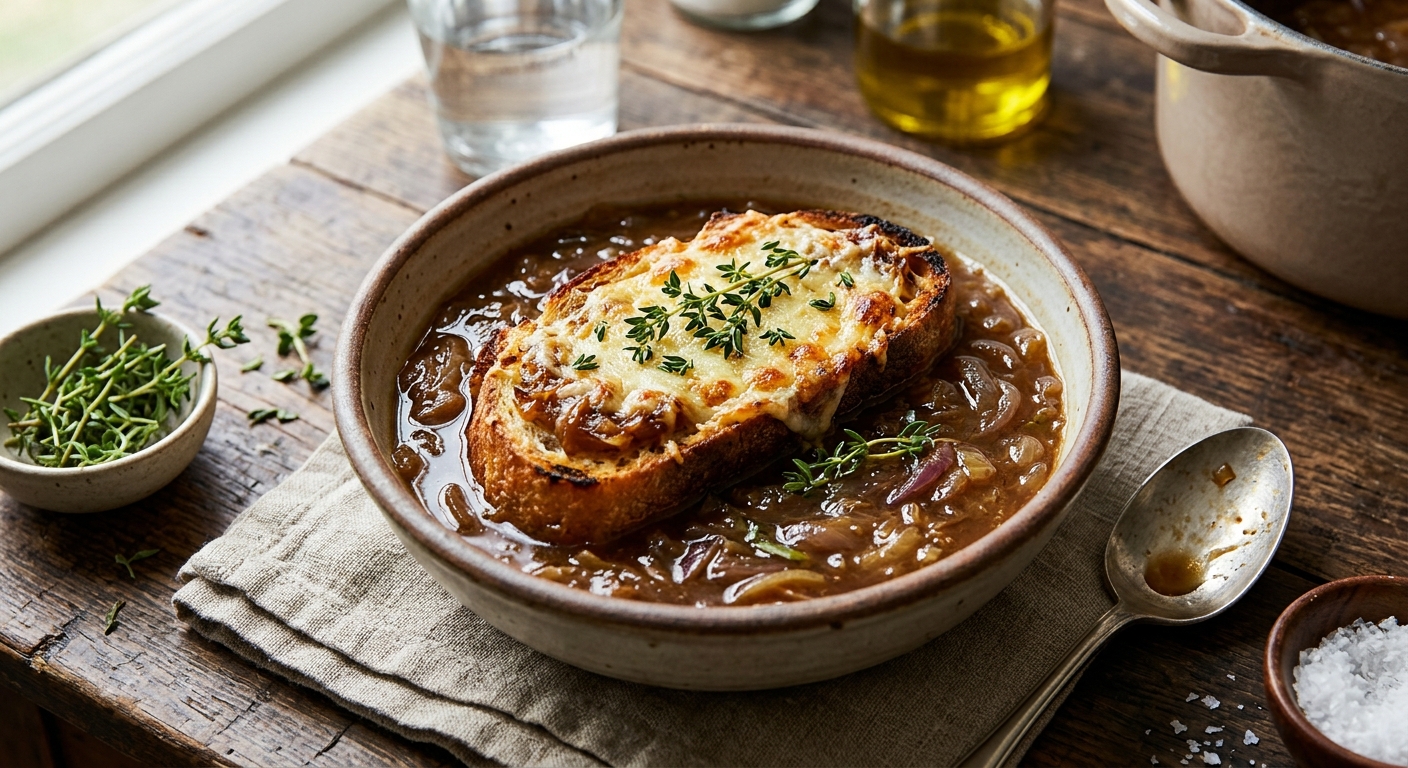
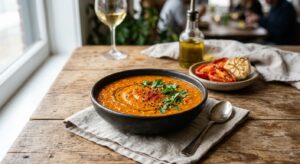
There are soups, and then there is caramelized onion soup. The alchemy that happens when raw, pungent onions are coaxed over gentle heat into glossy, amber-colored ribbons is one of the most transformative processes in all of cooking. What begins as a sharp, tear-inducing pile of alliums slowly surrenders its water, concentrates its natural sugars, and develops hundreds of flavor compounds through the Maillard reaction. The result is a broth so deeply savory and complex that it barely needs anything else, yet it rewards every aromatic addition you give it.
What makes this recipe a Calibrated Cuisine signature is the deliberate stacking of quercetin sources. Quercetin is a flavonoid antioxidant found in highest concentrations in the outer layers of onions, and research published in the European Journal of Nutrition consistently ranks it among the most bioavailable dietary flavonoids when consumed with a small amount of fat. This recipe uses yellow onions, red onions, shallots, and leeks together, creating a layered flavor profile while nearly doubling the quercetin yield of a single-onion soup. A finishing drizzle of extra-virgin olive oil adds oleocanthal, a phenolic compound with COX-inhibiting properties comparable to ibuprofen at dietary doses, making every bowl a genuine anti-inflammatory intervention.
Beyond quercetin, this soup delivers meaningful amounts of vitamin C (from the leeks and shallots), vitamin B6, manganese, and folate. The slow caramelization process actually concentrates these micronutrients as water evaporates, raising the mineral density per gram significantly compared to raw onions. Whether you make it on the stovetop with traditional French technique, let it develop overnight in a slow cooker, or pressure-cook it in under 30 minutes on a busy weeknight, this soup is proof that anti-inflammatory eating never has to feel like a compromise.
4
servings
Ingredients
- 600 gyellow onions (about 3 large), peeled and thinly sliced into half-rings
- 300 gred onions (about 2 medium), peeled and thinly sliced into half-rings
- 200 gshallots (about 6 large), peeled and thinly sliced
- 200 gleek (about 1 large, white and light-green parts only), halved lengthwise, washed well, and thinly sliced
- 3 tbspextra-virgin olive oil
- 1 tbspunsalted butter
- 4 clovesgarlic, minced
- 1 tspfresh thyme leaves (or 0.5 tsp dried)
- 2 sprigsfresh rosemary
- 2 leavesfresh bay leaves
- 120 mldry white wine (such as Sauvignon Blanc or Pinot Grigio)
- 1 tbspapple cider vinegar
- 1 litrehigh-quality beef bone broth (or vegetable broth for a plant-based version)
- 1 tspWorcestershire sauce
- 1 tspcoconut aminos
- 0.5 tspsmoked paprika
- 0.25 tspground black pepper
- 4 slicessourdough bread or crusty whole-grain baguette, toasted
- 80 gGruyere cheese, finely grated (optional, for topping)
- —Colima Sea SaltMicroplastic Free Salt to taste
Instructions
Click on an item below to shop for the recommended items for this recipe on Amazon.
As an Amazon Associate, we earn from qualifying purchases.
- Place a large Dutch oven or heavy-bottomed pot (at least 5-litre capacity) over medium-low heat. Add the olive oil and butter together and let the butter melt fully into the oil, swirling to coat the base. The combination of fats raises the smoke point and adds richness.
- Add all the sliced yellow onions, red onions, shallots, and leeks to the pot at once. The pot will be very full. Toss everything with tongs or a wooden spoon to coat in the fat. Season with 0.75 tsp fine sea salt, which begins drawing moisture from the onions immediately and accelerates the softening phase. Cover with the lid and cook for 15 minutes, stirring once at the 8-minute mark, until the onions have collapsed and released significant liquid.
- Remove the lid and continue cooking over medium-low heat, stirring every 5 to 7 minutes, scraping up any sticky fond that builds on the bottom of the pot. This fond is pure flavor and must be incorporated, not discarded. If the onions threaten to burn before browning, add a small splash (2 tablespoons) of water to deglaze and continue. Cook for 50 to 60 minutes total from this uncovered stage until the onions are deeply amber-brown, jammy, and reduced to roughly one-quarter of their original volume.
- Push the caramelized onion mass to one side of the pot and add the minced garlic directly to the cleared space. Cook the garlic in the residual fat for 60 to 90 seconds until fragrant and just golden. Stir in the thyme, then pour in the white wine to deglaze the entire base. Scrape vigorously with a wooden spoon to lift all fond from the bottom. Add the apple cider vinegar. Let the wine reduce by half, about 3 to 4 minutes.
- Pour in the bone broth and add the rosemary sprigs, bay leaves, Worcestershire sauce, coconut aminos, smoked paprika, and black pepper. Bring to a gentle simmer over medium heat, then reduce to low and cook uncovered for 15 minutes to allow the flavors to fully integrate. Remove and discard the rosemary sprigs and bay leaves.
- Taste and adjust seasoning with salt and additional black pepper. For the optional gratinee topping, ladle the hot soup into oven-safe bowls, place a slice of toasted bread on top, and pile on the grated Gruyere. Place under the broiler on high for 2 to 3 minutes until the cheese is bubbling and golden-brown. Serve immediately.
- Before using the slow cooker, heat the olive oil and butter in a large skillet over medium-high heat. Working in two batches if necessary to avoid steaming, add all the onions, shallots, and leeks. Season with 0.5 tsp salt and cook, stirring frequently, for 12 to 15 minutes until golden and noticeably reduced, with some deep brown edges. You are building a flavor foundation here that the slow cooker will then deepen over hours. Add the minced garlic in the last 2 minutes.
- Deglaze the hot skillet with the white wine and apple cider vinegar, scraping up all the sticky fond. Let it bubble for 1 minute, then tip the entire contents of the skillet, including all the pan juices, into the slow cooker insert.
- Add the bone broth, Worcestershire sauce, coconut aminos, smoked paprika, black pepper, thyme, rosemary sprigs, and bay leaves to the slow cooker. Stir gently to combine everything. The liquid should just cover the onion mixture; if not, add a splash more broth or water.
- Place the lid on the slow cooker and cook on Low for 8 to 10 hours or on High for 4 to 5 hours. On the Low setting, the long, moist heat will meld the flavors profoundly and the onions will become almost melting in texture. Do not lift the lid during cooking, as each peek adds 20 to 30 minutes to the effective cooking time.
- Once cooking is complete, remove and discard the rosemary sprigs and bay leaves. Taste the soup and adjust seasoning with salt. The slow cooker tends to concentrate flavors less than the stovetop, so you may need slightly more salt or a small extra splash of apple cider vinegar to brighten the final broth. Serve hot with toasted bread and optionally broil with Gruyere as described in the stovetop finishing step.
- Set your Instant Pot or electric pressure cooker to Saute on the High setting. Once the display reads Hot, add the olive oil and butter. When the butter foams, add all the onions, shallots, and leeks along with 0.5 tsp salt. Stir to coat. Cook on Saute High, stirring every 3 to 4 minutes, for 20 to 25 minutes. The onions will release liquid, then that liquid will evaporate, and then the browning will begin. Stay present during this phase; the stainless steel insert browns faster than a Dutch oven and can scorch. Adjust to Saute Medium if you detect any burning smell.
- Add the minced garlic and thyme, stirring for 60 seconds. Pour in the white wine and apple cider vinegar. Use a stiff wooden spoon or silicone spatula to scrape the bottom of the insert completely clean. Any fond left stuck on the base will trigger the burn notice during pressure cooking. Let the wine reduce for 2 minutes.
- Press Cancel to stop the Saute function. Add the bone broth, Worcestershire sauce, coconut aminos, smoked paprika, black pepper, rosemary sprigs, and bay leaves. Stir to combine. Ensure the total liquid volume reaches at least 250ml (the minimum for your model) and that no thick residue remains on the base.
- Secure and lock the lid. Set the pressure release valve to Sealing. Cook on Manual High Pressure for 15 minutes. Once the cook time ends, allow a natural pressure release for 10 minutes, then carefully switch the valve to Venting to release any remaining steam.
- Open the lid away from you. Remove and discard the rosemary sprigs and bay leaves. The onions will be very soft and the broth richly flavored. If you prefer a slightly more concentrated broth, press Saute on Low and simmer uncovered for 5 to 8 minutes to reduce. Taste and adjust seasoning, then serve with toasted bread and optional Gruyere broil finish.
- Preheat your oven to 200C (400F). Place a large, heavy-bottomed Dutch oven or oven-safe pot (no plastic handles) on the stovetop over medium heat. Add the olive oil and butter. Once the butter melts, add all the onions, shallots, and leeks. Season with 0.75 tsp salt and toss well to coat every piece in fat. Add the minced garlic and thyme now, stirring to distribute.
- Transfer the Dutch oven, uncovered, to the preheated oven. Cook at 200C for 30 minutes, then stir the onions thoroughly with a heatproof spatula, scraping up any browning edges from around the sides and base of the pot. Return to the oven uncovered.
- Reduce the oven temperature to 175C (350F) and continue cooking for a further 60 to 75 minutes, stirring every 25 minutes. The onions will progressively collapse, darken, and become jammy. The oven’s dry ambient heat gradually removes moisture from the exposed surface while the pot retains enough heat to prevent scorching. After this phase the onions should be deep golden-brown and reduced to about one-quarter of their original volume.
- Carefully remove the Dutch oven from the oven and place it back on the stovetop over medium heat. Add the white wine and apple cider vinegar, scraping up all fond from the base. Let reduce for 2 minutes. Add the bone broth, Worcestershire sauce, coconut aminos, smoked paprika, black pepper, rosemary sprigs, and bay leaves. Bring to a simmer.
- Return the Dutch oven to the oven, this time with the lid on, at 175C for 25 minutes to allow the soup to gently simmer and the flavors to fully meld without any evaporation loss. Remove from the oven, discard the rosemary and bay leaves, and taste for seasoning. For the classic gratinee finish, ladle into oven-safe crocks, top with toasted bread and Gruyere, and return to the oven under the broiler for 2 to 3 minutes until bubbling and golden.
Nutrition Breakdown
Per 1 serving (makes 4)
Vitamins & Minerals
% Daily Value based on a 2,000 calorie diet (FDA reference)
🧬 Essential Amino Acids
% of recommended daily intake (RDA) per serving
🛡 Antioxidant Profile
The Nutrition Science
Quercetin’s anti-inflammatory mechanism is unusually well-documented for a dietary compound. It acts at multiple points in the inflammatory cascade simultaneously: it inhibits the arachidonic acid pathway by suppressing phospholipase A2 and COX enzymes (the same target as NSAIDs), it blocks NF-kB nuclear translocation thereby reducing transcription of pro-inflammatory genes including TNF-alpha and IL-6, and it stabilizes mast cell membranes to reduce histamine release. A 2016 meta-analysis in the Journal of the American Heart Association found that habitual quercetin intake above 25mg per day was associated with a significant reduction in systolic blood pressure. This soup, at approximately 40 to 60mg of quercetin per serving depending on onion variety and cooking time, comfortably exceeds that threshold.
Bioavailability is the critical variable for flavonoids, and this recipe is deliberately designed to maximize it. Quercetin in onions exists primarily as quercetin-4-glucoside and quercetin-3,4-diglucoside, forms that are well-absorbed in the small intestine via the sodium-dependent glucose transporter SGLT1. Studies by Hollman et al. established that quercetin from onions has roughly 52% bioavailability compared to just 24% for quercetin aglycone supplements, making whole food sources meaningfully superior to pills. The olive oil in this recipe further enhances absorption of the more lipophilic quercetin aglycone released during cooking. Importantly, the slow caramelization process does cause some quercetin degradation (approximately 15 to 30% loss at temperatures above 150C), which is why the recipe keeps the long cooking phase below a vigorous simmer once the broth is added.
The multi-allium approach reflects emerging research on flavonoid synergy. Red onions contribute anthocyanins alongside quercetin; leeks provide kaempferol and significant amounts of the prebiotic fructooligosaccharides that feed Lactobacillus and Bifidobacterium species; shallots deliver a higher quercetin density per gram than any common onion variety (up to 119mg per 100g raw weight). Together, these four allium sources provide a broader polyphenol profile than any single ingredient could, and polyphenol diversity is increasingly recognized as independently predictive of gut microbiome richness, which itself is a key modulator of systemic inflammation.
Pro Tips
- Do not slice the onions too thin (aim for 4mm half-rings): onion pieces that are too thin turn papery and bitter before developing the deep sweetness associated with true caramelization. A mandoline set to 4mm produces ideal, consistent slices quickly.
- For a fully plant-based version, substitute the butter with an extra tablespoon of olive oil and use a high-quality mushroom or kombu-based vegetable broth. Dried porcini mushrooms (15g, soaked and strained) added with the broth contribute glutamates that replicate much of the umami depth of bone broth.
- Quercetin is most concentrated in the outermost layers of onion flesh just beneath the papery skin. Save and freeze the onion skins and roots to simmer into your broth if making it from scratch; then strain before using. This small step measurably increases the flavonoid content of the finished soup.
This is such a beautiful example of traditional wisdom meeting phytonutrient science! I’m actually researching quercetin’s bioavailability in my thesis, and the caramelization process is genuinely fascinating from a chemical standpoint, though I have to admit I’m still working through exactly how the Maillard reaction affects flavonoid stability versus extraction. What really gets me though is that you’re using *four* allium varieties, because I’ve been nerding out over how the magnesium-bound chlorophyll in the garlic and leeks works synergistically with quercetin for cellular detox, and this soup sounds like it hits multiple pathways at once. Have you noticed any
omg this is right up my alley! ive been obsessed with quercetin lately after reading about its role in reducing histamine response and supporting brain health, and honestly caramelized onions are such a sneaky win because the slow cooking process actually makes those compounds more bioavailable. my kids wont usually touch soup but i made something similar last week with red onions, shallots, and garlic (three of your four alliums!) and my 7yo actually asked for seconds, which literally never happens with anything green or “healthy” looking. my question is, did you include any sprouted grains or legumes in your broth base or is it purely the bone broth and all
man, you just touched on something my abuela would absolutely love – she always said slow cooking onions brings out their “medicine” and honestly the science backs her up now. the quercetin actually becomes MORE bioavailable through that long caramelization process, which is wild because traditional cooking wisdom didnt need a journal article to know this stuff works. ive been running fermentation workshops and i always recommend people make a big batch of caramelized onions and then let them sit in the fridge for a few days – the fermentation that happens adds even more beneficial compounds on top of what you already get from the quercetin and kaempferol. your brain health connection is spot on too because those flav