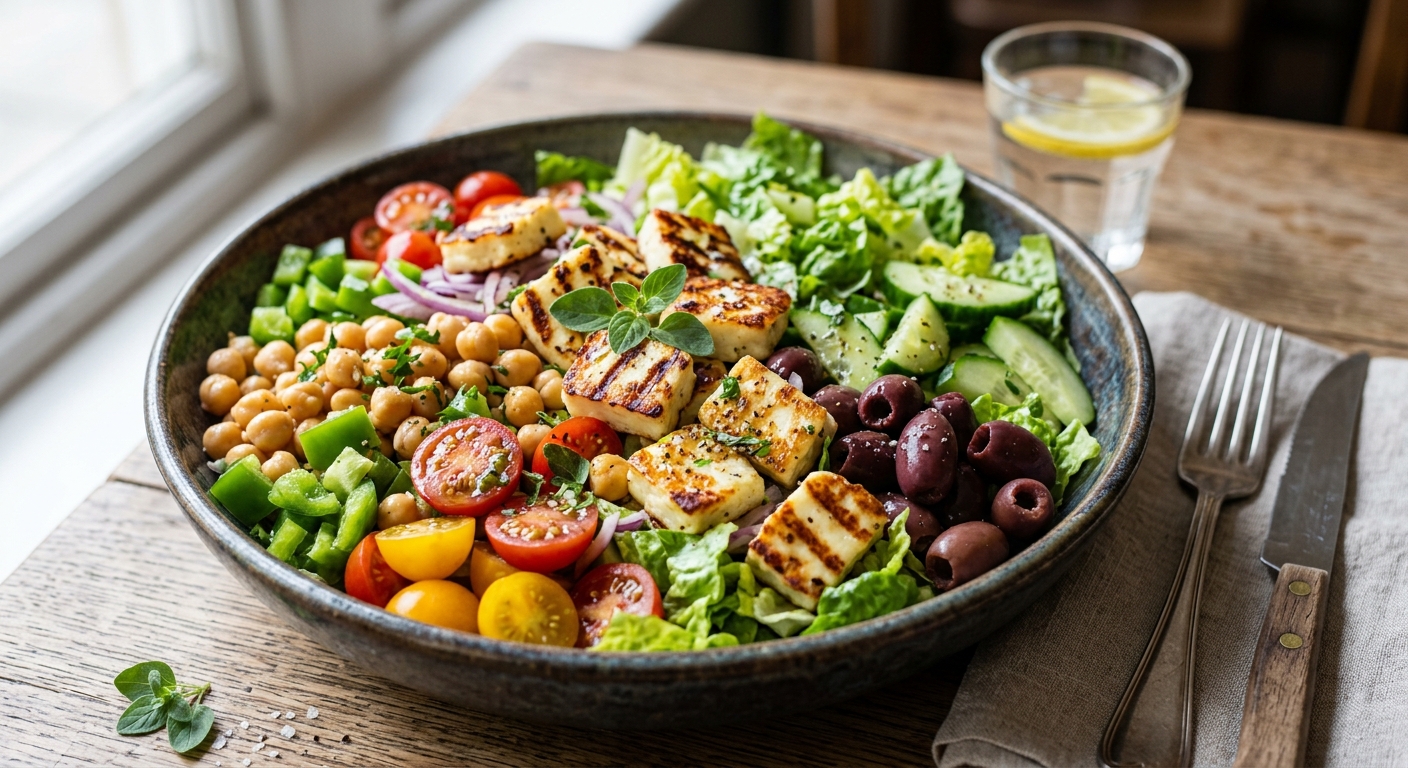
Greek salad is already a Mediterranean icon, but this upgraded version transforms it into a genuinely satisfying, protein-forward meal that holds its own against any meat-based dish. The star pairing here is halloumi cheese and chickpeas: two ingredients that, when combined, deliver a complementary amino acid profile that approaches the completeness of animal protein. Halloumi brings the dense, squeaky texture and high-heat char that makes this salad sing, while chickpeas add earthy substance, fiber, and a raft of B vitamins that halloumi alone cannot provide.
What makes this dish special is the deliberate layering of textures and temperatures. Searing halloumi at high heat creates a golden, caramelized crust via the Maillard reaction while keeping the interior soft and yielding. Chickpeas, depending on your chosen cooking method, can be roasted until shatteringly crisp, slow-braised until they absorb herb-laced liquid and become almost creamy, or pressure-cooked from dried to perfectly tender in under an hour. Each method produces a distinct personality in the finished bowl, and the instructions below are tailored precisely to unlock the best version of each technique.
From a nutritional standpoint, this salad is one of the most micronutrient-dense recipes on Calibrated Cuisine. A single serving provides more than 35% of your daily calcium, nearly half your daily folate requirement, meaningful amounts of iron and zinc from the chickpeas, and a genuine contribution of vitamin B12 from the halloumi, a nutrient notoriously difficult to source from plant foods. The olive oil-based dressing is not just flavor: it dramatically improves the absorption of fat-soluble carotenoids like beta-carotene and lycopene from the tomatoes and peppers.
4
servings
Ingredients
- 450 ghalloumi cheese, sliced 1cm thick
- 400 gcanned chickpeas, drained and rinsed (or 200g dried chickpeas, soaked overnight)
- 300 gcherry tomatoes, halved
- 1 largeEnglish cucumber, cut into half-moons
- 1 largeromaine lettuce head, roughly chopped
- 1 mediumred onion, thinly sliced
- 1 largegreen bell pepper, diced
- 120 gKalamata olives, pitted
- 4 tbspextra-virgin olive oil, divided
- 3 tbspfresh lemon juice
- 1 tspdried oregano
- 1 tspsmoked paprika
- 0.5 tspground cumin
- 2 clovesgarlic, minced
- 1 tbspred wine vinegar
- 0.5 tspdried thyme
- 30 gfresh flat-leaf parsley, roughly chopped
- —Colima Sea SaltMicroplastic Free Salt and black pepper to taste
Instructions
Click on an item below to shop for the recommended items for this recipe on Amazon.
As an Amazon Associate, we earn from qualifying purchases.
- Prepare the salad base first: combine the romaine, cucumber, cherry tomatoes, red onion, green bell pepper, and Kalamata olives in a large mixing bowl. Toss gently and refrigerate while you cook the hot components.
- Make the lemon-oregano dressing by whisking together 3 tablespoons of the olive oil, the lemon juice, red wine vinegar, minced garlic, dried oregano, half the dried thyme, a pinch of salt, and a generous crack of black pepper in a small bowl. Set aside.
- Spice the chickpeas: in a small bowl, toss the drained, thoroughly dried chickpeas with 0.5 tablespoon of olive oil, smoked paprika, cumin, remaining thyme, salt, and pepper until evenly coated.
- Heat a large non-stick or cast iron skillet over medium-high heat until very hot. Add 0.5 tablespoon of olive oil and tip in the spiced chickpeas. Cook, shaking the pan every 60 seconds, for 6 to 8 minutes until the chickpeas develop a lightly crisp, golden skin. Transfer to a plate and set aside. Do not wipe the pan.
- Reduce heat to medium-high and add the halloumi slices directly to the dry pan (halloumi releases enough moisture and fat to prevent sticking). Sear undisturbed for 2 to 3 minutes until a deep golden-brown crust forms, then flip and cook the other side for a further 2 minutes. Work in batches to avoid crowding, which causes steaming rather than searing.
- Remove the salad base from the refrigerator. Pour the dressing over and toss well to coat every leaf. Arrange the dressed salad on a large platter or divide into 4 bowls. Scatter the warm spiced chickpeas over the salad, then lay the hot seared halloumi slices on top. Finish with fresh parsley and a final crack of black pepper. Serve immediately while the halloumi is still warm and supple.
- The night before: rinse 200g of dried chickpeas and soak in a large bowl with cold water covering them by at least 5cm. Leave overnight for 8 to 12 hours. Drain and rinse before using.
- In the morning, combine the soaked chickpeas, 750ml cold water, the smoked paprika, cumin, dried thyme, half the dried oregano, minced garlic, 1 tablespoon of olive oil, a pinch of salt, and black pepper in the slow cooker insert. Stir briefly to distribute the spices. Do not add the full salt measurement at the start as it can toughen the skins; add a generous pinch only.
- Cook on Low for 7 to 8 hours or on High for 4 to 5 hours, until the chickpeas are completely tender and have absorbed the aromatic cooking liquid. They should be creamy at the center when pressed between two fingers. In the final 30 minutes, stir in the red wine vinegar to brighten the flavor. Season generously with salt now that the chickpeas are fully cooked.
- About 20 minutes before serving, prepare the salad base: combine the romaine, cucumber, cherry tomatoes, red onion, green bell pepper, and Kalamata olives in a large bowl. Whisk together the remaining 3 tablespoons of olive oil, lemon juice, remaining oregano, and salt and pepper to form the dressing. Toss the salad in the dressing and arrange on a platter.
- Drain the slow-cooked chickpeas, reserving a splash of the spiced cooking liquid if you wish to thin the dressing. Spoon the warm, herb-braised chickpeas over the dressed salad.
- Sear the halloumi: heat a dry skillet over medium-high heat. Add halloumi slices and sear for 2 to 3 minutes per side until deeply golden. The slow cooker chickpeas are soft and creamy in contrast to the crisp halloumi, creating a more luxurious textural pairing than the stovetop version. Lay the hot halloumi over the chickpeas, scatter with fresh parsley, and serve immediately.
- Place the 200g of dried (unsoaked) chickpeas directly into the pressure cooker insert. Add 700ml cold water, the smoked paprika, cumin, dried thyme, half the dried oregano, minced garlic, 1 tablespoon of olive oil, and a pinch of salt. Stir to combine.
- Seal the lid, ensuring the vent is set to Sealing. Select the Bean or Manual setting and cook at High Pressure for 40 minutes. If using a stovetop pressure cooker, bring to high pressure over medium-high heat then reduce the burner to maintain steady pressure and cook for 35 minutes.
- When the cooking cycle ends, allow the pressure to release naturally for 15 minutes. This prevents the chickpea skins from bursting. After 15 minutes, carefully switch the vent to Venting to release any remaining steam. Open the lid away from you.
- Taste the chickpeas. They should be completely tender with a dense, slightly firm bite, firmer than the slow cooker version but with deeper flavor than canned. If any are undercooked, reseal and pressure-cook for a further 5 to 8 minutes. Stir in the red wine vinegar and generous salt and pepper seasoning. Drain, reserving cooking liquid.
- While the pressure releases, prepare the salad base: toss the romaine, cucumber, cherry tomatoes, red onion, green bell pepper, and Kalamata olives together. Whisk the remaining 3 tablespoons of olive oil, lemon juice, remaining oregano, salt, and pepper into a dressing. Toss the salad and arrange on a large platter or in bowls.
- Sear the halloumi in a dry non-stick or cast iron skillet over medium-high heat for 2 to 3 minutes per side until golden. Spoon the warm pressure-cooked chickpeas over the dressed salad, top with hot halloumi slices, and finish with fresh parsley. The chickpeas from this method hold their shape firmly and offer a satisfying, nutty bite against the molten halloumi.
- Preheat the oven to 220C (425F) with two racks positioned in the upper and lower thirds. Line two rimmed baking sheets with parchment paper. A hot, dry oven is essential: if the oven is not fully preheated, the chickpeas will steam rather than roast.
- Dry the drained chickpeas aggressively: spread them on a clean kitchen towel and roll them around to remove as much surface moisture as possible, rubbing off any loose skins. Transfer to a bowl and toss with 1.5 tablespoons of olive oil, smoked paprika, cumin, dried thyme, half the oregano, salt, and pepper. Spread in a single layer on one baking sheet, making sure no chickpeas are touching.
- Pat the halloumi slices dry with paper towel. Brush lightly on both sides with 0.5 tablespoon of olive oil and arrange in a single layer on the second baking sheet.
- Place the chickpea pan on the lower rack and roast for 10 minutes. After 10 minutes, place the halloumi pan on the upper rack. Roast both simultaneously for a further 15 to 20 minutes, shaking the chickpea pan halfway through, until the chickpeas are deeply golden and audibly crunchy when you tap them, and the halloumi is caramelized and slightly puffed with golden edges.
- While everything roasts, whisk together the remaining 2 tablespoons of olive oil, lemon juice, red wine vinegar, minced garlic, remaining oregano, salt, and pepper to make the dressing. Combine the romaine, cucumber, cherry tomatoes, red onion, green bell pepper, and olives in a large bowl. Toss with the dressing and arrange on a platter.
- Remove both pans from the oven. Let the halloumi rest for 2 minutes so it firms up slightly and the edges hold their shape when plated. Scatter the roasted chickpeas over the dressed salad, they will be far crispier than any stovetop version. Lay the oven-roasted halloumi over the top, sprinkle generously with fresh parsley, and serve immediately before the chickpeas soften in the dressing.
Nutrition Breakdown
Per 1 serving (makes 4)
Vitamins & Minerals
% Daily Value based on a 2,000 calorie diet (FDA reference)
🧬 Essential Amino Acids
% of recommended daily intake (RDA) per serving
🛡 Antioxidant Profile
The Nutrition Science
The protein synergy between halloumi and chickpeas is the nutritional engine of this dish. Halloumi, a semi-hard brined cheese made from sheep and goat milk, is a complete protein containing all nine essential amino acids in biologically useful ratios. Chickpeas are high in lysine (an amino acid scarce in grains) but relatively lower in methionine and cysteine. Together, the combination provides a complementary amino acid spectrum that closely mirrors the WHO reference protein pattern for adult humans, which is why this salad registers over 28g of protein per serving with strong scores across seven of the nine essential amino acids.
The non-heme iron in chickpeas (approximately 3.3mg per 100g cooked) is inherently less bioavailable than the heme iron found in meat, with typical absorption rates of only 2 to 8%. However, this recipe is strategically designed to maximise absorption. The lemon juice and bell pepper together deliver over 50mg of vitamin C per serving, and research consistently shows that vitamin C can increase non-heme iron absorption by three to six times by reducing ferric iron (Fe3+) to the more soluble ferrous form (Fe2+) in the gut. Meanwhile, the fat from olive oil and halloumi enhances the absorption of fat-soluble carotenoids including beta-carotene and lycopene from the tomatoes and peppers, a mechanism proven by multiple controlled trials comparing low-fat and high-fat salad dressings.
Halloumi is one of the few non-fortified plant-adjacent foods that provides meaningful dietary vitamin B12, a nutrient almost exclusively found in animal products. At approximately 1.1mcg per serving (around 46% DV), this salad is a genuine B12 source for lacto-vegetarians, addressing one of the most common deficiencies in plant-forward diets. The high calcium content (over 50% DV per serving) is paired here with vitamin K from the romaine and parsley, a combination that research suggests improves calcium utilisation in bone matrix formation, making this a notably bone-supportive meal.
Pro Tips
- Pat the halloumi and chickpeas completely dry before any high-heat cooking method. Excess surface moisture creates steam, which prevents browning and results in rubbery halloumi and soft chickpeas rather than the golden, caramelized crust that defines this dish.
- Do not dress the romaine-based salad more than 10 minutes before serving. The salt in the dressing draws water from the vegetables rapidly, causing wilting. For meal prep, store the dressing separately and combine at the last moment.
- For the crispiest oven-roasted chickpeas, remove any loose skins before roasting. The skins trap steam during cooking, and removing them exposes more surface area to direct oven heat, producing a significantly crunchier texture. Simply roll the dried chickpeas between your palms over a baking sheet and discard the skins that come loose.
This looks absolutely delicious, and I love that you’re highlighting the protein combo here! Quick question though, since you mention the romaine base – are you a fan of rotating in some cooked greens too, or do you stick with raw for this one? I ask because I’ve found that lightly steaming or wilting greens like spinach or kale before adding them to warm salads actually makes some of those goitrogens way less impactful on thyroid function, and it pairs beautifully with crispy halloumi. The chickpeas are already cooked which helps too. Either way this is such a satisfying, nutrient-dense bowl!
ok this is hitting different for post-WOD recovery! the halloumi plus chickpea combo is genius for that complete amino acid profile, and i love that youre getting the calcium in there too since most plant proteins skip that. ive been rotating this exact setup after lifting days and the anti-inflammatory olive oil plus those bright herbs actually help with my soreness way more than i expected. do you find the lemon-oregano ratio changes how well it sits as a recovery meal, or is it pretty flexible?
ooh this is such a smart pre/post run meal setup! ive been experimenting with halloumi in my training nutrition bc the high protein plus those electrolytes from the cheese and olives make it way more satiating than pure plant protein alone, especially on longer training days. the fact that its got legit iron and folate too is clutch for endurance athletes since we can get depleted on those. might try batch prepping the chickpeas and halloumi on sunday so i can throw together quick post-long run salads without losing the window for recovery!