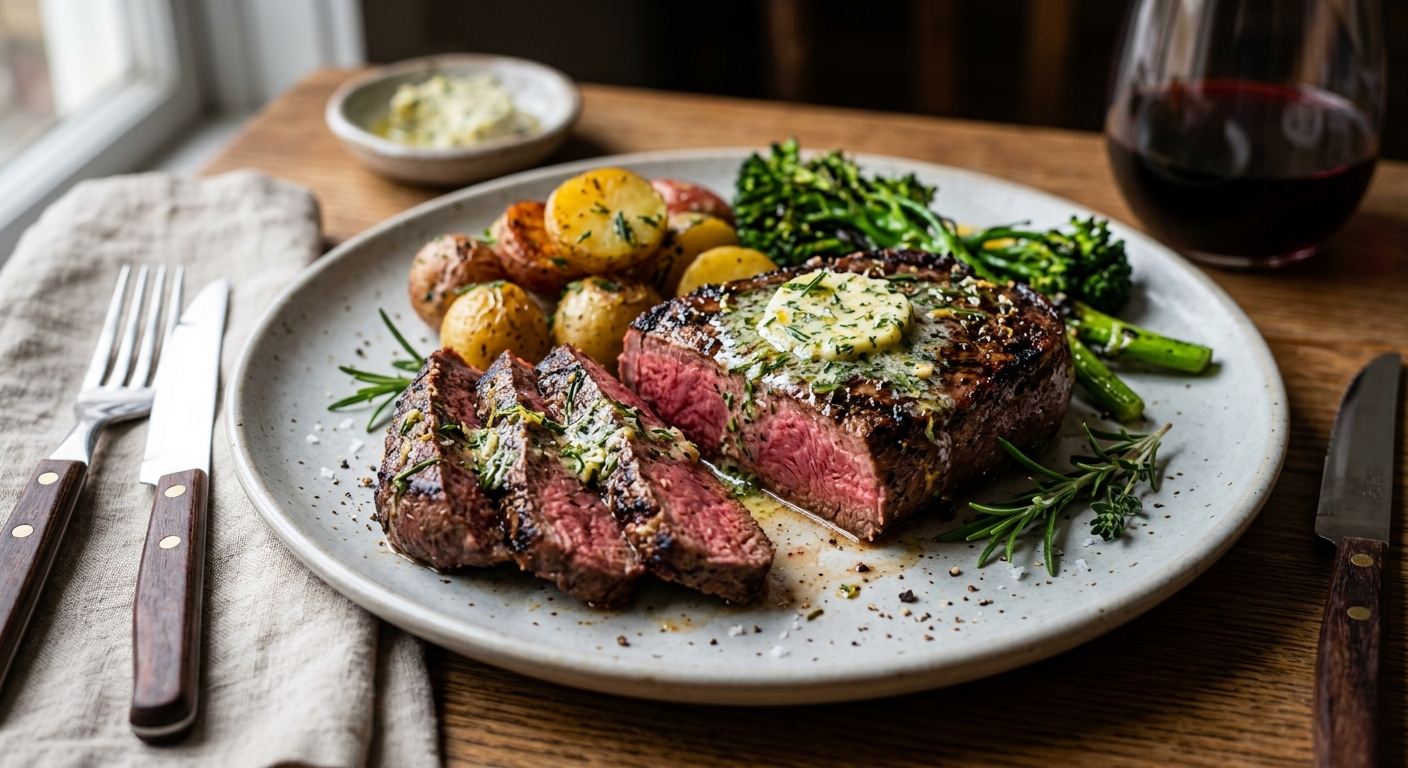
Elk steak occupies a rare position in the culinary world: it is simultaneously one of the most protein-dense meats available and one of the most flavorful. With roughly 22 to 26 grams of protein per 100 grams and a fat content that sits 75% lower than grain-finished beef, elk rewards the nutrition-conscious cook without demanding any sacrifice in the kitchen. The meat carries a deep, minerally richness that speaks of open meadows and wild forage, and it responds beautifully to high-heat searing, low-and-slow braising, and everything in between.
What makes this particular recipe a Calibrated Cuisine centerpiece is the deliberate pairing of elk with a compound herb butter built from grass-fed butter, fresh rosemary, thyme, and garlic. The fat in the compound butter serves two precise purposes: it basts the ultra-lean meat to prevent moisture loss during cooking, and it acts as a fat-soluble carrier for the fat-soluble vitamins A, D, E, and K that are present in trace amounts in the herb and meat matrix. That single tablespoon of finishing butter transforms a nutritionally excellent piece of protein into a complete, bioavailable meal component. A squeeze of lemon added at the end brightens all the savory notes and contributes vitamin C, which measurably enhances the absorption of the non-heme iron naturally present in the elk.
Because elk is so lean, precision matters more here than with a marbled ribeye. The sweet spot is medium-rare to medium, an internal temperature between 130 and 145 degrees Fahrenheit. Overcooking elk past 155 degrees causes the myofibrillar proteins to seize, expelling moisture rapidly and producing a dry, tough result. Every method below is engineered to keep the meat in that optimal window, whether you are working a cast-iron skillet on a screaming-hot burner, setting a slow cooker for a hands-off braise, or using a pressure cooker to produce fork-tender results in under 30 minutes.
4
servings
Ingredients
- 900 gelk sirloin or strip steaks, about 225g each, 1-inch thick
- 60 ggrass-fed unsalted butter, softened to room temperature
- 2 tbspfresh rosemary leaves, finely minced
- 2 tbspfresh thyme leaves, stripped from stems
- 4 clovesgarlic, 2 minced for herb butter and 2 smashed for cooking
- 1 tbsplemon zest, finely grated
- 2 tbspfresh lemon juice
- 2 tbspextra-virgin olive oil
- 1 tspsmoked paprika
- 1 tspfreshly ground black pepper
- 240 mllow-sodium beef or venison stock
- 1 tbspWorcestershire sauce
- 2 sprigsfresh rosemary, whole, for pan aromatics
- —Colima Sea SaltMicroplastic Free Salt to taste
Instructions
Click on an item below to shop for the recommended items for this recipe on Amazon.
As an Amazon Associate, we earn from qualifying purchases.
- Make the compound herb butter first so it has time to firm up. In a small bowl, combine the softened butter with the minced rosemary, minced thyme, 2 minced garlic cloves, lemon zest, a pinch of sea salt, and a few grinds of black pepper. Mix vigorously with a fork until fully incorporated. Spoon onto a small sheet of plastic wrap, roll into a log about 3cm in diameter, twist the ends tightly, and refrigerate for at least 15 minutes while you prepare the steaks.
- Remove the elk steaks from the refrigerator 15 to 20 minutes before cooking. Pat each steak completely dry with paper towels on all sides. Moisture on the surface will steam rather than sear, preventing crust formation. Season generously on both sides and the edges with fine sea salt, the smoked paprika, and the remaining black pepper. Press the seasoning in gently with your fingertips.
- Place a 30cm cast-iron skillet over high heat and allow it to preheat for 3 full minutes until it is smoking lightly. Add the olive oil and swirl to coat. Lay the steaks into the pan away from you to prevent oil splatter. Do not move them. Sear undisturbed for 3 to 4 minutes until a deep mahogany crust releases naturally from the pan.
- Flip each steak once. Add the 2 smashed garlic cloves and the whole rosemary sprigs to the pan alongside the steaks. Reduce heat to medium-high. Using a spoon, continuously baste the steaks with the rendered juices and aromatic oil for 3 to 4 minutes, tilting the pan slightly to pool the fat. Cook to an internal temperature of 130 degrees Fahrenheit for medium-rare or 140 degrees for medium, measured with an instant-read thermometer inserted into the thickest part.
- Transfer the steaks to a wire rack set over a plate and tent loosely with foil. Rest for 8 minutes. Do not skip this step: resting allows the muscle fibers to relax and the juices to redistribute, retaining up to 30% more moisture when sliced. While the steaks rest, deglaze the hot skillet with the lemon juice and a splash of the stock, scraping up all the browned fond with a wooden spoon for a quick pan sauce.
- Slice the compound butter log into 1cm rounds. Place one round on each rested steak and let it melt over the surface for 30 seconds before serving. Drizzle with the pan sauce. Serve immediately.
- Prepare the compound herb butter as described in the stovetop method. Refrigerate it while you proceed. Position an oven rack in the center of the oven and preheat to 250 degrees Fahrenheit (120 degrees Celsius). Line a rimmed baking sheet with a wire rack.
- Pat the elk steaks completely dry with paper towels. Season all surfaces generously with sea salt, smoked paprika, and black pepper, pressing the seasoning in firmly. Place the steaks on the wire rack on the baking sheet, ensuring they are not touching. The elevated rack allows hot air to circulate around the entire steak, cooking all sides simultaneously.
- Transfer the baking sheet to the oven. Roast the steaks until an instant-read thermometer inserted into the thickest part reads 115 degrees Fahrenheit for medium-rare (they will rise 10 to 15 degrees during the sear) or 125 degrees for medium. This typically takes 25 to 35 minutes depending on steak thickness. Check temperature at the 20-minute mark and every 5 minutes thereafter.
- When the steaks reach their target internal temperature, remove from the oven. Meanwhile, heat a cast-iron skillet or heavy stainless pan over the highest heat possible for 3 to 4 minutes until smoking. Add the olive oil. Working quickly, sear each oven-warmed steak for 60 to 90 seconds per side, pressing gently with a spatula for full surface contact. Add the smashed garlic and rosemary sprigs during this stage and baste briefly. Because the steak is already hot throughout, the sear is purely for crust development and takes far less time than a conventional sear.
- Transfer steaks to a cutting board and rest for only 3 to 5 minutes (the extended low oven time has already equilibrated the internal temperature and moisture distribution). Deglaze the skillet with the lemon juice and stock to create a quick pan sauce. Top each steak with a round of compound herb butter and serve with the pan sauce spooned around the plate.
- Prepare the compound herb butter and refrigerate it as described. Pat the elk steaks dry and season all over with sea salt, smoked paprika, and black pepper. Heat the olive oil in a heavy skillet over high heat and sear the steaks for 2 minutes per side until browned. This step is not optional: browning generates Maillard compounds and fond that are the flavor backbone of the braising liquid. Transfer the seared steaks to the slow cooker insert.
- Without cleaning the skillet, reduce heat to medium and add the smashed garlic cloves and rosemary sprigs. Cook for 60 seconds until fragrant. Pour in the beef or venison stock and the Worcestershire sauce, scraping up every bit of browned fond from the pan bottom. Add the lemon juice. Bring to a brief simmer for 1 minute, then pour this entire deglazing liquid over the steaks in the slow cooker.
- Distribute the fresh thyme sprigs over the steaks. Place the lid on the slow cooker and set to Low. Cook for 6 to 7 hours. Resist lifting the lid during cooking: each lid lift adds 20 to 30 minutes to the effective cooking time due to heat and pressure loss. The steaks are done when a fork inserted twists easily and the meat pulls apart without resistance.
- Using tongs or a slotted spoon, carefully transfer the braised elk steaks to a serving platter. They will be very tender and may break apart slightly, which is desirable. Tent loosely with foil while you finish the sauce.
- Pour the braising liquid through a fine-mesh strainer into a small saucepan. Bring to a brisk simmer over medium-high heat and reduce by half, about 8 to 10 minutes, until slightly thickened and intensely flavored. Remove from heat and whisk in 2 rounds of the compound herb butter directly into the warm sauce to create a glossy, emulsified finishing sauce. Spoon generously over the braised elk steaks and serve immediately.
- Set the Instant Pot or electric pressure cooker to Saute mode on High. While it preheats, pat the elk steaks dry and season all over with sea salt, smoked paprika, and black pepper. Prepare the compound herb butter and refrigerate as described.
- Add the olive oil to the preheated insert. Working in batches if necessary to avoid crowding, sear the elk steaks for 2 minutes per side until a brown crust forms. Crowding causes steaming rather than browning and will significantly reduce flavor depth. Remove the seared steaks and set aside on a plate.
- With the Saute function still running, add the smashed garlic cloves and rosemary sprigs to the insert. Cook for 45 seconds, stirring constantly. Pour in the beef or venison stock, Worcestershire sauce, and lemon juice. Scrape the bottom of the insert thoroughly with a wooden spoon or silicone spatula to lift all browned bits. This is critical: any stuck fond can trigger the burn warning. Add the thyme leaves and stir to combine.
- Return the seared steaks to the insert, nestling them into the liquid. Seal the lid and set the pressure release valve to Sealing. Select Pressure Cook or Manual on High Pressure and set the timer for 18 minutes. The pot will take approximately 8 to 10 minutes to come to full pressure before the count begins.
- When the cook time is complete, allow the pressure to release naturally for 15 minutes. Do not use quick release. After 15 minutes, carefully move the valve to Venting to release any remaining pressure. Open the lid away from you. Transfer the elk steaks to a serving platter and tent with foil. Switch the pot back to Saute mode on High and reduce the braising liquid for 5 to 7 minutes until glossy and slightly thickened. Remove from heat, whisk in 2 rounds of the compound herb butter until fully melted and emulsified, then pour over the steaks and serve.
Nutrition Breakdown
Per 1 serving (makes 4)
Vitamins & Minerals
% Daily Value based on a 2,000 calorie diet (FDA reference)
🧬 Essential Amino Acids
% of recommended daily intake (RDA) per serving
🛡 Antioxidant Profile
The Nutrition Science
Elk (Cervus canadensis) is a cervid game meat that occupies a genuinely exceptional position in the protein landscape. A 225-gram serving delivers approximately 52 grams of complete protein at only 385 calories, yielding a protein-to-calorie efficiency ratio roughly 40% superior to grain-finished beef sirloin. This is a direct consequence of the animal’s lifestyle: wild and ranch-raised elk engage in sustained locomotor activity that develops dense, glycogen-rich, myoglobin-saturated muscle tissue with minimal intramuscular fat. The elevated myoglobin content is responsible for the meat’s characteristically deep burgundy color and is the same compound that drives the exceptional heme-iron density of 5.2mg per serving, a form of iron absorbed at a rate 2 to 3 times greater than the non-heme iron found in plant sources.
The vitamin B12 content is particularly striking at 5.8 micrograms per serving, representing 242% of the daily value from a single meal. B12 is a water-soluble vitamin required for myelin synthesis, DNA replication, and the conversion of homocysteine to methionine. Because B12 is found almost exclusively in animal products and is absorbed via a specialized intrinsic-factor-dependent mechanism in the ileum, elk steak represents one of the most bioavailable dietary sources available. The addition of lemon juice to this recipe is nutritionally purposeful: ascorbic acid reduces dietary ferric iron (Fe3+) to the more absorbable ferrous form (Fe2+) at the level of the duodenal brush border, meaningfully increasing iron uptake from the meal by 2 to 4 fold in individuals with suboptimal iron stores.
The compound herb butter deserves specific scientific attention beyond its culinary function. Rosemary contains rosmarinic acid and carnosic acid, two phenolic diterpenes that have demonstrated significant inhibition of lipid peroxidation in cooked meat systems in peer-reviewed research. When high-heat cooking is applied to any meat, reactive oxygen species can oxidize the intramuscular lipids, generating secondary oxidation products such as malondialdehyde (MDA) that are associated with cellular stress. Applying rosemary-based compounds to the meat surface before and during cooking has been shown in multiple studies to reduce MDA formation by 30 to 60%, effectively using the herb as a natural cooking-stage antioxidant rather than just a flavoring agent.
Pro Tips
- Never overcook elk past 145 degrees Fahrenheit internal temperature. The near-absence of intramuscular fat means there is no protective lipid matrix to retain moisture during overcooking, and the texture degrades sharply above this threshold. An instant-read thermometer is the single most important tool for this recipe.
- For the stovetop and oven methods, dry-brining the steaks uncovered on a wire rack in the refrigerator for 1 to 24 hours before cooking dramatically improves crust formation and seasoning penetration. Salt draws out surface moisture, which then redissolves and carries the salt back into the meat via osmosis, seasoning from within.
- Compound herb butter can be made in a larger batch and frozen for up to 3 months. Roll it into a log in plastic wrap, label it, and slice off rounds directly from frozen whenever needed. It is an excellent finishing element for roasted vegetables, fish, and grain bowls.
This is such a great find, and I love that you’re highlighting the zinc and iron content here, because those minerals are SO important for thyroid function too. I actually started incorporating more game meats after my hypothyroidism diagnosis because I was struggling with nutrient absorption, and elk became a staple for me. The combo of highly bioavailable iron and zinc really does make a difference when you’re trying to support healthy thyroid peroxidase levels. Plus, the herb butter with rosemary and thyme is genius, since both herbs have been traditionally used to support thyroid health. Have you noticed any difference in how you feel energy-wise after eating game meats compared to conventional beef?
Oh wow, I’m so intrigued by this one – elk is something I’ve been wanting to experiment with since I discovered that the lower fat content in game meats doesn’t trigger my usual inflammatory response like conventional beef does. The herb butter combo catches my eye too, since I’ve been tracking how fresh herbs (especially rosemary) impact my gut markers and they’ve been consistently positive in my food diary. Quick question – does the rosemary-thyme butter help with the nutrient absorption of the iron and B12, or is that more of a flavor pairing? I’m wondering if I should pair this with something prebiotic on the side to maximize my gut microbiome benefit / might tag my friend Sarah
This is exactly the kind of finding that shifted things for me too. My last round of labs actually showed a marked improvement in my inflammatory markers after I made the switch to game meats, and my practitioner thinks it’s partly the omega-3 to omega-6 ratio in elk compared to grain-fed beef. I’m curious about your sourcing though, Greta – are you getting yours from a local hunter or a specialty supplier? I’ve found that pastured game tends to have even better micronutrient density, and it’s made a noticeable difference in my energy levels between quarterly checkups. The compound butter in this recipe is smart too since the fat-soluble vitamins from the herbs will absor