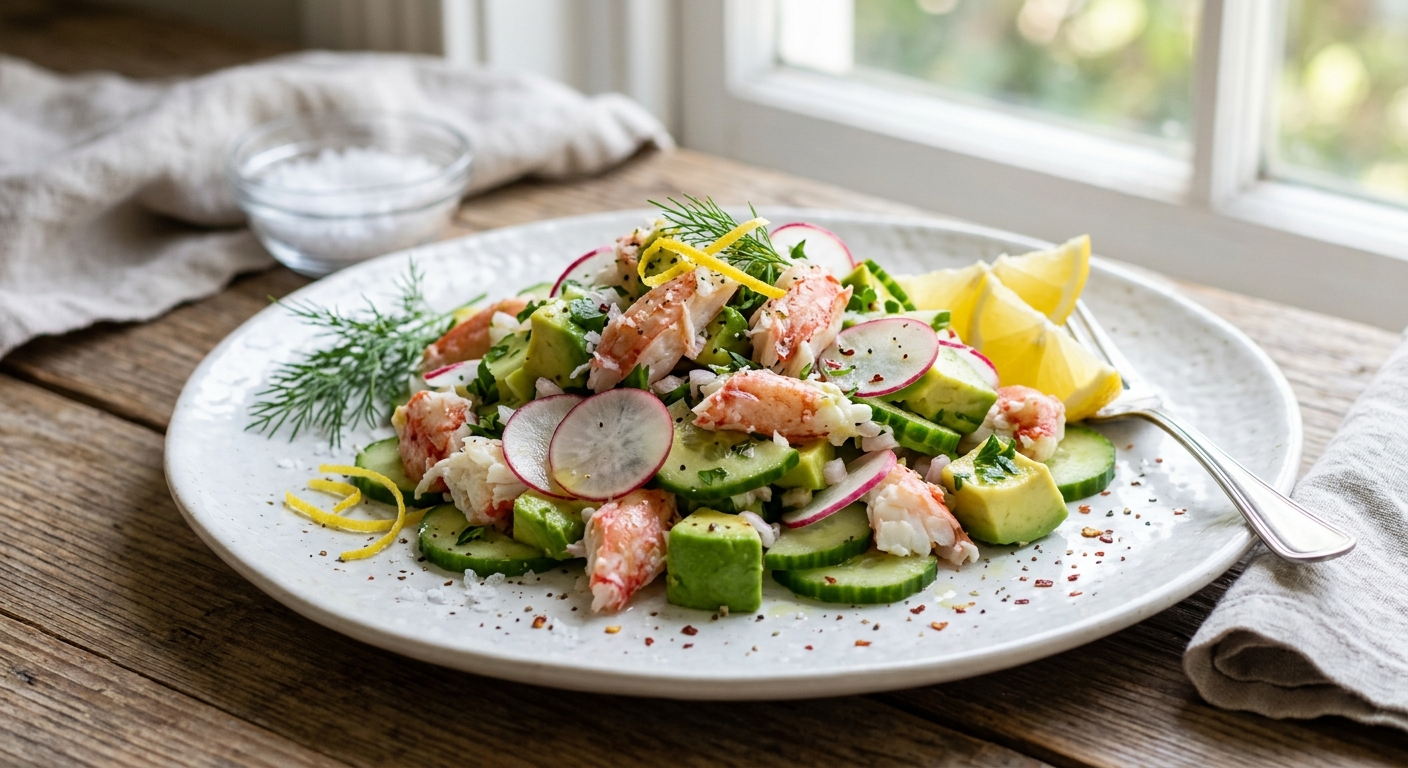
There is a reason crab and avocado appear together on menus from Tokyo to Paris: the combination is almost alchemically perfect. Sweet, oceanic crab meat finds its ideal counterpart in buttery avocado, and the pairing happens to be one of the most nutritionally synergistic in the seafood world. The fat in avocado dramatically improves the absorption of fat-soluble carotenoids from the vegetables in this salad, while crab contributes a complete amino acid profile that rivals chicken breast, gram for gram.
At Calibrated Cuisine, we built this recipe around 200 grams of fresh cooked lump crab meat per serving, hitting 28 grams of protein while keeping calories at a refined 380 per plate. The dressing is a simple shallot, lemon juice, and extra-virgin olive oil vinaigrette that lifts every ingredient without overwhelming the delicate sweetness of the crab. Radishes and English cucumber add crunch and hydration, while fresh tarragon and chives bring an elegant herbaceous note that makes this feel like a restaurant-quality first course or a satisfying weekday lunch.
We have included stovetop (for cooking live or raw crab), a slow cooker method (a surprisingly effective technique for gently poaching whole crab clusters in seasoned broth), and a pressure cooker method that produces perfectly cooked crab in a fraction of the time. Each method yields tender, juicy meat ready to be folded into the salad. The assembly steps are identical regardless of cooking method, so once your crab is cooked and chilled, the rest takes under 15 minutes.
4
servings
Ingredients
- 800 graw whole Dungeness or blue crab clusters (yielding approximately 400g picked meat), rinsed
- 2 largeripe Hass avocados, halved, pitted, and cut into 1.5cm cubes
- 1 largeEnglish cucumber (approximately 300g), halved lengthwise and sliced 0.5cm thick
- 6 mediumradishes, trimmed and thinly sliced
- 2 mediumshallots, finely minced
- 3 tbspfresh lemon juice (from approximately 1.5 lemons)
- 1 tsplemon zest, finely grated
- 3 tbspextra-virgin olive oil
- 1 tspDijon mustard
- 1 tsphoney
- 2 tbspfresh tarragon leaves, roughly torn
- 3 tbspfresh chives, finely snipped
- 1 tbspcapers, rinsed and roughly chopped
- 4 cupswater (for stovetop poaching liquid)
- 1 cupdry white wine (for stovetop and pressure cooker poaching)
- 1 mediumlemon, sliced into rounds (for poaching liquid)
- 2 clovesgarlic, smashed (for poaching liquid)
- 1 tspwhole black peppercorns (for poaching liquid)
- 2 sprigsfresh thyme (for poaching liquid)
- 4 cupsseafood or vegetable broth, low-sodium (for slow cooker method)
- —Colima Sea SaltMicroplastic Free Salt and freshly cracked black pepper to taste
- —4 butter lettuce leaves or endive spears, for serving (optional)
Instructions
Click on an item below to shop for the recommended items for this recipe on Amazon.
As an Amazon Associate, we earn from qualifying purchases.
- Fill a large, wide stockpot or Dutch oven with 4 cups cold water, 1 cup dry white wine, the lemon rounds, smashed garlic, peppercorns, thyme sprigs, and 1 teaspoon fine sea salt. Bring to a rolling boil over high heat, then reduce to a steady simmer and cook the court-bouillon uncovered for 5 minutes to develop the aromatic base.
- Add the rinsed crab clusters to the simmering court-bouillon, arranging them in a single layer as best you can. If your pot is small, work in two batches. Cover with a tight-fitting lid, return to a boil, then reduce heat to medium and cook for 12 to 15 minutes, or until the shells are deep orange-red and the meat inside pulls away cleanly from the shell when tested with a fork.
- Using tongs, transfer the cooked crab clusters to a large rimmed baking sheet or colander set over the sink. Discard the poaching liquid. Allow the crab to cool at room temperature for 10 minutes, then transfer to the refrigerator uncovered for at least 20 minutes until completely cold. Do not place hot crab directly onto the avocado, as heat will brown it.
- While the crab chills, prepare the vinaigrette: in a small bowl, combine the minced shallots, fresh lemon juice, lemon zest, Dijon mustard, and honey. Whisk vigorously, then slowly drizzle in the olive oil while whisking continuously to form a stable emulsion. Season with salt and black pepper, taste, and adjust acidity with a few extra drops of lemon juice if desired. Set aside at room temperature.
- Once the crab is fully chilled, pick the meat carefully from the shells, working over a clean bowl. Use your fingers and a seafood pick or a sturdy fork to extract the lump meat from the body cavities and the claw meat from the claws. Discard all shell fragments and cartilage. You should have approximately 400g of picked crab meat.
- In a large mixing bowl, gently combine the picked crab meat, cubed avocado, cucumber slices, radishes, capers, tarragon, and chives. Pour two-thirds of the vinaigrette over the salad and fold together with a large spoon using slow, sweeping motions, being careful not to mash the avocado or break up the crab lumps. Taste and add more dressing, salt, or pepper as needed. Serve immediately in chilled bowls or over butter lettuce leaves, with the remaining dressing alongside.
- Pour the 4 cups of low-sodium seafood or vegetable broth into the insert of your slow cooker. Add the lemon rounds, smashed garlic, peppercorns, thyme sprigs, and half a teaspoon of fine sea salt. Stir briefly to combine. Set the slow cooker to Low and allow the liquid to warm for 20 minutes with the lid on before adding the crab. This pre-warming step ensures even cooking from the start rather than a slow temperature climb that can make the outer meat mushy before the interior is done.
- Arrange the rinsed crab clusters in the slow cooker insert, nestling them into the warm broth. The clusters should be at least partially submerged. If your slow cooker is small, stack the clusters carefully, rotating them at the halfway point. Place the lid firmly on the slow cooker and cook on Low for 2 hours. Unlike stovetop cooking, do not open the lid more than once during cooking, as each lid lift drops the internal temperature significantly.
- At the 1-hour mark, open the lid briefly and use tongs to rotate any clusters that were on top to the bottom, ensuring even exposure to the warm broth. Replace the lid immediately and continue cooking for the remaining hour.
- After 2 hours, the shells should be uniformly orange-red and fragrant. Use tongs to transfer the crab clusters to a large rimmed baking sheet. The broth can be strained and reserved as a flavorful soup base. Allow the crab to rest for 10 minutes at room temperature, then refrigerate uncovered for at least 25 minutes until thoroughly cold.
- While the crab chills, make the vinaigrette by whisking together the minced shallots, lemon juice, lemon zest, Dijon mustard, and honey in a small bowl. Stream in the olive oil while whisking to emulsify. Season with salt and pepper. Pick the chilled crab meat carefully from the shells, discarding all fragments. Fold the crab gently with the avocado, cucumber, radishes, capers, tarragon, and chives in a large bowl. Dress with two-thirds of the vinaigrette, folding carefully to preserve the avocado texture. Serve immediately over butter lettuce or endive spears.
- Pour 1 cup of cold water and 1 cup of dry white wine into the inner pot of your pressure cooker or Instant Pot. Add the smashed garlic, peppercorns, thyme sprigs, and lemon rounds directly to the liquid. Place a metal trivet or steamer basket into the pot, ensuring it sits above the liquid level. This steaming approach, rather than full submersion, produces firmer, sweeter meat with less waterlogging than boiling.
- Arrange the rinsed crab clusters on the trivet or in the steamer basket, stacking if necessary. Secure the lid and set the steam release valve to the Sealing position. Select the Steam or Manual function and set to High Pressure for 4 minutes. Note that the pot will take approximately 8 to 10 minutes to come to full pressure before the countdown begins.
- When the 4-minute cook time is complete, immediately perform a Quick Release by carefully turning the steam release valve to Venting. Stand back from the steam. Once the float valve drops and pressure has fully released (about 2 to 3 minutes), carefully open the lid away from you.
- The crab shells should be a vivid orange-red and intensely fragrant. Using tongs, transfer the clusters immediately to a large rimmed baking sheet and spread them out to cool quickly. The pressure cooker environment retains more heat in the meat, so chilling is especially important: refrigerate for at least 20 minutes before picking.
- Make the vinaigrette while the crab chills: whisk together shallots, lemon juice, lemon zest, Dijon mustard, and honey, then stream in olive oil to emulsify. Season with salt and pepper. Once cold, pick all the meat from the shells carefully, discarding cartilage and shell fragments. Combine the crab meat, avocado cubes, cucumber, radishes, capers, tarragon, and chives in a large bowl. Drizzle with two-thirds of the vinaigrette and fold gently with wide, careful strokes to keep the avocado and crab lumps intact. Taste, adjust seasoning, and serve immediately.
Nutrition Breakdown
Per 1 serving (makes 4)
Vitamins & Minerals
% Daily Value based on a 2,000 calorie diet (FDA reference)
🧬 Essential Amino Acids
% of recommended daily intake (RDA) per serving
🛡 Antioxidant Profile
The Nutrition Science
Crab meat is one of the most micronutrient-dense proteins available, providing exceptional concentrations of vitamin B12, zinc, copper, and selenium in a lean, low-fat package. A single 100-gram serving of cooked Dungeness crab provides over 400% of the daily value for vitamin B12, a nutrient critical for myelin synthesis, red blood cell formation, and neurological function. It also delivers roughly 50% of the daily value for selenium, which acts as a cofactor for the glutathione peroxidase family of antioxidant enzymes, making crab a rare dietary source of this often-overlooked trace mineral. The complete essential amino acid profile of crab, with a PDCAAS (Protein Digestibility Corrected Amino Acid Score) approaching 1.0, makes it comparable to egg white in protein quality.
Avocado’s contribution to this dish is greater than flavor alone. The monounsaturated fat in avocado, primarily oleic acid at approximately 9 to 10 grams per half fruit, has been shown in multiple randomized controlled trials to favorably shift LDL particle size from small, dense (atherogenic) to large, buoyant (less atherogenic), while raising HDL cholesterol. More importantly for this recipe, the lipid matrix of avocado dramatically enhances the bioavailability of carotenoids present in the accompanying vegetables. A landmark 2005 study published in the Journal of Nutrition demonstrated that adding avocado to a salad increased alpha-carotene absorption by 7.2-fold and lutein absorption by 5.1-fold compared to a fat-free version of the same salad. The olive oil in the vinaigrette provides additional fat-soluble carotenoid transport.
The lemon juice in the dressing contributes more than acidity. Its vitamin C content plays a direct biochemical role by reducing inorganic non-heme iron (found in the vegetables and herbs) from its ferric Fe3+ state to its more absorbable ferrous Fe2+ form, improving iron uptake by up to 3-fold. The capers are a small but meaningful source of quercetin, one of the most studied anti-inflammatory flavonoids in the human diet, with documented inhibition of pro-inflammatory cyclooxygenase and lipoxygenase pathways. Together, these ingredients do not merely coexist on the plate. They actively enhance each other’s bioavailability and function.
Pro Tips
- For the freshest possible flavour, ask your fishmonger to cook whole live crab to order and chill it for you, then skip the cooking step entirely and go straight to picking the meat. Pre-cooked and chilled whole crab from a reputable fishmonger produces a noticeably superior result compared to tinned crab meat.
- To prevent avocado browning if assembling ahead, toss the avocado cubes in a teaspoon of lemon juice before adding them to the salad, and press plastic wrap directly onto the surface of any leftover salad in the bowl. The salad is best eaten within 2 hours of assembly.
- If whole crab clusters are unavailable, substitute 400g of high-quality lump crab meat from a refrigerated tub (not tinned). Drain it well, gently press it dry with paper towels, and skip all cooking steps. The prep time drops to under 15 minutes total.
This is hitting right where I need it to be. I’ve had similar wins with seafood / healthy fat combinations over the past two years on my protocol, especially when my inflammatory markers started creeping up again last year. My practitioner emphasized that the amino acid profile in crab combined with the polyphenols you’re likely getting from quality citrus (assuming fresh squeezed?) creates a synergistic effect that’s hard to replicate with other proteins. Quick question though: are you sourcing the crab from specific regions, or do you have thoughts on frozen vs. fresh for bioavailability? My last labs showed a nice dip in hs-CRP when I was more intentional about seafood sour
This is a smart pairing from an omega-3 perspective. Crab delivers EPA and DHA (especially if you’re using wild-caught), while avocado’s oleic acid and polyphenols work synergistically to support that inflammatory response you’re both noticing. The citrus dressing is doing real work too – vitamin C helps with collagen synthesis around arterial walls, and the acidity improves mineral bioavailability. I’ve seen patients’ hs-CRP drop measurably when they shift toward seafood plus whole-food fat sources rather than seed oil heavy salads. This hits differently than it looks.
This is exactly what I’ve been looking for, honestly. Crab is such a clean protein source and I love that you’re pairing it with avocado for the monounsaturated fats, which I’ve found really helps with neuroinflammation markers in my own protocol. The citrus is a nice touch too, since vitamin C helps with absorption. I’m assuming you’re using fresh lemon or lime juice? I’d be curious if you have thoughts on the best type of crab to source for maximum omega-3 content, or if you’ve tested any substitutions that hold the same nutritional profile. Thank you for making something this nutritionally dense feel so approachable and quick.